I now have comprehensive data to provide a thorough answer. Let me compile it all.
Antibiotic Classes: Classification, Mechanism, and Clinical Use
Antibiotics are organized primarily by their mechanism of action (what they target in bacteria). Below is a complete, structured reference.
1. Cell Wall Synthesis Inhibitors
Beta-Lactams
Penicillins (Bactericidal)
| Drug | Spectrum | Prescribed For |
|---|
| Penicillin G, Penicillin V | GP cocci & rods, GN cocci, most anaerobes | Strep throat, syphilis, dental infections, rheumatic fever prophylaxis |
| Ampicillin, Amoxicillin | Broader: adds Enterococcus, Listeria, Haemophilus | UTIs, otitis media, sinusitis, Listeria meningitis |
| Nafcillin, Oxacillin, Dicloxacillin | Antistaphylococcal (MSSA only) | Skin/soft tissue infections, staphylococcal bacteremia |
| Piperacillin + Tazobactam | Very broad - GP, GN, Pseudomonas, anaerobes | Hospital-acquired pneumonia, intra-abdominal infections, febrile neutropenia |
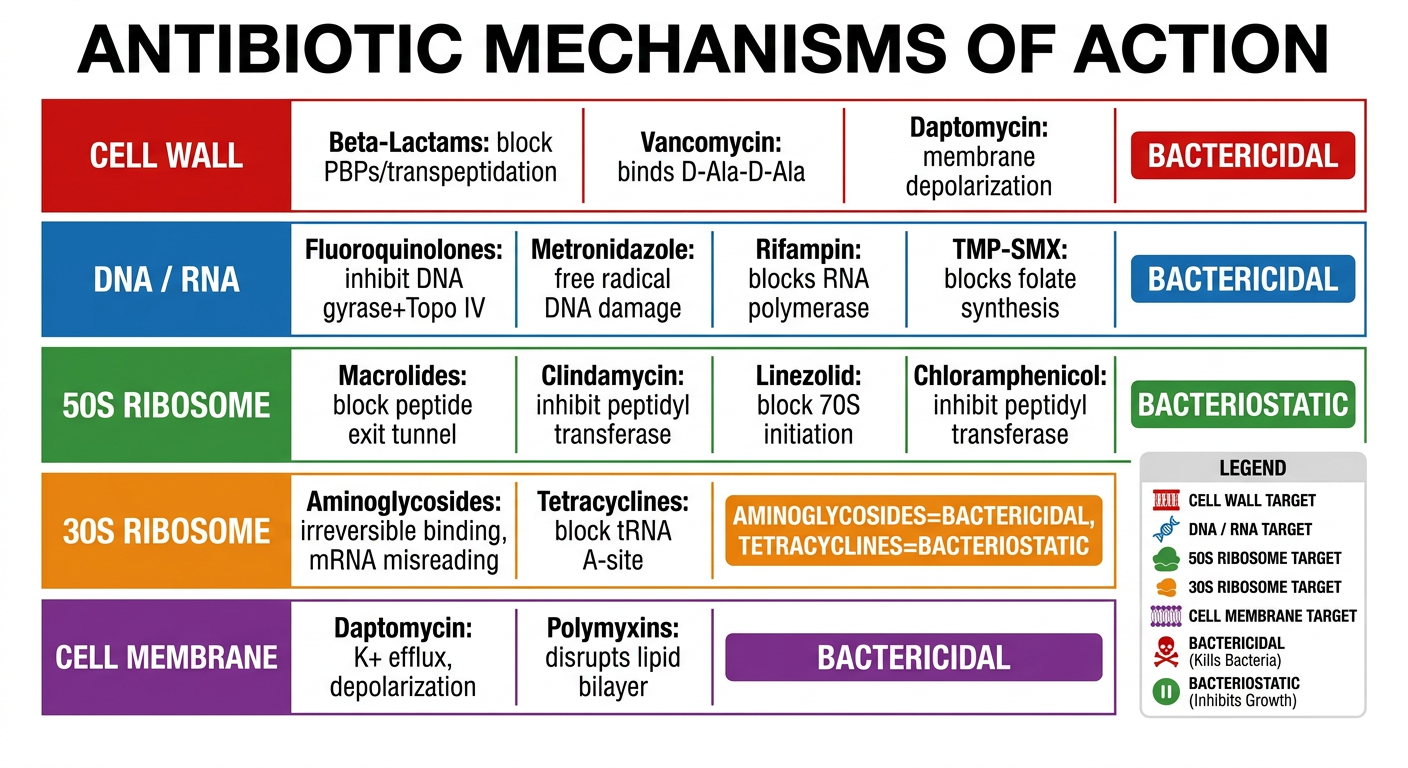
Mechanism: Bind to penicillin-binding proteins (PBPs) - inhibit transpeptidation of the bacterial cell wall, causing cell lysis.
Side effects: Hypersensitivity reactions (anaphylaxis), GI upset, interstitial nephritis.
Cephalosporins (Bactericidal)
Organized by generation:
| Generation | Example Drugs | Spectrum | Prescribed For |
|---|
| 1st Gen | Cefazolin, Cephalexin | GP cocci (MSSA), basic GN | Surgical prophylaxis, skin infections, UTIs |
| 2nd Gen | Cefuroxime, Cefoxitin | Better GN, adds anaerobes (cefoxitin) | Otitis media, sinusitis, community-acquired pneumonia, pelvic infections |
| 3rd Gen | Ceftriaxone, Cefotaxime, Ceftazidime | Broader GN, CNS penetration | Meningitis, pneumonia, gonorrhea, Lyme disease |
| 4th Gen | Cefepime | GP + broad GN including Pseudomonas | Hospital/ventilator-associated pneumonia, febrile neutropenia |
| 5th Gen | Ceftaroline | Includes MRSA | MRSA skin infections, community-acquired pneumonia |
Mechanism: Same as penicillins - bind PBPs, inhibit cell wall synthesis.
Carbapenems (Bactericidal)
| Drug | Spectrum | Prescribed For |
|---|
| Imipenem, Meropenem | Broadest spectrum - GP, GN, Pseudomonas, anaerobes | Multi-drug resistant infections, serious hospital-acquired infections |
| Ertapenem | GP + GN, NOT Pseudomonas | Community-acquired intra-abdominal infections |
Side effects: Imipenem lowers seizure threshold.
Monobactams
| Drug | Spectrum | Prescribed For |
|---|
| Aztreonam | GN only (Gram-negative aerobic bacilli) | Alternative in penicillin-allergic patients with GN infections |
Glycopeptides (Bactericidal)
| Drug | Spectrum | Prescribed For |
|---|
| Vancomycin | GP only: MRSA, Enterococcus | MRSA infections, C. difficile (oral), line infections |
| Teicoplanin | GP | Similar to vancomycin |
Mechanism: Bind to D-Ala-D-Ala terminus of cell wall precursors - block transglycosylation.
Side effects: "Red man syndrome" (rate-related infusion reaction), nephrotoxicity, ototoxicity.
Other Cell Wall Inhibitors
| Drug | Class | Spectrum | Prescribed For |
|---|
| Daptomycin | Lipopeptide | GP including MRSA, VRE | MRSA bacteremia, endocarditis, skin infections - NOT for pneumonia (inactivated by surfactant) |
| Fosfomycin | Phosphonic acid | GP + GN | UTIs (especially E. coli, ESBL organisms) |
| Bacitracin | Polypeptide | GP | Topical use only - wound/skin infections |
2. DNA Synthesis Inhibitors
Fluoroquinolones (Bactericidal)
Mechanism: Inhibit DNA gyrase and topoisomerase IV - cause DNA strand breakage.
| Drug | Spectrum | Prescribed For |
|---|
| Ciprofloxacin | GN bacilli, Pseudomonas, atypicals; limited GP, no anaerobes | UTIs, GI infections, anthrax, prostatitis |
| Levofloxacin | Broader - adds Streptococcus pneumoniae | Community/hospital-acquired pneumonia, sinusitis, UTIs |
| Moxifloxacin | Broadest - adds anaerobes; no Pseudomonas | CAP, skin infections, intra-abdominal |
Side effects: QTc prolongation, tendon rupture (especially Achilles), cartilage damage (avoid in children and pregnancy), CNS effects.
Nitroimidazoles (Bactericidal)
| Drug | Spectrum | Prescribed For |
|---|
| Metronidazole | Anaerobes, protozoa | C. difficile, intra-abdominal infections, bacterial vaginosis, amoebiasis, Giardia, Trichomonas |
| Tinidazole | Similar | Similar to metronidazole, better tolerated |
Trimethoprim-Sulfamethoxazole (TMP-SMX)
Mechanism: TMP inhibits dihydrofolate reductase; SMX inhibits conversion of PABA to dihydropteroic acid - sequential blockade of folate synthesis.
Spectrum: Broad - GP including CA-MRSA, GN
Prescribed for: UTIs, Pneumocystis jirovecii pneumonia (PCP), CA-MRSA skin infections, Toxoplasma prophylaxis, nocardiosis.
Side effects: Stevens-Johnson syndrome, bone marrow suppression, hyperkalemia, increases warfarin levels.
Nitrofurantoin
Mechanism: Damages bacterial DNA after reduction by nitrofuran reductase.
Spectrum: Lower urinary tract pathogens (E. coli, Enterococcus) - NOT useful above the bladder.
Prescribed for: Uncomplicated UTIs, long-term UTI prophylaxis. Avoid in renal failure and last trimester of pregnancy.
3. RNA Synthesis Inhibitors
Rifamycins (Bactericidal)
| Drug | Spectrum | Prescribed For |
|---|
| Rifampin (Rifampicin) | Broad - GP, GN, Pseudomonas, M. tuberculosis | TB (always combined), MAC, meningococcal prophylaxis, Staphylococcal biofilm infections |
| Rifaximin | Gut-confined | C. difficile (recurrent), traveler's diarrhea, hepatic encephalopathy |
Mechanism: Bind to and block bacterial RNA polymerase - prevent RNA transcription.
Side effects: Orange/red discoloration of body fluids, powerful CYP450 inducer (many drug interactions), hepatotoxicity.
4. Ribosome 50S Inhibitors (Bacteriostatic)
Macrolides
Mechanism: Irreversibly bind 50S ribosomal subunit - inhibit protein synthesis (prevent peptide chain elongation).
Spectrum: Broad - Streptococcus, Corynebacterium, Chlamydia, Legionella, Moraxella, H. pylori, atypicals.
| Drug | Notes | Prescribed For |
|---|
| Erythromycin | Increases GI motility | Strep throat (PCN allergy), Chlamydia, Legionella |
| Clarithromycin | Adjust in renal failure | CAP, H. pylori eradication (triple therapy), MAC |
| Azithromycin | Long tissue half-life (3 days), once-daily dosing | CAP, Chlamydia (single 1g dose), MAC prophylaxis in HIV |
Side effects: QTc prolongation, hepatotoxicity, GI upset, drug interactions (erythromycin/clarithromycin via CYP3A4).
Lincosamides
| Drug | Spectrum | Prescribed For |
|---|
| Clindamycin | GP (MRSA, Streptococcus), anaerobes | MRSA skin/soft tissue, aspiration pneumonia, dental infections, PCP (with primaquine), toxic shock syndrome (with beta-lactam) |
Side effects: C. difficile colitis (classic association), diarrhea.
Chloramphenicol
Spectrum: Broad - GP, GN, anaerobes, rickettsiae
Prescribed for: Typhoid fever (resource-limited settings), meningitis caused by resistant organisms, rickettsial infections.
Side effects: Aplastic anemia (rare, idiosyncratic), gray baby syndrome (neonates), dose-dependent bone marrow suppression.
Oxazolidinones
| Drug | Spectrum | Prescribed For |
|---|
| Linezolid | GP including MRSA, VRE | MRSA pneumonia, VRE infections, drug-resistant TB |
Side effects: Thrombocytopenia, serotonin syndrome (MAO inhibitor), optic neuritis with prolonged use.
5. Ribosome 30S Inhibitors
Aminoglycosides (Bactericidal)
Mechanism: Bind irreversibly to 30S ribosomal subunit - inhibit protein synthesis and cause misreading of mRNA.
Spectrum: Aerobic GN bacilli - Pseudomonas, Klebsiella, Serratia, Proteus, Acinetobacter, Enterobacter.
| Drug | Notes | Prescribed For |
|---|
| Streptomycin | Most vestibulotoxic | TB (2nd line), plague, tularemia |
| Gentamicin | Synergy with beta-lactams for Enterococcus | Serious GN infections, Enterococcal endocarditis (with PCN) |
| Tobramycin | More active vs. Pseudomonas | Pseudomonal infections, CF (inhaled) |
| Amikacin | Most cochleotoxic; reserved for resistant organisms | MDR Pseudomonas and Acinetobacter |
Side effects: Ototoxicity (vestibular > cochlear, dose-dependent, irreversible), nephrotoxicity (reversible), neuromuscular blockade. Monitor drug levels and renal function.
Vestibulotoxicity order: Streptomycin > Gentamicin > Tobramycin > Amikacin (most cochleotoxic)
Tetracyclines (Bacteriostatic)
Mechanism: Reversibly bind 30S ribosomal subunit - inhibit aminoacyl-tRNA binding.
Spectrum: Very broad - GP (MSSA, MRSA), GN, protozoa, spirochetes, mycobacteria, atypicals.
| Drug | Prescribed For |
|---|
| Doxycycline | CAP (atypicals), MRSA skin infections, Lyme disease, chlamydia, rickettsia, brucellosis, malaria prophylaxis, acne |
| Tetracycline | H. pylori, acne, chlamydia |
| Minocycline | MRSA, acne, rosacea |
| Tigecycline (glycylcycline) | MDR organisms - reserved for ID specialist use |
Side effects: Photosensitivity, teeth discoloration (avoid in children < 8 years and pregnancy), hepatotoxicity, pseudotumor cerebri, Fanconi syndrome (expired medication).
Quick Reference Summary Table
| Class | Target | Bactericidal/Static | Key Organisms |
|---|
| Penicillins | Cell wall (PBP) | Cidal | GP cocci, some GN |
| Cephalosporins | Cell wall (PBP) | Cidal | GP + progressive GN by generation |
| Carbapenems | Cell wall (PBP) | Cidal | Broadest spectrum |
| Glycopeptides | Cell wall (D-Ala-D-Ala) | Cidal | GP only (MRSA) |
| Fluoroquinolones | DNA gyrase/Topo IV | Cidal | GN, atypicals |
| Metronidazole | DNA damage | Cidal | Anaerobes, protozoa |
| TMP-SMX | Folate synthesis | Cidal | GP, GN, PCP |
| Rifamycins | RNA polymerase | Cidal | Mycobacteria, GP |
| Macrolides | 50S ribosome | Static | GP, atypicals |
| Clindamycin | 50S ribosome | Static | GP, anaerobes |
| Linezolid | 50S ribosome | Static | MRSA, VRE |
| Aminoglycosides | 30S ribosome | Cidal | Aerobic GN bacilli |
| Tetracyclines | 30S ribosome | Static | Broad, atypicals |
| Daptomycin | Cell membrane | Cidal | GP (MRSA, VRE) |
Key abbreviations: GP = Gram-positive, GN = Gram-negative, MRSA = methicillin-resistant S. aureus, VRE = vancomycin-resistant Enterococcus, MDR = multi-drug resistant, CAP = community-acquired pneumonia, MAC = Mycobacterium avium complex, PCP = Pneumocystis jirovecii pneumonia.
Sources: K J Lee's Essential Otolaryngology; Katzung's Basic and Clinical Pharmacology, 16th Ed.