
Write a five mark short note on complication of thyroidectomy Make it compatible, compact but high yielding. So that... I can easily remember and, uh, write it in a... Systematic way being a 2nd year resident.
Complications of Thyroidectomy
Classification
I. Immediate (Intraoperative / Within 24 hrs)
1. Haemorrhage / Neck Haematoma
- Incidence: ~1%
- Most dangerous complication - can cause airway compromise by venous congestion and tracheal compression
- Mx: Immediately open the wound at bedside (do NOT wait for OT) to relieve airway compression, then take to OT for formal exploration
- Fischer's Mastery of Surgery
2. Airway Injury / Tracheomalacia
- Seen with long-standing large goiters - tracheal rings weakened by chronic pressure
- Can collapse after gland removal
- Risk of pneumothorax during substernal goitre resection
- Barash Clinical Anesthesia, 9e
II. Early (24 hrs - 1 week)
3. Hypocalcemia / Hypoparathyroidism ⭐ (Most Common)
- Due to: inadvertent removal, devascularization, or manipulation of parathyroid glands
- Symptoms appear 24-96 hrs post-op
- Features: perioral tingling, carpopedal spasm, tetany, laryngospasm (can be first sign), Chvostek's sign, Trousseau's sign
- Transient: 1-30% (most recover within 1 month)
- Permanent: ~2% (high-volume centres)
- Highest risk: total thyroidectomy + central neck dissection
- Hungry Bone Syndrome: severe/prolonged hypocalcaemia in hyperthyroid patients post-op (despite normal PTH) - also low Mg, low PO₄, high K
- Mx: IV calcium gluconate (acute); oral calcium + Vit D (maintenance)
- Current Surgical Therapy 14e; Fischer's Mastery; Barash
4. Recurrent Laryngeal Nerve (RLN) Injury ⭐ (Most Significant)
- Transient hoarseness: up to 80% (resolves in weeks-months)
- True RLN palsy: up to 10%; up to 30% in re-operative setting
- Permanent: ~1-2% with experienced surgeons
- Unilateral: hoarseness, weak voice, bovine cough
- Bilateral: stridor, dyspnoea, aphonia - requires immediate reintubation / tracheostomy
- Palsy lasting >6 months = likely permanent (may take up to 2 years to resolve)
- Prevention: direct visualisation + Intraoperative Nerve Monitoring (IONM)
- Fischer's Mastery; Current Surgical Therapy 14e; Barash
5. Superior Laryngeal Nerve (External Branch - EBSLN) Injury
- Results in loss of cricothyroid muscle function
- Features: inability to hit high notes, change in voice pitch, loss of voice projection
- Often subtle; significant for singers and voice professionals
- Sabiston Textbook of Surgery
III. Late Complications
6. Hypothyroidism
- Inevitable after total thyroidectomy - requires lifelong levothyroxine
- Can occur in up to 30-50% after subtotal thyroidectomy
- Fischer's Mastery; Washington Manual
7. Thyroid Storm (Thyrotoxic Crisis)
- Rare (~1-5% of hospitalised thyrotoxic patients), mortality up to 25%
- Triggered by: surgery in a non-euthyroid patient, cessation of ATD, acute stress
- Burch-Wartofsky scoring system for diagnosis
- Prevention: ensure biochemically euthyroid before surgery (ATDs ± beta-blockers ± Lugol's iodine for Graves')
- Current Surgical Therapy 14e
8. Wound Complications
- Infection, keloid scar, poor cosmesis
- Rare with transverse cervical incision placed in skin crease
Quick Recall Table
| Complication | Key Feature | Timing |
|---|---|---|
| Haematoma | Open wound at bedside | Immediate |
| Hypocalcemia | Tetany, 24-96 hrs | Early |
| RLN - Unilateral | Hoarseness | Early/Late |
| RLN - Bilateral | Stridor + emergency airway | Immediate |
| EBSLN | Loss of high pitch | Late |
| Hypothyroidism | After total thyroidectomy | Late |
| Thyroid Storm | Non-euthyroid at surgery | Perioperative |
Exam Tip Mnemonic: "H-H-R-S-T-W"
Haematoma - Hypocalcemia - RLN injury - SLN (external) - Thyroid storm - Wound/hypothyroidism
Create a high density, high yielding image based(generate image) Flashcard I can use Before exam to revise and remember all the important points regarding this short-note
Medical exam flashcard for "Complications of Thyroidectomy" — high density, high yield, dark background study card designed for a surgery resident. Layout: TOP HEADER: Bold title "COMPLICATIONS OF THYROIDECTOMY" in large white text on a deep navy/dark teal banner. Subtitle: "5-Mark High Yield Revision Card" in yellow. BODY divided into 3 columns on dark background (#1a1a2e): COLUMN 1 — IMMEDIATE: Section header in red box: "⚡ IMMEDIATE" • Haematoma (1%) - Venous congestion → airway compromise - ⚠️ OPEN WOUND AT BEDSIDE first - Then → OT for exploration • Tracheomalacia - Long-standing goitre - Ring collapse post-excision - Substernal goitre → Pneumothorax risk COLUMN 2 — EARLY (24h–1wk): Section header in orange box: "🕐 EARLY (24–96 hrs)" • Hypocalcaemia ⭐ MOST COMMON - Inadvertent parathyroid removal/devascularisation - Signs: Chvostek ✓, Trousseau ✓, tetany, laryngospasm - Transient: 1–30% | Permanent: ~2% - Hungry Bone Syndrome (hyperthyroid pts): ↓Ca ↓Mg ↓PO₄ - Mx: IV Ca-gluconate (acute) → oral Ca + Vit D • RLN Injury ⭐ MOST SIGNIFICANT - Transient hoarseness: up to 80% - Unilateral: hoarseness, bovine cough - Bilateral: STRIDOR + APHONIA → Emergency airway - Permanent: ~1–2% (experienced surgeon) - Re-op setting: up to 30% - >6 months = likely permanent • EBSLN Injury - Loss of high pitch / cricothyroid dysfunction - Important in singers COLUMN 3 — LATE / SPECIAL: Section header in purple box: "⏳ LATE / SPECIAL" • Hypothyroidism - Total thyroidectomy → lifelong T4 - Levothyroxine replacement • Thyroid Storm ☠️ - Mortality: up to 25% - Trigger: surgery in non-euthyroid patient - Burch-Wartofsky score - Prevention: euthyroid BEFORE surgery • Wound complications - Keloid, infection, poor scar BOTTOM SECTION — full width: Bright yellow box titled "MNEMONIC: H²-R-S-T-W" H = Haematoma | H = Hypocalcaemia | R = RLN injury | S = SLN (external) | T = Thyroid Storm | W = Wound/Hypothyroidism Mini table below mnemonic with 3 columns (Complication | Key Clue | Timing): Haematoma | Open wound at bedside | Immediate Hypocalcaemia | Tetany 24–96h | Early RLN Unilateral | Hoarseness | Early RLN Bilateral | Stridor → Emergency airway | Immediate EBSLN | High-pitch loss | Late Hypothyroidism | After total thyroidectomy | Late Thyroid Storm | Non-euthyroid at surgery | Periop FOOTER: small text "Sources: Current Surgical Therapy 14e • Sabiston • Fischer's Mastery • Barash" Style: Clean medical flashcard, dark mode (#1a1a2e background), white and yellow text, color-coded section headers (red/orange/purple), star emojis for high-yield points, warning symbols for emergencies, compact dense layout, professional medical typography.
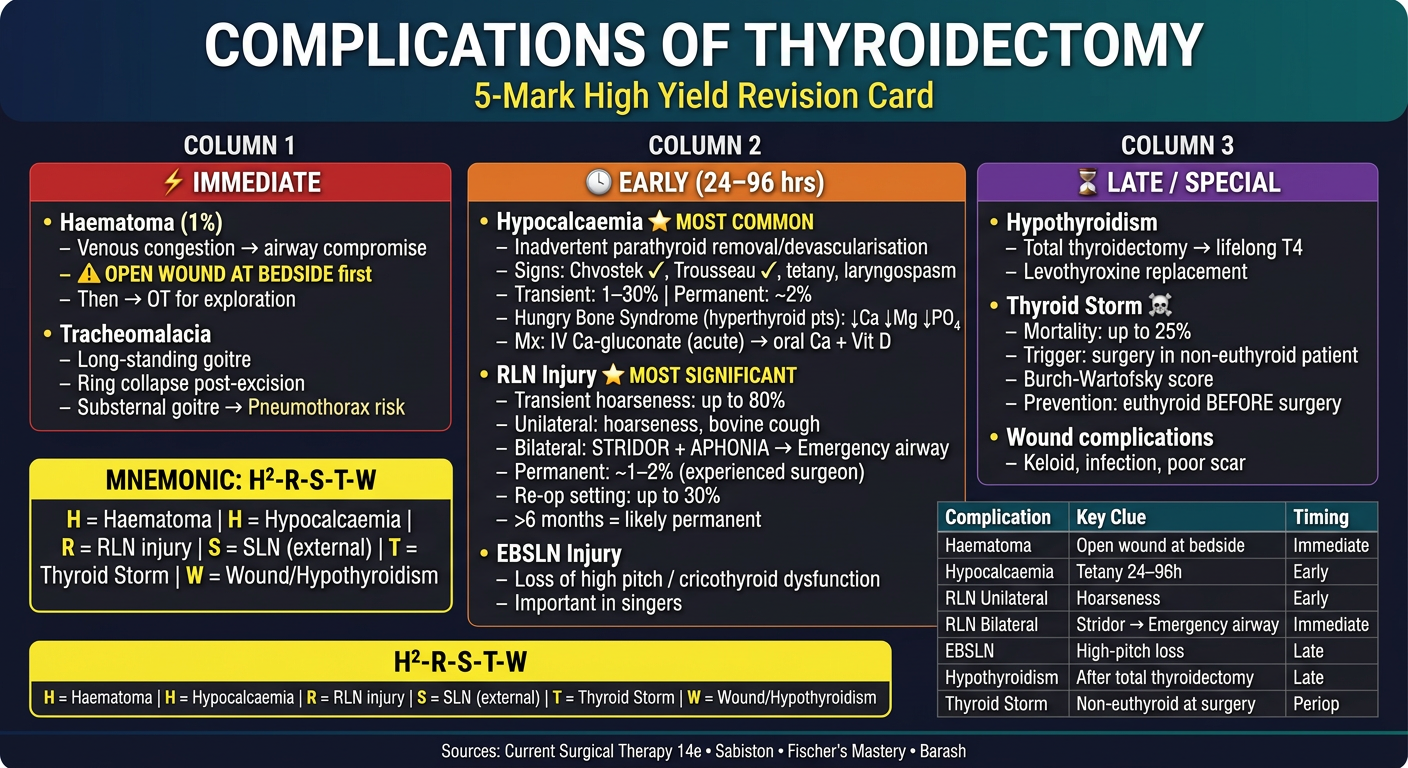
- Red flags: Haematoma = open neck at bedside (not in OT). Bilateral RLN = emergency airway. These are the classic exam traps.
- The two ⭐ stars = most common (Hypocalcaemia) and most significant (RLN injury) - examiners love these
- Hungry Bone Syndrome is a high-yield differentiator from simple hypoparathyroidism
- Thyroid Storm mortality (25%) and the Burch-Wartofsky score name are easy marks