
Treatment of congenital hydrocele
Reading File
Congenital hydrocele is a collection of fluid in the tunica vaginalis due to a patent processus vaginalis. In most infants it resolves spontaneously by age 1-2 years; surgical repair (herniotomy/ligation of the patent processus vaginalis) is indicated if it persists beyond 2 years or causes complications.
Searching sources...
Finding Sources
Searching PubMed
congenital hydrocele treatment management
Reading File
Reading File
Reading File
The Bailey & Love content is the most useful. Let me read the treatment/management section specifically:
Reading File
Finding Sources
Let me get the full treatment section from Bailey & Love and search for the pediatric surgery/congenital hydrocele treatment specifically:
Reading File
Finding Sources
Excellent - I have the key treatment content. Let me read the full treatment description and also the pediatric section from Campbell-Walsh:
Reading File
Reading File
Reading File
I now have comprehensive information from multiple authoritative textbooks. Let me also fetch the hydrocele types diagram:
Loading Image
Searching Images
congenital hydrocele patent processus vaginalis ligation herniotomy surgical repair
I now have all the information needed for a comprehensive answer. Here is the full treatment overview:
Treatment of Congenital Hydrocele
What is a Congenital Hydrocele?
A congenital (communicating) hydrocele occurs when the processus vaginalis - a peritoneal diverticulum that descends with the testis into the scrotum around the 28th week of gestation - fails to close. This persistent communication allows peritoneal fluid to flow freely into the tunica vaginalis surrounding the testis. Because the opening is usually too small to allow herniation of abdominal contents, it differs from an inguinal hernia, though both share the same underlying anatomical defect.
The diagram below (Bailey & Love's Surgery) shows the four structural types:
- (a) Vaginal (communicating/congenital) hydrocele - open processus throughout
- (b) Infantile hydrocele - proximal processus patent, distal closed
- (c) Hydrocele of the cord - only mid-portion patent
- (d) Closed non-communicating (vaginal) hydrocele
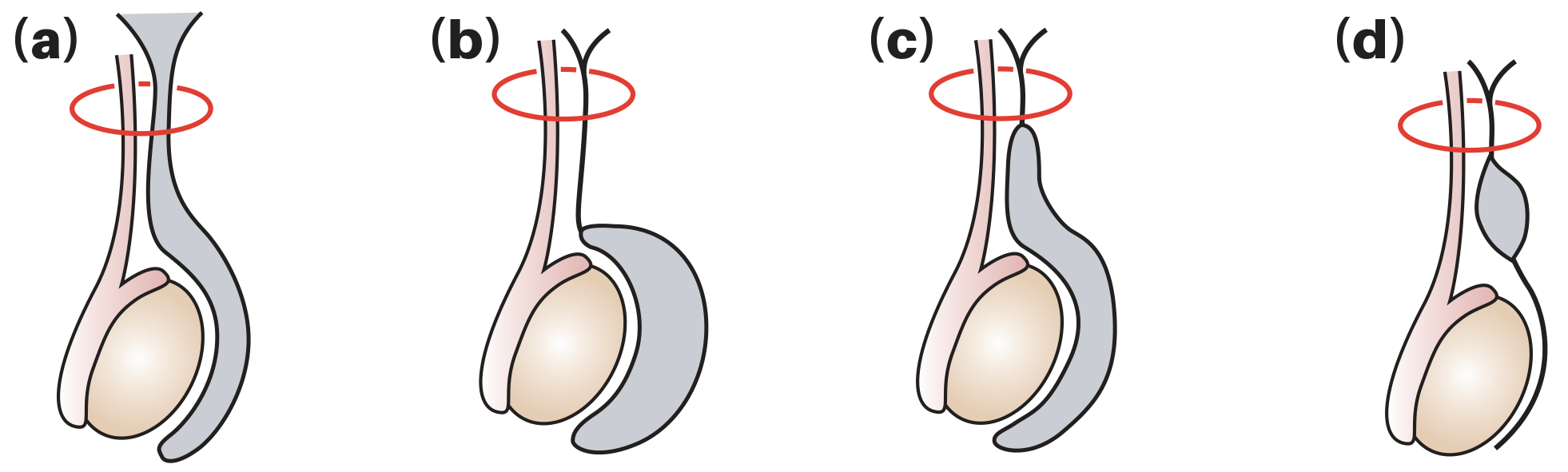
Key Points Before Treatment
- More than 80% of newborn boys have a patent processus vaginalis, but most close spontaneously within 18 months of age.
- A communicating hydrocele can be identified clinically by a history of enlargement with activity or in the evening, and reduction when supine (fluid drains back into the peritoneal cavity when lying down).
- The hydrocele may be intermittent; bilateral swellings in a child should prompt exclusion of ascites.
- Ultrasound is valuable in all cases to assess the testis and epididymis, particularly when they are impalpable within the hydrocele, and to exclude a secondary cause such as testicular tumour.
- If a tumour is suspected, the hydrocele must not be aspirated (risk of malignant needle-track implantation).
Treatment Principles
1. Conservative Management (Watchful Waiting)
The mainstay of initial management in infants under 2 years is observation.
"In the majority of infants, there is no indication for surgery within the first 24 months of age because they resolve spontaneously." - Campbell-Walsh-Wein Urology
Most congenital hydroceles close on their own as the processus vaginalis obliterates. Surgery is deferred unless:
- The hydrocele persists beyond 18-24 months of age
- It is associated with a symptomatic inguinal hernia (warrants earlier repair)
- There is rapid enlargement or concern for an underlying pathology
2. Surgical Treatment - Herniotomy (High Ligation of the Patent Processus Vaginalis)
When surgery is indicated, the definitive operation for congenital hydrocele is:
High ligation of the patent processus vaginalis - this is identical to the procedure performed for inguinal hernia repair in children (herniotomy).
"Congenital hydroceles are treated by ligation of the patent processus vaginalis (herniotomy) if they do not resolve spontaneously." - Bailey & Love's Surgery 28e
"The operation performed is high ligation of the patent processus vaginalis, the same procedure as that performed for inguinal hernia repair." - Campbell-Walsh-Wein Urology
Key surgical points:
- An inguinal (groin) incision is used to access and divide/ligate the processus at the internal ring - the "high" ligation.
- The distal sac (around the testis) is left open and widely divided rather than excised, to avoid creating a closed space in which fluid could reaccumulate.
- The operation is performed under general anaesthesia as a day-case procedure.
- If a scrotal hernia coexists with hydrocele, it is best to remove the hernia sac in its entirety whenever possible; if complete removal is not possible, the distal sac is opened widely and never tied off (tying off the distal sac creates a closed space and a new hydrocele).
3. Special Considerations by Age Group
| Age Group | Approach |
|---|---|
| Neonates/infants < 18-24 months | Watchful waiting; spontaneous resolution expected |
| Children > 2 years (persistent) | High ligation of processus vaginalis (herniotomy) |
| Associated with inguinal hernia | Prompt surgical repair regardless of age |
| Teenage boys (non-communicating) | Plication (Lord's procedure) or eversion (Jaboulay's procedure) of tunica vaginalis |
| Acute hydrocele with febrile illness | Observation; explore only if it persists |
| Bilateral hydroceles in infant | Exclude ascites before surgery |
4. Surgical Techniques for Acquired/Non-communicating Hydroceles (Relevant for Older Children and Adults)
If a non-communicating hydrocele develops in a teenage boy or older patient, a scrotal approach is used with one of three techniques:
-
Plication (Lord's operation) - best when the sac wall is thin. Multiple interrupted absorbable sutures gather and bunch the redundant tunica vaginalis at the testis margin. Minimal dissection; reduced risk of haematoma.
-
Eversion (Jaboulay's procedure) - the sac is opened and everted behind the testis, which is then placed in a fascial pouch. Risk of haematoma from cut edges is higher; overrunning sutures at the cut edge reduce this.
-
Excision - the sac wall is excised entirely; used when walls are thick (as in established acquired hydroceles). Highest risk of haematoma.
5. Aspiration and Sclerotherapy (Not for Children)
- Aspiration is simple but the fluid almost always reaccumulates within a week. It is only suitable for men unfit for surgery.
- Sclerotherapy (injection of agents such as tetracycline) can be effective but is painful and is not used in the paediatric setting.
Summary of Management Algorithm
Congenital hydrocele diagnosed in infant
          ↓
     Age < 18-24 months?
    /                  \
  Yes                   No (or associated hernia)
   ↓                          ↓
Watchful waiting       High ligation of patent
                       processus vaginalis
                       (inguinal herniotomy)
          ↓
  Persists beyond 24 months?
          ↓
  Surgical repair indicated
References:
- Bailey & Love's Short Practice of Surgery, 28th Ed., pp. 1586-1587 (Hydrocele: Treatment)
- Campbell-Walsh-Wein Urology, 12th Ed., Chapter on Scrotal Mass (Hernia and Hydrocele in Children)
- 2025 systematic review on global prevalence: Salari et al., BMC Pediatrics 2025 (PMID 39987032) - found resolution rates support conservative management in infants
Hydrocele types
Hydroceles are classified by anatomy (site of patent processus) and by aetiology (congenital vs acquired). The main structural types are: vaginal hydrocele, infantile hydrocele, congenital (communicating) hydrocele, and hydrocele of the cord.
Searching sources...
Reading File
Finding Sources
I have all the information needed. The diagram is the same one retrieved last time, so I can compose the answer directly.
Types of Hydrocele
Hydroceles are classified in two overlapping ways: structurally (based on the anatomy of the processus vaginalis) and aetiologically (based on cause).
Structural / Anatomical Classification
The processus vaginalis is a peritoneal diverticulum that descends with the testis into the scrotum around the 28th week of gestation and normally obliterates through infancy. The pattern of obliteration - or failure to do so - determines the type of hydrocele.
Type 1 - Vaginal (Non-communicating) Hydrocele
(Figure a in diagram)
- The processus vaginalis is fully closed; there is no communication with the peritoneal cavity.
- Fluid accumulates within the tunica vaginalis due to excessive production or defective absorption by the tunica, usually from disruption to lymphatic drainage.
- If idiopathic, it is called a primary hydrocele - this is the most common type globally, typically seen in middle-aged and older men.
- Secondary non-communicating hydroceles are caused by local injury, infection, torsion, neoplasm, or radiotherapy.
Type 2 - Communicating (Congenital) Hydrocele
(Figure c in diagram)
- The processus vaginalis remains fully patent from the peritoneal cavity down to the tunica vaginalis.
- Peritoneal fluid flows freely into the scrotum; the hydrocele is intermittent - enlarges when upright/active, reduces when supine.
- Associated with indirect inguinal hernias (same anatomical defect, just larger opening).
- Seen predominantly in infants and young children.
- The opening is usually too small to allow herniation of abdominal contents.
Type 3 - Infantile Hydrocele
(Figure b in diagram)
- The distal end of the processus vaginalis closes correctly, but the mid-portion and proximal end remain patent and communicate with the tunica vaginalis.
- Fluid fills the whole cord from the internal ring down to and including the tunica vaginalis around the testis.
- The processus is closed above the internal ring (does not communicate with the peritoneal cavity).
Type 4 - Hydrocele of the Cord (Encysted Hydrocele of the Cord)
(Figure d in diagram)
- The mid-portion only of the processus vaginalis remains patent; both ends are closed (the proximal peritoneal end and the distal tunica vaginalis end are obliterated).
- Results in an isolated cystic swelling along the spermatic cord, separate from the testis.
- Clinically: a smooth, oval swelling above the testis that moves downward and becomes less mobile when the testis is pulled gently downward.
- Can be mistaken for an inguinal hernia.
- The equivalent in females is the hydrocele of the canal of Nuck (related to the round ligament, partially within the inguinal canal).
Aetiological Classification
| Type | Features |
|---|---|
| Primary (idiopathic) | No identifiable underlying cause; most are non-communicating vaginal hydroceles; common in adults |
| Congenital | Patent processus vaginalis; seen in neonates and infants; spontaneously resolves in most by 18-24 months |
| Secondary (acquired) | Due to local pathology - trauma, torsion, epididymo-orchitis, filariasis, testicular tumour, radiotherapy; usually men >40 years |
Secondary Hydrocele - Common Causes
- Infection: Epididymo-orchitis, filariasis (Wuchereria bancrofti - accounts for up to 80% of hydroceles in tropical countries, and can produce chylocele if a lymphatic varix ruptures into the sac)
- Trauma/Torsion: Acute presentation
- Neoplasm: Testicular tumour - must be excluded in any young man with an acute hydrocele; do NOT aspirate if malignancy suspected
- Iatrogenic: Post-varicocelectomy (from lymphatic obstruction); post-inguinal hernia repair
Quick Reference Summary
| Type | Processus vaginalis | Communication with peritoneum | Location of fluid | Age group |
|---|---|---|---|---|
| Vaginal (non-communicating) | Fully closed | No | Tunica vaginalis only | Adults |
| Communicating (congenital) | Fully patent | Yes | Tunica vaginalis (varies) | Infants/children |
| Infantile | Mid + proximal patent, distal closed | No (proximal closed) | Along cord + tunica vaginalis | Infants |
| Hydrocele of cord | Mid-portion only patent | No (both ends closed) | Isolated cord swelling | Any age |
Source: Bailey & Love's Short Practice of Surgery 28th Edition, pp. 1585-1587
This is a shared conversation. Sign in to Orris to start your own chat.