Define psychology

Psychology is the scientific study of the mind and behavior. It examines how people think, feel, perceive, learn, remember, and act - both as individuals and in social groups. The field spans a wide range, from biological processes in the brain to cultural influences on behavior, and covers both normal functioning and mental disorders.
Key branches include clinical psychology (assessment and treatment of mental health), cognitive psychology (mental processes like memory and reasoning), developmental psychology (how people change across the lifespan), social psychology (how people influence each other), and neuropsychology (brain-behavior relationships).
Psychology sits at the intersection of natural science, social science, and humanities - drawing on biology, philosophy, medicine, and sociology to understand what makes us think and behave the way we do.

What are the main schools of psychological thought?

Here are the main schools of psychological thought, roughly in historical order:

1. Structuralism (1870s-1900s)

Key figure: Wilhelm Wundt, Edward Titchener The first formal school. Aimed to break down mental processes into their basic elements using introspection - trained self-observation. Tried to identify the "structure" of conscious experience, much like chemistry identifies elements.

2. Functionalism (1890s-1900s)

Key figures: William James, John Dewey A reaction to structuralism. Instead of what the mind is made of, asked what the mind does and why. Influenced by Darwin - focused on how mental processes help organisms adapt to their environment.

3. Psychoanalysis / Psychodynamic (1890s-present)

Key figures: Sigmund Freud, Carl Jung, Alfred Adler Behavior is driven by unconscious forces, repressed memories, and early childhood experiences. Freud's model of id/ego/superego and defense mechanisms remains culturally influential, though much of it lacks empirical support by modern standards.

4. Behaviorism (1910s-1960s)

Key figures: John B. Watson, B.F. Skinner, Ivan Pavlov Rejected the study of the mind altogether - only observable behavior counts as science. Learning occurs through classical conditioning (Pavlov) and operant conditioning (Skinner - rewards and punishments). Dominated American psychology for decades.

5. Gestalt Psychology (1910s-1940s)

Key figures: Max Wertheimer, Wolfgang Köhler, Kurt Koffka Arose in Germany as a counter to structuralism. Famous for the principle: "The whole is greater than the sum of its parts." Focused on perception and how the brain organizes sensory input into meaningful wholes.

6. Humanistic Psychology (1950s-1960s)

Key figures: Abraham Maslow, Carl Rogers Rejected both behaviorism (too mechanical) and psychoanalysis (too deterministic). Emphasized free will, personal growth, self-actualization, and the inherent goodness of people. Maslow's hierarchy of needs and Rogers' client-centered therapy came from this school.

7. Cognitive Psychology (1950s-present)

Key figures: Jean Piaget, Ulric Neisser, Aaron Beck The "cognitive revolution" brought the mind back into focus after behaviorism's dominance. Studies mental processes - memory, attention, language, problem-solving, and reasoning - often using information-processing models (the mind as a computer).

8. Biological / Neuroscience Perspective (1960s-present)

Key figures: Roger Sperry, Antonio Damasio Behavior and mental processes are rooted in biology - genes, brain structures, neurotransmitters, and hormones. Advances in brain imaging (MRI, fMRI) have made this one of the most active areas today.

9. Evolutionary Psychology (1980s-present)

Key figures: David Buss, Leda Cosmides, John Tooby Applies Darwinian evolution to explain psychological traits. Argues that many behaviors (mate selection, cooperation, aggression) are adaptations shaped by natural selection over thousands of generations.

10. Sociocultural Psychology (ongoing)

Key figures: Lev Vygotsky, Harry Triandis Emphasizes that behavior and thought are shaped by culture, social context, and historical period. Challenges findings from Western, educated, industrialized, rich, democratic (WEIRD) populations being generalized universally.

Where Things Stand Today

Modern psychology is largely eclectic - most practitioners and researchers draw on multiple perspectives rather than strictly adhering to one school. Cognitive-behavioral approaches dominate clinical practice, while neuroscience increasingly underpins the whole field.

Definition of psychology with author name

Here are notable definitions of psychology from key authors and thinkers:

Classic Definitions

Wilhelm Wundt (founder of experimental psychology, 1879):
"Psychology is the science which investigates the facts, laws, and causes of mental life."
William James (1890, Principles of Psychology):
"Psychology is the science of mental life, both of its phenomena and of their conditions."
John B. Watson (1913, behaviorist manifesto):
"Psychology as the behaviorist views it is a purely objective experimental branch of natural science. Its theoretical goal is the prediction and control of behavior."
Sigmund Freud (psychoanalytic perspective):
"Psychology is the science of mental processes, including unconscious ones, and their influence on behavior."

Modern Definitions

B.F. Skinner (radical behaviorism):
"Psychology is the science of behavior - not of the mind."
Carl Rogers (humanistic psychology):
"Psychology is the study of the human person in the fullness of their experience, growth, and potential."
Sigmund Koch (1959):
"Psychology is the study of the attributes of organisms that make behavior intelligible."

Contemporary Textbook Definitions

David G. Myers & C. Nathan DeWall (Psychology, 13th ed.):
"Psychology is the science of behavior and mental processes."
Philip Zimbardo, Robert Johnson & Vivian McCann:
"Psychology is the scientific study of behavior and mental processes."
Robert S. Feldman (Understanding Psychology):
"Psychology is the scientific study of behavior and mental processes, encompassing not just what people do but also their thoughts, feelings, perceptions, reasoning processes, memories, and biological activities."
Clifford T. Morgan (one of the most cited classic definitions):
"Psychology is the science of human and animal behavior; it includes the application of this science to human problems."

Key Takeaway

Most modern definitions converge on two core elements:
ElementMeaning
ScienceUses systematic, empirical methods
Behavior & mental processesObservable actions + internal experiences (thoughts, emotions, memory)
The shift from early definitions (focused purely on "the mind") to modern ones (adding "behavior" and "science") reflects psychology's century-long effort to establish itself as a rigorous empirical discipline.

Anatomy and physiology of heart

Reading File
Finding Sources
Finding Sources
Reading File
Reading File
Finding Sources
Finding Sources
Reading File
Reading File
Here is a comprehensive overview of the anatomy and physiology of the heart, drawn from Goldman-Cecil Medicine, Harrison's Principles of Internal Medicine, and Rosen's Emergency Medicine.

Anatomy and Physiology of the Heart


ANATOMY

Location and General Structure

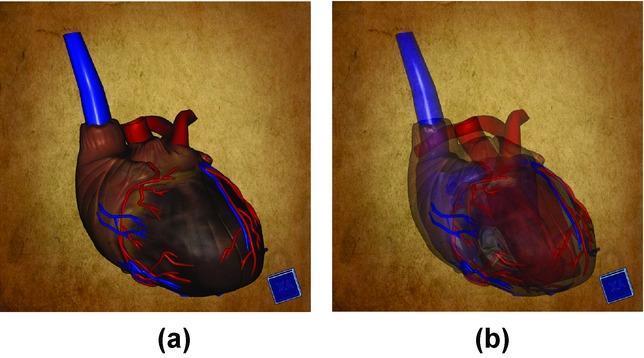
The heart is a hollow, muscular organ located in the mediastinum, slightly left of the midline, enclosed within a protective fibrous sac called the pericardium. It weighs approximately 250-350 g in adults and is roughly the size of a fist.

Chambers

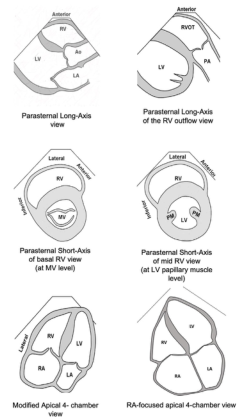
The heart has four chambers:
ChamberWall ThicknessFunction
Right Atrium (RA)ThinReceives deoxygenated blood from systemic veins (SVC, IVC)
Right Ventricle (RV)ThinPumps blood to the lungs via pulmonary artery
Left Atrium (LA)ThinReceives oxygenated blood from pulmonary veins
Left Ventricle (LV)Thick (~1 cm)Pumps blood to the body via the aorta
The interventricular septum divides the left and right ventricles. The left ventricle is the primary pumping chamber, composed of billions of cardiomyocytes connected end to end through gap junctions - Goldman-Cecil Medicine.

Valves

There are four valves that ensure one-way blood flow:
Atrioventricular (AV) Valves - between atria and ventricles:
  • Tricuspid valve - right side (3 leaflets)
  • Mitral (bicuspid) valve - left side (2 leaflets)
Both AV valves are attached to papillary muscles via chordae tendineae. The papillary muscles establish valve leaflet positions and prevent regurgitant (backward) flow during contraction.
Semilunar Valves - between ventricles and great vessels:
  • Pulmonary valve - between RV and pulmonary artery
  • Aortic valve - between LV and aorta
These valves separate the ventricles from their arterial connections and enable forward blood flow out of the ventricles - Goldman-Cecil Medicine.

Layers of the Heart Wall

LayerDescription
EpicardiumOuter layer; part of the visceral pericardium
MyocardiumMiddle, muscular layer; responsible for contraction
EndocardiumInner lining; smooth surface reducing blood friction

Coronary Circulation

The coronary arteries receive blood from the aorta directly above the aortic valve and travel through the epicardium to supply the heart muscle:
  • Right Coronary Artery (RCA) - supplies the right heart and inferior LV
  • Left Coronary Artery (LCA) - divides into:
    • Left Anterior Descending (LAD) - anterior LV and septum
    • Left Circumflex (LCx) - lateral and posterior LV
Coronary blood flows to the endocardium predominantly during diastole, when the myocardium is relaxed and not compressing the vessels - Goldman-Cecil Medicine.

Cellular Composition

Although the heart is a muscular pump, 60-70% of cardiac cells are fibroblasts, not muscle cells. These fibroblasts produce collagen and other extracellular matrix components that maintain the heart's structural integrity. In pathologic states (hypertension, MI, heart failure), fibroblasts generate excess matrix, leading to fibrosis - Goldman-Cecil Medicine.

PHYSIOLOGY

The Cardiac Cycle

The cardiac cycle has two phases:
  • Systole (~300 ms at 75 bpm) - ventricular contraction, blood ejected into aorta and pulmonary artery
  • Diastole (~500 ms at 75 bpm) - ventricular relaxation and filling
Systole accounts for about one third of the entire cardiac cycle. As heart rate increases, diastole shortens proportionally more than systole - Goldman-Cecil Medicine, Medical Physiology.

Cardiac Output

Cardiac output (CO) is the volume of blood pumped per minute:
CO = Heart Rate (HR) × Stroke Volume (SV)
Or physiologically:
CO = Chronotropy × Lusitropy × Inotropy - Rosen's Emergency Medicine
TermMeaning
ChronotropyHeart rate
InotropyContractile force (ejection fraction)
LusitropyDiastolic relaxation and filling (end-diastolic volume)
Normal CO at rest = ~5 L/min. It can rise to 20-25 L/min during vigorous exercise.

Frank-Starling Mechanism

Increasing end-diastolic volume (preload) stretches myocardial sarcomeres, allowing them to contract more forcefully - increasing stroke volume. This self-regulating mechanism ensures the heart pumps out whatever volume it receives. Beyond a maximum stretch point, further increases in EDV impair function and cause systolic dysfunction - Rosen's Emergency Medicine.

The Conduction System

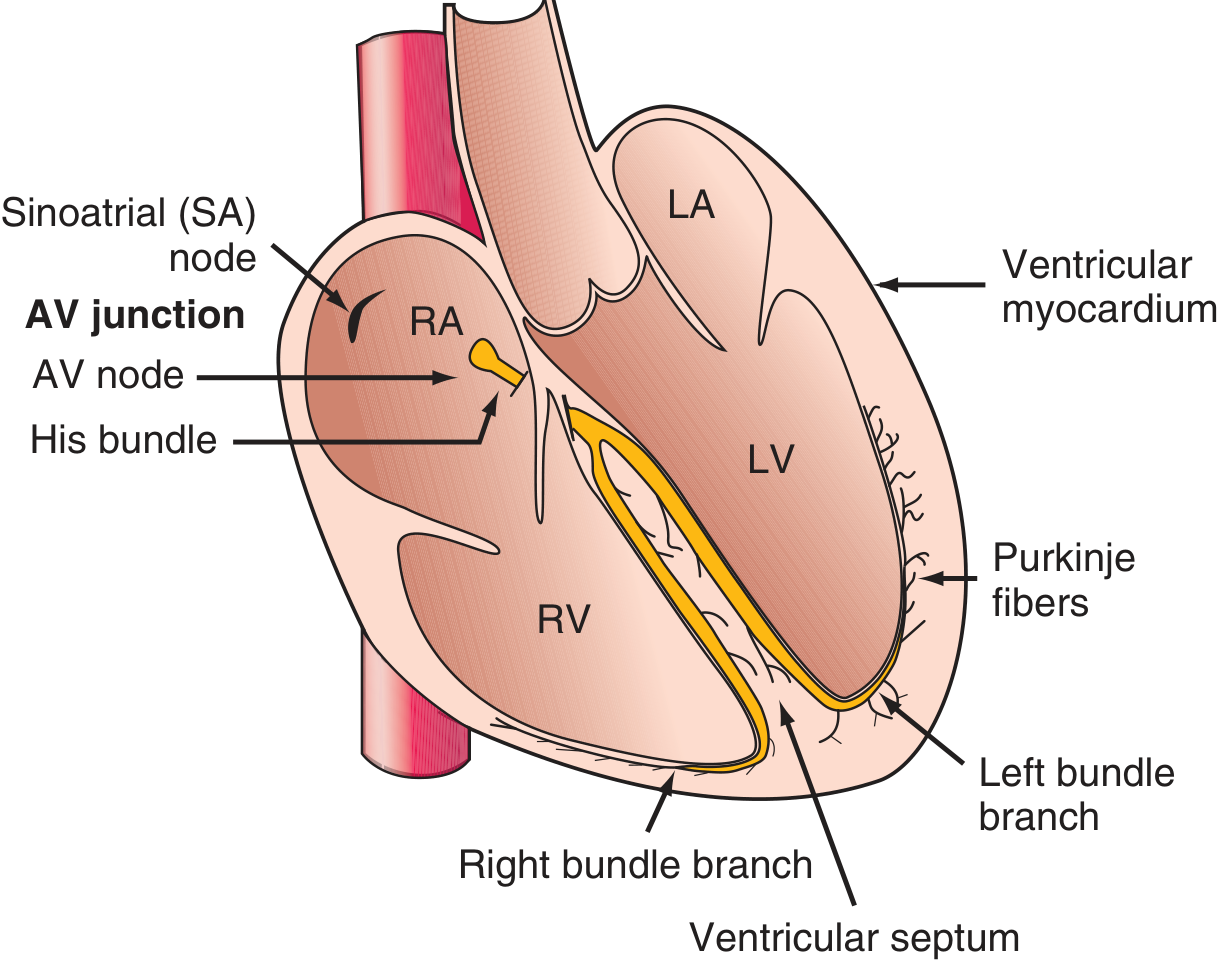
The heart's electrical system generates and coordinates contractions:
Cardiac conduction system diagram showing SA node, AV node, and His-Purkinje system
Cardiac conduction system - Harrison's Principles of Internal Medicine
  1. Sinoatrial (SA) Node - the natural pacemaker; fires spontaneously at 60-100 bpm, located in the right atrium
  2. AV Node - receives impulse from atria; delays it (~120 ms) to allow ventricular filling
  3. Bundle of His - passes impulse through the fibrous skeleton into the ventricles
  4. Right and Left Bundle Branches - carry impulse to each ventricle
  5. Purkinje Fibers - rapidly spread depolarization through ventricular myocardium from endocardium to epicardium, triggering coordinated contraction - Harrison's Principles of Internal Medicine.

Excitation-Contraction Coupling

  • Action potential triggers voltage-gated L-type calcium channels to open
  • Calcium influx triggers calcium-induced calcium release from the sarcoplasmic reticulum via ryanodine receptors
  • Calcium binds troponin C, causing tropomyosin to shift and expose actin binding sites
  • Myosin cross-bridges attach to actin, shortening the sarcomere (contraction)
  • Relaxation occurs when calcium is pumped back into the SR by SERCA pumps

Sympathetic Regulation

During stress, beta-adrenergic stimulation (epinephrine/norepinephrine) activates adenylyl cyclase, generating cAMP and activating protein kinase A. This phosphorylates multiple targets (phospholamban, ryanodine receptor, L-type Ca²+ channel) to increase calcium release and enhance contractility - Goldman-Cecil Medicine.

Blood Pressure and the Aorta

The aorta acts as a pressure buffer:
  • During systole, the compliant aorta expands and stores part of the stroke volume
  • During diastole, elastic recoil propels stored blood forward, maintaining continuous flow
  • This mechanism keeps coronary arteries perfused during diastole (when the myocardium is relaxed)
  • Pulse pressure = Systolic BP - Diastolic BP; reflects arterial stiffness and stroke volume

Summary: Blood Flow Through the Heart

Body → Superior/Inferior Vena Cava → Right Atrium → (Tricuspid Valve) →
Right Ventricle → (Pulmonary Valve) → Pulmonary Artery → Lungs →
Pulmonary Veins → Left Atrium → (Mitral Valve) →
Left Ventricle → (Aortic Valve) → Aorta → Body

Sources: Goldman-Cecil Medicine; Harrison's Principles of Internal Medicine 22E; Rosen's Emergency Medicine; Medical Physiology (Boron & Boulpaep)
This is a shared conversation. Sign in to Orris to start your own chat.