
About Pinguecula
Reading File
Searching sources...
Finding Sources
Searching PubMed
pinguecula pathogenesis treatment
Reading File
Reading File
Reading File
Reading File
Loading Image
Here is a thorough overview of pinguecula drawn from multiple authoritative ophthalmology and emergency medicine textbooks.
Pinguecula
Definition
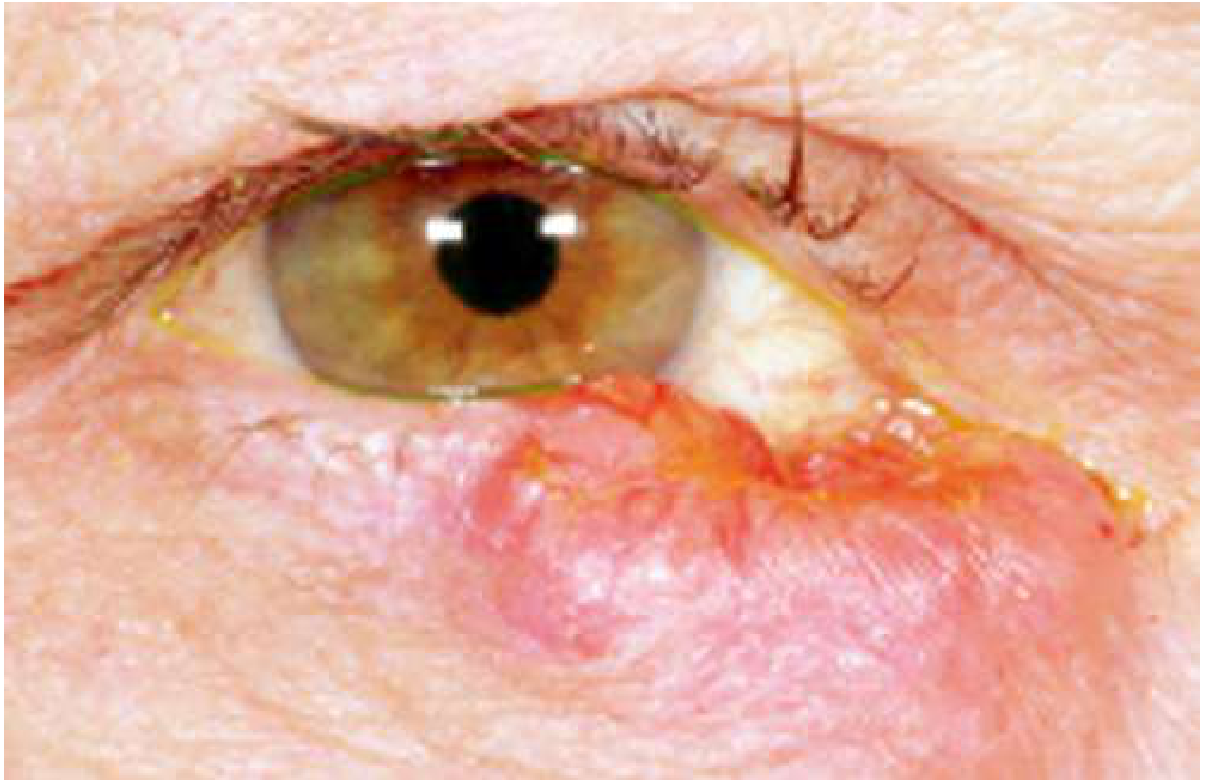
A pinguecula is a yellow-white, flat or slightly raised conjunctival lesion, typically located in the interpalpebral fissure (the exposed area between the eyelids) adjacent to the limbus (the junction of the cornea and sclera), but crucially not extending onto the cornea. It represents a degenerative process of the bulbar conjunctiva.
Pathophysiology
The underlying mechanism is elastotic degeneration of the deep conjunctival layers, leading to fibrovascular tissue proliferation. This is driven by:
- Chronic UV light exposure - the primary trigger
- Chronic wind, dust, and environmental irritation
- More prevalent in individuals from equatorial regions (higher UV index)
At the subepithelial level, UV damage degrades the connective tissue architecture of the conjunctiva. The process is confined to the limbal and bulbar conjunctiva. When this same degenerative process extends onto the cornea, it becomes a pterygium - a related but more advanced condition.
Epidemiology
- Very common, especially in sunny or dusty climates
- More frequent in people living near the equator
- Associated with outdoor occupations and prolonged sun exposure
- Can occur at any age but more common in middle-aged and older adults
Symptoms
Pinguecula is often asymptomatic. When symptoms do occur, they include:
- Irritation and foreign body sensation
- Redness (especially when inflamed - "pingueculitis")
- Dryness and tearing
- Cosmetic concern
- Rarely, decreased vision (vision loss is not typical unless a delle forms or it progresses to pterygium)
Signs
On examination (slit lamp):
- Yellow-white, flat or slightly elevated conjunctival lesion
- Located in the interpalpebral fissure, usually at the 3-o'clock or 9-o'clock perilimbal position (nasal side more commonly)
- Does NOT involve the cornea (this distinguishes it from pterygium)
- May be highly vascularized and injected when inflamed
- May be associated with superficial punctate keratitis (SPK)
- A delle (localized corneal thinning adjacent to the lesion, due to drying) may be present
Relationship to Pterygium
| Feature | Pinguecula | Pterygium |
|---|---|---|
| Corneal involvement | No - stops at limbus | Yes - grows onto cornea |
| Shape | Flat/raised nodule | Wing-shaped fibrovascular fold |
| Vision effect | Minimal | Can cause astigmatism |
| Surgery indicated | Rarely | More often |
| Malignant potential | None significant | 2-10% coexisting squamous carcinoma |
Differential Diagnosis
- Conjunctival intraepithelial neoplasia (CIN): Papillomatous, jelly-like, velvety or leukoplakic mass - may not follow the typical 3/9-o'clock pattern
- Limbal dermoid: Congenital rounded white lesion, usually inferotemporal
- Pseudopterygium: Conjunctival tissue adherent to peripheral cornea after prior trauma or surgery - associated with corneal thinning
- Pannus: Blood vessels growing into cornea (without a raised lesion); associated with contact lens use, blepharitis, trachoma
- Peripheral hypertrophic subepithelial corneal degeneration: Bilateral, mostly in Caucasian women, elevated subepithelial opacities
- Sclerokeratitis: Associated with scleritis
- Conjunctival squamous cell carcinoma: Particularly in older Caucasian patients - new growths should be referred for specialist workup
Workup
- Slit lamp examination is the key diagnostic tool
- Evaluate the adjacent corneal integrity and thickness
- Assess for corneal astigmatism (often irregular, but may be with-the-rule)
- No laboratory workup is routinely needed
- Biopsy is warranted if the lesion appears atypical or if CIN cannot be excluded
Management
1. Prevention / General Measures
- UV-protective sunglasses (wraparound style preferred)
- Protective goggles in dusty or windy environments
2. Lubrication
- Preservative-free artificial tears, 4-8 times per day - the first-line symptomatic treatment
3. Inflamed Pinguecula (Pingueculitis)
- Mild: Artificial tears QID
- Moderate to severe:
- Topical mild corticosteroid (e.g., fluorometholone 0.1%, loteprednol 0.2%-0.5% QID)
- Topical NSAID (e.g., ketorolac 0.4%-0.5% QID)
- Topical antihistamine ± mast cell stabilizer (e.g., bepotastine, ketotifen, olopatadine)
4. Delle (adjacent corneal thinning)
- Artificial tear ointment every 2 hours
5. Surgical Removal
Indicated when:
- Excessive irritation not relieved by medical treatment
- Interfering with contact lens wear
- Cosmetic concerns are significant
- Pre-operative preparation before cataract or refractive surgery
Note: Surgical excision with conjunctival autograft or amniotic membrane graft reduces recurrence. Intraoperative mitomycin C (antimetabolite) is typically reserved for recurrent cases, as it carries a risk of corneoscleral thinning or necrosis.
Follow-Up
- Asymptomatic, stable pinguecula: Can be reviewed every 1-2 years
- If treated with topical steroids: recheck after a few weeks to monitor inflammation and intraocular pressure (IOP); taper and discontinue steroid once inflammation has resolved
Sources:
- Goldman-Cecil Medicine (International Edition, 2-volume set), Section on Pinguecula and Pterygium
- The Wills Eye Manual - Office and Emergency Room Diagnosis and Treatment of Eye Disease, Section 4.9
- Rosen's Emergency Medicine: Concepts and Clinical Practice, Chapter 57
This is a shared conversation. Sign in to Orris to start your own chat.