
Guideline on how and when to start insulin in diabetes mellitus
Reading File
Now let me search the medical library and recent guidelines in parallel.
Finding Sources
Finding Sources
Searching PubMed
"insulin initiation" AND "type 2 diabetes"
The Family Medicine textbook has a dedicated section on insulin initiation. Let me read that in detail alongside other key sources.
Reading File
Finding Sources
Finding Sources
Excellent content from the Family Medicine textbook. Let me now read the rest of the insulin initiation section and get content from Goldman-Cecil and Goodman & Gilman.
Reading File
Reading File
Finding Sources
Now let me get the Goldman-Cecil treatment section and Harrison's insulin-specific content:
Reading File
Finding Sources
Reading File
Finding Sources
Reading File
Loading Image
Loading Image
Now let me get the Family Medicine textbook's basal insulin dosing section and the Washington Manual inpatient dosing:
Reading File
Finding Sources
I now have comprehensive content from multiple authoritative textbooks. Let me compile the complete guideline answer.
Insulin in Diabetes Mellitus: When and How to Start
Overview
Insulin is the most potent glucose-lowering agent available and is the treatment of choice for type 1 diabetes mellitus (T1DM) and an important option at multiple stages of type 2 diabetes mellitus (T2DM). Its timely initiation reduces insulin resistance, induces beta-cell rest, and minimizes both micro- and macrovascular complications through a mechanism called "metabolic memory."
- Textbook of Family Medicine 9e, p. 978
PART 1 - TYPE 1 DIABETES
When to Start
Insulin is mandatory from diagnosis in T1DM - there are no alternatives because absolute insulin deficiency is the fundamental defect.
What Regimen to Use
A physiological (basal-bolus) regimen is the standard of care:
| Component | Insulin Type | Timing |
|---|---|---|
| Basal | Glargine, detemir, or degludec | Once daily (bedtime or morning) |
| Bolus (prandial) | Lispro, aspart, or glulisine | 15 min before each meal |
| Correction | Same rapid-acting analog | Added to bolus as needed |
An alternative is continuous subcutaneous insulin infusion (CSII/insulin pump) using rapid-acting analogs - preferred for patients with hypoglycemia unawareness, highly variable glucose, or who require tight control (e.g., pregnancy).
HbA1c target: <7% for most patients; <6.5% if achievable without hypoglycemia in young, newly diagnosed individuals.
PART 2 - TYPE 2 DIABETES
When to Start Insulin
T2DM is a progressive disease with gradual beta-cell failure. Insulin is typically introduced at several decision points:
1. At Diagnosis (Early/Intensive Initiation)
Consider immediate insulin therapy when:
- HbA1c >9.0% with symptomatic hyperglycemia (polyuria, polydipsia, weight loss)
- HbA1c >8.5% with symptoms
- Fasting glucose consistently >200 mg/dL
Short-term (2 weeks to 3 months) intensive insulin in newly diagnosed T2DM with high HbA1c can induce beta-cell rest and may improve long-term outcomes. - Goldman-Cecil Medicine, p. 1056
2. Oral Agent Failure (Most Common Scenario)
Start insulin when:
- Adequate trial of 2-3 oral/non-insulin injectable agents fails to achieve target HbA1c
- HbA1c remains >7-8% despite maximally tolerated oral agents
- Progressive beta-cell failure (common after 10-15 years of T2DM)
3. Special Circumstances
- Hospitalization / critical illness: Initiate insulin for blood glucose >180 mg/dL (target 140-180 mg/dL); 80-110 mg/dL may be targeted in select ICU settings
- Pregnancy (gestational diabetes / pre-existing DM): Insulin is the preferred agent; initiate before pregnancy in those with pre-existing DM, targeting HbA1c <6%
- Renal/hepatic failure: When oral agents are contraindicated
- Steroid-induced hyperglycemia
- DKA or hyperosmolar state (even in T2DM)
How to Start Insulin in T2DM: Step-by-Step
Step 1 - Choose the Starting Regimen
Basal insulin first is the preferred approach for most outpatients:
- Start with glargine, detemir, or degludec (long-acting analogs preferred over NPH to minimize hypoglycemia risk)
- Starting dose: 10 units once daily (bedtime or morning), OR 0.1-0.2 units/kg/day
- Can be combined safely with metformin, SGLT-2 inhibitors, DPP-4 inhibitors, and GLP-1 receptor agonists
- Approximately 60% of T2DM patients achieve HbA1c ≤7% with basal insulin + oral agents - Textbook of Family Medicine 9e, p. 1591
Step 2 - Titrate the Dose
A common self-titration protocol (the "2-2-2 rule" or similar):
- Increase basal dose by 2 units every 3 days if fasting glucose is 130-180 mg/dL
- Increase by 4 units if fasting glucose >180 mg/dL
- Reduce dose if any fasting glucose reading is <80 mg/dL
Target fasting glucose: 80-130 mg/dL
Step 3 - Add Prandial Insulin When Needed
Consider adding rapid-acting prandial insulin when:
- HbA1c remains >7% despite fasting glucose <100 mg/dL on optimized basal insulin
- Basal insulin dose has exceeded 60 units/day
- Patient has not met HbA1c goal within 1 year of starting basal insulin
- "BeAM factor" (bedtime glucose minus morning glucose) is >55 mg/dL - this indicates uncontrolled postprandial glucose
- Repeated nocturnal hypoglycemia on basal titration
Starting prandial dose: 4-6 units with the largest meal, titrated up by 1-2 units every 3 days based on 2-hour postprandial glucose target (<180 mg/dL).
Inpatient Dosing (Hospitalized T2DM Patients)
- Starting dose: 8-16 units long-acting insulin + 3-5 units rapid-acting before each meal
- Add a correction dose of 1-2 units per 50 mg/dL above target
- Target glucose: 140-180 mg/dL in non-critical care settings
Insulin Pharmacokinetic Profile
The figure below shows the onset and duration of action for all major insulin types:
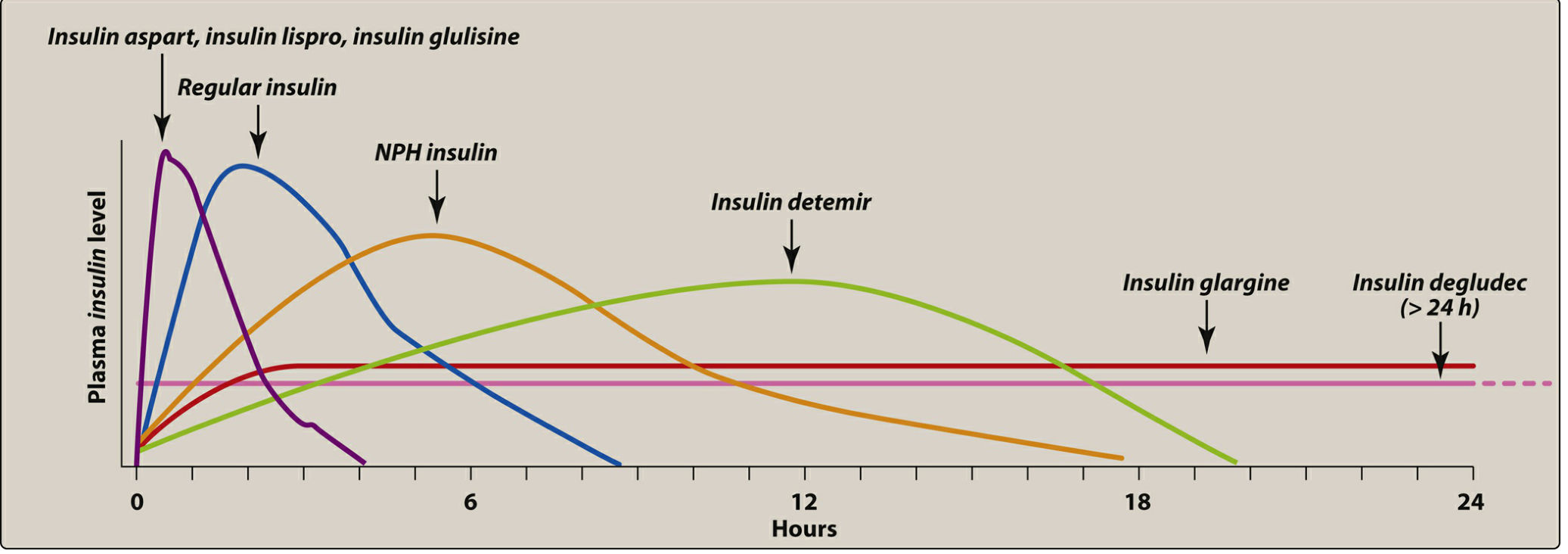
| Type | Examples | Onset | Peak | Duration |
|---|---|---|---|---|
| Rapid-acting | Lispro, Aspart, Glulisine | 15 min | 1-2 h | 3-5 h |
| Short-acting | Regular human | 30-60 min | 2-4 h | 6-8 h |
| Intermediate | NPH | 1-2 h | 4-10 h | 12-18 h |
| Long-acting | Glargine, Detemir | 1-2 h | Peakless | 20-24 h |
| Ultra-long | Degludec | 1-2 h | Flat | >24 h |
Common Insulin Regimens
The diagram below illustrates three standard insulin regimens:
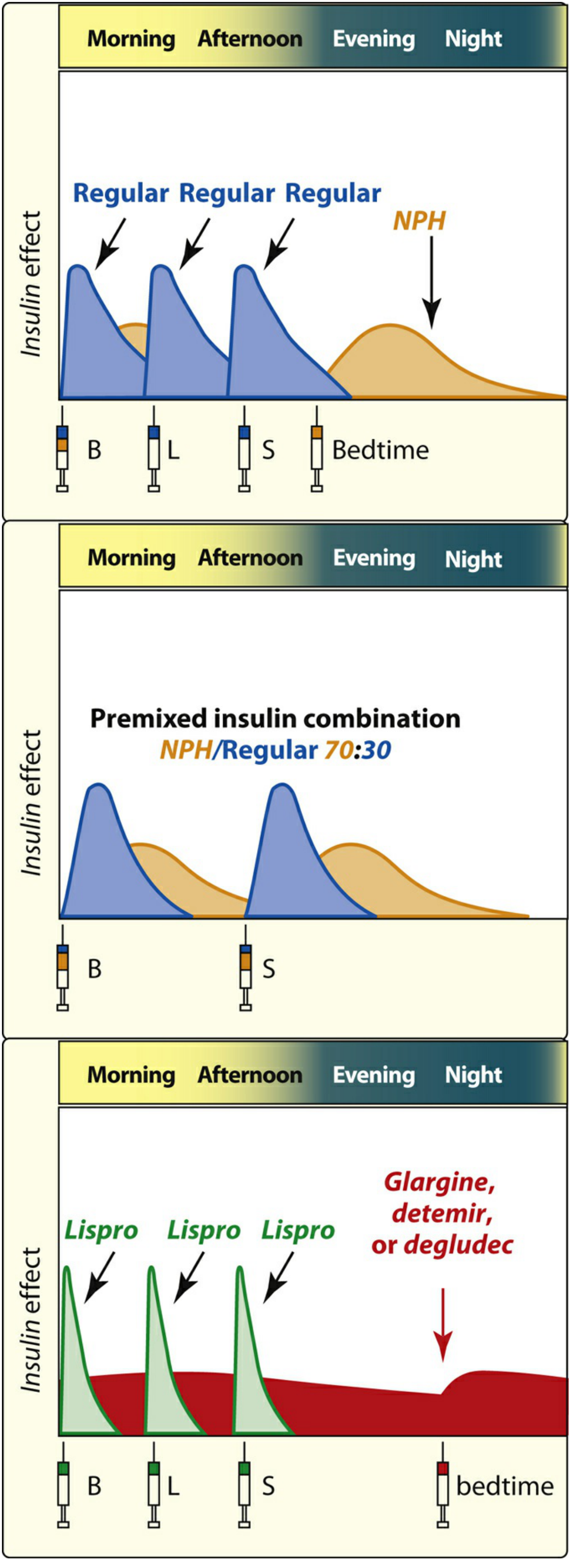
- Conventional: Regular insulin at each meal + NPH at bedtime
- Premixed (70:30 NPH/Regular): Twice daily injections - simpler, for patients with regular meal schedules and HbA1c 8.5-10%
- Basal-Bolus (preferred): Long-acting at bedtime + rapid-acting analog at each meal - most physiological, best glycemic control
Practical Keys to Successful Insulin Initiation
The following points are evidence-based recommendations from the Textbook of Family Medicine 9e (Table 34-20):
- Explain the difference between "basal" and "bolus" insulin to minimize dosing errors
- Use insulin pens or disposable pumps rather than syringes - improves accuracy and adherence
- Inject rapid-acting analogs 15 minutes before meals (unless pre-meal glucose <80 mg/dL)
- Use analog insulins rather than regular human insulin to reduce hypoglycemia risk
- When adding a GLP-1 receptor agonist to basal insulin, reduce the basal dose by 20%
- Teach patients structured self-monitoring of blood glucose (SMBG) to detect impending hypoglycemia
- Patients with renal insufficiency should reduce insulin doses by 10% and monitor carefully (reduced renal insulin clearance increases hypoglycemia risk)
- To reduce weight gain: consider discontinuing sulfonylureas, thiazolidinediones, or glinides when insulin is started
- Agents safely continued alongside insulin: metformin, bromocriptine, SGLT-2 inhibitors, alpha-glucosidase inhibitors, DPP-4 inhibitors (not with GLP-1 agonists)
- Always provide patients with a written, individualized titration plan
Glycemic Targets Summary
| Setting | Target |
|---|---|
| HbA1c (most adults) | <7% |
| HbA1c (young, no hypoglycemia risk) | <6.5% |
| HbA1c (elderly, comorbidities, hypoglycemia unawareness) | 7-8% |
| Fasting glucose | 80-130 mg/dL |
| 2-hour postprandial glucose | <180 mg/dL |
| Inpatient (non-ICU) | 140-180 mg/dL |
Recent evidence note: A 2026 systematic review and network meta-analysis (PMID: 41436667) in Diabetologia compared insulin regimens in T2DM, confirming that basal-bolus regimens provide the greatest HbA1c reduction but with higher hypoglycemia rates. Basal insulin alone remains the preferred starting point due to its simplicity and safety.
This is a shared conversation. Sign in to Orris to start your own chat.