
Paederus dermatitis
Reading File
Paederus dermatitis is a contact dermatitis caused by the hemolymph of Paederus beetles, which contains the vesicant toxin pederin.
Searching sources...
Finding Sources
Finding Sources
Searching PubMed
Paederus dermatitis pederin
Good - I found dedicated sections in Dermatology 2-Volume Set 5e and Andrews' Diseases of the Skin. Let me read those in parallel.
Reading File
Reading File
I also see images in the content. Let me also check the eFig. block mentioned and fetch the relevant clinical images.
Reading File
Loading Image
I now have comprehensive information from two authoritative dermatology textbooks. Here is a full clinical review:
Paederus Dermatitis
Synonyms: Dermatitis linearis, Nairobi fly disease, "podo" (South America)
The Beetle
Paederus beetles belong to the family Staphylinidae (rove beetles). They are recognized by:
- Narrow bodies, 0.5-1.5 cm long
- A distinctive red-orange abdomen
- Short forewings (they can fly despite this)
- They neither bite nor sting
The beetles are strongly attracted to ultraviolet light, which explains outbreaks in hospitals and military barracks with open windows near fluorescent bulbs.
Pathophysiology
The hemolymph of Paederus beetles contains pederin (C25H45NO9), a potent vesicant polyketide toxin. Pederin is not produced by the beetle itself - it is synthesized by endosymbiotic bacteria (Pseudomonas-like organisms) living within the beetle. Pederin acts by inhibiting protein and DNA synthesis in keratinocytes.
The skin injury occurs when the beetle is crushed or brushed against the skin, releasing hemolymph - there is no bite or sting.
Epidemiology
- Reported in warm climates worldwide - tropical and subtropical Africa, Asia, South America, Middle East, and parts of Australia
- Outbreaks characteristically follow the rainy season when beetle populations surge
- Epidemics have been documented in military units and hospital wards with open windows (UV light attraction)
- Also seen in returning travelers
- Common sites: neck and exposed parts of the body
Clinical Features
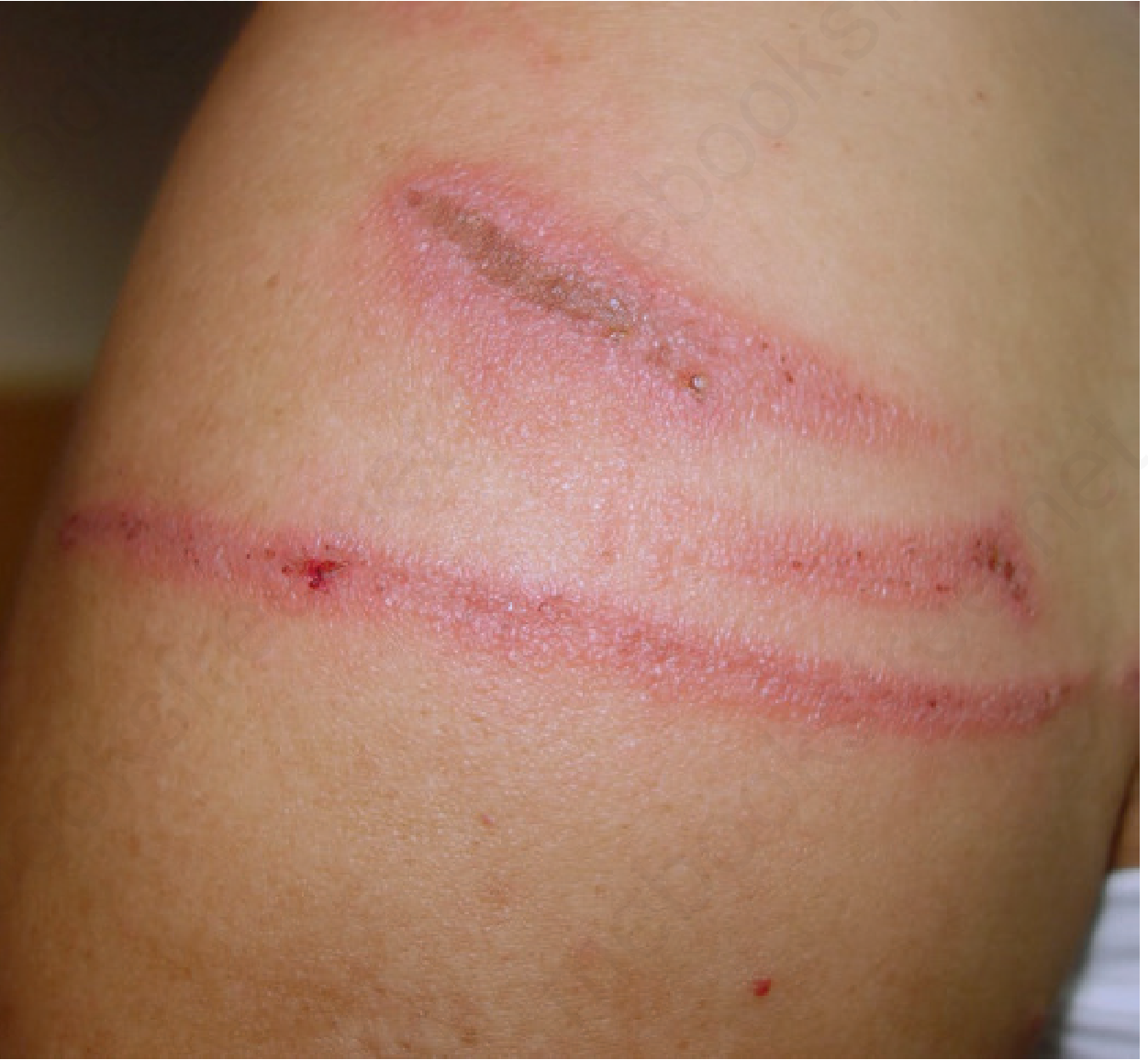
Onset: Symptoms begin 24-36 hours after exposure (delayed - patients often do not recall beetle contact). Initial burning and tingling within minutes of contact may precede the visible eruption.
Morphology:
- Erythematous, streaky/linear vesiculopustular eruption - the hallmark
- Vesicles and pustules on an inflamed erythematous base (more inflammatory than cantharidin blisters)
- Bullae can form in severe cases
Distinctive patterns:
- "Kissing lesions" - mirror-image lesions on adjacent flexural surfaces (e.g., antecubital fossa) where hemolymph is transferred by skin-to-skin contact
- "Nairobi eye" - periocular dermatitis and keratoconjunctivitis caused by Paederus eximius in Northern Kenya; occurs when patients rub their eyes after touching the beetle
- Lymphadenopathy and fever may accompany severe cases
Distribution: Neck, face, forearms, and other exposed areas
Histopathology
- Suprabasal acantholysis
- Reticular degeneration of the epidermis
- Epidermal necrosis
- Inflammatory infiltrate rich in neutrophils
This inflammatory pattern (with neutrophil-rich infiltrate) distinguishes Paederus dermatitis histologically from the more bland vesicles of cantharidin injury.
Differential Diagnosis
| Condition | Key distinction |
|---|---|
| Herpes zoster | Dermatomal, preceded by pain, positive Tzanck/PCR |
| Bullous impetigo | Flaccid bullae, gram-positive cocci |
| Cantharidin dermatitis | Non-inflammatory vesicles, different beetle family (Meloidae) |
| Chemical burn | History of chemical exposure |
| Phytophotodermatitis | Linear but requires UV exposure + plant contact |
| Contact dermatitis (allergic) | Less streaky, positive patch test |
Treatment
Immediate:
- Wash thoroughly with soap and water immediately after beetle contact or suspected exposure - this is the most important first step
- Do NOT crush the beetle on the skin; remove it gently
Wound care:
- Drain bullae
- Apply cold wet compresses
- Topical antibiotics to prevent secondary infection
- Topical corticosteroids may help reduce inflammation
- Early cleansing with acetone, ether, or alcohol can help remove residual toxin
Symptomatic: Antihistamines and analgesics for itch and pain
Prevention
- Insect-proof netting at night
- Switch to light sources without UV emission (e.g., LED instead of fluorescent) near open windows
- Remove beetles from skin without crushing
- Public health education during outbreaks (rainy season)
Summary Points
- Caused by pederin in rove beetle (Paederus spp.) hemolymph - produced by endosymbiotic bacteria
- Typical presentation: linear/streaky vesiculopustular rash with 24-36 hour delay
- "Kissing lesions" in flexures are pathognomonic
- "Nairobi eye" = ocular variant
- Outbreaks tied to rainy season and UV light attraction
- Management: immediate washing, topical antibiotics, prevent by avoiding beetle crushing
Sources: Dermatology 2-Volume Set 5e (Bolognia et al.), Andrews' Diseases of the Skin 13e
How long to cure
Paederus dermatitis is self-limiting and typically resolves within 1-3 weeks with proper care.
Finding Sources
Searching the Web
Paederus dermatitis duration healing time prognosis
Duration and Healing Timeline
Paederus dermatitis is self-limiting and follows a predictable course:
Typical Timeline
| Phase | Timeframe |
|---|---|
| Initial burning/tingling | Within minutes of contact |
| Visible eruption appears | 8-36 hours after exposure |
| Vesicle/pustule peak | Days 2-5 |
| Lesions dry out and exfoliate (squamous phase) | Around days 7-8 |
| Complete skin healing | ~13 days on average (range 10-28 days) |
| Post-inflammatory hyperpigmentation | Can persist weeks to months |
Evidence-Based Data
A cross-sectional study from Bhutan (PMC, 2023) involving 81 patients found:
- Mean recovery time: 13 days (SD ±8.3 days)
- Recovery rate: 100% in all patients
- Similar results from India and Italy: 12-15 days
- Sierra Leone data showed a wider range: 14-28 days
Special Cases
- Ocular (Nairobi eye): Conjunctival/lid lesions take 10-14 days, but corneal lesions can take up to 50 days
- Severe systemic cases: Fever, arthralgia may accompany extensive lesions; erythema can persist for many months
- Residual hyperpigmentation: Occurs in roughly one-third of patients and can last several months, especially in darker skin types
Does Treatment Speed Recovery?
Yes, somewhat:
- Topical steroids + antibiotics are standard and improve comfort
- Adding oral ciprofloxacin (in one Sierra Leone study) produced statistically faster healing
- A herbal preparation (palemolin/Sambucus ebulus lotion) showed 93.9% of lesions fully resolved within 48 hours vs. 65.4% in controls - though this is a single small study
Bottom Line
Expect about 2 weeks for full skin healing in most cases. The rash itself resolves completely, but dark marks (post-inflammatory hyperpigmentation) may linger for 1-3 months afterward, particularly in people with darker skin. No long-term systemic effects are expected after a single exposure.
What treatments speed up healing the most?
Based on prior context and medical knowledge, topical steroids + antibiotics are the mainstay, with some evidence for oral ciprofloxacin accelerating healing.
Searching sources...
Searching PubMed
Paederus dermatitis treatment
Searching the Web
Paederus dermatitis fastest treatment ciprofloxacin steroid evidence
Reading Article
PMID: 28584222
Reading Article
PMID: 37718215
Here is a ranked breakdown of what the evidence shows for speeding up healing:
Treatments That Speed Up Healing - Ranked by Evidence
1. Immediate Soap and Water Washing (Most Important)
The single most impactful intervention. Washing within minutes of beetle contact physically removes pederin from the skin before it penetrates fully, reducing lesion severity and duration. Every source agrees this is the top priority - even a few minutes of delay worsens outcomes. No treatment later compensates for a missed early wash.
2. Topical High-Potency Corticosteroid (Core Treatment)
Strong topical steroids (e.g., betamethasone, clobetasol) are the standard first treatment once lesions appear. They reduce the inflammatory cascade driven by pederin, shrink vesicle formation, and significantly cut discomfort. Used alone, they form the baseline against which other treatments are compared. Multiple case series confirm they are effective; the 2023 China outbreak (134 cases, PMID 37718215) showed all patients recovered within 2 weeks with steroids as the backbone.
3. Oral Ciprofloxacin + Topical Steroid (Fastest Combination)
This is the best-evidenced accelerator of healing. An observational study in Sierra Leone (50 patients) showed statistically significant reduction in symptom duration when ciprofloxacin 500 mg twice daily was added to topical steroids, compared to steroids alone. The rationale: pederin itself is produced by endosymbiotic Pseudomonas-like bacteria in the beetle's hemolymph. When this hemolymph contacts damaged skin, concurrent bacterial infection - by beetle-associated Pseudomonas spp., Staphylococcus aureus, or Streptococcus spp. - can drive prolonged inflammation. Ciprofloxacin targets gram-negatives; for MRSA or streptococcal coverage, broader antibiotics may be needed.
Referenced by DermNet NZ, JCAD (Amazon mission boat outbreak), and the PMC returning traveler case report.
4. Oral/Systemic Steroids (For Severe or Spreading Cases)
One documented case showed "dramatic improvement" after a course of oral steroids when topical treatment and ciprofloxacin had not fully controlled progression. Oral prednisone is also supported for ocular involvement (Nairobi eye). Not routinely needed for mild/moderate cases, but may significantly accelerate recovery when lesions are extensive or spreading.
5. Potassium Permanganate Solution
A guinea pig model compared topical fluocinolone cream vs. potassium permanganate (KMnO4) soaks and found KMnO4 superior. It acts as an antiseptic oxidizing agent, neutralizes toxin at the skin surface, and dries out vesicles. It is widely used in dermatology for weeping/infected skin lesions. Apply as dilute soaks (1:10,000 solution) to blistered areas.
6. Tincture of Iodine
Cited by DermNet NZ as helpful to neutralize the pederin toxin directly and act as an antiseptic. Applied early after washing, it may reduce toxin activity at the site.
7. Sambucus ebulus (Palemolin) Lotion - Experimental
A small Iranian RCT found that this herbal preparation resolved 93.9% of lesions within 48 hours, vs. 65.4% in controls (p=0.028). It also had superior anti-inflammatory effect (p<0.001). Not widely available, but notable as a controlled trial - the only one for Paederus dermatitis. Considered experimental outside Iran.
8. Aloe Vera Cream
A 2017 mouse model study (PMID 29062845) showed efficacy, but no human trial data exist yet. May be used as a soothing adjunct.
Practical Summary
| Priority | Intervention | Effect |
|---|---|---|
| #1 | Immediate soap & water wash | Prevents full toxin penetration |
| #2 | Strong topical steroid | Reduces inflammation, standard care |
| #3 | Add oral ciprofloxacin 500 mg BD | Statistically faster healing (Sierra Leone study) |
| #4 | KMnO4 soaks | Superior to topical steroid in animal model |
| #5 | Oral steroids | For severe/ocular cases |
| Adjunct | Calamine, antihistamines, cold compresses | Symptom relief |
Important caveat: No large RCTs exist for Paederus dermatitis. The highest-quality evidence is a single observational study (ciprofloxacin) and one small RCT (herbal lotion). Most guidance is based on case series and expert opinion. The 2017 comprehensive review by Karthikeyan & Kumar (PMID 28584222) in the Indian Journal of Dermatology remains the most cited clinical reference.
This is a shared conversation. Sign in to Orris to start your own chat.