
Spleen how does it look and how do i identify white red pukp and other parts of it in histology
Reading File
Now let me search the library for spleen histology content and images in parallel.
Finding Sources
Finding Sources
Searching Images
spleen histology white pulp red pulp microscopy
Excellent. Now let me read the detailed histology content from the two best textbook sources in parallel, and fetch key images.
Reading File
Reading File
Loading Image
Now let me read the spleen plate section and the diagram image from the textbook, plus more detailed content:
Reading File
Reading File
Reading File
I now have rich content. Let me fetch the key diagrams and microscopy images to include in the answer:
Loading Image
Loading Image
Loading Image
I have everything needed for a comprehensive answer. Let me also fetch the white pulp micrograph:
Loading Image
Now I have everything needed for a thorough, image-rich answer.
Spleen Histology: Complete Guide
Overview & Low-Power Appearance
At low magnification (scanning power), the spleen is the only major lymphoid organ with no cortex/medulla distinction. Instead you see two intermingled regions flooding the entire section:
- A thick dense connective tissue capsule on the outer surface
- Trabeculae — thick bands of connective tissue projecting inward from the capsule, carrying trabecular arteries and veins
- White pulp — scattered dark blue/purple islands
- Red pulp — the dominant pink background filling everything between
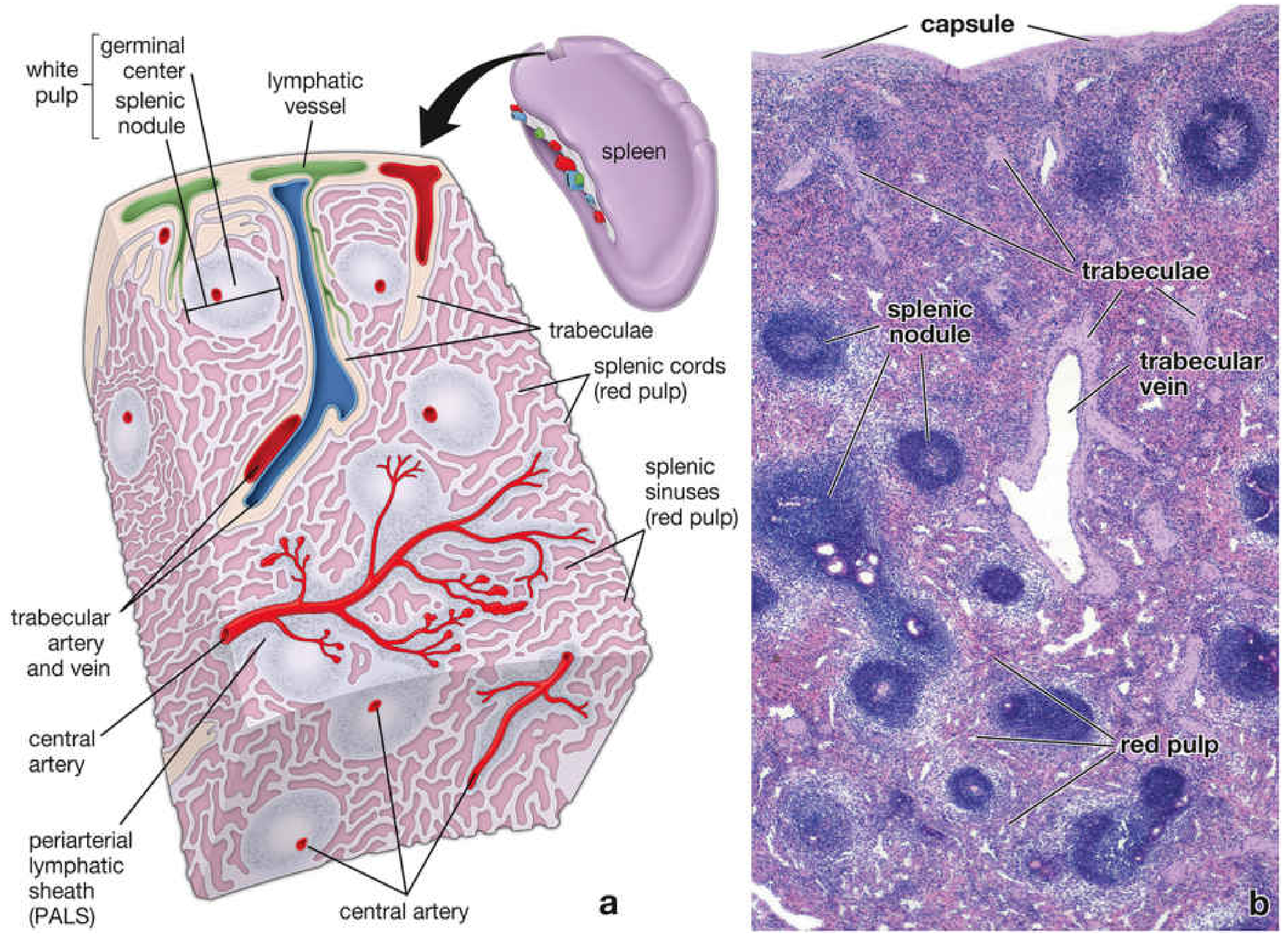
How to Identify Each Part
1. Capsule & Trabeculae
| Feature | What you see in H&E |
|---|---|
| Capsule | Thick eosinophilic (pink) band of dense connective tissue at the periphery; contains scattered myofibroblast nuclei |
| Trabeculae | Dense pink connective tissue bundles radiating inward; large vessels (trabecular arteries/veins) run inside them — the trabecular vein is thin-walled and lumen is wide |
Key clue: Trabeculae are the only pink dense structures that contain a large vascular lumen. They connect the capsule to the interior and are your anchor point when orienting a spleen section.
2. White Pulp
Color in H&E: Dark blue-purple (basophilic), because the densely packed lymphocyte nuclei stain intensely with hematoxylin.
In fresh tissue: Whitish-gray islands.
White pulp has two components:
a) Periarteriolar Lymphatic Sheath (PALS)
- A cuff of T lymphocytes surrounding the central artery (a small arteriole that has left the trabecula)
- The central artery sits roughly in the middle of the sheath — this is the defining feature
- Appears as a dark blue elongated sleeve around a small artery in longitudinal section
b) Splenic Nodules (Malpighian corpuscles)
- Compact spherical or oval dark blue masses = B-lymphocyte follicles
- When activated: show a paler germinal center (large, proliferating B cells with vesicular nuclei) surrounded by a dark mantle of small lymphocytes
- The central artery is pushed eccentrically to the periphery of the nodule (no longer central!) — this is a classic exam point
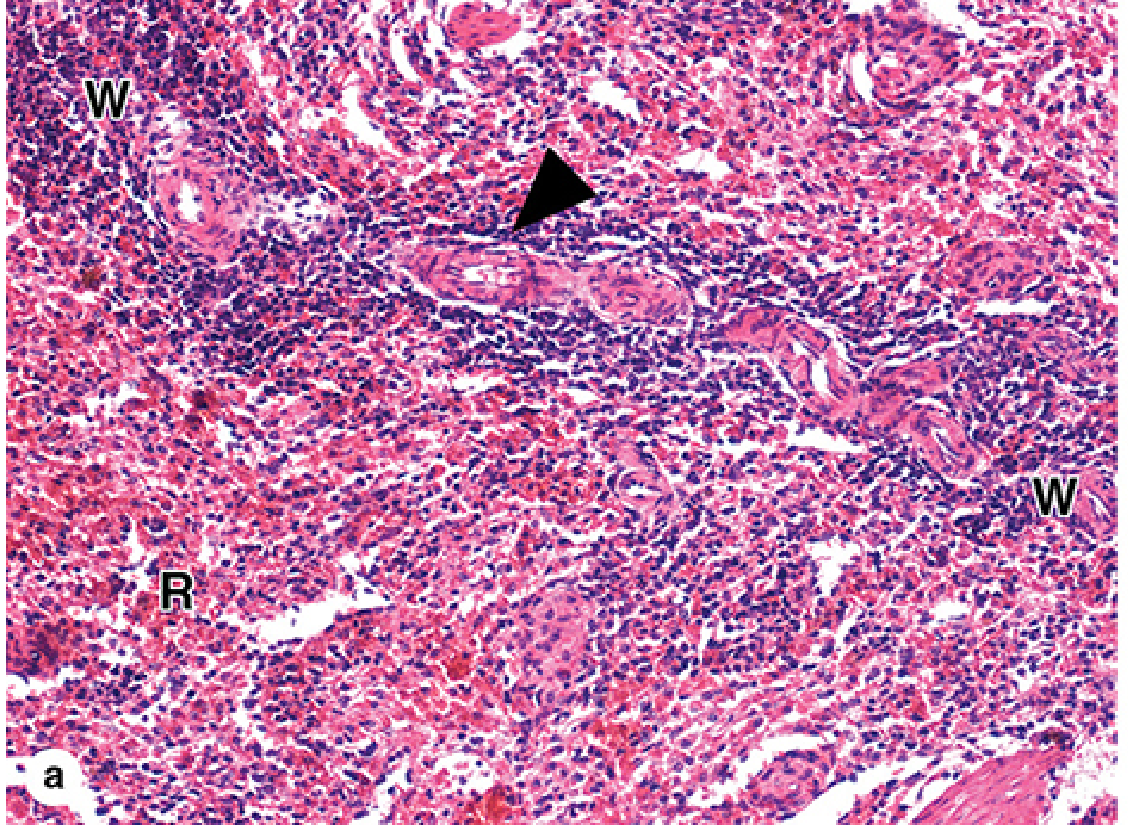
Quick identification rule: Find a small artery → look for the blue lymphocyte cuff around it → that is white pulp.
3. Marginal Zone
- The transition zone between white and red pulp
- Contains a mix of B cells, macrophages, and small sinusoid-like vascular spaces
- Slightly less densely blue than the PALS/nodule core
- Important site for trapping blood-borne antigens and first-responder B cells
4. Red Pulp
Color in H&E: Pink (eosinophilic) — filled with erythrocytes.
Red pulp has two components that alternate throughout:
a) Splenic Sinusoids (Venous Sinuses)
- Irregular elongated pale/clear spaces or spaces filled with RBCs
- Lined by unique "stave cells" — rod-shaped endothelial cells whose nuclei bulge into the lumen (look like barrel staves)
- The basal lamina is discontinuous (fenestrated barrel-hoop pattern), allowing RBCs to squeeze through
b) Splenic Cords (Cords of Billroth)
- The tissue between the sinusoids
- Contains RBCs, platelets, macrophages, lymphocytes in a reticular framework
- Macrophages here phagocytose old/damaged RBCs — you may see macrophages with engulfed erythrocytes (deeply eosinophilic inclusions)
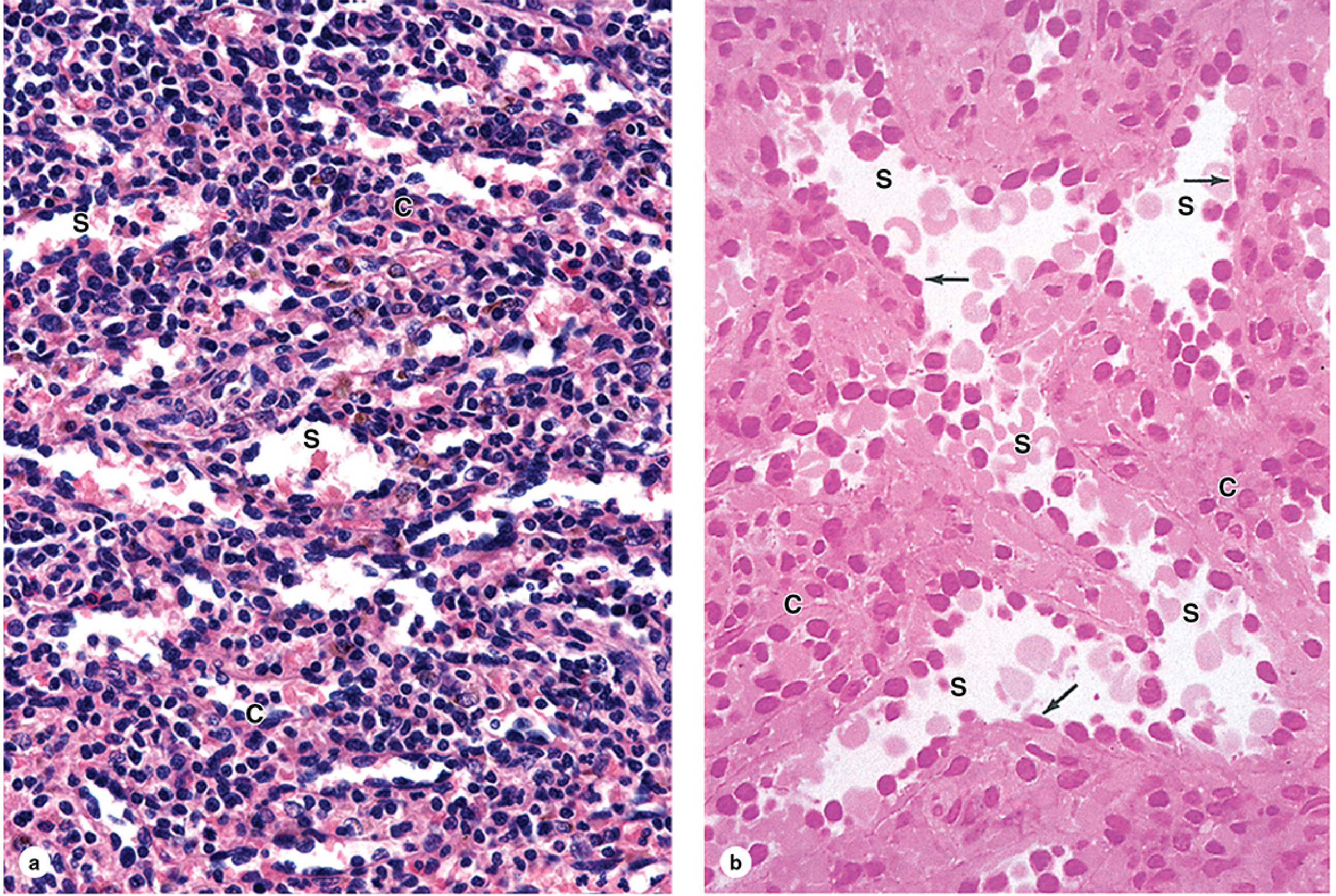
Quick identification rule: The red pulp = alternating pattern of pale slit-like sinusoids + RBC-filled cords. The stave-cell nuclei poking into the sinus lumen are distinctive at high power.
H&E Summary Table
| Structure | Color (H&E) | Key identifying feature |
|---|---|---|
| Capsule | Pink | Thick outer band, myofibroblasts |
| Trabeculae | Pink | Inward projections, contain blood vessels |
| White pulp (PALS) | Dark blue-purple | Sleeve of lymphocytes around central artery |
| Splenic nodule | Dark blue-purple with pale center | Round B-cell follicle; central artery eccentric |
| Marginal zone | Intermediate | Thin transitional band at WP/RP border |
| Red pulp cords | Pink | Reticular meshwork, macrophages, RBCs |
| Splenic sinusoids | Pale/clear to pink | Stave-cell nuclei bulging into lumen |
Normal H&E section — recognizing white vs. red pulp at a glance
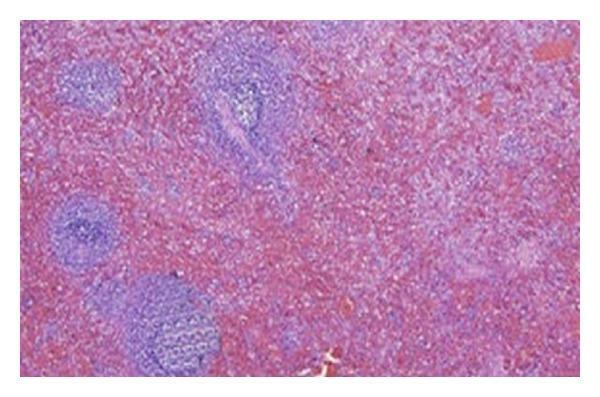
In this image you can immediately spot:
- Dark violet-blue round/oval masses = white pulp (lymphoid nodules/PALS)
- Diffuse pink background = red pulp (cords + sinusoids)
- The proportion is approximately 80% red pulp, 20% white pulp
Blood Flow Recap (helps understand the architecture)
Splenic artery → trabecular artery → central arteriole (enters white pulp, acquires PALS) → penicillar arterioles → sheathed capillaries → open circulation into splenic cords (RBCs squeeze through sinusoid walls to return to blood) → sinusoids → trabecular veins → splenic vein.
Sources: Histology: A Text and Atlas (Ross & Pawlina), 9th ed.; Junqueira's Basic Histology, 17th ed.
This is a shared conversation. Sign in to Orris to start your own chat.