
Parks measles
Reading File
Now let me search the library for measles content in Park's textbook, along with a PubMed search for recent evidence.
Finding Sources
Searching PubMed
measles epidemiology prevention
The user is asking about "Parks measles" - this refers to Park's Textbook of Preventive and Social Medicine, a classic community medicine/epidemiology textbook. However, I don't see it in the library. Let me search for Park's textbook specifically and also search the paragraphs_fts for detailed measles content.
Finding Sources
Finding Sources
Park's Textbook of Preventive and Social Medicine is not in the library. Let me read the best available measles content from Andrews' (dermatology) and Goldman-Cecil, which have dedicated measles sections, and also from Tintinalli's Emergency Medicine.
Reading File
Reading File
Reading File
Now let me read the Goldman-Cecil section on measles (pathogenesis, clinical, treatment) and also fetch the Koplik spots image.
Reading File
Loading Image
Now let me get the Goldman-Cecil clinical features and treatment section, and also search for the measles rash image and the SSPE/complications content.
Reading File
Finding Sources
Park's Textbook IS in the library. Let me read the Park's measles section directly.
Finding Sources
Now let me read the main Park's measles section comprehensively.
Reading File
Reading File
Reading File
Reading File
Reading File
Now let me also get the treatment section and the complications section fully, and get the Park's measles vaccine section from block 6.
Reading File
I now have comprehensive content from Park's Textbook. Let me also grab the prodromal phase section that was cut off earlier.
Reading File
I now have all the essential content from Park's. Let me compile the comprehensive answer.
Measles (Rubeola) - Park's Textbook of Preventive and Social Medicine
(Park's Textbook of Preventive and Social Medicine, Chapter on Communicable Diseases)
Definition
Measles (rubeola) is an acute, highly infectious disease of childhood caused by an RNA paramyxovirus (genus Morbillivirus). It is clinically characterized by fever, catarrhal symptoms of the upper respiratory tract (coryza, cough), followed by a typical maculopapular rash. There is only one serotype and humans are the only reservoir - no animal reservoir exists.
Problem Statement
- Measles is endemic virtually worldwide and occurs in epidemics when the proportion of susceptible children reaches ~40%.
- In virgin communities, >90% of individuals will be infected upon introduction.
- In 1980, before widespread vaccination, ~2.6 million measles deaths occurred annually worldwide.
- By 2018, measles-related deaths fell by 73% and cases by 76% compared to 2000, but still accounted for ~9.7 million cases and >140,000 deaths in 2018.
- Measles accounts for ~2% of under-five mortality worldwide.
- In India, it is a significant cause of childhood morbidity, with West Bengal, Assam, J&K, Maharashtra, Delhi, Uttar Pradesh, and Rajasthan being heavily affected states.
Epidemiological Determinants
Agent Factors
| Factor | Detail |
|---|---|
| Agent | RNA paramyxovirus, single serotype |
| Source | Only a case of measles (no carriers) |
| Infective material | Nasal, throat, and respiratory secretions during prodrome and early rash |
| Communicability | 4 days before to 4 days after rash onset |
| Isolation period | 7 days from onset of rash |
| Immunity after infection | Life-long; second attacks are rare (usually diagnostic errors) |
Host Factors
| Factor | Detail |
|---|---|
| Age | 6 months - 3 years in developing countries; >5 years in developed countries |
| Sex | Incidence equal |
| Maternal immunity | Protects infants up to 6 months (sometimes >9 months) |
| Nutrition | Mortality in malnourished children up to 400 times higher than well-nourished; related to impaired cell-mediated immunity |
Environmental Factors
- In tropical zones: mostly dry season
- In temperate climates: winter disease (crowding indoors)
- India: epidemics peak January to April (winter-early spring)
- Population density and poor socioeconomic conditions lower the average age of attack
Transmission
- Primarily droplet infection and droplet nuclei (person-to-person)
- Portal of entry: respiratory tract (conjunctival route also possible)
- Communicable from 4 days before rash to 4 days after rash onset
- Vaccine recipients are NOT contagious to others
Incubation Period
- 10 days from exposure to onset of fever
- 14 days from exposure to appearance of rash
- When live vaccine is injected (bypassing respiratory tract): shortened to ~7 days
Clinical Features
There are three stages in the natural history:
1. Prodromal Stage (Days 10-14 post-exposure)
- Fever, coryza (sneezing, nasal discharge), cough, red eyes (conjunctivitis), lacrimation, photophobia
- Vomiting or diarrhoea may occur
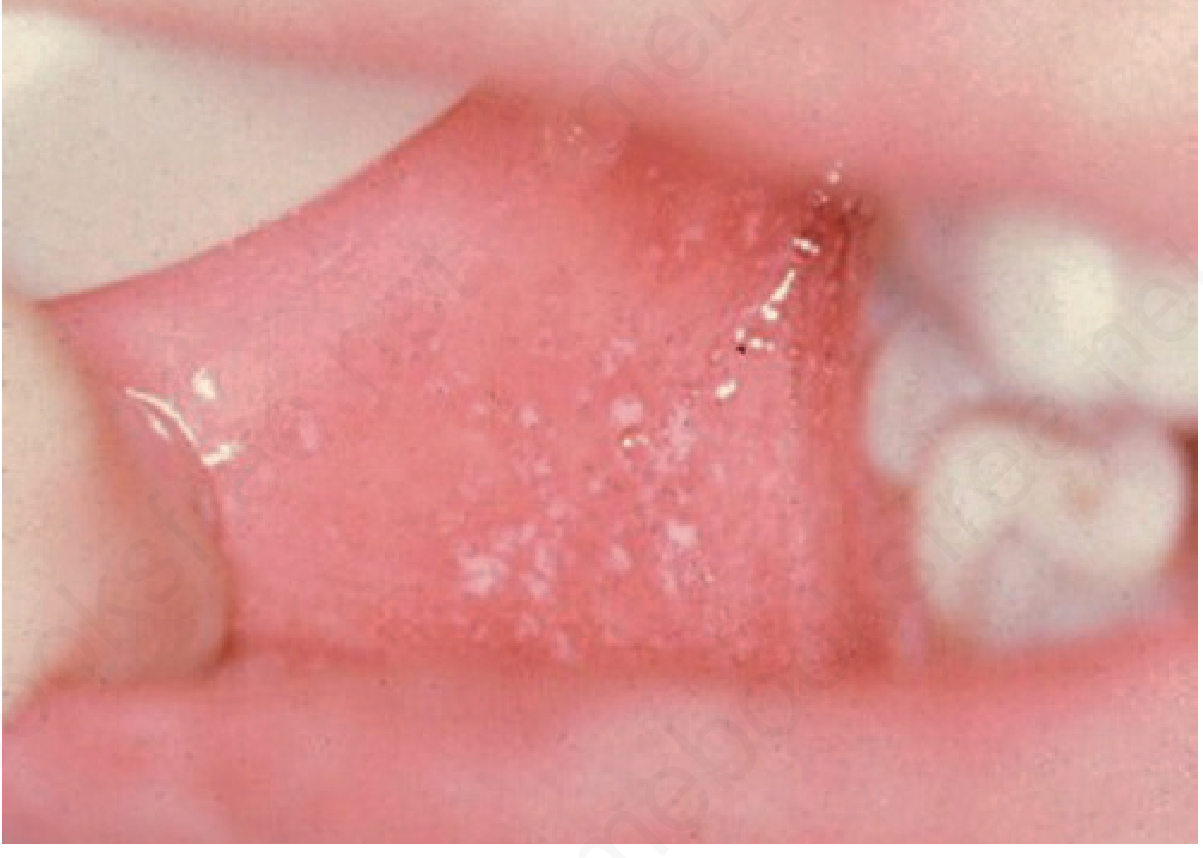
- Koplik's spots - appear 1-2 days before the rash: small, bluish-white spots on a red base, like "table salt crystals," on buccal mucosa opposite the first and second lower molars - pathognomonic of measles
2. Eruptive Stage
- Dusky-red macular or maculopapular rash begins behind the ears, spreads over face and neck within hours
- Extends downward over trunk to lower extremities over 2-3 days (cephalocaudal spread)
- Rash may be discrete initially, then becomes confluent and blotchy
- Virus is present in tears, nasal/throat secretions, urine, and blood during the prodrome and first 2-5 days of rash
- As rash appears, circulating antibodies become detectable, viraemia disappears, and fever falls
- Rash results from interaction of immune T-cells with virus-infected cells in small blood vessels; in patients with defective cell-mediated immunity, no rash develops
- Fever and rash clear by day 3-4 of eruptive phase; rash fades leaving brownish discoloration that persists for 2+ months
3. Post-Measles Stage
- Weight loss and weakness persist for days
- Risk of secondary infections: increased susceptibility to bacterial and viral infections
- May develop: growth retardation, diarrhoea, cancrum oris, pyogenic infections, candidiasis, reactivation of pulmonary tuberculosis
Diagnosis
- Clinical: typical rash + Koplik's spots; diagnosis is incorrect in any febrile exanthem without red eyes and cough
- In developed countries (where measles is uncommon):
- Specific IgM antibodies by ELISA (present at rash onset)
- RT-PCR (detects measles virus RNA in throat swabs, oral fluid, nasopharyngeal mucus, or urine)
- RT-PCR can distinguish true measles from IgM elevation due to recent vaccination
Complications
Complications occur in approximately 30% of reported cases. Risk is highest in children <5 years, malnourished children (especially vitamin A deficient), those living in overcrowded conditions, and immunocompromised individuals.
| Complication | Frequency/Notes |
|---|---|
| Otitis media | 7-9% (developed countries) |
| Diarrhoea | 8% (developed countries) |
| Pneumonia | 1-6% (major cause of death) |
| Laryngotracheobronchitis (croup) | Common |
| Post-infectious encephalitis | ~1-4 per 1,000-2,000 cases; fatal in some |
| Subacute sclerosing panencephalitis (SSPE) | 1 per 10,000-100,000 cases; appears years after infection; risk higher if infected <2 years of age |
| Measles inclusion-body encephalitis | Immunocompromised individuals |
| Giant cell pneumonia | Immunocompromised individuals |
| Measles in pregnancy | Associated with spontaneous abortion and premature delivery (not congenital abnormalities) |
| HIV-infected children | Case-fatality rate up to 50% |
Case-fatality rates:
- Developing countries: 3-6%, up to 30% in displaced/isolated populations
- Developed countries: 0.01-0.1%
- Highest mortality: children <1 year and adults >30 years
Treatment
There is no specific antiviral treatment for measles.
Supportive care:
- Relieve fever, cough, nasal congestion, conjunctivitis
- Nutritional support (prevent malnutrition)
- Encourage breast-feeding where appropriate
- Oral rehydration salts to prevent dehydration
- Patient isolation (important to prevent spread)
Vitamin A therapy (WHO recommendation):
- All severe cases and all cases in areas with high case-fatality rates
- Dose schedule:
- <6 months: 50,000 IU/day for 2 days
- 6-11 months: 100,000 IU/day for 2 days
- ≥12 months: 200,000 IU/day for 2 days
- If clinical signs of vitamin A deficiency (e.g., Bitot's spots): give a third dose 4-6 weeks later
- Rationale: Many children develop acute vitamin A deficiency during measles, which can lead to keratomalacia and blindness from corneal scarring
Prevention
Two main strategies:
- Achieve immunization rate >95%
- On-going immunization through successive generations
Measles Vaccination
Vaccine characteristics:
- Only live attenuated vaccines are recommended (safe and effective)
- Available as: monovalent measles; MR (measles-rubella); MMR (measles-mumps-rubella); MMRV (measles-mumps-rubella-varicella)
- Freeze-dried product; reconstituted with sterile diluent; each dose 0.5 mL with ≥1,000 viral infective units
- Contains sorbitol and hydrolyzed gelatin as stabilizers; small amount of neomycin; no thiomersal
- Sensitive to heat and sunlight; kept in colored glass vials
- Reconstituted vaccine loses ~50% potency in 1 hour at 20°C; nearly all potency at 37°C in 1 hour
- After reconstitution: store at 2-8°C in dark; use within 4 hours
Schedule (India/WHO):
| Setting | MCV1 | MCV2 |
|---|---|---|
| High transmission risk (developing countries) | 9 months | 15-18 months |
| Low transmission/near elimination | 12 months | As per schedule |
| Minimum interval between MCV1 and MCV2 | - | 4 weeks |
Contraindications:
- Pregnancy (theoretical grounds)
- Altered immunocompetence (except HIV-infected who are not severely immunocompromised)
- History of anaphylaxis to prior dose or vaccine component
- Note: patients with anaphylactic reactions to eggs can be vaccinated without prior skin testing
Immunoglobulin (Passive Immunization)
- Dose: 0.25 ml/kg body weight given within 3-4 days of exposure
- Live measles vaccine should be given 8-12 weeks later to establish active immunity
- Need is now much reduced due to availability of live attenuated vaccine
Outbreak Control Measures
- Isolation for 7 days after onset of rash
- Immunization of contacts within 2 days of exposure
- If vaccine is contraindicated: immunoglobulin within 3-4 days of exposure
- Prompt immunization at the start of an epidemic to limit spread
Eradication of Measles
Measles is considered amenable to eradication (like smallpox) because:
- Humans are the only reservoir
- There is only one serotype
- Effective live attenuated vaccines are available
WHO 2010 targets (milestones toward eradication):
- ≥90% MCV1 coverage nationally; ≥80% in every district
- Annual incidence <5 cases per million population
- ≥95% reduction in measles mortality compared to 2000
Global Measles and Rubella Strategic Framework 2021-2030: Vision - "A world free from measles and rubella," with the goal to "achieve and sustain regional measles and rubella elimination goals."
India's strategies for elimination:
- 95% coverage with measles and rubella vaccination
- Case-based MR surveillance with laboratory support
- Linkage with other child health interventions
- Increased public confidence and demand for immunization
Recent Evidence
Recent systematic reviews support the above:
- A 2024 meta-analysis (PMID 39574018) confirms high measles vaccine effectiveness in African children
- A 2025 systematic review (PMID 39799850) examined adverse events following measles vaccines in infants <12 months
- A 2026 systematic review (PMID 41619351) provides updated guidance on measles exposure periods for contact tracing
Sources: Park's Textbook of Preventive and Social Medicine; Goldman-Cecil Medicine; Andrews' Diseases of the Skin; Tintinalli's Emergency Medicine
Measles cyclical trend explain
Measles shows a well-known cyclical (epidemic) pattern - outbreaks occur every 2-3 years in unvaccinated populations. This happens because after each epidemic, the pool of susceptibles is depleted, but as new births accumulate susceptible individuals, the pool rebuilds until a threshold is reached and the next epidemic ignites.
Searching sources...
Finding Sources
Finding Sources
Finding Sources
Finding Sources
Finding Sources
Finding Sources
Finding Sources
Finding Sources
Excellent - Harrison's has exactly what we need. Let me read that section fully, and also search Park's for the susceptible threshold concept.
Reading File
Finding Sources
Now let me read the Park's epidemiology section for the 40% susceptible threshold concept, and search for herd immunity/R0 content.
Reading File
Finding Sources
That's the exact key passage from Park's on India's cyclical trend. I now have all the material needed for a comprehensive answer. Let me compile it.
Measles - Cyclical (Epidemic) Trend Explained
The Core Concept
Measles does not circulate at a constant level. It follows a cyclical pattern - periods of epidemic activity alternate with quieter inter-epidemic periods. This happens because measles virus can only sustain transmission by maintaining an unbroken chain of acute infections, and that requires a continuous supply of susceptible individuals.
Why Cycles Occur - The Susceptible Pool Mechanism
The cycle is driven by the accumulation and depletion of susceptibles in the population:
Epidemic burns through susceptibles
       ↓
Susceptible pool depleted → epidemic dies out
       ↓
New births (unimmunized) + waning maternal antibodies
add susceptibles back to the population
       ↓
Susceptible pool builds up again over successive birth cohorts
       ↓
Threshold reached (~40% susceptible) → next epidemic ignites
       ↓
Repeat
Key facts driving this:
- There are no animal reservoirs and no latent/persistent infections with measles virus
- One attack confers lifelong immunity - once infected, a person is removed from the susceptible pool permanently
- The primary source of new susceptibles is unimmunized newborns, who lose maternal antibody protection by 6-9 months of age
Park's Textbook - What It Says Directly
"Measles tends to occur in epidemics when the proportion of susceptible children reaches about 40 per cent."
- Park's Textbook of Preventive and Social Medicine
"Prior to the immunization programme, cyclical increase in the incidence of measles were recorded every third year in India. With the increase in immunization coverage levels, the intervals between cyclical peaks has increased and the intensity of the peak minimized."
- Park's Textbook of Preventive and Social Medicine
In India specifically:
- Before the Universal Immunization Programme (UIP): epidemics every 3 years
- In 1987: ~2.47 lakh (247,000) cases reported
- After UIP implementation: cases fell to 20,895 with 34 deaths in 2018
- The cyclical pattern persisted in tribal and remote areas with low vaccine coverage
Two Overlapping Cycles (Harrison's, 22nd Ed.)
Harrison's describes measles as having two superimposed temporal patterns:
| Cycle | Periodicity | Mechanism |
|---|---|---|
| Annual seasonal cycle | Every year | Social networks (school congregation) + environmental factors favoring viral viability; typically late winter/early spring in temperate climates |
| Longer epidemic cycle | Every 2-5 years | Accumulation of susceptibles over successive birth cohorts until threshold is reached, then rapid depletion during epidemic |
Between these longer epidemics, measles cases do still occur during inter-epidemic periods - but at low incidence.
The Role of R₀ and Herd Immunity Threshold
- Measles has the highest R₀ of any known pathogen - estimated at 12-18 (Goldman-Cecil Medicine), meaning one case can infect 12-18 susceptible contacts
- This extreme transmissibility means:
- Outbreaks can occur when even <10% of the population is susceptible (Harrison's)
- The herd immunity threshold needed to prevent spread is very high: approximately 92-95% immune coverage required
- Achieving >95% vaccination rate is required to prevent epidemic cycles (Park's)
How Vaccination Changes the Cycle
| Vaccination Coverage | Effect on Cyclical Pattern |
|---|---|
| Low / no vaccination | Epidemics every 2-3 years (India: every 3rd year pre-UIP) |
| Moderate vaccination | Interval between cycles lengthens (e.g., every 5-10 years), but outbreaks still occur - and may be more severe because older age groups (adolescents, adults) have not been naturally exposed |
| >95% vaccination | Cycles are broken; endemic transmission interrupted; measles can be eliminated |
| <95% with vaccine hesitancy | Cycles resume in under-immunized clusters/communities |
This is why increasing immunization coverage does two things simultaneously:
- Lengthens the interval between epidemic peaks
- Reduces the intensity (size) of each peak
Shift in Age Distribution with Vaccination
As vaccination coverage increases, the age pattern of cases shifts:
- Low coverage, high density (developing countries): disease hits infants and young children (peak <2 years)
- Moderate coverage: cases shift to school-age children
- High coverage: cases shift to adolescents and adults (who escaped natural infection and were not vaccinated)
- Some countries develop a bimodal distribution: cases in young infants (born to mothers with vaccine-derived - rather than naturally acquired - antibodies, whose maternal antibody levels are lower) AND adults
Summary Diagram of the Cycle
EPIDEMIC PEAK
 (susceptibles ~40% of population)
        |
        ↓ (epidemic burns through susceptibles)
INTER-EPIDEMIC TROUGH
 (susceptibles now <threshold; virus has nothing to spread to)
        |
        ↓ (new births accumulate unimmunized susceptibles)
        ↓ (waning maternal antibody in infants)
        ↓ (migration of susceptibles into area)
SUSCEPTIBLE POOL REBUILDS
        |
        ↓ (threshold ~40% reached again)
NEXT EPIDEMIC PEAK
Without vaccination: Cycle repeats every 2-3 years (India: every 3rd year).
With vaccination: Cycles lengthen, peaks shrink; at >95% coverage, the chain breaks entirely.
Sources: Park's Textbook of Preventive and Social Medicine; Harrison's Principles of Internal Medicine 22nd Ed.; Goldman-Cecil Medicine
Explain the 95% herd immunity threshold for measles mathematically
The herd immunity threshold for measles derives directly from the basic reproduction number (R₀). When R₀ = 12-18, the fraction of the population that must be immune to stop transmission is 1 - 1/R₀, giving approximately 92-95%.
Reasoning...
Finding Sources
Finding Sources
Finding Sources
Finding Sources
Finding Sources
Finding Sources
Both Park's and Roitt's have dedicated herd immunity sections. Let me read both simultaneously.
Reading File
Reading File
I have excellent textbook content. Now let me also search for the Goldman-Cecil R₀ passage from the previous session (R₀ 12-18), and look for any Park's content on the critical immunization threshold formula.
Finding Sources
Finding Sources
Reading File
I have all the necessary material. Now let me build the full mathematical explanation from first principles.
The 95% Herd Immunity Threshold for Measles - Mathematical Explanation
Step 1: Start with R₀ (Basic Reproduction Number)
R₀ is defined as the average number of secondary cases produced by one infectious individual in a completely susceptible population.
For measles:
"Measles may be the most contagious pathogen known to humans... its basic reproduction number R₀ has been estimated to be 12 to 18."
- Goldman-Cecil Medicine
To compare: Ebola R₀ = 2-3; Influenza R₀ = 2-3; COVID-19 (original) R₀ ≈ 2-3.
Measles is in a league of its own.
Step 2: The Effective Reproduction Number (Rₑ)
In the real world, not everyone is susceptible. Some people are immune (through vaccination or prior infection). If a fraction p of the population is immune, then only the fraction (1 - p) is susceptible.
When a measles case contacts people randomly, only the susceptible fraction can be infected. So:
$$R_e = R_0 \times (1 - p)$$
Where:
- Rₑ = effective reproduction number (actual number of new cases per index case)
- R₀ = basic reproduction number (12-18 for measles)
- p = proportion of the population that is immune
Step 3: The Condition for Epidemic Control
An epidemic grows when each case produces more than one new case → Rₑ > 1
An epidemic dies out when each case produces less than one new case → Rₑ < 1
The tipping point is Rₑ = 1.
To stop an epidemic, we need:
$$R_e < 1$$
$$R_0 \times (1 - p) < 1$$
$$1 - p < \frac{1}{R_0}$$
$$p > 1 - \frac{1}{R_0}$$
This gives the Herd Immunity Threshold (HIT):
$$\boxed{p_c = 1 - \frac{1}{R_0}}$$
Where p_c is the critical proportion that must be immune to prevent sustained transmission.
Step 4: Plug in Measles R₀
Using R₀ = 12 (lower bound):
$$p_c = 1 - \frac{1}{12} = 1 - 0.083 = \mathbf{0.917 = 91.7%}$$
Using R₀ = 15 (midpoint):
$$p_c = 1 - \frac{1}{15} = 1 - 0.067 = \mathbf{0.933 = 93.3%}$$
Using R₀ = 18 (upper bound):
$$p_c = 1 - \frac{1}{18} = 1 - 0.056 = \mathbf{0.944 = 94.4%}$$
| R₀ | 1/R₀ | HIT (p_c) |
|---|---|---|
| 12 | 0.083 | 91.7% |
| 14 | 0.071 | 92.9% |
| 15 | 0.067 | 93.3% |
| 16 | 0.063 | 93.8% |
| 18 | 0.056 | 94.4% |
The range of 92-95% emerges naturally from the R₀ range of 12-18. WHO and Park's use 95% as the operational target because:
- It covers the upper end of the R₀ range
- It builds in a safety margin for vaccine efficacy (vaccines are ~95-99% effective, not 100%)
- It accounts for geographic clustering of unvaccinated individuals
Step 5: Why Vaccine Efficacy Matters - Required Coverage ≠ HIT
The herd immunity threshold (p_c) is the proportion of the population that must be immune. But no vaccine is 100% effective. If vaccine efficacy is E, then the required vaccination coverage (V_c) to achieve that level of immunity is:
$$V_c = \frac{p_c}{E} = \frac{1 - \frac{1}{R_0}}{E}$$
For measles vaccine (two-dose MMR efficacy ≈ 97%):
Using R₀ = 15, p_c = 93.3%:
$$V_c = \frac{0.933}{0.97} = 0.961 = \mathbf{96.1%}$$
So even if 93% of the population needs to be immune, you need to vaccinate ~96% to actually achieve that, given that ~3% of vaccinated individuals don't seroconvert.
Step 6: What Happens at Different Coverage Levels
Let's trace what Rₑ looks like at different vaccination coverages (using R₀ = 15):
| Vaccination Coverage (p) | Immune fraction | Rₑ = 15 × (1-p) | Interpretation |
|---|---|---|---|
| 0% | 0% | 15.0 | Epidemic grows explosively |
| 40% | 40% | 9.0 | Still growing fast |
| 60% | 60% | 6.0 | Still growing |
| 80% | 80% | 3.0 | Still growing |
| 90% | 90% | 1.5 | Still growing (epidemic possible) |
| 93.3% | 93.3% | 1.0 | Tipping point |
| 95% | 95% | 0.75 | Declining - epidemic dies out |
| 99% | 99% | 0.15 | Near elimination |
This explains why Park's says measles epidemics occur when susceptibles reach ~40% of the population - at 60% immune coverage, Rₑ is still 6.0, well above 1, so an epidemic is entirely possible.
Step 7: Intuitive Explanation
Think of it this way. With R₀ = 15, one measles case will try to infect 15 people. If 14 out of those 15 contacts are immune (93.3% immune), on average only 1 person gets infected per case - the chain neither grows nor shrinks. If even slightly more are immune, the chain shrinks and the epidemic dies.
R₀ = 15: One case tries to infect 15 people

At 93% immune:     [ I I I I I I I I I I I I I S S ] → 2 new cases (Rₑ=2 → grows)
At 93.3% immune:   [ I I I I I I I I I I I I I I S ] → 1 new case (Rₑ=1 → stable)
At 95% immune:     [ I I I I I I I I I I I I I I I ] → <1 new case (Rₑ<1 → dies)

I = Immune, S = Susceptible
Step 8: Why Clustering Breaks the Model
The formula assumes random mixing across the population. In reality, unvaccinated individuals tend to cluster together (communities with vaccine hesitancy, religious groups, tribal/remote populations in India). In a cluster where 50% are unvaccinated:
Local Rₑ = 15 × 0.50 = 7.5 - epidemic easily ignites within that cluster
This is why Park's emphasizes the need for ≥95% coverage in every district, not just nationally - a 95% national average with 60% coverage in some districts still allows local outbreaks.
Comparison with Other Vaccine-Preventable Diseases
| Disease | R₀ | HIT (1 - 1/R₀) |
|---|---|---|
| Measles | 12-18 | 92-95% |
| Mumps | 4-7 | 75-86% |
| Rubella | 5-7 | 80-86% |
| Diphtheria | 6-7 | 83-86% |
| Polio | 5-7 | 80-86% |
| Smallpox | 5-7 | 80-86% |
| COVID-19 (original) | 2-3 | 50-67% |
Measles has the highest HIT of any vaccine-preventable disease - this is what makes it so hard to eliminate, and why >95% vaccination coverage is the international target.
"Studies have shown that it is neither possible nor necessary to achieve 100 per cent herd immunity in a population to halt an epidemic... The proportion of immune individuals above which a disease may no longer persist is the herd immunity threshold. Its value varies with the virulence of the disease, the efficacy of the vaccine and the contact parameter for the population."
- Park's Textbook of Preventive and Social Medicine
Summary
$$\text{HIT} = p_c = 1 - \frac{1}{R_0}$$
For measles (R₀ = 12-18):
$$p_c = 1 - \frac{1}{12 \text{ to } 18} = 91.7% \text{ to } 94.4%$$
WHO/Park's operational target: ≥95% (covers upper R₀ range + vaccine efficacy buffer + clustering safety margin)
Sources: Park's Textbook of Preventive and Social Medicine; Goldman-Cecil Medicine; Roitt's Essential Immunology; Harrison's Principles of Internal Medicine 22nd Ed.
This is a shared conversation. Sign in to Orris to start your own chat.