
What is the stages of delusion With references please
delusion formation stages phenomenology
delusion phenomenology schizophrenia
stages of delusion formation psychiatry Conrad Jaspers trema apophany
https://pmc.ncbi.nlm.nih.gov/articles/PMC2800156
Stages of Delusion Formation
Conrad's Five-Stage Model of Delusion Development
Stage I: Trema (Delusional Mood / Atmosphere)
- The term comes from the Greek colloquial for "stage fright"
- The patient experiences an undefinable, increasingly upsetting quality that spreads from salient aspects to the entire perceptual field
- There is no formed belief yet - just a pervasive, ominous sense that something is wrong or about to happen
- The perceptual background, previously unnoticed, takes on its own character and significance
- Clinically: anticipatory excitement, suspiciousness, alienation, fear, guilt, depression, or a combination
- The patient may perform abrupt, seemingly meaningless actions
- Everything in the "periphery of attention" becomes a potential threat
"The perceptual background acquires entirely new characteristics. Everything that lies in the periphery to one's attention, what is behind, or not part of the current thematic focus becomes a potential threat." - Conrad
Stage II: Apophany (Delusional Revelation / Aha-Erlebnis)
- From Greek: apo (away from) + phaenein (to show) = revelation
- This is the critical "Aha-Erlebnis" (Aha-experience) - the moment when a normal percept or event is suddenly given an abnormal, self-referential meaning
- The patient repetitively and monotonously experiences abnormal meanings in the surrounding experiential field (e.g., being watched, spoken about, followed)
- The patient loses the ability to distance themselves from the experience or consider it from another perspective
- This stage corresponds closely to what Jaspers called "delusional perception" - a real perception that receives an abnormal meaning
- The patient is not conscious of having lost their capacity to consider alternative perspectives
Stage III: Anastrophe (Heightening / Apocalyptic Phase)
- Heightening of the psychosis to its maximum intensity
- The patient's world is reorganized around the delusional framework
- May include catastrophic or apocalyptic features (Conrad also called a related sub-stage the "apocalyptic-catatonic" phase)
- The self is now placed at the center of all events; everything refers to the patient personally
- Marked perplexity, terror, or grandiosity depending on the delusional content
Stage IV: Consolidation (Systematization / New World Formation)
- Formation of a new, stable worldview built on the delusional meaning system
- The patient constructs an internally consistent explanatory framework around their delusions
- The acute emotional distress of earlier stages may reduce as the delusion becomes organized
- Corresponds to what is clinically called "systematized delusions"
- The patient achieves a kind of partial equilibrium within the delusional world
Stage V: Residuum (Burnt-Out / Autistic State)
- The eventual autistic or defect state
- Emotional intensity fades (the delusion "burns out")
- The belief may persist but the patient is no longer acutely distressed or driven by it
- Associated with negative symptoms of schizophrenia: social withdrawal, affective flattening, poverty of thought
- The patient may become fixed in their delusional world, isolated from shared reality
Additional Context: Jaspers' Primary vs. Secondary Delusion
| Feature | Primary Delusion | Secondary Delusion |
|---|---|---|
| Origin | Arises "out of the blue," incomprehensible | Understandable from mood, circumstance, or personality |
| Forms | Delusional mood, delusional perception, delusional idea | Derived from hallucinations, mood, or other psychopathology |
| Example | Delusional perception | Persecutory belief arising from auditory hallucinations |
- Delusional mood - corresponds to Conrad's Trema
- Delusional perception - a real percept suddenly acquires a special, self-referential significance
- Delusional memory - a past memory is suddenly reinterpreted as having had special significance
Roberts' 3-Stage Anthropological Model (1992)
- Premorbid vulnerability - biological and psychological predisposition
- Delusional formation - the emergence of the belief
- Delusional consolidation - stabilization and elaboration of the belief
Summary Table: Conrad's 5 Stages
| Stage | Name | Core Feature |
|---|---|---|
| I | Trema | Delusional mood - vague dread, "something is wrong" |
| II | Apophany | Aha-revelation - normal event acquires delusional meaning |
| III | Anastrophe | Heightening - full psychotic break, world reorganized |
| IV | Consolidation | Systematized stable delusion, partial equilibrium |
| V | Residuum | Burnt-out autistic state, emotional blunting |
References
-
Conrad, K. (1958). Die beginnende Schizophrenie [Beginning Schizophrenia]. Stuttgart: Thieme. - Original source of the 5-stage model.
-
Jaspers, K. (1913/1963). General Psychopathology. Manchester: Manchester University Press. - Foundation of phenomenological approach to delusions.
-
Mishara, A.L. (2010). Klaus Conrad (1905-1961): Delusional mood, psychosis, and beginning schizophrenia. Schizophrenia Bulletin, 36(6), 1083-1085. PMC2800156 - Key secondary source on Conrad's model with full stage table.
-
Teeple, R.C., Caplan, J.P., & Stern, T.A. (2009). Delusions. StatPearls NCBI Bookshelf NBK563175 - Summarizes Conrad's 5 stages alongside other theories.
-
Kapur, S. (2003). Psychosis as a state of aberrant salience: a framework linking biology, phenomenology, and pharmacology in schizophrenia. American Journal of Psychiatry, 160(1), 13-23. PMID: 12505794 - Key neurobiological framework (dopamine dysregulation → aberrant salience → delusional meaning formation).
-
Kaplan & Sadock's Comprehensive Textbook of Psychiatry (10th ed.) - Lists classic types of delusions including delusional mood, delusional perception, and delusional memory as distinct phenomena (Table 8-2).
-
P.C. Dikshit's Textbook of Forensic Medicine and Toxicology - Defines delusion and its types in the medicolegal context.
-
The Essentials of Forensic Medicine and Toxicology (36th ed., 2026) - Distinguishes primary and secondary delusions in clinical and forensic settings.
Yes
- More detail on Jaspers' phenomenology
- The neurobiological basis (aberrant salience theory)
- Types of delusions in more depth
- Clinical assessment of delusions
- Medicolegal aspects of delusions
Make a comparison poster: Conrad vs Jaspers models
A professional academic comparison poster titled "Models of Delusion Formation: Conrad vs Jaspers" for psychiatry education. Left side (deep navy blue header): "CONRAD'S 5-STAGE MODEL (1958)" with a vertical timeline showing 5 numbered stages with icons: Stage 1 - TREMA: Delusional Mood - vague dread, stage fright, sense something is wrong Stage 2 - APOPHANY: Delusional Revelation - Aha-Erlebnis, normal event gets delusional meaning Stage 3 - ANASTROPHE: Heightening - full psychotic break, world reorganized around self Stage 4 - CONSOLIDATION: Systematization - stable delusional worldview forms Stage 5 - RESIDUUM: Burnt-out state - autistic withdrawal, emotional blunting Right side (deep burgundy/maroon header): "JASPERS' PHENOMENOLOGICAL MODEL (1913)" with 3 forms of primary delusion: Form 1 - DELUSIONAL MOOD: Vague atmospheric change, no formed belief yet Form 2 - DELUSIONAL PERCEPTION: Real percept given abnormal self-referential meaning Form 3 - DELUSIONAL IDEA/MEMORY: Past memory reinterpreted with special significance Plus distinction box: Primary Delusion (un-understandable, arises out of the blue) vs Secondary Delusion (understandable from mood/circumstances) Center divider: A comparison table with rows: - Approach: Sequential stages vs Phenomenological forms - Focus: Progression over time vs Structure of the experience - Key Concept: Stage fright to burnt-out vs Primary vs Secondary - Origin: Clinical observation vs Philosophical psychopathology - Scope: Schizophrenia prodrome vs All psychotic states Bottom bar: clean reference strip "Conrad (1958) Die beginnende Schizophrenie | Jaspers (1913) General Psychopathology" Clean medical poster design, white background, clear typography, color-coded columns, professional academic style
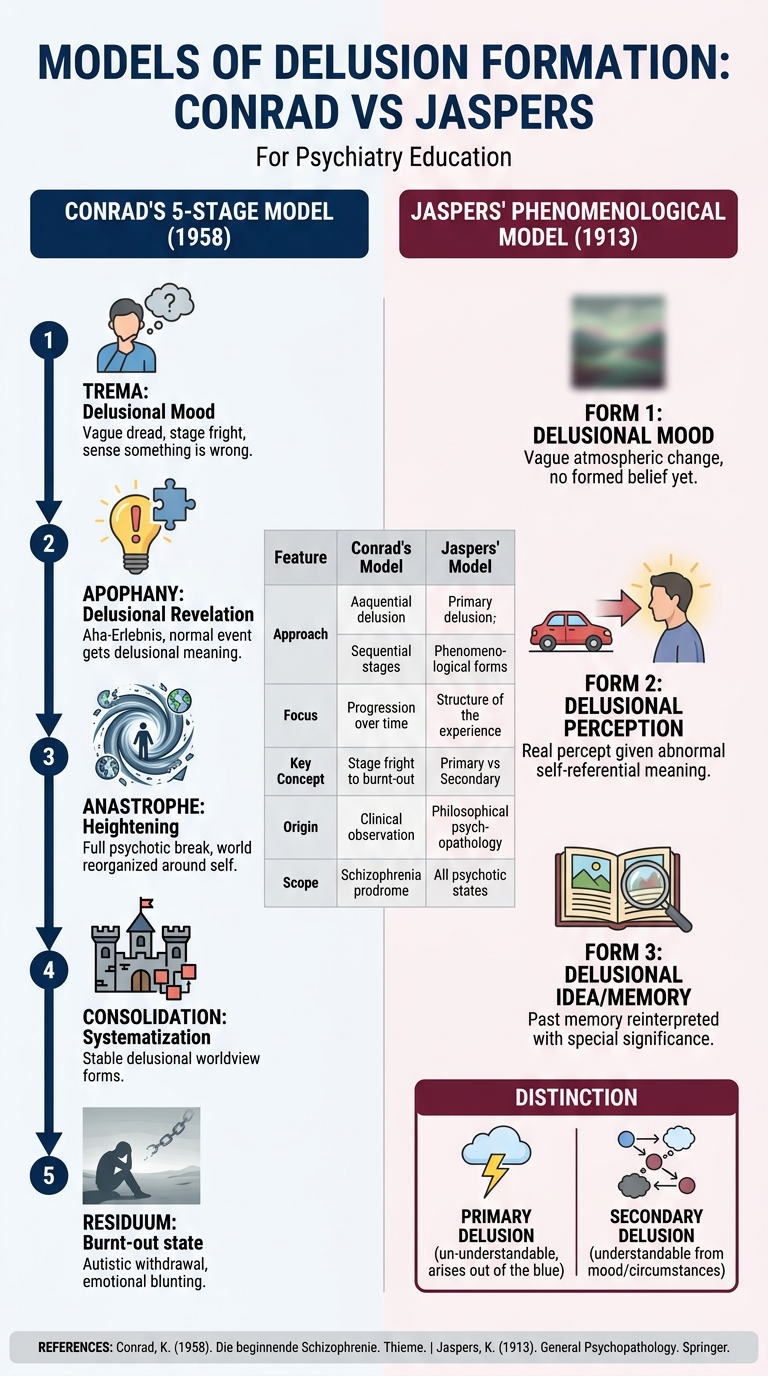
- Left (Conrad, 1958) - the 5 sequential stages from Trema through Residuum, showing delusion as a progressive unfolding process
- Right (Jaspers, 1913) - the phenomenological forms (delusional mood, perception, idea/memory) plus the primary vs. secondary distinction
- Center - a quick comparison table highlighting how the two models differ in approach, focus, and scope