
Pancreatic insufficiency effect on lipid metabolism
Reading File
Now I'll run parallel searches across the library and PubMed simultaneously.
Finding Sources
Finding Sources
Searching PubMed
exocrine pancreatic insufficiency lipid metabolism fat malabsorption
Good results. Now I'll read the most relevant textbook sections in parallel.
Reading File
Reading File
Reading File
Searching PubMed
exocrine pancreatic insufficiency steatorrhea lipid
Excellent data. Let me read a bit more from Costanzo and also fetch the lipid absorption diagram for visual reference.
Reading File
Reading File
Loading Image
I now have comprehensive information from multiple authoritative textbooks. Here is the full answer:
Pancreatic Insufficiency: Effects on Lipid Metabolism
Exocrine pancreatic insufficiency (EPI) disrupts lipid metabolism at its very first step - luminal digestion - and the consequences cascade through absorption, transport, and systemic lipid homeostasis.
Normal Lipid Digestion: What Pancreatic Enzymes Do
Lipid digestion normally depends on four key pancreatic enzymes secreted into the duodenum:
| Enzyme | Substrate | Product |
|---|---|---|
| Pancreatic lipase (+ colipase) | Triglycerides | Monoglycerides + free fatty acids (FFAs) |
| Cholesterol ester hydrolase | Cholesterol esters | Free cholesterol + FFAs |
| Phospholipase A2 | Phospholipids | Lysolecithin + FFAs |
| Pancreatic bicarbonate | (maintains pH ~6 for enzyme function) | - |
These products (monoglycerides, FFAs, cholesterol, lysolecithin) are then solubilized into bile salt micelles, diffuse into enterocytes, are re-esterified into TG/cholesterol esters/phospholipids, packaged into chylomicrons (with Apo B), and exit via the lymphatic lacteals to the thoracic duct and systemic circulation.
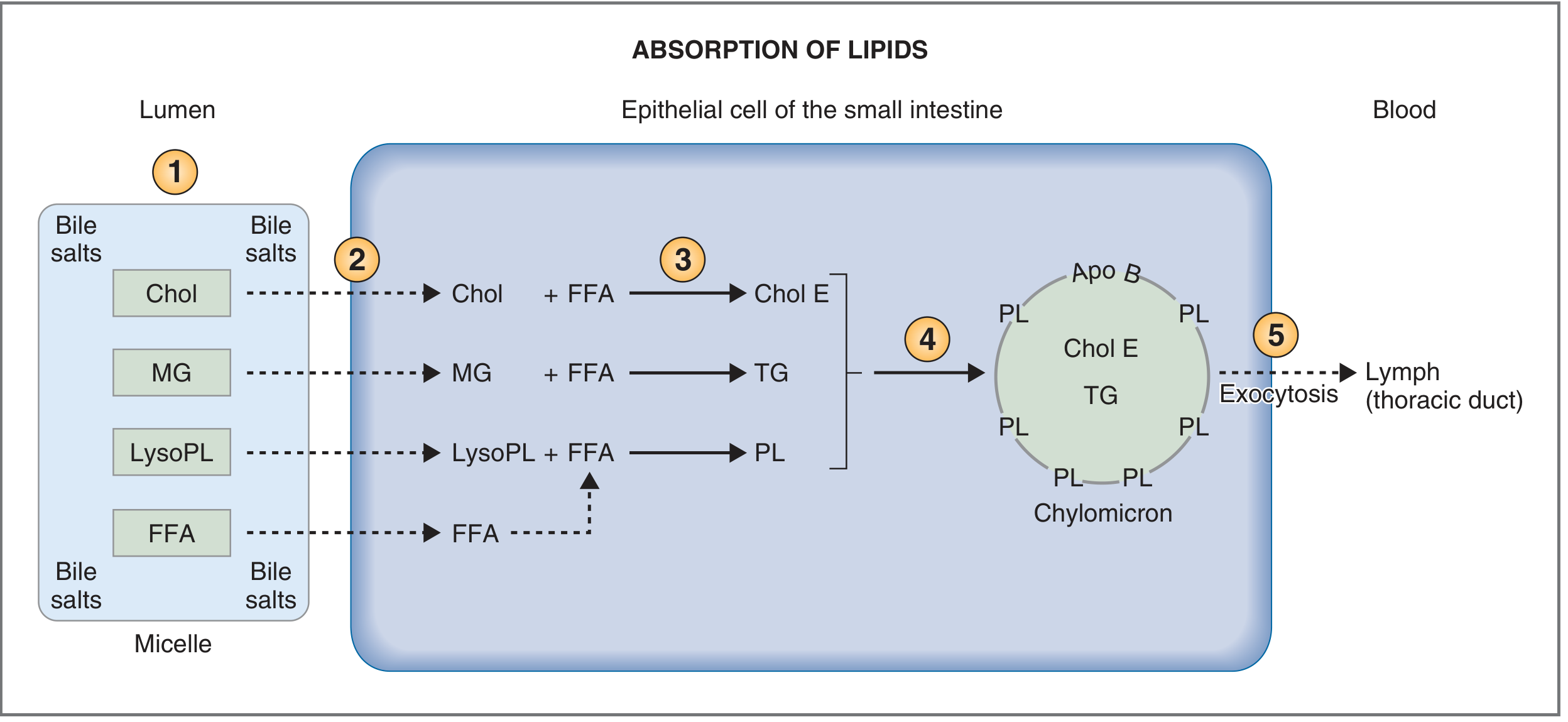
The Threshold for Insufficiency
EPI manifests clinically only when >90% of pancreatic acinar cell mass is destroyed, at which point lipase production falls below 10% of normal. Below this threshold, fat and protein digestion are severely impaired. This occurs in chronic pancreatitis, cystic fibrosis, pancreatic cancer, and after pancreatic resection. - Yamada's Textbook of Gastroenterology, 7th ed.
Step-by-Step Disruption of Lipid Metabolism
1. Failure of Intraluminal Fat Digestion
Without pancreatic lipase and colipase, dietary triglycerides cannot be hydrolyzed to monoglycerides and FFAs. Undigested triglycerides are not absorbable and pass unchanged into the colon. Similarly:
- Cholesterol esters remain intact (no hydrolase activity)
- Phospholipids are not cleaved (no phospholipase A2)
The result is steatorrhea - greasy, foul-smelling, bulky stools. Normally, >93-97% of ingested fat is absorbed; in EPI this drops dramatically. Fecal fat testing showing neutral fats (rather than split fats/FFAs) specifically points to pancreatic maldigestion rather than intestinal malabsorption. - Yamada's Textbook of Gastroenterology, 7th ed.
2. Impaired Micelle Formation (Secondary)
EPI also reduces pancreatic bicarbonate secretion, leaving acidic chyme in the duodenum (pH 2-4). Pancreatic lipase has an optimal pH of ~6 - in an acidic environment, any residual lipase is inactivated, compounding fat maldigestion. - Costanzo Physiology, 7th ed.
3. Fat-Soluble Vitamin Deficiency (A, D, E, K)
Since these vitamins depend on the same micelle-mediated absorption pathway as dietary fats, all four are malabsorbed when intraluminal lipid digestion fails:
- Vitamin A - night blindness, xerophthalmia
- Vitamin D - osteomalacia, metabolic bone disease
- Vitamin E - peripheral neuropathy, hemolytic anemia
- Vitamin K - coagulopathy, elevated PT/INR
4. Disrupted Lipoprotein Metabolism
A less-recognized consequence is the loss of apolipoproteins and HDL cholesterol. Because chylomicron assembly requires adequate substrate supply of triglycerides and cholesterol esters from the gut lumen, EPI substantially reduces post-prandial chylomicron synthesis. Yamada's notes direct loss of "apolipoproteins and high-density lipoproteins" in EPI, contributing to dyslipidemia - specifically low HDL - in chronic EPI patients. - Yamada's Textbook of Gastroenterology, 7th ed.
5. Systemic Nutritional Consequences
| Consequence | Mechanism |
|---|---|
| Weight loss / cachexia | Energy malabsorption from fat (~9 kcal/g) |
| Steatorrhea | Undigested TG in stool |
| Fat-soluble vitamin deficiency (A, D, E, K) | No micellar solubilization |
| Low HDL, reduced apolipoprotein levels | Reduced chylomicron assembly |
| Micronutrient loss (Mg, Se, Zn) | Secondary effects of malabsorption |
| Pancreatogenic diabetes (Type 3c) | Concurrent loss of beta cells in severe disease |
Note: Vitamin B12 deficiency is relatively rare in EPI despite the need for pancreatic proteases to free B12 from transcobalamin - sufficient intrinsic factor-mediated absorption usually compensates.
Diagnosis Clues Specific to Lipid Malabsorption
- Fecal fat >7 g/24 h (quantitative, on 100 g fat/day diet) confirms steatorrhea
- Neutral fat on Sudan III staining = pancreatic etiology (vs. split fats = mucosal disease)
- Fecal elastase-1 <100 μg/g = severe EPI; <200 μg/g = moderate EPI
- Fat-soluble vitamin levels (A, D, E, K/PT) help gauge severity
Treatment Implications
Management targets the root defect:
- Pancreatic enzyme replacement therapy (PERT) - taken with meals; restores lipase, protease, and amylase; when secretion falls below 10% of normal, PERT is essential
- Fat-soluble vitamin supplementation - vitamins A, D, E, K
- Diet - meeting recommended fat intake (not low-fat, as this worsens energy deficit); medium-chain triglycerides (MCTs) can be used since they do not require pancreatic lipase or micelle formation
- Acid suppression (PPI) - raises duodenal pH, protecting residual lipase activity
- Katzung's Basic and Clinical Pharmacology, 16th ed.; Yamada's Gastroenterology, 7th ed.
Sources: Costanzo Physiology 7th ed., p. 386-387 | Yamada's Textbook of Gastroenterology 7th ed., pp. 456, 721 | Katzung's Basic and Clinical Pharmacology 16th ed. | Murray & Nadel's Respiratory Medicine | Sleisenger & Fordtran's GI and Liver Disease
This is a shared conversation. Sign in to Orris to start your own chat.