
Falciparum malaria
Reading File
Researching falciparum malaria across pathophysiology/clinical features, diagnosis/management, and relevant imaging/microscopy.
search_medical_text
Plasmodium falciparum malaria pathophysiology clinical features complications
Harrison's Principles of Internal Medicine, Twenty First Edition
Page 6341
search_medical_text
falciparum malaria diagnosis treatment management antimalarial drugs
Prevention and Treatment of Opportunistic Infections in Children with and Exposed to HIV
Page 299
search_medical_image
Plasmodium falciparum blood smear microscopy malaria
Hugging Face pmc clinical VQA raw
Page 0
GradeResponse
GradeResponse
GradeResponse
Here is a comprehensive overview of Plasmodium falciparum malaria:
Plasmodium falciparum Malaria
Epidemiology
P. falciparum is the most lethal malaria species. It predominates in sub-Saharan Africa, accounting for >80% of malaria infections and ~90% of malarial deaths worldwide. All Plasmodium species are transmitted by the bite of female Anopheles mosquitoes in tropical and subtropical regions. (Harrison's, p. 6341)
Why P. falciparum Is Uniquely Dangerous
| Feature | P. falciparum | Other species |
|---|---|---|
| Erythrocyte invasion | Any RBC (no restriction) | Only reticulocytes (vivax/ovale) |
| Parasitemia level | Very high | Lower |
| Cytoadherence | Yes — adheres to vascular endothelium | Minimal |
| Drug resistance | Most common | Less frequent |
| Persistent liver stage | No | P. vivax, P. ovale (hypnozoites) |
Pathophysiology
- Cytoadherence & sequestration — Infected RBCs express PfEMP1 (P. falciparum erythrocyte membrane protein 1) on their surface, causing them to adhere to capillary and post-capillary venule endothelium. This sequesters parasitized cells in deep vascular beds (brain, lung, kidney, gut), causing microvascular obstruction and organ damage.
- Rosetting — Infected RBCs bind uninfected RBCs, further obstructing microcirculation.
- High parasitemia — Destruction of RBCs leads to hemolytic anemia, hemoglobinuria, and metabolic acidosis.
- Cytokine storm — TNF-α, IL-1, IL-6 drive fever, rigors, and systemic inflammation.
Clinical Features
Uncomplicated malaria:
- Paroxysms of fever (often irregular/daily in falciparum, unlike the 48-h tertian cycle)
- Chills, rigors, diaphoresis
- Headache, myalgia, arthralgia
- Nausea, vomiting, abdominal pain
- Splenomegaly, mild hepatomegaly
- Anemia, thrombocytopenia
Severe/complicated malaria (WHO criteria — any of the following):
| Complication | Key Features |
|---|---|
| Cerebral malaria | Unarousable coma (GCS ≤11), seizures |
| Severe anemia | Hb <7 g/dL |
| Respiratory distress | ARDS-like picture |
| Hypoglycemia | Especially with quinine/quinidine treatment |
| Renal failure | "Blackwater fever" (hemoglobinuria + AKI) |
| Circulatory collapse | Algid malaria (septic shock picture) |
| Abnormal bleeding | DIC |
| Hyperparasitemia | >5% parasitized RBCs |
| Jaundice | Hemolytic + hepatic |
Diagnosis
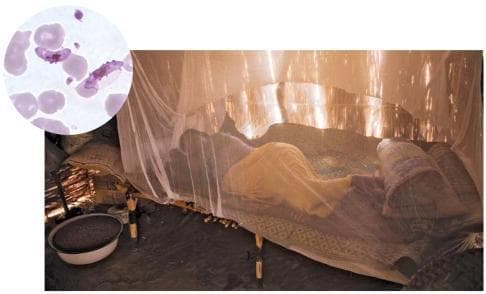
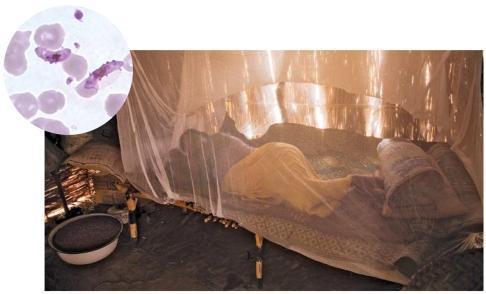
- Thick and thin Giemsa-stained blood smears — gold standard; thick smear for sensitivity, thin smear for species ID
- Characteristic findings on thin smear:
- Multiple ring forms per RBC
- Appliqué (Maurer's clefts) forms
- Banana-shaped (crescentic) gametocytes — pathognomonic for P. falciparum
- No enlarged RBCs (unlike vivax/ovale)
- Rapid Diagnostic Tests (RDTs) — detect HRP-2 or pLDH antigens; useful in field settings
- PCR — gold standard for species confirmation and drug-resistance genotyping
Treatment
Treatment depends on disease severity, geographic resistance patterns, age, and pregnancy status. (OI Guidelines, p. 299)
Uncomplicated P. falciparum
| Scenario | First-line Options |
|---|---|
| Chloroquine-susceptible | Chloroquine phosphate OR artemether-lumefantrine OR atovaquone-proguanil OR quinine + doxycycline/clindamycin |
| Chloroquine-resistant (most of the world) | Artemether-lumefantrine (preferred) OR atovaquone-proguanil OR quinine + doxycycline/tetracycline/clindamycin |
| Mefloquine | Alternative only |
Key principle: Chloroquine should NOT be used in areas with known chloroquine-resistant P. falciparum. Artemisinin-based combination therapies (ACTs) are the WHO-recommended backbone globally.
Severe/Complicated P. falciparum
- IV artesunate — WHO/CDC preferred agent for severe malaria (superior to quinine in RCTs)
- IV quinidine gluconate + doxycycline OR clindamycin OR tetracycline — alternative where artesunate unavailable
- Followed by a complete oral ACT course once patient can tolerate oral therapy
- Adjunctive care: correct hypoglycemia (monitor with quinine/quinidine), manage raised ICP in cerebral malaria, renal replacement therapy for AKI, mechanical ventilation for ARDS
Drug Interactions (HIV co-infection)
- Quinidine is contraindicated with ritonavir; use with caution alongside atazanavir, darunavir, fosamprenavir
- Ritonavir may need to be substituted if IV quinidine is required
Chemoprophylaxis & Prevention
- Atovaquone-proguanil, doxycycline, or mefloquine depending on destination and patient factors
- Insecticide-treated bed nets (ITNs), indoor residual spraying
- DEET-based repellents
- Trimethoprim-sulfamethoxazole is NOT recommended for antimalarial prophylaxis
- G6PD deficiency must be excluded before primaquine (relevant for P. vivax/ovale radical cure, not falciparum)
Special Populations
| Population | Consideration |
|---|---|
| Pregnancy | High risk of severe disease, fetal loss, LBW; avoid artemisinin in 1st trimester if possible; quinine + clindamycin preferred in 1st trimester |
| Children | Cerebral malaria and severe anemia disproportionately affect children <5 years |
| HIV co-infection | Treatment choice unchanged but monitor drug–drug interactions |
| Travelers | Pre-travel counseling essential; treat as chloroquine-resistant unless confirmed susceptible region |
Prognosis
- Uncomplicated falciparum malaria treated promptly: good prognosis
- Cerebral malaria: 15–20% mortality even with treatment; neurological sequelae in survivors
- Overall case fatality rate heavily dependent on access to IV artesunate and ICU-level care
This is a shared conversation. Sign in to Orris to start your own chat.