
Development of kidney 5m answer
Reading File
The kidney develops from the intermediate mesoderm through three successive structures: pronephros, mesonephros, and metanephros. Now let me search the textbooks for detailed content.
Searching sources...
Finding Sources
Finding Sources
Reading File
Reading File
Reading File
Reading File
Reading File
Reading File
Now let me fetch a key diagram image to include in the answer:
Loading Image
Loading Image
I now have all the content needed for a thorough 5-mark answer. Here it is:
Development of the Kidney
The kidney develops from the intermediate mesoderm along the posterior abdominal wall. Both the urinary and genital systems arise from this common mesodermal ridge. Three pairs of excretory organs form in a cranial-to-caudal, overlapping temporal sequence:
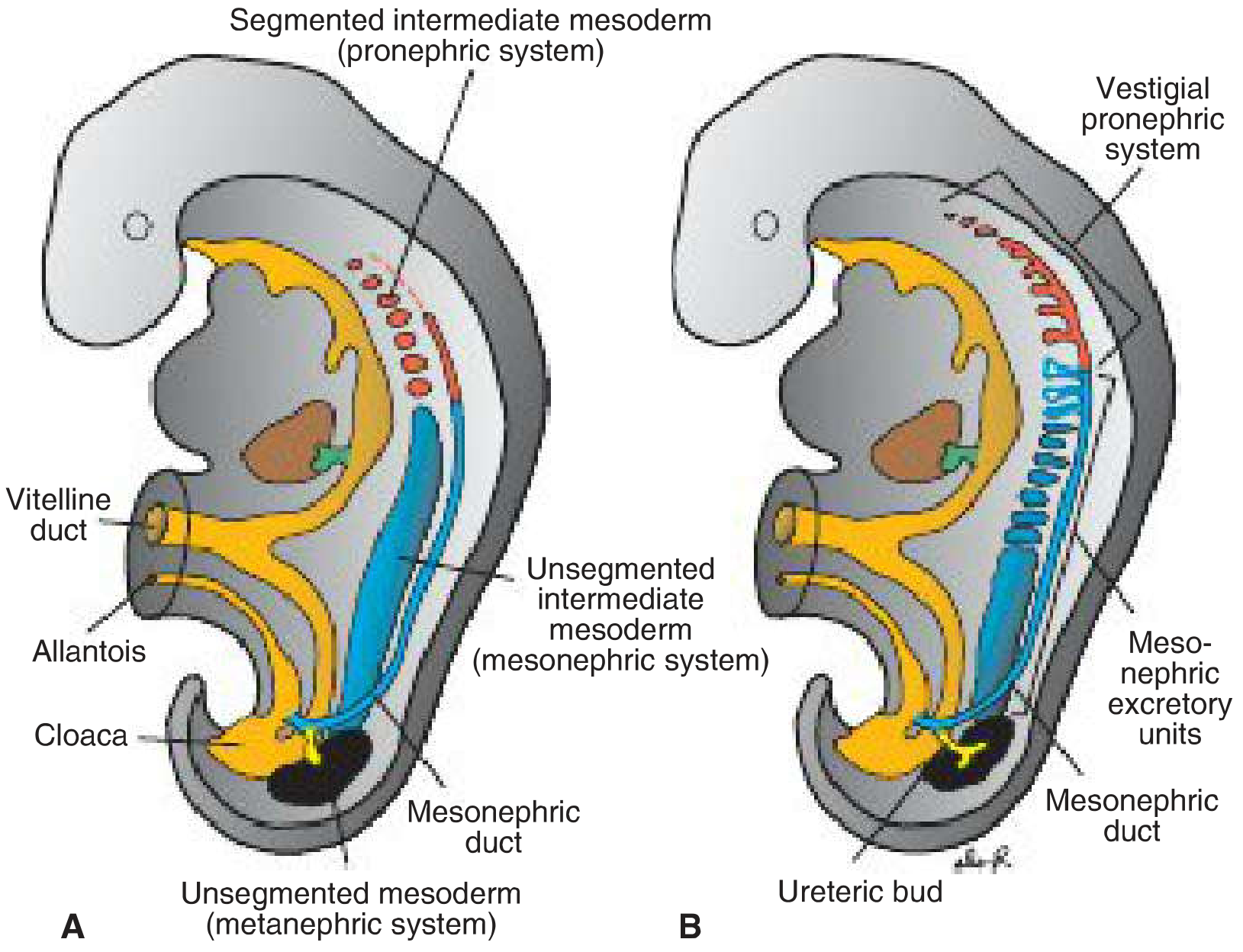
1. Pronephros (Week 4 - rudimentary, non-functional)
- Appears at the beginning of the 4th week in the cervical region
- Represented by 7-10 solid cell groups (nephrotomal vestigial excretory units called nephrotomes)
- Regress cranially before caudal ones form; completely disappear by the end of the 4th week
- Contributes to the formation of the mesonephric (Wolffian) duct, which persists and is important for subsequent development
2. Mesonephros (Week 4-8 - temporarily functional)
- Derived from intermediate mesoderm from upper thoracic to upper lumbar (L3) segments
- Forms a large ovoid organ on each side of the midline together with the gonad, creating the urogenital ridge
- Excretory units resemble primitive nephrons; produce small amounts of urine contributing to amniotic fluid
- By week 16, mesonephric tubules regress in females; in males, a few caudal tubules and the mesonephric duct persist to form elements of the male genital duct system (epididymis, vas deferens, seminal vesicles)
3. Metanephros (Week 5 onwards - permanent kidney)
The definitive kidney appears in the 5th week and develops from two sources:
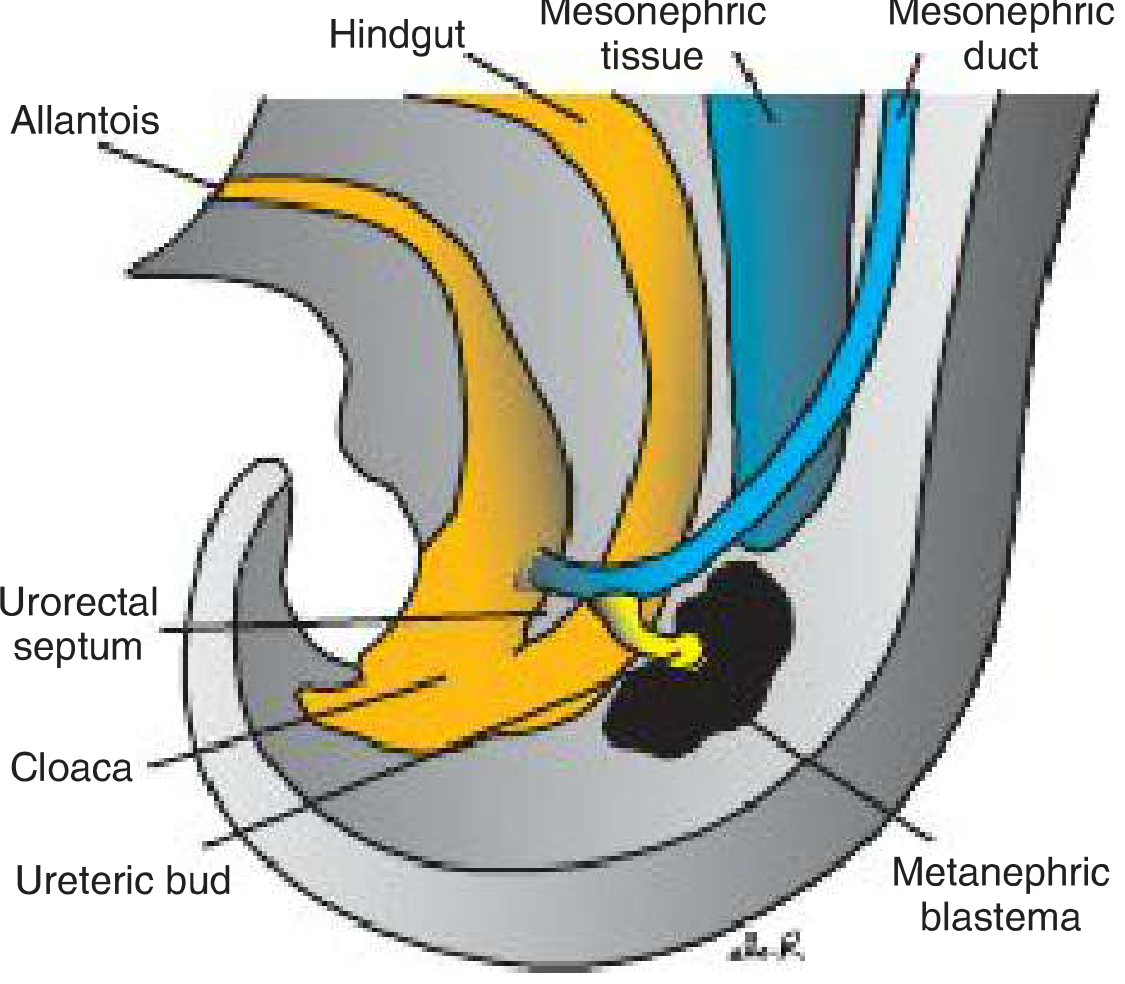
A. Ureteric Bud (Collecting System)
- An outgrowth of the mesonephric duct close to its entrance into the cloaca, around day 28-32
- Penetrates the metanephric mesenchyme (blastema) and becomes capped by it
- Dilates to form the primitive renal pelvis, then splits into cranial and caudal portions - future major calyces
- Each calyx forms more buds; through 12 or more generations of tubular subdivision, the entire collecting system forms: major calyces → minor calyces → collecting tubules → collecting ducts
- Branching morphogenesis is complete by ~week 20-22 of gestation
- Ultimately gives rise to: ureter, renal pelvis, major and minor calyces, and collecting ducts
B. Metanephric Mesoderm (Excretory Units / Nephrons)
- The metanephric mesenchyme (metanephric blastema) undergoes mesenchymal-to-epithelial transition (MET) induced by ureteric bud signals
- Mesenchymal cells condense around collecting tubule tips → form renal vesicles → S-shaped tubules
- Capillaries grow into the pocket at one end of the S-shaped tubule and differentiate into glomeruli
- Continuous lengthening of the excretory tubule produces: Bowman capsule → proximal convoluted tubule → loop of Henle → distal convoluted tubule
- The distal end of each nephron forms an open connection with a collecting tubule, establishing a continuous passageway
Molecular Regulation
Key signaling molecules govern metanephric induction:
| Signal | Source | Receptor / Target | Action |
|---|---|---|---|
| WT1 (transcription factor) | Metanephric mesenchyme | - | Makes mesenchyme competent to respond to induction |
| GDNF | Mesenchyme | RET (on ureteric bud) | Stimulates ureteric bud branching and growth |
| HGF (scatter factor) | Mesenchyme | MET (on ureteric bud) | Stimulates ureteric bud growth |
| FGF2 + BMP7 | Ureteric bud | Mesenchyme | Block apoptosis, stimulate mesenchymal proliferation, maintain WT1 |
| WNT9B / WNT6 | Ureteric bud epithelium | Mesenchyme | Upregulate PAX2 and WNT4 |
| WNT4 | Mesenchyme (induced) | - | Drives mesenchyme-to-epithelium conversion (tubule formation) |
| PAX2 | Mesenchyme (induced) | - | Promotes condensation of mesenchyme |
Key Developmental Milestones
| Timing | Event |
|---|---|
| Day 22 | Pronephros appears |
| Day 25 | Pronephros disappears |
| Week 4 | Mesonephros develops |
| Day 28-32 | Ureteric bud invades metanephric blastema |
| Week 5 | Metanephros begins |
| Week 10 | Glomerular capillaries begin to form |
| Week 12 | Urine production begins |
| Week 20-22 | Branching morphogenesis complete |
| Week 36 | Nephrogenesis complete (~1 million nephrons per kidney) |
| Birth | Kidneys have lobulated appearance (disappears in infancy) |
Clinical Correlates
- Renal agenesis: Failure of ureteric bud to interact with metanephric mesoderm; bilateral agenesis causes Potter sequence (anuria, oligohydramnios, hypoplastic lungs, Potter facies, clubfeet)
- Wilms tumor (Nephroblastoma): Mutation in WT1 gene (chromosome 11p13); associated with WAGR syndrome and Denys-Drash syndrome
- Multicystic dysplastic kidney: Ureteric bud fails to branch; nephrons fail to develop
- Polycystic kidney disease: Autosomal recessive (ARPKD, 1/5,000) or autosomal dominant (ADPKD) cyst formation
Sources: Langman's Medical Embryology; National Kidney Foundation Primer on Kidney Diseases, 8e
This is a shared conversation. Sign in to Orris to start your own chat.