
Cholecystokinin pancreozymin Notes for mbbs 1st year physiology
Reading File
search_medical_text
cholecystokinin pancreozymin CCK synthesis secretion actions physiology
search_medical_text
CCK receptors mechanism of action gallbladder pancreas gastrointestinal hormones
search_medical_image
cholecystokinin CCK gastrointestinal hormone diagram physiology
GradeResponse
GradeResponse
GradeResponse
search_medical_text
CCK cholecystokinin structure molecular forms I cells duodenum jejunum release stimuli inhibition
search_medical_text
cholecystokinin gallbladder contraction Oddi sphincter satiety hunger appetite regulation
GradeResponse
GradeResponse
Here are comprehensive MBBS 1st year physiology notes on Cholecystokinin-Pancreozymin (CCK-PZ):
Cholecystokinin-Pancreozymin (CCK-PZ)
MBBS 1st Year Physiology Notes
1. Historical Background
- Cholecystokinin (CCK) was first described by Ivy and Oldberg (1928) as a hormone causing gallbladder contraction.
- Pancreozymin (PZ) was separately identified by Harper and Raper (1943) as a hormone stimulating pancreatic enzyme secretion.
- Later proved to be the same molecule — hence the dual name CCK-PZ.
- Now commonly called simply CCK.
2. Chemical Nature & Structure
| Property | Detail |
|---|---|
| Type | Peptide hormone |
| Family | Gastrin-CCK family |
| Active forms | CCK-58, CCK-33, CCK-8, CCK-4 (CCK-33 is most common in circulation) |
| Active site | C-terminal octapeptide (CCK-8) — biologically most potent |
| Structural similarity | Shares C-terminal pentapeptide with gastrin |
| Sulphation | Tyrosine residue at position 7 from C-terminus is sulphated — essential for full activity |
3. Source / Site of Secretion
- I cells (also called Ito cells) of the duodenal and proximal jejunal mucosa
- Also found in:
- Neurons of the enteric nervous system (acts as neurotransmitter)
- Brain (hypothalamus, cerebral cortex) — mediates satiety
4. Stimuli for Release
✅ Stimulatory Factors:
| Stimulus | Notes |
|---|---|
| Long-chain fatty acids | Most potent stimulus |
| Proteins & essential amino acids | Tryptophan, phenylalanine, valine, methionine are particularly effective |
| Gastric acid (low duodenal pH) | Triggers release |
| Monoglycerides | Products of fat digestion |
| Vagal stimulation | Cephalic phase contribution |
❌ Inhibitory Factors:
- Somatostatin — inhibits CCK release
- CCK-releasing factor (CCK-RF) is inactivated by trypsin and chymotrypsin in the duodenum — so when proteases are present (i.e., after eating protein), they stop further CCK release (negative feedback)
- Pancreatic proteases (feedback inhibition)
5. Mechanism of Action
- Acts via CCK-A receptors (alimentary/peripheral) and CCK-B receptors (brain/gastric, also respond to gastrin)
- Second messenger: IP₃ / Ca²⁺ pathway (Phospholipase C → DAG + IP₃)
- Important human-specific note (Harrison's p.9714): Unlike other species, there are no CCK receptors on acinar cells in humans. In humans, CCK at physiologic concentrations stimulates pancreatic secretion by stimulating afferent vagal and intrapancreatic nerves — i.e., it acts indirectly via the vagus nerve.
6. Actions of CCK-PZ
A. 🫀 On the Gallbladder (the "Cholecysto-" part)
(Harrison's p. 9657)
- Powerful contraction of the gallbladder → bile expelled into duodenum
- Relaxation of the Sphincter of Oddi → decreased resistance to bile flow
- Enhanced flow of biliary contents into the duodenum
- Facilitates digestion of fats and fat-soluble vitamins
B. 🫁 On the Pancreas (the "-kinin/Pancreozymin" part)
(Harrison's p. 9712)
- Stimulates enzyme-rich (ecbolic) secretion from acinar cells
- Amylase, lipase, proteases (trypsinogen, chymotrypsinogen, etc.)
- Acts via vagal pathways (not directly on acinar cells in humans)
- Potentiates secretin's action on bicarbonate secretion (synergism)
C. 🧠 On the Brain (Satiety)
- Acts on hypothalamus via CCK-B receptors
- Produces satiety (feeling of fullness) — reduces food intake
- This is why high-fat/high-protein meals make you feel full quickly
D. 🔄 On the Stomach
- Weak stimulation of gastric acid secretion (via CCK-B receptors shared with gastrin)
- Slows gastric emptying — allows adequate time for digestion in the duodenum
E. 🧫 On the Intestine
- Stimulates intestinal motility
- Enhances growth of exocrine pancreas (trophic effect)
F. On Sphincter of Oddi
- Relaxes the sphincter → promotes bile and pancreatic juice flow into duodenum
7. Summary of Actions Table
| Target Organ | Effect |
|---|---|
| Gallbladder | Contraction ↑ (bile ejection) |
| Sphincter of Oddi | Relaxation (↓ resistance) |
| Exocrine pancreas | Enzyme secretion ↑ (ecbolic) |
| Stomach | Gastric emptying ↓; acid ↑ (weak) |
| Intestine | Motility ↑ |
| Brain (hypothalamus) | Satiety ↑, food intake ↓ |
| Pancreas (trophic) | Growth and hypertrophy ↑ |
8. Phases of Pancreatic Secretion & CCK Role
| Phase | Stimulus | CCK Role |
|---|---|---|
| Cephalic | Sight/smell of food, vagal | Minor — via vagal stimulation |
| Gastric | Gastric distension, proteins | Minor |
| Intestinal | Fats, AAs entering duodenum | Major — primary phase for CCK action |
9. CCK vs. Secretin — Key Comparison
| Feature | CCK | Secretin |
|---|---|---|
| Source | I cells (duodenum, jejunum) | S cells (duodenum) |
| Stimulus | Fats, proteins, AA | Gastric acid (low pH) |
| Effect on pancreas | Enzyme-rich juice (ecbolic) | Water + HCO₃⁻ rich juice (hydrokinetic) |
| Effect on gallbladder | Contraction | Weak stimulation |
| Interaction | Potentiate each other | Potentiate each other |
10. Clinical Correlates (High Yield for Exams)
| Condition | CCK Link |
|---|---|
| Cholelithiasis (gallstones) | Impaired CCK response → poor gallbladder emptying → bile stasis → stone formation |
| Celiac disease / malabsorption | Reduced mucosal I cells → reduced CCK → poor fat digestion |
| Exocrine pancreatic insufficiency | Loss of CCK-stimulated enzyme secretion |
| Obesity research | Defective CCK-mediated satiety is studied as a mechanism for overeating |
| Zollinger-Ellison syndrome | CCK-B receptors (shared with gastrin) — gastrinomas exploit this pathway |
11. CCK as a Neurotransmitter
- CCK-8 is the most abundant neuropeptide in the CNS
- Found in cortex, hippocampus, hypothalamus
- Functions:
- Satiety signaling
- Anxiety modulation
- Pain modulation
- Memory and learning
12. Quick Revision Points (Memory Aids)
-
"CCK = Contract, Contract, Kill acid, Kinin enzymes"
- Contracts gallbladder
- Cuts (relaxes) Sphincter of Oddi
- Kills hunger (satiety)
- Kindles pancreatic enzyme secretion
-
Cells: I cells (I = "I" make you full and digest fat)
-
Stimuli: Fat and Protein → best stimuli
-
CCK-8: most biologically active form
13. Diagram — CCK in Food-Intake & Metabolic Regulation
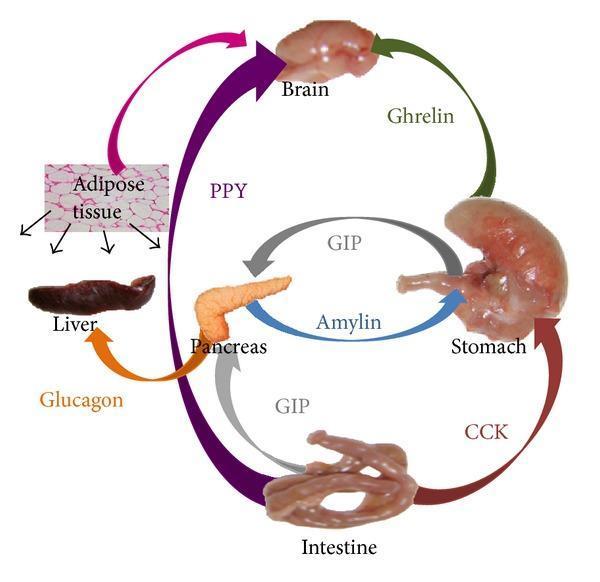
CCK from the intestine targets the stomach and pancreas as part of a complex multi-organ dialogue coordinating digestion, satiety, and energy homeostasis.
References
- Harrison's Principles of Internal Medicine, 21st Edition, pp. 9657, 9712, 9714
- Ganong's Review of Medical Physiology
- Guyton & Hall Textbook of Medical Physiology
This is a shared conversation. Sign in to Orris to start your own chat.