

Describe the teeth and gum
Reading File
I will analyze this intraoral image focusing on the lower anterior teeth and surrounding gingival tissues.
search_medical_image
gingival recession lower anterior teeth periodontal findings
Hugging Face pmc clinical VQA raw
Page 0
search_medical_text
gingival recession mandibular anterior teeth periodontal assessment clinical features
Harrison's Principles of Internal Medicine, Twenty First Edition
Page 1084
GradeResponse
GradeResponse
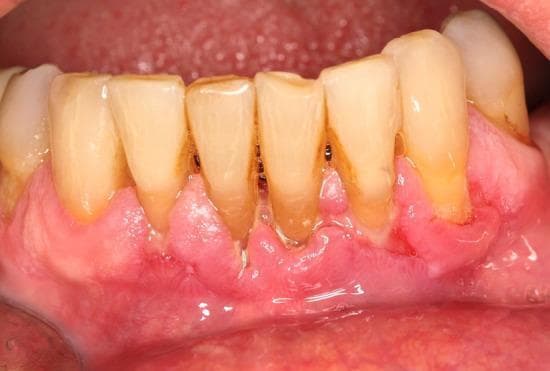
Clinical Description of the Teeth and Gingiva
Teeth
| Feature | Findings |
|---|---|
| Teeth visible | Lower anterior teeth (mandibular incisors and canines — approximately 6 teeth) |
| Color | Yellow-cream discoloration; notably not white/translucent as in healthy enamel |
| Shape | Incisal edges appear worn (attrition), with a relatively flat biting surface suggesting bruxism or chronic wear |
| Alignment | Mild crowding/rotation, particularly of the central incisors; slight overlapping |
| Crown length | Clinically elongated due to gingival recession, giving a "long tooth" appearance |
| Deposits | Visible supragingival calculus (tartar) deposits along the cervical margins and interproximal areas |
Gingiva (Gums)
| Feature | Findings |
|---|---|
| Color | Pale/light pink with areas of erythema; not the healthy coral-pink uniform tone |
| Contour | Scalloped with recession — the gingival margin has migrated apically (downward), exposing the cementoenamel junction (CEJ) and root surfaces |
| Recession pattern | Pronounced interdental papilla loss — the triangular papillae between teeth appear blunted or absent ("black triangles" between teeth) |
| Texture | Loss of normal stippled (orange-peel) texture; surface appears smooth and slightly edematous |
| Consistency | Soft-appearing with some swelling, consistent with inflammation |
| Attachment loss | Clinically apparent loss of attachment, with root surfaces visibly exposed in several teeth |
Summary of Clinical Impression
The image shows features consistent with chronic periodontitis with generalized gingival recession:
- Plaque and calculus accumulation at the gingival margins indicates poor oral hygiene
- Gingival recession exposing root surfaces puts teeth at risk for root caries and sensitivity
- Loss of interdental papillae creates food traps and further plaque retention
- Tooth discoloration and wear suggest long-standing hygiene neglect and possible parafunctional habits
This presentation warrants a full periodontal assessment including probing depths, clinical attachment levels, and radiographic bone evaluation, followed by professional debridement and oral hygiene instruction (Harrison's, p. 1084).
Management after doing scaling
search_medical_text
periodontal management after scaling root planing chronic periodontitis
Harrison's Principles of Internal Medicine, Twenty First Edition
Page 1084
search_medical_text
gingival recession treatment options management after debridement
Head and Neck Cancer Survivorship Care
Page 23
GradeResponse
GradeResponse
Based on the clinical findings in the image (chronic periodontitis, gingival recession, calculus deposits) and established periodontal guidelines, here is the structured post-scaling management protocol:
Post-Scaling Management
Phase 1 — Immediate Post-Scaling Care (First 24–72 hours)
- Analgesics: Ibuprofen 400 mg TDS PRN for post-procedural soreness
- Chlorhexidine gluconate 0.12% mouthwash twice daily for 2 weeks to suppress residual pathogenic bacteria (avoid longer use due to staining risk)
- Soft diet for 24–48 hours; avoid hard, crunchy, or very hot food
- Avoid smoking — it significantly impairs healing and periodontal response to treatment
Phase 2 — Re-evaluation (4–6 Weeks Post-Scaling)
A mandatory reassessment to gauge tissue response:
| Parameter | What to Check |
|---|---|
| Probing depths | Should have reduced by 1–3 mm if treatment is effective |
| Bleeding on probing (BOP) | Should be significantly reduced |
| Residual calculus | Re-instrument any remaining deposits |
| Tooth mobility | Note any improvement or progression |
| Oral hygiene compliance | Reinforce and correct technique |
Phase 3 — Oral Hygiene Instruction (Critical)
Given the heavy plaque and calculus seen in the image, this is the most important component of long-term success:
- Tooth brushing: Modified Bass technique — soft-bristled brush at 45° to the gingival margin, 2 minutes twice daily
- Interdental cleaning: Daily flossing or interdental brushes (especially critical given the visible recession and black triangles)
- Fluoride toothpaste: Desensitizing toothpaste (containing potassium nitrate or stannous fluoride) for exposed root surfaces
- Tongue cleaning and rinsing after meals
Phase 4 — Adjunctive Therapy (If Pockets Persist ≥5 mm at Re-evaluation)
- Systemic antibiotics: Metronidazole 400 mg TDS × 7 days ± Amoxicillin 500 mg TDS × 7 days (for aggressive or refractory disease)
- Local drug delivery: Subgingival chlorhexidine chips or doxycycline gel into residual pockets
- Referral to periodontist if pockets remain ≥6 mm after non-surgical therapy
Phase 5 — Surgical Considerations
Given the significant gingival recession visible in the image:
| Procedure | Indication |
|---|---|
| Connective tissue graft (CTG) | Gold standard for root coverage in localized recession |
| Free gingival graft (FGG) | Increasing the zone of keratinized gingiva |
| Osseous surgery / flap debridement | If residual deep pockets and bone loss confirmed on X-ray |
| Orthodontic consultation | For crowding/malalignment contributing to plaque retention |
Phase 6 — Supportive Periodontal Therapy (SPT / Maintenance)
Once active disease is controlled, the patient enters a lifelong maintenance program:
- Professional cleaning every 3 months for the first year, then every 6 months if stable
- Radiographic bone level monitoring annually
- Reassess for caries on exposed root surfaces (high risk given visible recession)
- Motivational reinforcement at every visit — compliance is the key determinant of long-term tooth retention
Key Prognosis Factors for These Teeth
| Factor | Impact |
|---|---|
| Patient compliance with OH | Most critical — poor compliance = disease recurrence |
| Smoking cessation | Smoking doubles recurrence risk |
| Diabetes control (if applicable) | Poor glycemic control worsens periodontitis |
| Severity of bone loss on radiograph | Determines which teeth are salvageable |
The overall prognosis with thorough scaling, diligent home care, and regular maintenance is fair to good for most of the visible teeth, provided bone support is adequate on radiographic assessment (Harrison's, p. 1084).
This is a shared conversation. Sign in to Orris to start your own chat.