
In clubbing of finger what are imported blood test
clubbing of fingers blood investigations workup causes
finger clubbing diagnosis investigation
https://emedicine.medscape.com/article/1105946-workup
finger clubbing grades nail
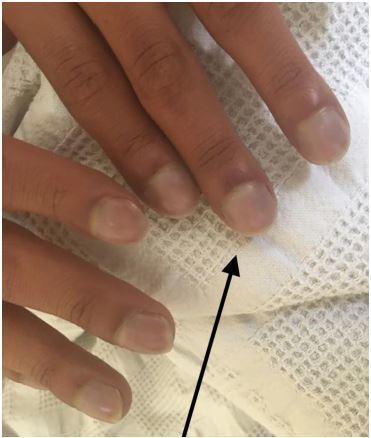
This clinical photograph shows a close-up of a patient's fingers demonstrating classic signs of digital clubbing and peripheral cyanosis. The distal phalanges exhibit a bulbous, 'drumstick' appearance with a noticeable loss of the normal Lovibond angle (the angle between the nail plate and the proximal nail fold). The nail beds appear convex and rounded. A distinct bluish-purple discoloration (cyanosis) is visible across the nail beds and distal fingertips, indicating poor blood oxygenation or circulation. A black arrow points to the most prominent area of clubbing on the index finger. These findings are clinically significant as they often indicate chronic hypoxemia secondary to congenital heart disease (such as Ebstein anomaly), pulmonary disease, or chronic inflammatory conditions. This image serves as a teaching tool for physical examination findings in cardiovascular and respiratory medicine.
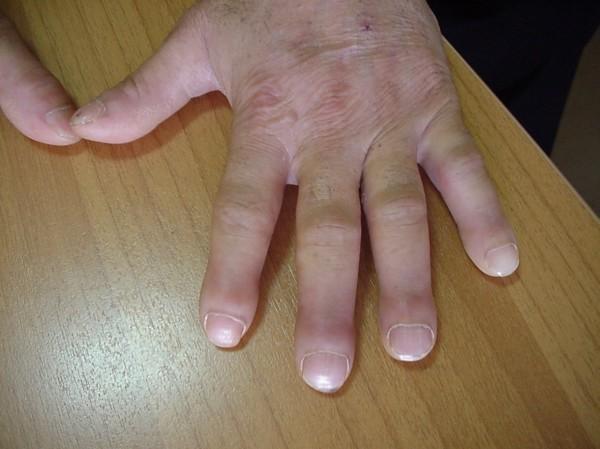
This clinical photograph displays a dorsal view of a human hand resting on a flat surface, illustrating classic features of digital clubbing. The distal phalanges of all visible fingers show significant bulbous enlargement and swelling, resulting in a 'drumstick' appearance. The nails exhibit increased longitudinal and transverse curvature (convexity), becoming rounded and broad. There is a visible loss of the normal angle between the nail plate and the proximal nail fold (Lovibond's angle), with the proximal nail fold appearing thickened and shiny. The skin over the hand is wrinkled, and an old linear scar is noted on the dorsal web space between the thumb and index finger. These findings are highly characteristic of digital clubbing, a clinical sign often associated with chronic hypoxemia, cardiovascular disease, or neoplastic pulmonary conditions such as bronchogenic carcinoma, particularly in patients with a significant smoking history.
Finger Clubbing - Important Blood Investigations

1. First-Line / Screening Tests (All Patients)
| Test | What it detects |
|---|---|
| CBC (Complete Blood Count) | Polycythemia (cyanotic heart disease), anemia (SBE, IBD, malignancy), leukocytosis (infection/abscess) |
| ESR / CRP | Chronic inflammation - infection, malignancy, IBD |
| LFTs (Liver Function Tests) | Hepatic causes - cirrhosis, hepatocellular carcinoma, biliary disease |
| RFTs (Renal Function Tests) | Baseline; occasional renal associations |
| Blood glucose | General metabolic screen |
2. Respiratory / Pulmonary Causes (Most common - ~80% of acquired clubbing)
| Test | What it detects |
|---|---|
| Arterial Blood Gas (ABG) | Hypoxemia (PaO2 <60 mmHg) - the key physiologic driver of clubbing |
| SpO2 (Pulse oximetry) | Chronic hypoxia |
| Sputum culture & sensitivity | Lung abscess, bronchiectasis, empyema |
| AFB smear + culture | Tuberculosis |
| Tumour markers: CEA, CYFRA 21-1 | Bronchogenic carcinoma (the most common single cause of acquired clubbing) |
| Serum ACE (Angiotensin-Converting Enzyme) | Sarcoidosis |
| Sweat chloride test + CFTR mutation | Cystic fibrosis |
3. Cardiac Causes
| Test | What it detects |
|---|---|
| Blood cultures (x3 sets) | Subacute bacterial endocarditis (SBE) - a classic cause |
| CBC + ESR + CRP | SBE - elevated WBC, raised inflammatory markers |
| Rheumatoid Factor | Can be positive in SBE |
| Complement levels (C3, C4) | Low in certain vasculitides/endocarditis |
| Pro-BNP / BNP | Heart failure with congenital disease |
4. Gastrointestinal Causes
| Test | What it detects |
|---|---|
| LFTs + GGT + Bilirubin | Cirrhosis, hepatocellular carcinoma, biliary atresia |
| Albumin | Malnutrition, chronic liver disease, IBD |
| AFP (Alpha-fetoprotein) | Hepatocellular carcinoma |
| Stool for occult blood (FOBT) | Colorectal carcinoma, IBD |
| Celiac serology (anti-tTG IgA) | Sprue / celiac disease |
| Calprotectin (stool) | IBD (Crohn's / UC) |
| ANCA (p-ANCA, c-ANCA) | IBD-associated vasculitis |
5. Thyroid Causes (Thyroid Acropachy)
| Test | What it detects |
|---|---|
| TSH, Free T3, Free T4 | Hyperthyroidism (Graves' disease) |
| Anti-TSH receptor antibodies (TRAb) | Graves' disease specifically |
| Long-acting thyroid stimulator (LATS) | Elevated in thyroid acropachy |
6. Malignancy / Paraneoplastic Screen
| Test | What it detects |
|---|---|
| CEA | Lung, colon, other GI cancers |
| CA 19-9 | Pancreatic / biliary malignancy |
| PSA | Prostate cancer with metastases |
| LDH | Lymphoma, haematological malignancy |
| Beta-2 microglobulin | Lymphoma, myeloma |
7. Connective Tissue / Rheumatological Causes
| Test | What it detects |
|---|---|
| ANA, Anti-dsDNA | SLE |
| Rheumatoid factor, Anti-CCP | Rheumatoid arthritis with lung involvement |
| ANCA | Vasculitis (GPA / MPA) |
8. Specific Markers Relevant to the Mechanism of Clubbing
| Marker | Relevance |
|---|---|
| Platelet count | Platelet-derived growth factor (PDGF) from megakaryocytes is implicated in the pathogenesis of clubbing |
| VEGF (Vascular Endothelial Growth Factor) | Elevated in clubbing; promotes vasodilation and soft tissue proliferation |
| Growth hormone (GH) | Elevated in bronchogenic carcinoma-associated clubbing and hypertrophic osteoarthropathy |
| Prostaglandin E2 / HPGD gene | Relevant in hereditary/pachydermoperiostosis forms |
Key Clinical Principle
- CBC, ESR/CRP, LFTs, RFTs - universal baseline
- ABG or SpO2 - if respiratory/cardiac cause suspected
- Blood cultures x3 - if SBE suspected
- Chest X-ray + CT chest - before or alongside bloods (to guide further testing)
- Organ-specific markers based on clinical findings