
Openings in the diaphragm
Reading File
Searching for anatomy of the diaphragmatic openings now.
search_medical_text
openings apertures diaphragm anatomy
Bailey and Love's Short Practice of Surgery 28th Edition
Page 1016
GradeResponse
GradeResponse
Openings in the Diaphragm
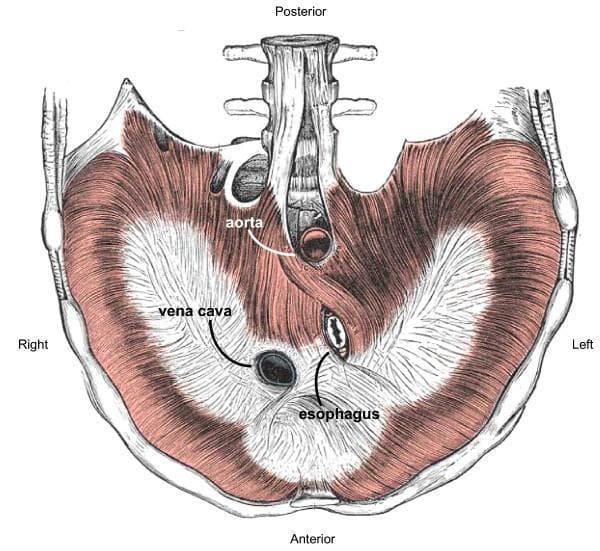
The diaphragm has three major openings (hiatuses/apertures) through which structures pass between the thorax and abdomen, plus several minor openings.
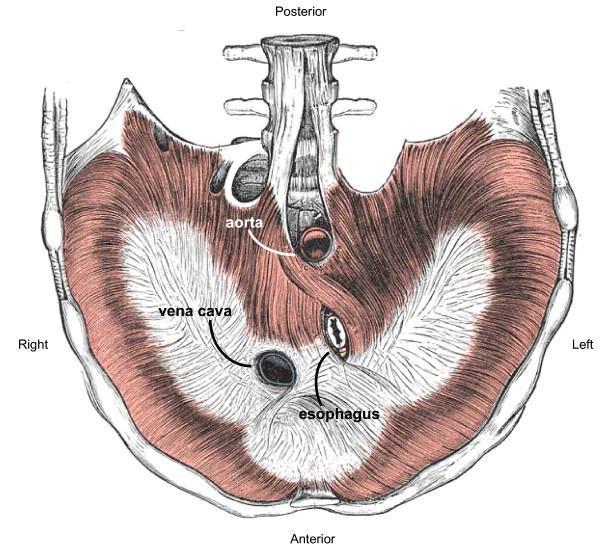
Inferior (abdominal) view of the diaphragm showing the three major apertures and their relationships.
Major Openings
| Opening | Vertebral Level | Location | Structures Passing Through |
|---|---|---|---|
| Caval Opening (Foramen venae cavae) | T8 | Central tendon, right of midline | Inferior vena cava (IVC), right phrenic nerve branches |
| Esophageal Hiatus | T10 | Muscular part, left of midline, formed by right crus | Esophagus, vagal trunks (anterior & posterior), esophageal branches of left gastric vessels |
| Aortic Hiatus | T12 | Posterior, behind the diaphragm between the two crura | Aorta, thoracic duct, azygos vein |
Mnemonic: "I 8 (ate) 10 eggs at 12" — IVC at T8, Esophagus at T10, Aorta at T12
Key Anatomical Notes
- Caval opening: Located within the central tendon, so it widens during inspiration (tendon is stretched), facilitating venous return. The IVC is effectively held open.
- Esophageal hiatus: Formed by the muscular fibers of the right crus (in most people). This arrangement creates a physiological sphincter mechanism — contraction of the diaphragm during inspiration helps prevent gastroesophageal reflux. Clinically important as the site of hiatus hernias (sliding and paraesophageal).
- Aortic hiatus: Technically behind the diaphragm (between the crura and the vertebral column), so it is not truly a hole in the diaphragm. Diaphragmatic contractions do not compress the aorta. The thoracic duct passes through on the right side of the aorta.
Minor Openings
| Structure | Route |
|---|---|
| Left phrenic nerve | Passes through the left dome of the diaphragm (muscular part) |
| Hemiazygos vein | Small opening in the left crus |
| Sympathetic trunk | Passes posterior to the medial arcuate ligament (under, not through, diaphragm) |
| Splanchnic nerves (greater, lesser, least) | Pierce the crura |
Clinical Relevance
- Hiatus hernia: Herniation through the esophageal hiatus — most commonly sliding (Type I), where the gastroesophageal junction moves into the thorax. Paraesophageal (Type II) hernias involve the gastric fundus herniating alongside a normally positioned GEJ.
- Diaphragmatic hernia: Congenital (Bochdalek — posterolateral, left > right) or traumatic herniation.
- Bochdalek's hernia: Through the lumbocostal triangle (posterolateral defect), the most common congenital diaphragmatic hernia.
- Morgagni hernia: Through the sternocostal triangle (anterior defect), less common.
This is a shared conversation. Sign in to Orris to start your own chat.