
Anatomy of knee joint and common injuries to it ,signs and symptoms for differential diagnosis between them
Reading File
Searching anatomy of the knee joint and common knee injuries in parallel.
search_medical_text
knee joint anatomy bones ligaments menisci bursae muscles
Bailey and Love's Short Practice of Surgery 28th Edition
Page 583
search_medical_image
knee joint anatomy diagram ligaments meniscus
Hugging Face pmc clinical VQA raw
Page 0
GradeResponse
GradeResponse
search_medical_text
ACL PCL MCL LCL meniscus tear knee injury signs symptoms clinical features
Bailey and Love's Short Practice of Surgery 28th Edition
Page 511
search_medical_image
knee ligament injury ACL tear clinical tests Lachman McMurray
Hugging Face pmc clinical VQA raw
Page 0
GradeResponse
GradeResponse
Here is a comprehensive overview of the anatomy of the knee joint and common injuries with differential diagnosis.
Knee Joint: Anatomy, Common Injuries & Differential Diagnosis
PART 1 — ANATOMY OF THE KNEE JOINT
(Bailey & Love's Short Practice of Surgery, 28th Ed., p. 583)
Joint Type & Compartments
The knee is a synovial hinge joint — the largest and most complex joint in the body. It consists of:
- Two condyloid tibiofemoral joints (medial & lateral)
- One sellar (saddle-shaped) patellofemoral joint
- Three compartments: medial, lateral, and patellofemoral
The shape makes the joint inherently unstable; stability depends on static and dynamic stabilisers.
Bony Anatomy
| Bone | Contribution |
|---|---|
| Femur | Medial & lateral condyles; intercondylar notch |
| Tibia | Medial & lateral tibial plateaus; tibial spines |
| Patella | Largest sesamoid bone; sits in femoral trochlear groove |
| Fibula | Head articulates with lateral tibial condyle (not a true knee joint but relevant for LCL/PLC) |
Ligaments (Static Stabilisers)
| Ligament | Location | Primary Function |
|---|---|---|
| ACL (Anterior Cruciate) | Within joint, intercondylar notch | Resists anterior tibial translation; prevents internal rotation |
| PCL (Posterior Cruciate) | Within joint, intercondylar notch | Resists posterior tibial translation |
| MCL (Medial Collateral) | Medial aspect | Resists valgus stress; restrains external rotation |
| LCL (Lateral Collateral) | Lateral aspect | Resists varus stress |
| Posterolateral Corner (PLC) | Posterior-lateral capsule | Popliteus tendon, arcuate ligament, popliteofibular ligament |
| Posteromedial Corner | Posterior-medial capsule | Oblique popliteal ligament, semimembranosus attachments |
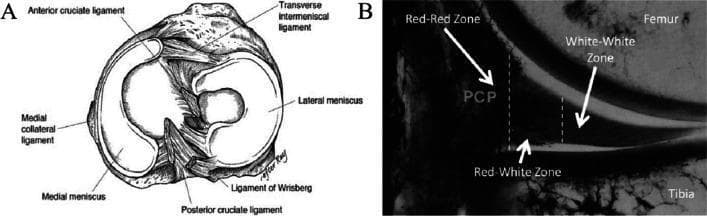
Menisci
The knee has two fibrocartilaginous menisci sitting on the tibial plateau:
| Feature | Medial Meniscus | Lateral Meniscus |
|---|---|---|
| Shape | C-shaped (larger) | O-shaped / circular (smaller) |
| Mobility | Less mobile (attached to MCL & capsule) | More mobile |
| Blood supply | Peripheral red-red zone only | Peripheral red-red zone only |
| Injury rate | More commonly torn | Less commonly torn |
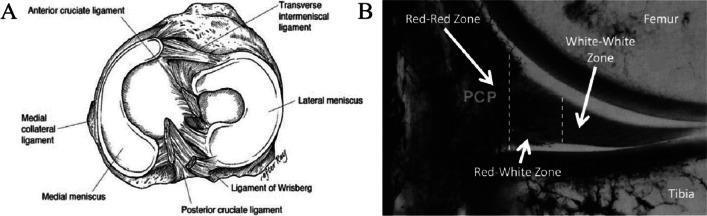
Vascular zones of the meniscus (critical for repair planning):
- Red-Red Zone (peripheral): well-vascularised → heals spontaneously
- Red-White Zone (transitional): partial vascularity → may heal with repair
- White-White Zone (central): avascular → poor healing; resection often needed
Muscles (Dynamic Stabilisers)
| Group | Muscles | Action |
|---|---|---|
| Extensors | Quadriceps femoris (rectus femoris, vastus medialis/lateralis/intermedius) + patellar tendon | Knee extension; patellofemoral control |
| Flexors | Hamstrings (biceps femoris, semitendinosus, semimembranosus) | Knee flexion; ACL co-stabilisers |
| Pes anserinus | Sartorius, gracilis, semitendinosus | Medial stabilisation |
| Popliteus | Popliteus | Unlocks the knee; posterolateral stability |
| Iliotibial band | TFL + iliotibial tract | Lateral knee stability |
Bursae
Key bursae around the knee:
- Prepatellar bursa (between skin and patella)
- Infrapatellar bursa (superficial and deep)
- Pes anserinus bursa (medial, under pes anserinus tendons)
- Baker's cyst / Popliteal bursa (posterior, communicates with joint)
- Semimembranosus bursa
PART 2 — COMMON KNEE INJURIES
PART 3 — DIFFERENTIAL DIAGNOSIS: SIGNS & SYMPTOMS
1. Anterior Cruciate Ligament (ACL) Tear
Mechanism: Non-contact deceleration/pivoting, or direct blow; knee forced into valgus + internal rotation; hyperextension.
Signs & Symptoms:
- Audible/felt "pop" at time of injury (classic)
- Immediate haemarthrosis (within 1–2 hours; hallmark finding)
- Rapid, tense joint effusion
- Inability to continue activity
- Feeling of knee "giving way" (instability)
- Anterior knee pain
Clinical Tests:
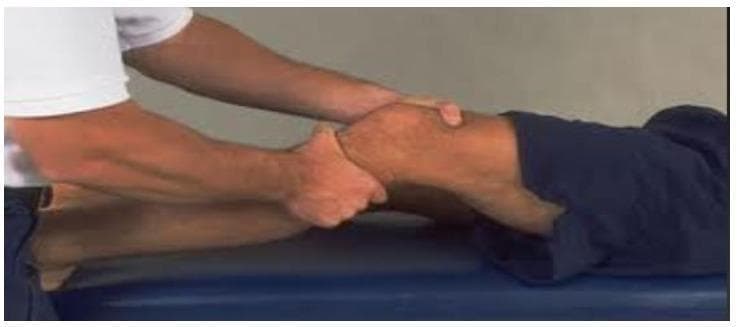
- Lachman Test (most sensitive, 85%) — knee at 20–30° flexion; anterior force on tibia; positive = increased anterior translation with soft end-point
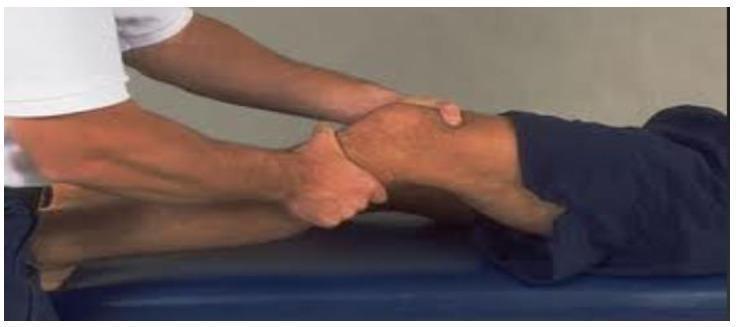
- Anterior Drawer Test — knee at 90°; anterior tibial pull; less sensitive than Lachman
- Pivot Shift Test — most specific for ACL functional instability
Investigations: MRI (gold standard for soft tissue)
2. Posterior Cruciate Ligament (PCL) Tear
Mechanism: Dashboard injury (posterior force on proximal tibia in flexed knee); hyperflexion; hyperextension.
Signs & Symptoms:
- Less dramatic presentation than ACL
- Posterior knee pain
- Haemarthrosis (less tense than ACL)
- Posterior sag of tibia (gravity sign)
- Difficulty with stairs (quadriceps overload)
- Vague instability (often underdiagnosed)
Clinical Tests:
- Posterior Drawer Test — positive (tibia pushed posteriorly)
- Posterior Sag Sign (Godfrey's) — supine, hips/knees at 90°; tibia visually sags posteriorly
- Quadriceps Active Test — contraction of quadriceps reduces posterior sag
3. Medial Collateral Ligament (MCL) Tear
Mechanism: Valgus stress (blow to lateral knee); common in contact sports.
Grading:
| Grade | Description |
|---|---|
| I | Sprain; fibres intact; point tenderness; no laxity |
| II | Partial tear; moderate laxity; pain + swelling |
| III | Complete rupture; gross laxity; may be painless |
Signs & Symptoms:
- Medial knee pain and tenderness along MCL
- Swelling (usually not haemarthrosis unless combined injury)
- Valgus deformity in severe cases
- Instability on lateral loads
Clinical Tests:
- Valgus Stress Test at 0° and 30° — laxity at 30° = isolated MCL; laxity at 0° = MCL + capsule/cruciate involvement
4. Lateral Collateral Ligament (LCL) / Posterolateral Corner (PLC) Injury
Mechanism: Varus stress; direct medial blow; hyperextension.
Signs & Symptoms:
- Lateral knee pain and tenderness over LCL (fibular head to lateral epicondyle)
- Varus deformity
- Peroneal nerve symptoms (foot drop, paraesthesia) if severe PLC injury
- Posterolateral rotatory instability
Clinical Tests:
- Varus Stress Test at 0° and 30°
- Dial Test — external tibial rotation at 30° and 90°; increased rotation at 30° alone = PLC injury; at both = PLC + PCL
- External Rotation Recurvatum Test
5. Meniscal Tear
Mechanism: Twisting on a loaded, slightly flexed knee; degenerative tears in older patients.
Signs & Symptoms:
- Joint line tenderness (medial or lateral) — most reliable sign
- Effusion (slower onset, 24–48 hours after acute injury)
- Locking (bucket-handle tear — true mechanical block to extension)
- Clicking / clicking sensation with rotation
- Pain on squatting or climbing stairs
- Delayed onset of swelling
Clinical Tests:
- McMurray's Test — knee from full flexion with varus/valgus + rotation; positive = palpable/audible click with pain at joint line
- Apley's Grind Test — prone, knee 90°; compression + rotation = pain (meniscal); distraction + rotation = pain (ligamentous)
- Thessaly Test (20° flexion, weight-bearing rotation) — sensitive for degenerative tears
- Joint line tenderness — simple but clinically significant
6. Patellar Dislocation / Patellofemoral Syndrome
Mechanism: Lateral patellar dislocation — valgus + external rotation (especially in adolescent females with trochlear dysplasia).
Signs & Symptoms:
- Visible lateral displacement of patella (acute dislocation)
- Medial peripatellar tenderness (retinaculum tear)
- Haemarthrosis
- Apprehension sign — patient resists lateral patellar glide
- Chronic patellofemoral pain: diffuse anterior knee pain, worse with stairs/squatting/prolonged sitting ("theatre sign")
7. Patellar Tendon / Quadriceps Tendon Rupture
Mechanism: Eccentric loading; more common in athletes (patellar) or elderly/systemic disease (quadriceps).
Signs & Symptoms:
- Sudden pain and inability to extend the knee
- Palpable gap in tendon
- High-riding patella (patella alta — patellar tendon rupture) or low-riding (patella baja — quadriceps rupture)
- Loss of active straight-leg raise
8. Tibial Plateau Fracture
Mechanism: Axial load + valgus/varus; "bumper fracture" from vehicular impact.
Signs & Symptoms:
- Haemarthrosis (lipohemarthrosis on X-ray = fat-fluid level)
- Severe pain and swelling
- Inability to weight-bear
- Compartment syndrome risk
- Associated neurovascular injury (popliteal artery, peroneal nerve)
PART 4 — COMPARATIVE DIFFERENTIAL DIAGNOSIS TABLE
| Feature | ACL Tear | PCL Tear | MCL Tear | LCL/PLC Tear | Meniscal Tear | Patellar Dislocation |
|---|---|---|---|---|---|---|
| Mechanism | Pivot/valgus + IR | Dashboard/hyperflexion | Valgus blow | Varus/hyperextension | Twisting on flexed knee | Valgus + ER |
| Pop at injury | ✅ Classic | Rare | Sometimes | Sometimes | Rare | Sometimes |
| Haemarthrosis timing | Immediate (1–2 hrs) | Moderate | Mild/none | Mild | Delayed (24–48 hrs) | Immediate |
| Effusion | Large, tense | Moderate | Small-moderate | Small | Moderate, delayed | Moderate |
| Pain location | Central/diffuse | Posterior | Medial | Lateral | Joint line (M or L) | Peripatellar/medial |
| Instability | Anterior, rotatory | Posterior | Valgus | Varus, posterolateral | Locking/clicking | Lateral subluxation |
| Key test | Lachman | Posterior sag/drawer | Valgus stress | Varus stress/Dial | McMurray/Apley | Apprehension sign |
| Locking | ❌ | ❌ | ❌ | ❌ | ✅ (bucket-handle) | Occasional |
| X-ray finding | Segond fracture (lateral capsule avulsion) | Reverse Segond | Normal | Normal/fibular avulsion | Normal | Lateral patellar shift |
| MRI | ACL discontinuity | PCL discontinuity | MCL edema/tear | LCL/popliteus tear | Meniscal signal change | Trochlear dysplasia |
Key Distinguishing Pearls
- Immediate haemarthrosis → think ACL tear, patellar dislocation, tibial plateau fracture (not meniscal tear, which is delayed)
- Mechanical locking (inability to fully extend) → bucket-handle meniscal tear until proven otherwise
- "Pop" + giving way + rapid swelling → ACL tear (the classic triad)
- Posterior sag in supine position → PCL injury
- Joint line tenderness → meniscal pathology
- Medial tenderness + valgus laxity → MCL injury
- Peroneal nerve deficit → suspect PLC/LCL injury
- Apprehension on lateral patellar glide → patellofemoral instability
Sources: Bailey & Love's Short Practice of Surgery, 28th Edition (pp. 511, 583); supplemented from standard orthopaedic clinical knowledge.
This is a shared conversation. Sign in to Orris to start your own chat.