
For ugi bleed do we need to give bolus dose of ppi followed by infusion according to recent guidelines, how to manage ugi bleed according to recent guidelines
upper gastrointestinal bleeding management guidelines PPI
UGI bleed PPI bolus infusion 2024 2025 guidelines ACG BSG recommendations
PMID: 38517201
PMID: 40114631
https://pmc.ncbi.nlm.nih.gov/articles/PMC12997055
Upper GI Bleed (UGIB) Management - Current Guidelines (2024-2026)
1. PPI - Bolus Followed by Infusion: What Do Current Guidelines Actually Say?
Pre-Endoscopic PPI
- Pre-endoscopic high-dose IV PPI (80 mg bolus + 8 mg/hr infusion) does reduce the proportion of patients with high-risk endoscopic stigmata (active bleeding, non-bleeding visible vessel, adherent clot), thus reducing the need for endoscopic therapy - demonstrated in a meta-analysis of 6 RCTs (2,223 patients).
- However, it does NOT reduce mortality, rebleeding rates, or need for surgery.
| Guideline | Recommendation |
|---|---|
| ACG (2021, updated 2024) | Does not recommend for/against pre-endoscopic PPI; notes it may benefit a minority; acceptable to give if endoscopy will be delayed |
| ESGE (2021) | Recommends IV PPI pre-endoscopy |
| BSG | Recommends pre-endoscopic PPI |
| APASL (2025) | PPI use in acute non-variceal UGIB is helpful (Strong recommendation) |
- Clinical Gastrointestinal Endoscopy, 3rd ed., p. 215: "No recommendations can be made regarding the optimal dose or optimal route of administration of PPIs administered preendoscopy. A reasonable strategy may be to adopt a high-dose intravenous bolus (e.g., 80 mg) followed by a continuous infusion (e.g., 8 mg/hr) regimen."
Post-Endoscopic PPI - This Is Where High-Dose Therapy Is Most Evidence-Based
- Two separate meta-analyses confirmed that IV PPI bolus + 72-hour continuous infusion after endoscopic therapy reduces:
- Mortality (RR = 0.40; NNT = 12) - only in those who underwent successful endoscopic hemostasis
- Rebleeding (RR = 0.40; NNT = 12)
- Surgery (RR = 0.43; NNT = 28)
- Harrison's 22e (2025): "High-dose, proton pump inhibitor, given to reduce intragastric acid and thereby enhance clot stability, decreases further bleeding and mortality in patients with high-risk ulcers (active bleeding, nonbleeding visible vessel, adherent clot) when given after endoscopic therapy."
- Harrison's 22e: "Meta-analysis of randomized trials indicates that outcomes are comparable with high-dose PPIs given as a constant infusion or intermittently."
2. Full Management of UGIB - Current Approach
Initial Management Algorithm
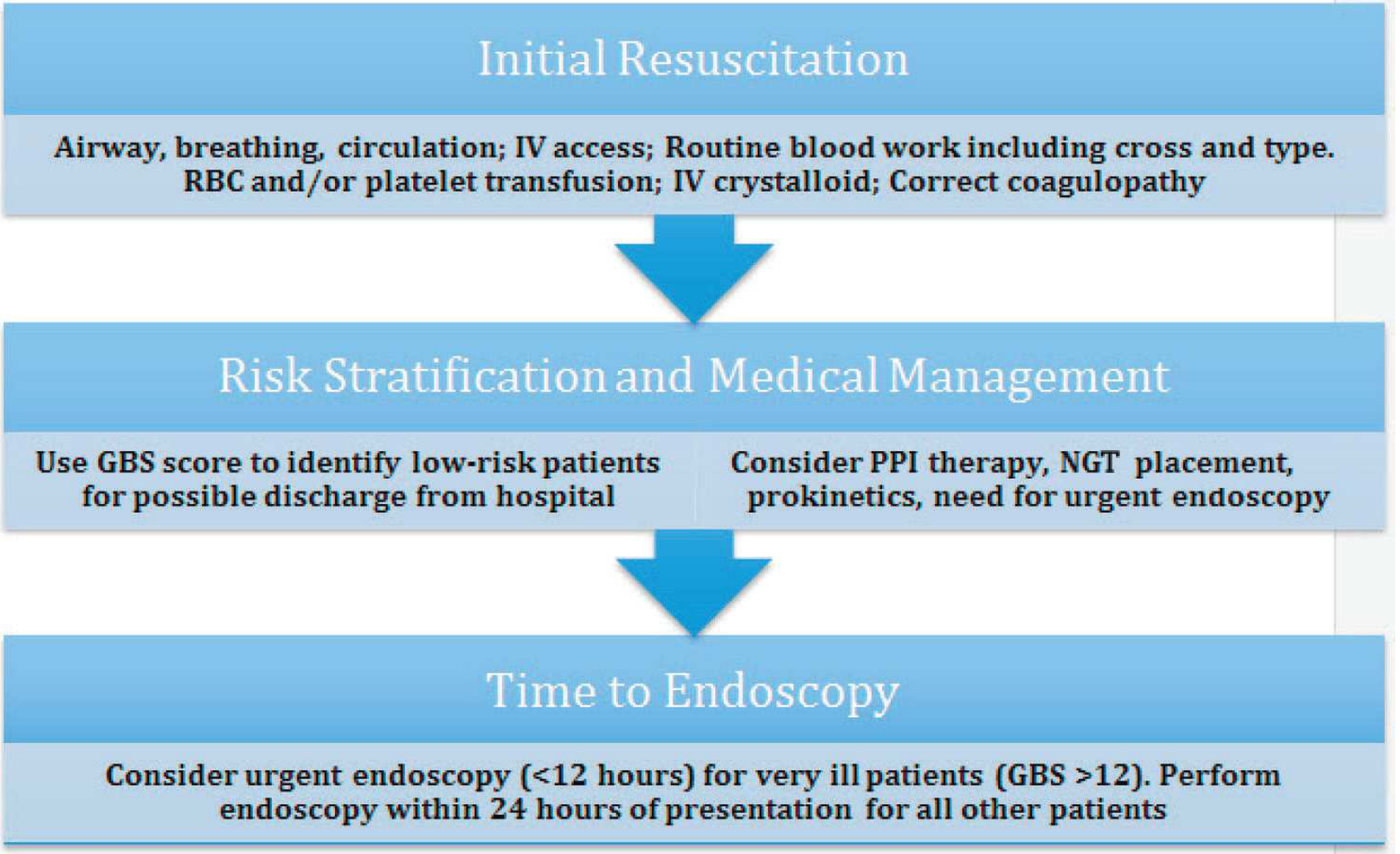
STEP 1: Resuscitation
- Massive hemorrhage / hemodynamic instability: Whole blood first (if available), then pRBCs + platelets + FFP in 1:1:1 ratio (massive transfusion protocol). Give IV calcium.
- Stable patients: Restrictive transfusion threshold - Hb < 7 g/dL (use ≥8 g/dL in cardiovascular disease). This threshold is endorsed by ACG, ESGE, and BSG based on multiple RCTs showing lower rebleeding with restrictive strategy.
- Two large-bore IV lines, airway protection if needed (consider intubation in active hematemesis with altered consciousness)
- Blood work: CBC, CMP, coagulation profile (only if on anticoagulants or cirrhosis), cross-match
- Correct coagulopathy: Vitamin K antagonists - give IV Vit K + PCC/FFP. Hold NOACs; use reversal agents (idarucizumab for dabigatran, andexanet alfa for Factor Xa inhibitors) in severe bleeding.
STEP 2: Risk Stratification
- Glasgow-Blatchford Score (GBS): Score 0-1 = low risk; eligible for outpatient management (ACG 2024 update - more selective hospitalization). GBS >12 = high risk, urgent endoscopy (<12 hours) should be considered.
- Rockall Score: Post-endoscopy for rebleed/mortality prediction.
- Pre-endoscopy: GBS is preferred (does not require endoscopy findings).
STEP 3: Pre-Endoscopic Medical Therapy
| Intervention | Recommendation | Dose |
|---|---|---|
| PPI | Consider (especially if endoscopy delayed >16h or high-risk presentation) | IV bolus 80 mg + 8 mg/hr infusion until endoscopy |
| Erythromycin | Recommended if active hemorrhage (hematemesis, melena, acute anemia needing resuscitation) or recently eaten | 250 mg IV bolus, 30-45 minutes before endoscopy |
| Metoclopramide | Alternative prokinetic if erythromycin contraindicated | 10 mg IV |
| NGT | No longer routinely recommended | |
| Tranexamic acid | NOT recommended in UGIB (HALT-IT trial - no benefit, possible harm) | |
| Octreotide/terlipressin | Only if variceal bleeding suspected | See below |
| Antibiotics | Only if cirrhosis | Ceftriaxone 1 g/day IV for 5 days |
STEP 4: Endoscopy
- Timing: Within 24 hours for all admitted UGIB patients (reduces LOS, rebleeding, surgery)
- Urgent (<12 hours): Consider for very high-risk patients (GBS >12, hemodynamic instability, ongoing hematemesis)
- Urgent (<6 hours / immediate): Evidence does NOT support routine "emergency" endoscopy <6 hours - the PILOT RCT showed it did not improve outcomes vs 6-24 hours; may increase risk in inadequately resuscitated patients
| Forrest Class | Finding | Rebleed Risk | Treatment |
|---|---|---|---|
| Ia | Spurting arterial bleed | ~55% | Endoscopic therapy + high-dose PPI |
| Ib | Oozing bleed | ~55% | Endoscopic therapy + high-dose PPI |
| IIa | Non-bleeding visible vessel | ~43% | Endoscopic therapy + high-dose PPI |
| IIb | Adherent clot | ~22% | Attempt clot removal; therapy if vessel beneath + high-dose PPI |
| IIc | Flat pigmented spot | ~10% | Oral PPI, can discharge |
| III | Clean base ulcer | ~5% | Oral PPI, can discharge home after endoscopy |
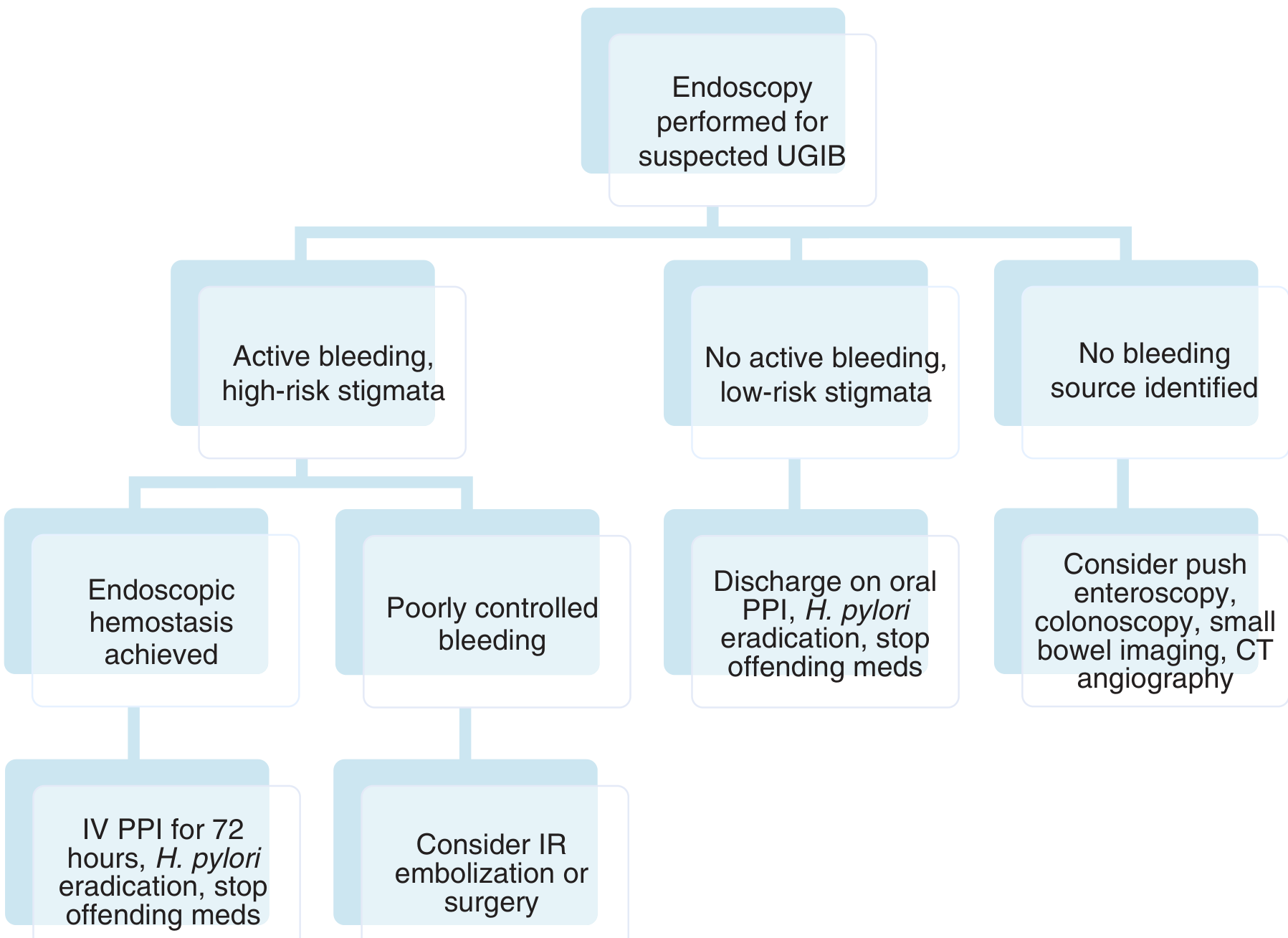
- Combination therapy is preferred: injection (epinephrine 1:10,000) + thermal coagulation OR clips
- Epinephrine injection alone is insufficient
- Over-the-scope clips (OTSCs): Superior to standard clips for large vessels; use as first-line or rescue
- TC-325 (Hemospray): Effective as temporizing/bridge measure; NOT monotherapy for high-risk peptic ulcers (insufficient duration of action for 72-hour rebleed window)
- Thermal therapy: Bipolar electrocoagulation, heater probe, APC
STEP 5: Post-Endoscopic Management
- Keep nil per os (NPO) for 24 hours
- Hospitalize for 72 hours
- High-dose IV PPI for 72 hours - bolus 80 mg + infusion 8 mg/hr, OR intermittent high-dose PPI (40 mg IV/oral twice to four times daily) - evidence now shows these are comparable
- Early enteral feeding recommended for all UGIB patients (2024 evidence)
- Rebleeding: repeat endoscopy first; if fails, angiographic embolization or surgery
- Discharge on oral PPI (once daily standard dose)
- No second-look endoscopy routinely (only if high-risk or suboptimal initial therapy)
STEP 6: Special Considerations
- Vasoactive drugs (octreotide 50 mcg IV bolus then 50 mcg/hr infusion for 2-5 days, OR terlipressin, somatostatin) - start before endoscopy
- Prophylactic antibiotics (ceftriaxone 1 g/day for 5 days; 2 days may suffice with successful endoscopy - APASL 2025)
- Endoscopic variceal ligation (EVL) is treatment of choice for esophageal varices
- N-butyl cyanoacrylate glue injection for gastric varices; EUS-guided alternatives emerging (APASL 2025)
- Early-TIPS: Consider in Child-Pugh B (score 8-9) with active bleeding or HVPG >20 mmHg - significantly improves survival
- SEMS (self-expanding metal stents): For refractory esophageal variceal bleeding as bridge to TIPS (preferred over balloon tamponade)
- Long-term: Non-selective beta-blockers + EVL combination
- Test ALL patients with erosive/ulcer UGIB during acute episode
- False-negative rate is high in acute setting (up to 55%) - repeat if initial test negative after stopping PPI
- Eradicate if positive - reduces rebleed to <5%
- Confirm eradication (urea breath test)
- If H. pylori negative + no NSAID/aspirin use: indefinite PPI therapy (42% rebleed rate at 7 years without it)
- Aspirin for secondary CV prevention: Do NOT stop; restart within 3-5 days if temporarily held
- Aspirin for primary prevention: Discontinue; reassess risk-benefit before resuming
- NOACs/anticoagulants: Resume within 7-15 days based on thromboembolic risk
- DAPT: Prophylactic PPI co-therapy recommended for all patients on DAPT
- Discontinue if possible; if must continue, use COX-2 selective + PPI
Summary on PPI Bolus + Infusion Question
| Situation | Recommendation |
|---|---|
| Pre-endoscopic | Optional/consider (downgraded) - 80 mg bolus + 8 mg/hr; never delay endoscopy |
| Post-endoscopic, high-risk stigmata | Strongly recommended - 72 hours of high-dose PPI (bolus + infusion OR intermittent high-dose PPI equally acceptable) |
| Post-endoscopic, low-risk | Oral PPI standard dose only |
| Variceal bleed | PPI useful adjunct (APASL 2025 strong recommendation), but not the primary treatment |
Create a clinical decision tree summarizing when to use PPI bolus+infusion vs. oral PPI
A clean, professional clinical decision tree flowchart titled "PPI Selection in Upper GI Bleeding (UGIB)" for medical use. The tree flows top to bottom with clear boxes and arrows. Start at the top: "Patient presents with UGIB" First decision diamond: "Hemodynamically stable? Resuscitation complete?" - Left branch (NO): Box "Resuscitate first — ABC, IV access, transfusion (Hb threshold 7 g/dL). DO NOT give PPI before resuscitation" - Right branch (YES): Continue down Next box: "Phase of Management?" Branch 1 — PRE-ENDOSCOPIC PHASE: Decision diamond: "Will endoscopy be delayed >16 hours OR high-risk presentation (hematemesis, high GBS)?" - YES → Green box: "Consider IV PPI — Bolus 80 mg IV + Infusion 8 mg/hr until endoscopy. ⚠️ NEVER delay endoscopy for PPI" - NO / Low-risk (GBS 0–1) → Orange box: "Oral PPI acceptable. Consider outpatient management" Branch 2 — POST-ENDOSCOPIC PHASE: Decision diamond: "Endoscopic findings?" Sub-branch A: "High-risk stigmata (Forrest Ia, Ib, IIa, IIb)" → Decision: "Endoscopic hemostasis achieved?" - YES → Red/Bold Green box: "IV PPI Bolus 80 mg + Infusion 8 mg/hr × 72 hours (OR intermittent high-dose PPI q6-12h × 72h — equally effective). Keep NPO 24h. Admit 72h." - NO (failed hemostasis) → Red box: "IR embolization or surgery. IV PPI adjunct" Sub-branch B: "Low-risk stigmata (Forrest IIc — flat spot, Forrest III — clean base)" → Blue box: "Oral PPI once daily. Discharge if stable. No second-look endoscopy routinely" Sub-branch C: "Variceal bleeding" → Purple box: "IV PPI as adjunct (APASL 2025 Strong). Primary Rx: Vasoactive drugs + EVL + Antibiotics (if cirrhosis)" Bottom footer notes in small text: "ACG 2024 / ESGE 2021 / Harrison's 22e / Shung & Laine 2024 | Intermittent high-dose PPI = comparable to continuous infusion (meta-analysis) | P-CABs (vonoprazan) emerging as non-inferior alternative" Use a white background, color-coded boxes (green for safe/discharge, orange for caution, red for high-risk/urgent action, blue for low-risk, purple for variceal), bold decision diamonds in grey, clean sans-serif font, professional medical style.
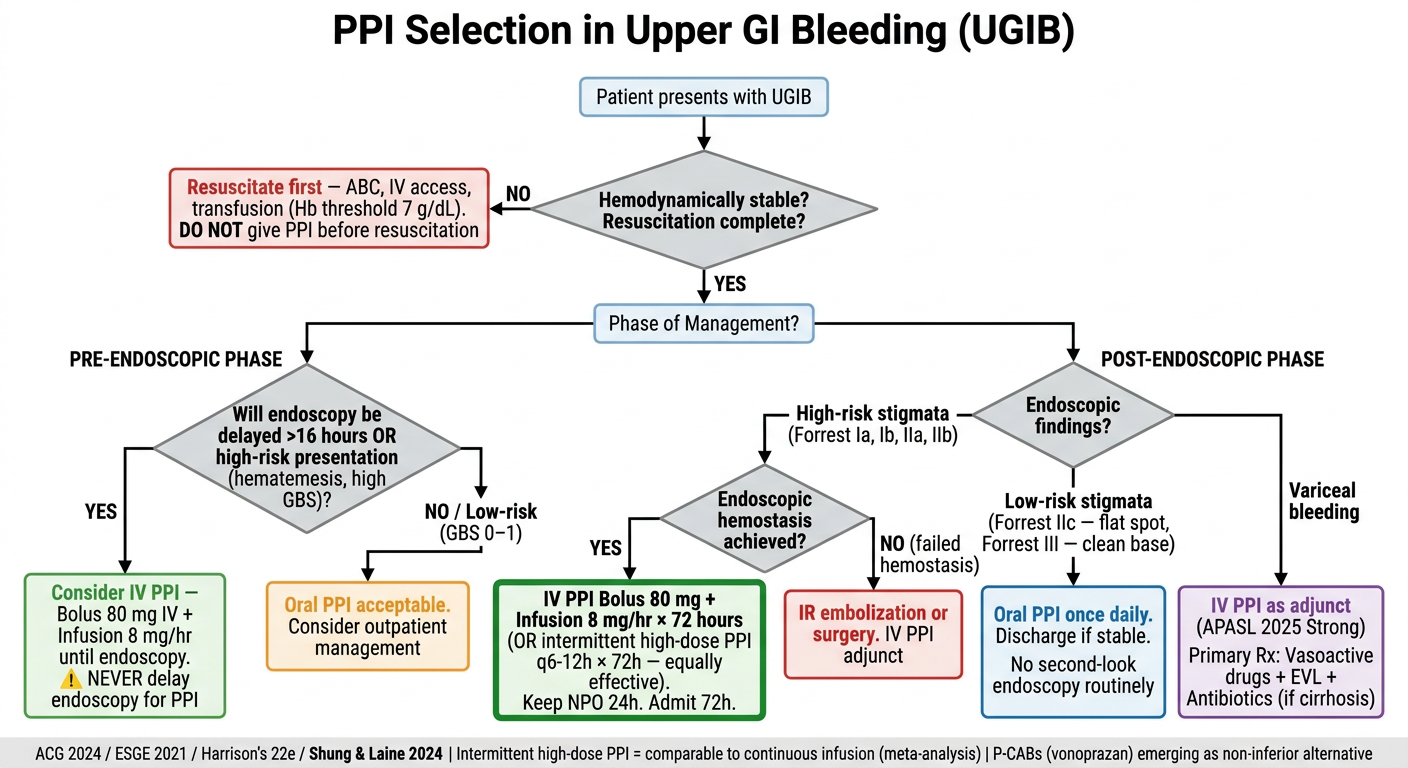
Quick Reference - PPI Route Decision in UGIB
- High-risk presentation (hematemesis, GBS >1, endoscopy delayed >16h) → IV bolus 80 mg + infusion 8 mg/hr until endoscopy
- Low-risk (GBS 0-1) → Oral PPI, consider outpatient discharge
- Universal rule: never delay endoscopy to give PPI
- High-risk stigmata (Forrest Ia/Ib/IIa/IIb) + successful hemostasis → IV PPI bolus 80 mg + 8 mg/hr × 72 hours OR intermittent high-dose PPI (40 mg IV/oral q6-12h) - both are now considered equally effective per current meta-analyses
- Low-risk stigmata (Forrest IIc/III) → Oral PPI once daily, can discharge home
- Variceal bleed → IV PPI is a useful adjunct, but primary treatment is vasoactive drugs + endoscopic variceal ligation + antibiotics (if cirrhosis)