
Culture methods in tb full details for md exam answer 15 marks
Reading File
Finding Sources
Finding Sources
Reading File
Reading File
Reading File
Finding Sources
Finding Sources
Reading File
Reading File
Reading File
Finding Sources
Reading File
Reading File
I now have comprehensive data from multiple authoritative textbooks. Let me fetch the TB culture diagnostic flowchart image and compile the full answer.
Loading Image
Loading Image
I now have all the material needed for a comprehensive MD exam answer. Here it is:
Culture Methods in Tuberculosis — MD Exam Answer (15 Marks)
Introduction
Culture of Mycobacterium tuberculosis (MTB) is the gold standard for definitive diagnosis of TB. It is far more sensitive than smear microscopy (~100× more sensitive), capable of detecting as few as 10–100 CFU/mL of specimen, compared to 5,000–10,000 organisms/mL needed for smear positivity. Culture is also essential for drug susceptibility testing (DST) and species identification.
Diagnostic Algorithm Overview
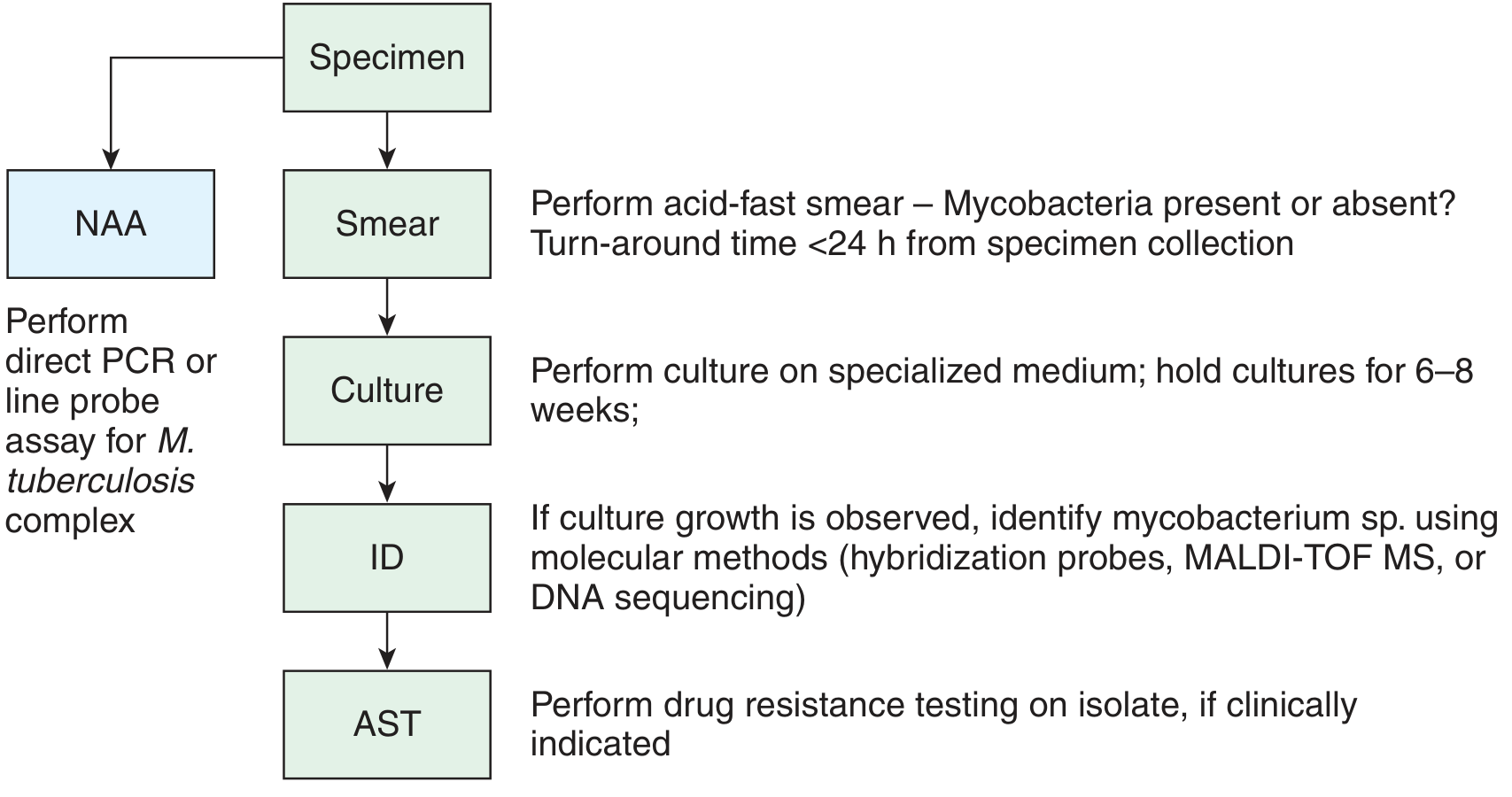
Step 1: Specimen Collection
Types of Specimens
| Specimen | Notes |
|---|---|
| Sputum | 3 early-morning specimens on consecutive days; ≥3–5 mL; most common |
| Gastric aspirate | For children unable to expectorate; collected fasting in morning |
| Bronchial washings / BAL | For smear-negative or endobronchial disease |
| CSF | Large volume (≥10 mL); lymphocytic pleocytosis (100–400 cells/µL) |
| Urine | 3 consecutive early-morning, mid-stream specimens |
| Pleural / pericardial fluid | Paucibacillary; culture more useful than smear |
| Biopsy tissue | Must NOT be placed in formalin — formaldehyde is toxic to mycobacteria |
| Blood | Anticoagulated (SPS, heparin, citrate); EDTA tubes are contraindicated |
Step 2: Specimen Processing
Before inoculation, non-sterile specimens (sputum, urine, gastric aspirate) must be:
- Liquefaction / digestion — with N-acetyl-L-cysteine (NALC) to break mucus
- Decontamination — with 2% NaOH (sodium hydroxide) to kill contaminating bacteria and fungi; mycobacteria resist brief alkali treatment due to their thick lipid-rich cell wall
- Neutralization — with phosphate buffer to bring pH to ~6.8
- Concentration — by centrifugation at 3,000×g for 15 minutes; deposits are used for smear and culture
Sterile specimens (CSF, pleural fluid, pericardial fluid) do not require decontamination — they are centrifuged directly and inoculated.
Note: Prolonged or excessive decontamination kills mycobacteria and lowers yield.
Step 3: Culture Media
A. Solid Media
1. Egg-based: Löwenstein-Jensen (L-J) Medium (Oldest and most widely used)
| Parameter | Detail |
|---|---|
| Composition | Coagulated whole eggs, glycerol, asparagine, malachite green (inhibits contaminants) |
| Preparation | Inspissated (coagulated) at 85°C for 45 minutes |
| pH | 6.8 |
| Incubation | 37°C, 5–10% CO₂, for 4–8 weeks |
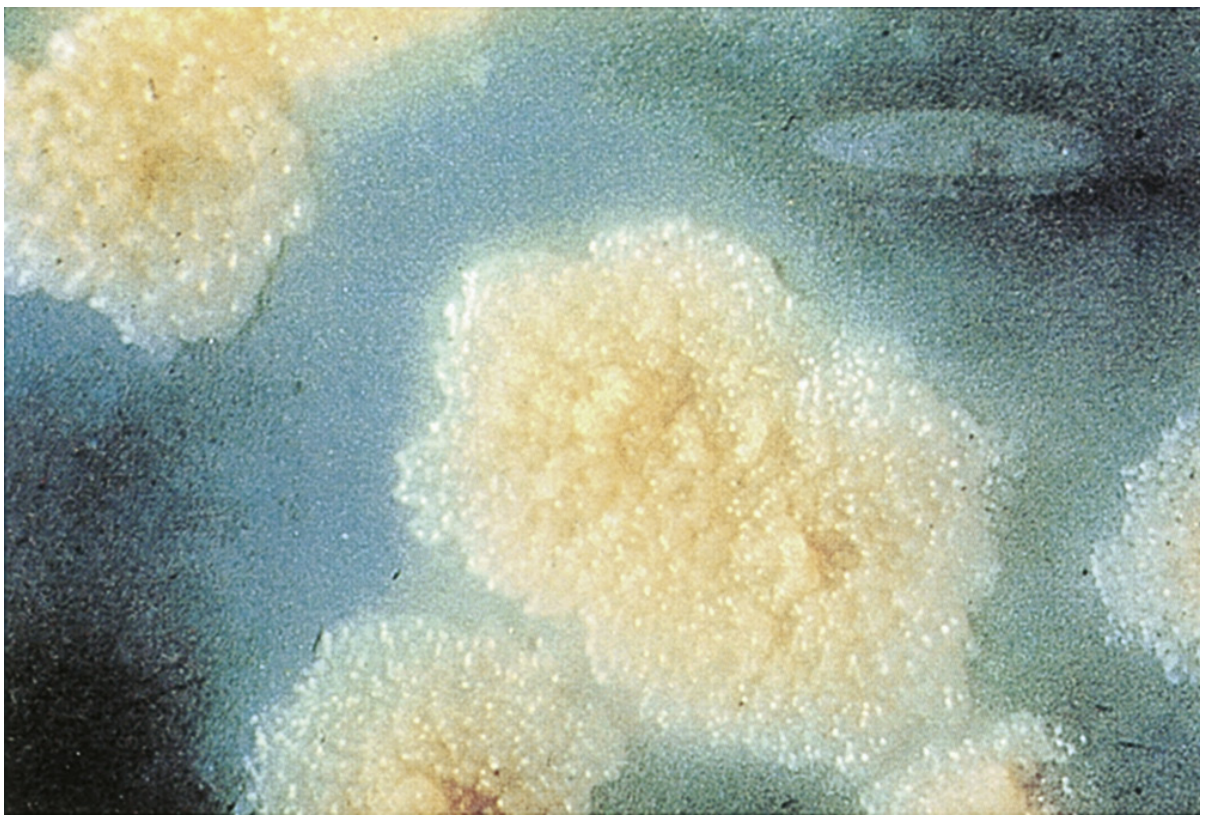
| M. tuberculosis colonies | Appear in 3–8 weeks; "rough and buff" — dry, rough, wrinkled, cream/buff coloured, cauliflower-like, non-pigmented |
| M. bovis | Flat, smooth, dysgonic colonies; does not grow on pyruvate-free L-J |
| Advantage | Inexpensive, stable, suppresses contamination |
| Disadvantage | Slow (18–24 days to visible colonies), batch-to-batch variability |
Classical mnemonics: M. tuberculosis = "Eugonic, Rough, Non-pigmented"
Colony morphology on L-J:
2. Agar-based: Middlebrook 7H10 and 7H11
| Parameter | Detail |
|---|---|
| Composition | 7H10: Oleic acid-albumin-dextrose-catalase (OADC) enrichment; 7H11: adds casein hydrolysate (for drug-resistant strains) |
| Incubation | 37°C, 5–10% CO₂ (CO₂ mandatory for agar-based media) |
| Time to growth | 10–12 days (faster than L-J) |
| Advantage | Chemically defined, allows transparent colony inspection under microscope, colonies visible earlier |
| Disadvantage | Less stable — exposure to excessive heat or light releases formaldehyde (toxic to mycobacteria); must be stored in dark at 4°C |
Selective versions contain antibiotics (e.g., PANTA: Polymyxin B, Amphotericin B, Nalidixic acid, Trimethoprim, Azlocillin) to suppress contaminants.
B. Liquid (Broth) Media — Current WHO-Recommended Reference Standard
Liquid culture is ~10% more sensitive than solid media and detects growth faster. However, it has a higher contamination rate.
1. BACTEC MGIT 960 System (Most widely used automated system)
| Parameter | Detail |
|---|---|
| Full name | Mycobacteria Growth Indicator Tube |
| Broth | Modified Middlebrook 7H9 broth + OADC enrichment |
| Principle | Contains a fluorescent compound (ruthenium complex) embedded in silicone at the bottom of the tube, quenched by dissolved oxygen. As mycobacteria grow and consume O₂, quenching is relieved → fluorescence increases |
| Detection | Automated fluorometric monitoring every 60 minutes |
| Time to detection | Average 10–14 days (range: 6–21 days for positive); tubes read until Week 6–8 before declaring negative |
| Sensitivity | Detects as few as 10⁴ CFU/mL (faster still in heavy inocula) |
| Supplements | MGIT PANTA (antibiotic cocktail) + OADC added to reduce contamination |
2. VersaTREK System (Thermo Fisher)
- Uses sensor detecting pressure changes (O₂ consumption) in a headspace above broth
- Suitable for blood and bone marrow specimens (MGIT is not)
3. BACT/ALERT 3D (bioMérieux)
- Colorimetric CO₂ detection principle
- Also uses Middlebrook broth
Current guidelines specify both solid and broth media must be inoculated in parallel for every specimen — broth for speed/sensitivity, solid for colony morphology and detection of mixed cultures.
Step 4: Identification of M. tuberculosis
A. Conventional / Phenotypic Methods
| Feature | M. tuberculosis |
|---|---|
| Growth rate | Slow (>7 days) |
| Optimum temperature | 35–37°C |
| CO₂ requirement | Stimulated |
| Colony morphology | Rough, buff, non-pigmented ("rough and buff") |
| Pigmentation | Non-chromogen (no pigment in light or dark) |
| Niacin test | Positive (accumulates niacin — unique to MTB among pathogenic mycobacteria) |
| Nitrate reduction | Positive |
| Catalase | Weakly positive (heat labile at 68°C — negative at 68°C) |
| Tween 80 hydrolysis | Negative |
Conventional biochemical tests require 6–8 weeks — now largely of historical interest and being replaced by molecular methods.
B. Molecular Identification Methods
| Method | Details |
|---|---|
| Nucleic acid hybridization probes | Species-specific probes (e.g., Gen-Probe AccuProbe) for MTB complex; results in hours |
| 16S rRNA gene sequencing | Definitive species identification; used for unusual isolates |
| MALDI-TOF MS | Mass spectrometry of cell proteins; results in <1 hour; low cost; identifies virtually all mycobacterial species |
| Line probe assays (LPA) | e.g., HAIN GenoType MTBDRplus — detects MTB + resistance mutations for rifampicin (rpoB) and isoniazid (katG, inhA) |
| Xpert MTB/RIF (GeneXpert) | Rapid molecular test (2 hours); sensitivity >91%, specificity 97–100%; detects MTB + rifampicin resistance; WHO-recommended point-of-care test |
Step 5: Drug Susceptibility Testing (DST)
| Method | Principle | Comments |
|---|---|---|
| Proportion method on L-J / Middlebrook | Growth on drug-containing vs. drug-free medium | Gold standard phenotypic DST; takes 4–8 weeks |
| BACTEC MGIT 960 DST | Automated broth; compares growth with and without drug | Results in 4–14 days; WHO recommended |
| Absolute concentration method | Growth inhibition at defined drug concentrations | |
| Resistance ratio method | Ratio of MIC of test strain to reference strain | |
| Molecular DST | LPA, Xpert detect resistance mutations | Rapid but limited to known mutations |
Runyon Classification (for contextual classification of mycobacteria)
| Group | Pigment | Growth | Examples |
|---|---|---|---|
| I — Photochromogens | Only in light | Slow | M. kansasii, M. marinum |
| II — Scotochromogens | In light and dark | Slow | M. scrofulaceum, M. gordonae |
| III — Nonchromogens | None | Slow | M. tuberculosis complex, MAC |
| IV — Rapid growers | Variable | <7 days | M. fortuitum, M. chelonae |
All M. tuberculosis complex organisms are Group III nonchromogens — any pigment indicates NTM.
Biosafety Considerations
- All culture procedures involving live MTB must be conducted in a Biosafety Level 3 (BSL-3) laboratory
- Negative-pressure rooms, Class II biosafety cabinets, N95 respirators mandatory
- Primary smear microscopy requires BSL-2
Summary Comparison of Culture Methods
| Feature | L-J (solid) | Middlebrook 7H10/11 (solid) | MGIT 960 (liquid) |
|---|---|---|---|
| Time to growth | 3–8 weeks | 10–12 days | 10–14 days |
| Sensitivity | Standard | Higher | Highest |
| Cost | Low | Moderate | High |
| Contamination rate | Low | Low | Higher |
| Colony morphology | Yes | Yes | No |
| Mixed culture detection | Yes | Yes | No |
| WHO recommendation | Yes (as parallel) | Yes (as parallel) | Primary standard |
| DST possible | Yes | Yes | Yes (automated) |
Key Points for Exam
- Gold standard for TB diagnosis = Culture (liquid MGIT is current WHO reference standard)
- L-J medium: egg-based, malachite green as inhibitor, growth in 3–8 weeks, rough-buff colonies
- NALC-NaOH decontamination: kills commensals but not mycobacteria; must not be excessive
- MGIT: fluorometric O₂ consumption method; detects in 10–14 days; both solid and broth media must be used in parallel
- Niacin test positive + nitrate positive + 68°C catalase negative = M. tuberculosis
- Middlebrook 7H11 preferred for drug-resistant strain isolation (contains casein hydrolysate)
- Culture sensitivity = ~100× smear; detects 10–100 CFU/mL
- Cultures held for 6–8 weeks before declaring negative; some laboratories extend to 12 weeks for suspected slowly growing NTM
- Biopsy tissue must never be placed in formalin if culture is intended
- All TB culture work requires BSL-3 facilities
Sources: Harrison's Principles of Internal Medicine 22E (2025); Tietz Textbook of Laboratory Medicine 7E; Murray & Nadel's Textbook of Respiratory Medicine; Medical Microbiology 9E (Murray); Jawetz Melnick & Adelbergs Medical Microbiology 28E
This is a shared conversation. Sign in to Orris to start your own chat.