
Renal function tests
Reading File
Now I'll search the medical library for comprehensive coverage of renal function tests.
Finding Sources
Finding Sources
Good sources found. Let me read the most relevant ones in parallel - the Urology textbook's dedicated RFT section and the Clinical Pathology compendium.
Reading File
Reading File
Reading File
Excellent content retrieved. Let me get more from the Urology textbook (the BUN section was cut off) and the Clinical Pathology compendium (for tubular function tests, proteinuria, etc.).
Reading File
Reading File
Reading File
I have rich content. Let me get the ARF table and tubular function tests from the Clinical Pathology compendium, and tubular function/proteinuria content from the Miller's Anesthesia section.
Reading File
Reading File
I now have comprehensive content. Let me fetch the graph image and get the remaining tubular function content.
Loading Image
Reading File
I now have comprehensive content from multiple authoritative sources. Let me compile the full answer.
Renal Function Tests
Renal function tests (RFTs) assess both glomerular and tubular components of kidney function. They can be broadly divided into tests of glomerular function, tubular function, urinalysis, and novel biomarkers.
1. Tests of Glomerular Function
Serum Creatinine
Creatinine is the end product of skeletal muscle creatine metabolism. It is freely filtered at the glomerulus and is neither significantly reabsorbed nor secreted (a negligible amount is secreted in the distal nephron).
- Normal range: 0.8-1.2 mg/dL in adults; 0.4-0.8 mg/dL in young children; 0.5-1.0 mg/dL in pregnancy
- Serum creatinine remains within the normal range until approximately 50% of renal function has been lost - this is the "creatinine blind spot"
- It is not influenced by dietary protein intake (unlike BUN), making it more specific for renal function
- The Jaffe reaction (alkaline picrate) is used for measurement; false elevations occur with cephalosporins, ketones, glucose, ascorbic acid, and protein
- Smith and Tanagho's General Urology, 19th Edition; Quick Compendium of Clinical Pathology, 5th Ed.
Blood Urea Nitrogen (BUN)
Urea is the primary metabolite of protein catabolism and is excreted entirely by the kidneys. It is freely filtered and partially reabsorbed by the nephron.
- Normal range: 5-25 mg/dL
- About two-thirds of renal function must be lost before a significant BUN rise occurs
- BUN is less specific than creatinine because it is influenced by:
- Dietary protein intake
- Hydration status
- GI bleeding
- Catabolic states (corticosteroid use)
- Tetracyclines (increase BUN)
- Liver disease, malnutrition, SIADH (decrease BUN)
- Elevated BUN = azotemia; high BUN with toxic effects = uremia
- Miller's Anesthesia, 10e; Quick Compendium of Clinical Pathology, 5th Ed.
BUN:Creatinine Ratio
- Normal: ~10:1
- Elevated (>20:1): dehydration, prerenal azotemia, bilateral urinary obstruction, urinary extravasation, GI bleeding, catabolic states
- Low (<10:1): advanced hepatic insufficiency, overhydration, malnutrition, SIADH
- Key diagnostic utility: differentiating prerenal from intrarenal ARF
- Smith and Tanagho's General Urology, 19th Ed.
Glomerular Filtration Rate (GFR)
GFR is the best measure of glomerular function. Normal GFR is approximately 125 mL/min. Clinical manifestations of reduced GFR are not typically seen until GFR drops to 50% of normal.
GFR Staging:
| Stage | GFR | Clinical Significance |
|---|---|---|
| Normal | ~125 mL/min | No symptoms |
| Moderate RI | ~30% of normal | Biochemical abnormalities only (elevated creatinine, urea); nocturia, anemia |
| Severe RI | <30% of normal | Uremia, acidemia, volume overload, neurologic/cardiac/respiratory manifestations |
| ESRD | 5-10% of normal | Renal replacement therapy required |
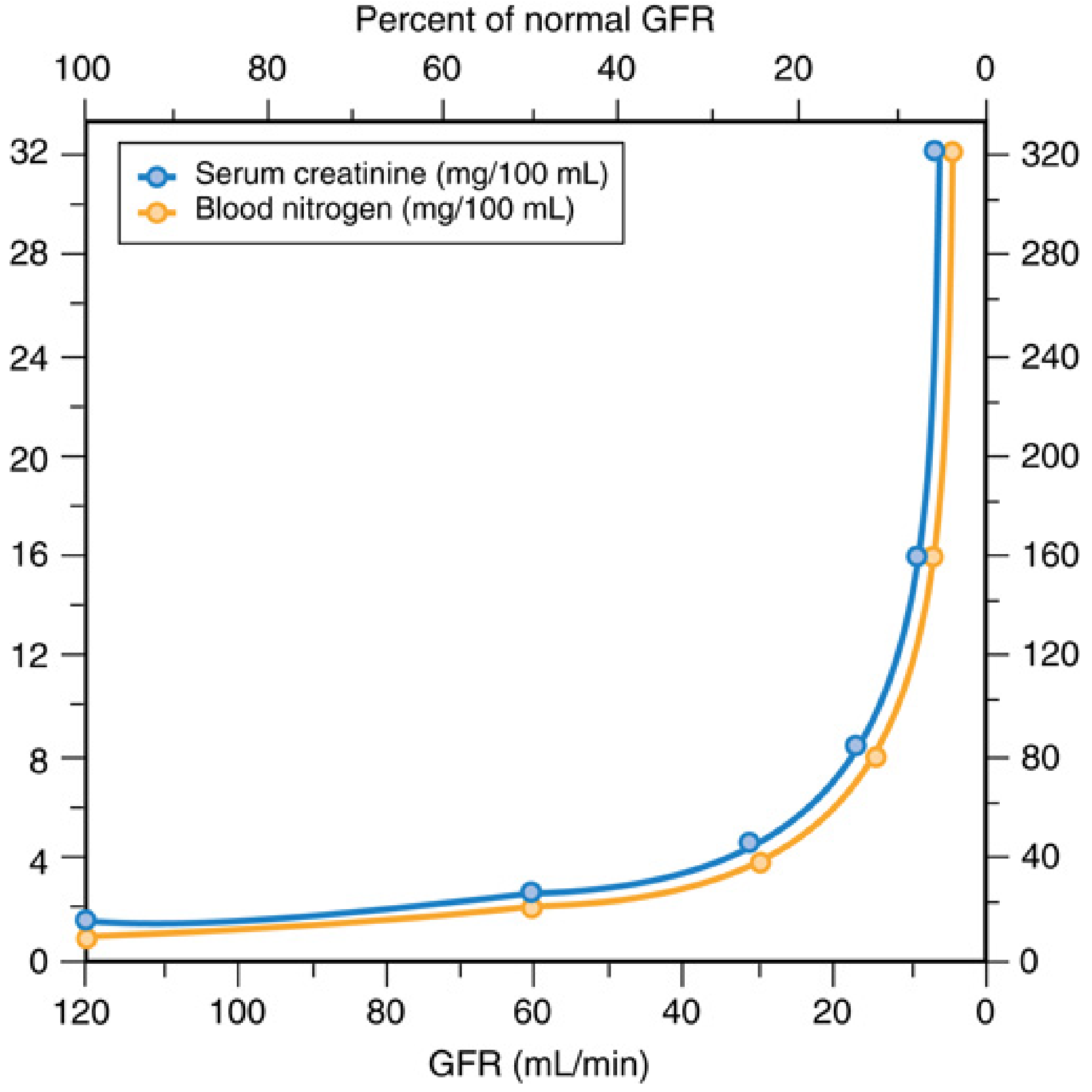
Fig: Note the exponential rise in both BUN and creatinine as GFR falls below 30 mL/min - Miller's Anesthesia, 10e
Creatinine Clearance (Endogenous)
The most accurate measure of GFR without exogenous substances. Requires a timed 24-hour urine collection plus a concurrent serum sample.
Formula:
CrCl = (UCr × Vurine) / (PCr × time in minutes)
- UCr = urine creatinine (mg/dL), V = urine volume (mL), PCr = plasma creatinine (mg/dL)
- Normal: 80-120 mL/min (corrected normal: 70-140 mL/min per 1.73 m²)
Cockcroft-Gault formula (estimated CrCl):
CrCl (mL/min) = [(140 - age) × Lean body weight (kg)] / [Plasma creatinine (mg/dL) × 72]
- Multiply by 0.85 for women (lower muscle mass fraction)
- Smith and Tanagho's General Urology, 19th Ed.; Miller's Anesthesia, 10e
GFR Estimation Equations (eGFR)
| Equation | Key Features |
|---|---|
| MDRD | Based on creatinine + age; validated in adult Caucasians and African Americans with GFR <60; not reliable when GFR >60 mL/min/1.73 m² |
| CKD-EPI | Based on creatinine, age, sex, race; more accurate when GFR is high; better predicts risk of ESRD and cardiovascular mortality |
| Cockcroft-Gault | Based on creatinine, age, weight, sex; used for drug dosing |
- Quick Compendium of Clinical Pathology, 5th Ed.; Smith and Tanagho's General Urology, 19th Ed.
2. Tests of Tubular Function
Urine Specific Gravity and Osmolality
Tubular function is primarily assessed by the kidney's ability to concentrate urine.
| Finding | Interpretation |
|---|---|
| Specific gravity 1.030 / osmolality 1050 mOsm/kg | Excellent tubular function |
| Specific gravity 1.002-1.030 | Normal range |
| Specific gravity fixed at 1.006-1.010 / osmolality ~290 mOsm/kg (isosthenuria) | Significant tubular damage |
| Dilution to osmolality 50-100 mOsm/kg | May persist even in advanced renal disease |
- In early renal damage, the concentrating mechanism is impaired before the diluting mechanism
- Urinary osmolality is a more meaningful measurement than specific gravity, but specific gravity is useful at the bedside
- Smith and Tanagho's General Urology, 19th Ed.; Miller's Anesthesia, 10e
Fractional Excretion of Sodium (FENa)
A key test for differentiating prerenal from intrarenal (ATN) acute renal failure:
FENa (%) = (UNa × PCr) / (PNa × UCr) × 100
- FENa <1%: prerenal ARF (avid sodium retention - tubules still working)
- FENa >2%: intrarenal ARF / ATN (tubular dysfunction)
Urinary β2-Microglobulin and Lysozyme
- Assays for tubular dysfunction - these low-molecular-weight proteins are normally reabsorbed by the proximal tubule
- Elevated in proximal tubular injury
- Quick Compendium of Clinical Pathology, 5th Ed.
3. Urinalysis (Routine + Microscopy)
Reference Ranges (Miller's Anesthesia, 10e)
| Parameter | Normal |
|---|---|
| Color | Straw to amber |
| Appearance | Clear to hazy |
| Protein | 0 mg/dL (dipstick) |
| Blood | Negative |
| Glucose | 0 mg/dL |
| Ketones | 0 mg/dL |
| pH | 4.5-8.0 |
| Specific gravity | 1.002-1.030 |
| Bilirubin | Negative |
| RBCs (microscopic) | 0-3/HPF |
| WBCs (microscopic) | 0-5/HPF |
| Casts | 0-2/LPF |
Proteinuria
- Normal protein excretion: <150 mg/day (mainly Tamm-Horsfall protein)
- Urine dipstick is most sensitive to albumin; insensitive to other proteins
- Microalbuminuria: detectable by the microalbumin assay (≥0.3 mg/dL); sensitive marker of glomerular dysfunction - recommended annual screening for diabetics, hypertensives, and those with family history of renal disease
- Massive proteinuria (>750 mg/day or >3.5 g/day): indicates severe glomerular damage (nephrotic range)
Glycosuria
- Glucose is freely filtered and reabsorbed in the proximal tubule
- Glycosuria indicates that tubular reabsorptive capacity has been exceeded (usual threshold ~180 mg/dL plasma glucose) - most commonly diabetes mellitus, or Fanconi syndrome (tubular defect)
Urine Microscopy - Key Casts
| Cast Type | Significance |
|---|---|
| Hyaline casts | Normal / concentrated urine |
| RBC casts | Glomerulonephritis |
| WBC casts | Pyelonephritis / interstitial nephritis |
| Granular ("muddy brown") casts | Acute tubular necrosis |
| Waxy/broad casts | Chronic renal failure |
- Miller's Anesthesia, 10e; Quick Compendium of Clinical Pathology, 5th Ed.
4. Novel Biomarkers
Cystatin C
- Produced by nearly all nucleated cells; freely filtered by the glomerulus; completely reabsorbed by the proximal tubule (not secreted)
- Superior to creatinine as a predictor of cardiovascular mortality
- An early indicator of evolving CKD
- Not influenced by muscle mass, age, or sex - useful when creatinine is unreliable (e.g., cachexia, muscular patients)
- Increasingly used to calculate eGFR (CKD-EPI cystatin C equation)
NGAL, KIM-1, IL-18
Novel AKI biomarkers that appear in urine within hours of tubular injury, before serum creatinine rises. Still under investigation for widespread clinical use.
- Quick Compendium of Clinical Pathology, 5th Ed.; Miller's Anesthesia, 10e
5. Differentiating Prerenal vs. Intrarenal ARF
| Parameter | Prerenal ARF | Intrarenal (Renal) ARF |
|---|---|---|
| BUN:Creatinine ratio | >20:1 | <20:1 |
| Urine specific gravity | High (>1.020) | Low (<1.010) |
| Urine osmolality | High (>500 mOsm/kg) | Low (300-400 mOsm/kg) |
| FENa | <1% | >2% |
| FE urea | <35% | >35% |
| Urine microscopy | Usually normal | "Active" sediment (granular casts, dysmorphic RBCs) |
| Response to fluids | Sustained improvement | No improvement |
- Quick Compendium of Clinical Pathology, 5th Ed.
6. Serum Electrolytes and Additional Tests
| Test | Normal Range | Clinical Relevance |
|---|---|---|
| Sodium | 133-147 mmol/L | Volume status, SIADH, salt-losing nephropathy |
| Potassium | 3.2-5.2 mmol/L | Hyperkalemia in uremia |
| Chloride | 94-110 mmol/L | Acid-base assessment |
| CO2 (bicarbonate) | 22-32 mmol/L | Metabolic acidosis in CKD |
| Uric acid | 2.5-7.5 mg/dL | Gout, uric acid nephropathy |
| Calcium | 8.5-10.5 mg/dL | Secondary hyperparathyroidism, renal osteodystrophy |
| Phosphorus | 2.2-4.2 mg/dL | Hyperphosphatemia in CKD |
Summary - Quick Reference
| Test | What it Measures | Limitation |
|---|---|---|
| Serum creatinine | Glomerular filtration | Stays normal until 50% function lost; affected by muscle mass |
| BUN | Glomerular filtration | Affected by diet, hydration, GI bleeding |
| Creatinine clearance | GFR directly | Requires accurate 24h urine collection |
| eGFR (CKD-EPI) | Estimated GFR | Less accurate without known CKD |
| Urine specific gravity | Tubular concentrating ability | Less precise than osmolality |
| FENa | Differentiates prerenal vs ATN | Unreliable if diuretics given |
| Microalbuminuria | Early glomerular damage | Screening test only |
| Cystatin C | GFR; early CKD | More expensive |
This is a shared conversation. Sign in to Orris to start your own chat.