
I am a Post graduate/Junior residency student in Otorhinolaryngology preparing for University exams. Give an elaborated essay answer for a question "Physiology of Balance ?" Under 2000 words, also provide relevant & standard images/diagrams, flowcharts/tables. Take direct excerpts from standard books 1. Cummings Otorhinolaryngology, Head & Neck Surgery 7th Edition - Volume 3, section 7 2. Scott Brown's textbook of Otorhinolaryngology - 8th edition.
physiology of balance vestibular system semicircular canals otolith organs
Bailey and Love's Short Practice of Surgery 28th Edition
Page 773
vestibulo-ocular reflex vestibulospinal reflex central vestibular pathways balance
Harrison's Principles of Internal Medicine, Twenty First Edition
Page 721
vestibular system anatomy semicircular canals utricle saccule physiology diagram
hair cell mechanotransduction cupula ampulla otolith macula balance
Hugging Face pmc clinical VQA raw
Page 0
Cummings otolaryngology vestibular physiology hair cell stereocilia kinocilium endolymph
Scott Brown otolaryngology balance physiology otolith macula utricle saccule angular linear acceleration
vestibulo-ocular reflex pathway diagram central connections vestibular nuclei cerebellum
otolith organ macula utricle saccule otoconial membrane striola diagram
Physiology of Balance
Introduction
"The vestibular labyrinth consists of the semicircular canals, utricle and saccule and their central connections... hair cells are present. Shearing forces, caused by angular movements of the head, produce hair cell movements and generate action potentials. In the utricle and saccule the hair cells are embedded in an otoconial membrane, which contains particles of calcium carbonate. These respond to changes in linear acceleration and the pull of gravity." — Bailey & Love's Short Practice of Surgery, 28th Ed., p. 773
I. The Three Sensory Inputs to Balance
| Sensory System | Stimulus Detected | Receptor |
|---|---|---|
| Vestibular | Angular & linear acceleration; gravity | Semicircular canals, Utricle, Saccule |
| Visual | Environmental motion cues; horizon | Retina → visual cortex |
| Somatosensory/Proprioception | Joint position, pressure, muscle stretch | Mechanoreceptors, Golgi tendon organs, muscle spindles |
II. Peripheral Vestibular Apparatus
A. Anatomy Overview
- Three semicircular canals (SCCs): Lateral (horizontal), Posterior (inferior), and Superior (anterior)
- Two otolith organs: Utricle and Saccule
B. The Hair Cell — The Universal Mechanotransducer
- Stereocilia (60–100 per cell): actin-filled microvilli arranged in rows of increasing height
- Kinocilium (one per cell): a true cilium at the tallest end of the bundle
- Tip links: fine filaments connecting the tip of each stereocilium to the side of the taller adjacent one
- Deflection toward kinocilium → tip links pull open mechanically gated K⁺/Ca²⁺ channels → depolarisation → increased neurotransmitter (glutamate) release → increased firing rate
- Deflection away from kinocilium → channels close → hyperpolarisation → decreased neurotransmitter release → decreased firing rate
- At rest: hair cells maintain a tonic firing rate (~80 spikes/sec), allowing bidirectional modulation
Deflection toward kinocilium   →   Depolarisation   →   ↑ Afferent firing
Deflection away from kinocilium →  Hyperpolarisation →   ↓ Afferent firing
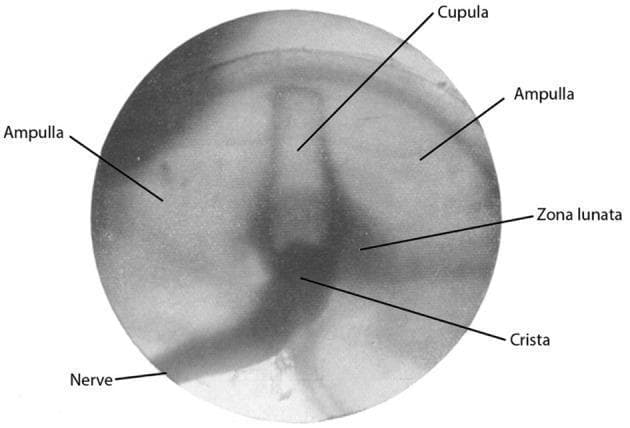
III. The Semicircular Canals (SCCs) — Detectors of Angular Acceleration
Structure
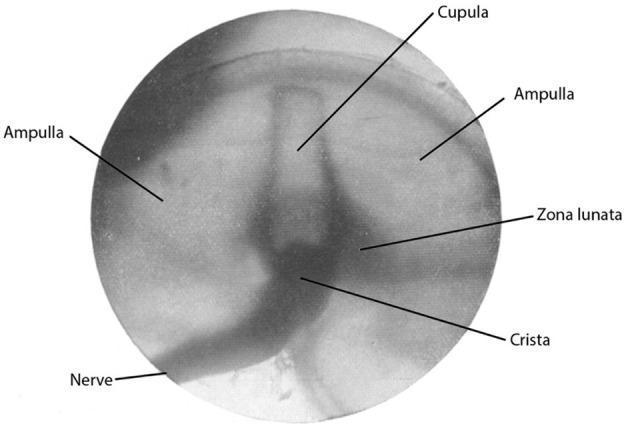
Mechanism of Angular Acceleration Detection
| Law | Statement |
|---|---|
| 1st Law | Eye and head movements occur in the plane of the stimulated canal |
| 2nd Law | In the horizontal canal, ampullpetal flow (toward ampulla) causes a greater response than ampullofugal flow |
| 3rd Law | In the vertical canals (superior and posterior), ampullofugal flow causes a greater response |
Canal Orientation & Functional Pairs
| Pair | Left Canal | Right Canal |
|---|---|---|
| Horizontal pair | Left lateral SCC | Right lateral SCC |
| LARP pair | Left anterior SCC | Right posterior SCC |
| RALP pair | Right anterior SCC | Left posterior SCC |
Frequency Response
IV. The Otolith Organs — Detectors of Linear Acceleration and Gravity
Structure
- Utricle: macula oriented horizontally (in the plane of the lateral SCC) — detects horizontal linear acceleration and head tilt
- Saccule: macula oriented vertically — detects vertical linear acceleration (e.g., bobbing in an elevator)
The Striola
- In the utricle: kinocilia point toward the striola (medially directed)
- In the saccule: kinocilia point away from the striola
Tilt vs. Translation — The Tilt-Translation Ambiguity
- Comparing otolith signals with SCC signals (SCCs detect tilt as angular acceleration)
- Using visual input
- Using proprioceptive context
V. Central Vestibular Pathways
Primary Afferents
- Regular afferents: low spontaneous rate, respond linearly — encode sustained stimuli
- Irregular afferents: high spontaneous rate, more sensitive to transients — encode high-frequency head movements
Vestibular Nuclei
| Nucleus | Key Projections |
|---|---|
| Superior (Bechterew's) | MLF → ocular motor nuclei (VOR) |
| Medial (Schwalbe's) | MLF bilaterally → cervical cord (VSR); also gaze stabilisation |
| Lateral (Deiters') | Lateral vestibulospinal tract → ipsilateral limb extensors |
| Inferior (Roller's, Spinal) | Cerebellum, reticular formation |
VI. Vestibular Reflexes
A. Vestibulo-Ocular Reflex (VOR)
Vestibular hair cell
        ↓
Vestibular nucleus (medial/superior)
        ↓ (via MLF — Medial Longitudinal Fasciculus)
Contralateral ocular motor nucleus (CN III, IV, VI)
        ↓
Extraocular muscles
"The most useful bedside test of peripheral vestibular function is the head impulse test, in which the vestibulo-ocular reflex (VOR) is assessed with small-amplitude (~20°) rapid head rotations... If the VOR is deficient, the rotation is followed by a catch-up saccade in the opposite direction." — Harrison's Principles of Internal Medicine, 21st Ed., p. 721
B. Vestibulospinal Reflexes (VSR)
| Tract | Origin | Function |
|---|---|---|
| Lateral vestibulospinal tract (LVST) | Lateral vestibular nucleus (Deiters') | Ipsilateral extensor facilitation; limb postural support |
| Medial vestibulospinal tract (MVST) | Medial vestibular nucleus | Bilateral neck and proximal limb muscles; head stabilisation |
C. Vestibulo-Collic Reflex (VCR)
VII. The Cerebellum — The Adaptive Calibrator
- Modulation of VOR gain in real time
- Adaptive plasticity — recalibrates VOR gain after peripheral vestibular injury (compensation)
- Timing and coordination of vestibulospinal responses
VIII. Cortical Vestibular Processing
- Parieto-insular vestibular cortex (PIVC) — primary vestibular cortex; multimodal integration
- Supplementary motor area (SMA)
- Posterior parietal cortex — spatial orientation and self-motion perception
IX. Sensory Integration and the Sensory Organisation
| Condition | Primary Cue Used |
|---|---|
| Eyes open, firm surface | Visual + proprioception dominant |
| Eyes closed, firm surface | Proprioception + vestibular |
| Eyes open, moving visual scene | Vestibular + proprioception (visual down-weighted) |
| Eyes closed, compliant foam surface | Vestibular dominant |
X. Summary Flowchart — Physiology of Balance
HEAD MOVEMENT / EXTERNAL PERTURBATION
              │
    ┌─────────┴───────────┐──────────────────┐
    │                     │                  │
VESTIBULAR             VISUAL           PROPRIOCEPTIVE
APPARATUS              SYSTEM              SYSTEM
(SCCs + Otoliths)    (Retina / OKN)    (Joints, muscles)
    │
    ▼
Vestibular Nuclei (Medulla/Pons)
    │
    ├──────────────────────────────────────────────┐
    │                                              │
    ▼                                              ▼
VOR (via MLF)                          VSR (via LVST/MVST)
(Ocular motor nuclei)                  (Spinal cord → muscles)
    │                                              │
Compensatory                              Postural correction
eye movements                             (antigravity tone)
    │
    ▼
CEREBELLUM ──── Adaptive gain, timing, compensation
    │
    ▼
THALAMUS → CORTEX (PIVC)
    │
Conscious spatial awareness,
sensory reweighting, motor planning
XI. Key Concepts Table
| Concept | Detail |
|---|---|
| Cupula time constant (Tc) | ~7 seconds — determines adaptation to sustained rotation |
| VOR gain | Normal = 1.0; reduced in peripheral hypofunction |
| Ewald's 2nd Law | Ampullopetal > ampullofugal response in horizontal canal |
| Otoconia density | ~2.7 g/cm³ (vs endolymph ~1.0 g/cm³) |
| Striola function | Bidirectional sensitivity of macular hair cells |
| Tonic firing rate | ~80 spikes/sec at rest — enables excitatory and inhibitory modulation |
| PIVC | Parieto-insular vestibular cortex — primary cortical vestibular area |
| Sensory weighting | CNS suppresses unreliable input during conflict |
Conclusion
- Cummings Otolaryngology, Head & Neck Surgery, 7th Ed., Vol. 3, Section 7 (Vestibular Physiology)
- Scott-Brown's Otolaryngology, Head & Neck Surgery, 8th Ed. (Vestibular Physiology Chapter)
- Bailey & Love's Short Practice of Surgery, 28th Ed., p. 773
- Harrison's Principles of Internal Medicine, 21st Ed., p. 721
"Parapharyngeal Space Anatomy"?
parapharyngeal space anatomy boundaries contents compartments
Bailey and Love's Short Practice of Surgery 28th Edition
Page 796
parapharyngeal space anatomy diagram axial cross section compartments
Hugging Face pmc clinical VQA raw
Page 0
parapharyngeal space prestyloid poststyloid fascia styloid process tensor veli palatini
Bailey and Love's Short Practice of Surgery 28th Edition
Page 796
parapharyngeal space MRI tumor deep lobe parotid prestyloid poststyloid
Hugging Face pmc clinical VQA raw
Page 0
Parapharyngeal Space Anatomy
Introduction
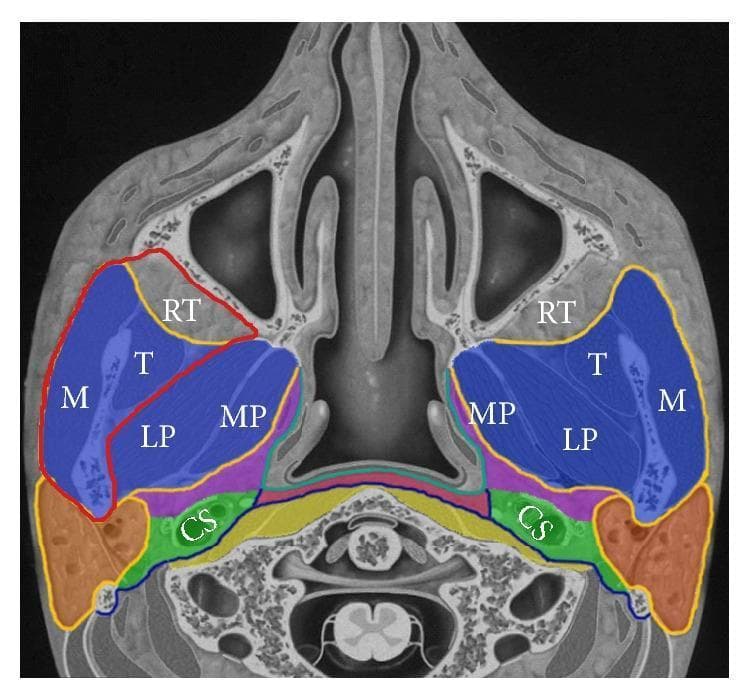
"This potential space lies lateral to the pharynx and is shaped like an inverted pyramid with its base at the base of the skull and its apex at the level of the hyoid. It is divided into a prestyloid space... and a poststyloid space (also known as carotid space)." — Bailey & Love's Short Practice of Surgery, 28th Ed., p. 796
I. Gross Morphology
| Feature | Detail |
|---|---|
| Shape | Inverted pyramid |
| Base (superior) | Base of skull — petrous apex, sphenoid spine, foramen lacerum, foramen ovale |
| Apex (inferior) | Greater cornu of the hyoid bone |
| Vertical extent | Base of skull → hyoid bone |
| Transverse width | Widest superiorly, narrows inferiorly |
II. Boundaries
| Wall | Boundary |
|---|---|
| Medial | Pharyngeal constrictor muscles + buccopharyngeal fascia (middle layer of deep cervical fascia); pharyngeal mucosa |
| Lateral (superior) | Medial pterygoid muscle + pterygoid fascia; mandibular ramus; parotid gland (deep lobe) |
| Lateral (inferior) | Medial surface of the deep lobe of parotid + investing layer of deep cervical fascia |
| Posterior | Prevertebral fascia (deep layer of deep cervical fascia) |
| Anterolateral | Pterygomandibular raphe; buccinator muscle |
| Superior (base) | Petrous temporal bone; greater wing of sphenoid — foramina ovale and spinosum |
| Inferior (apex) | Hyoid bone |
III. Division by the Styloid Process
PARAPHARYNGEAL SPACE
        │
        ├── PRESTYLOID COMPARTMENT (Anterior)
        │       (anterior to styloid process & stylomandibular ligament)
        │
        └── POSTSTYLOID COMPARTMENT (Posterior)
                (= Carotid Space)
                (posterior to styloid process)
IV. Prestyloid (Anterior) Compartment
Contents
| Structure | Notes |
|---|---|
| Fat (predominant) | The space is largely filled with adipose tissue — the "fat pad" |
| Deep lobe of parotid gland | Extends medially through the stylomandibular tunnel |
| Internal maxillary artery | Branch of external carotid; traverses anteriorly |
| Inferior alveolar nerve | Branch of V3; crosses through |
| Lingual nerve | Branch of V3 |
| Auriculotemporal nerve | Branch of V3 |
| Ascending pharyngeal artery | Small branch of ECA |
| Pharyngeal venous plexus | Venous drainage |
| Lymph nodes | Level IIa nodes may reside here |
Key Relationships
- The tensor veli palatini muscle lies at the medial boundary and is a key landmark
- The stylomandibular ligament separates the prestyloid PPS from the parotid space (an important surgical landmark)
- The pterygomandibular space is contiguous anteriorly
Surgical Significance (Prestyloid)
- ~80% of PPS tumours are benign
- Most common prestyloid tumour: Pleomorphic adenoma of the deep lobe of the parotid
- Displacement of the parapharyngeal fat pad posteriorly on imaging suggests a prestyloid mass of parotid origin
- Displacement of fat pad anteriorly suggests a poststyloid (carotid space) mass
V. Poststyloid (Posterior) Compartment — Carotid Space
Contents
| Structure | Notes |
|---|---|
| Internal carotid artery (ICA) | Enters through carotid canal superiorly |
| Internal jugular vein (IJV) | Descends from jugular foramen |
| Cranial nerve IX (Glossopharyngeal) | Exits jugular foramen |
| Cranial nerve X (Vagus) | Lies between ICA and IJV in the carotid sheath |
| Cranial nerve XI (Accessory) | Exits jugular foramen |
| Cranial nerve XII (Hypoglossal) | Exits hypoglossal canal; lies medial to ICA |
| Cervical sympathetic chain | Lies posteromedially — Horner's syndrome if involved |
| Deep cervical lymph nodes | Jugulodigastric and deep chain |
| Glomus tissue (paraganglia) | Carotid body-type tissue |
Key Relationships
- All four CNs exiting the jugular foramen (IX, X, XI) + CN XII from the hypoglossal canal converge in the poststyloid PPS
- The carotid sheath encases the ICA, IJV, and CN X as a distinct fascial sleeve
- The sympathetic chain lies posteromedially, outside the carotid sheath proper
Surgical Significance (Poststyloid)
- Most common poststyloid tumours: Paraganglioma (glomus vagale, glomus jugulare) and Schwannoma/Neurofibroma of CN IX–XII
- Vagal paraganglioma: displaces ICA anteriorly
- Carotid body tumour: splays ICA and ECA (lyre sign on angiography)
- Horner's syndrome (ptosis, miosis, anhidrosis) indicates sympathetic chain involvement
VI. Fascial Layers — The Architectural Framework
| Fascial Layer | Also Called | Forms |
|---|---|---|
| Superficial layer of deep cervical fascia | Investing layer | Encases entire neck; splits for parotid and submandibular gland |
| Middle layer (visceral layer) | Pretracheal fascia | Buccopharyngeal fascia posteriorly; encases viscera |
| Deep layer | Prevertebral fascia | Posterior wall of PPS; "danger space" lies between its two laminae |
VII. Communication with Adjacent Deep Neck Spaces
                    ┌──────────────────────┐
                    │  PARAPHARYNGEAL SPACE │
                    └────────────┬─────────┘
          ┌──────────────────────┼────────────────────────┐
          │                      │                        │
          ▼                      ▼                        ▼
   Retropharyngeal         Masticator Space          Carotid Space
      Space                (anterolaterally)        (poststyloid)
   (posteromedially)
          │                                              │
          ▼                                              ▼
   "Danger Space"                               Posterior mediastinum
   (posterior to                              (via carotid sheath —
  prevertebral fascia)                       "Lincoln's highway")
          │
          ▼
  Posterior mediastinum
| Adjacent Space | Communication Route | Clinical Implication |
|---|---|---|
| Retropharyngeal space | Posteromedially, via buccopharyngeal fascia | Retropharyngeal abscess spreads to PPS |
| Masticator space | Anterolaterally, past pterygomandibular raphe | Dental infections track to PPS |
| Parotid space | Via stylomandibular tunnel | Deep lobe parotid tumours enter PPS |
| Carotid space | Directly continuous (poststyloid compartment) | Tracking of tumour/infection down to mediastinum |
| Submandibular space | Inferiorly | Ludwig's angina can extend superiorly |
| Pterygomandibular space | Anteriorly | Third molar infections |
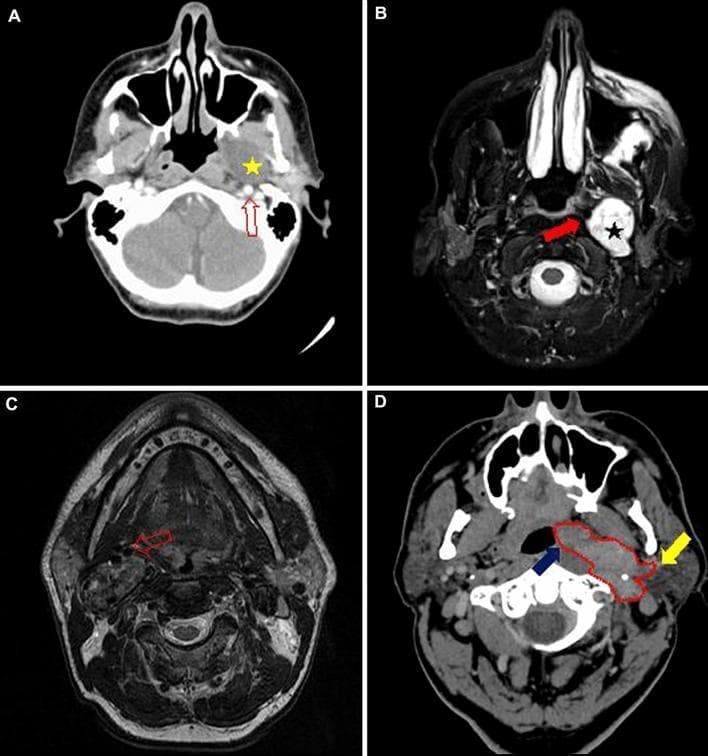
VIII. Imaging Anatomy
CT / MRI — Key Axial Landmarks
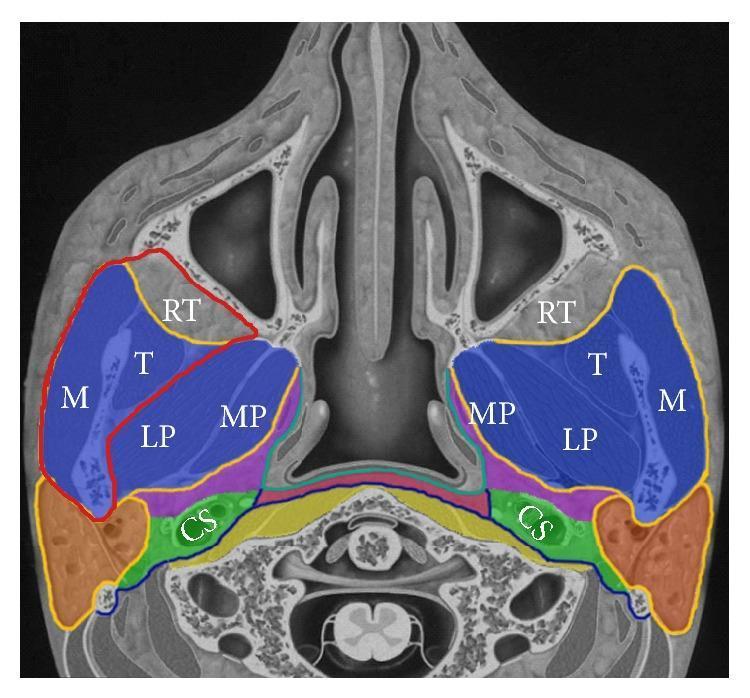
Identifying Prestyloid vs. Poststyloid Tumours on Imaging
| Feature | Prestyloid Mass | Poststyloid Mass |
|---|---|---|
| Fat pad displacement | Pushed posteriorly | Pushed anteriorly |
| ICA displacement | Posterior/lateral | Anteromedial |
| Typical tumour | Pleomorphic adenoma | Paraganglioma, Schwannoma |
| Enhancement | Mild (pleomorphic adenoma) | Vivid (paraganglioma); "salt & pepper" on MRI |
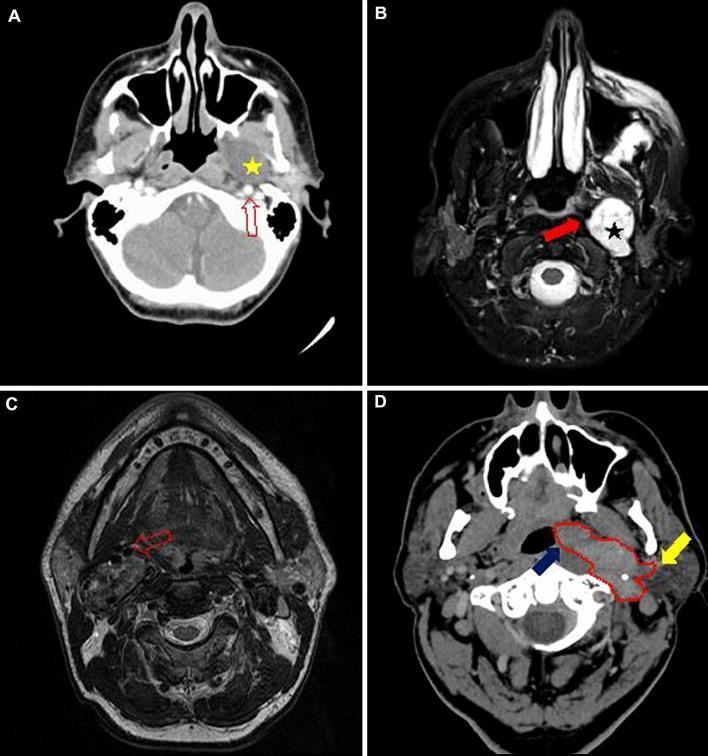
IX. Clinical Correlates
Parapharyngeal Space Tumours
- 80% benign; 20% malignant
- Most common overall: Salivary gland tumours (deep lobe parotid pleomorphic adenoma) — ~45%
- Second most common: Neurogenic tumours (schwannoma, paraganglioma) — ~25%
Classic Clinical Presentation
- Intraoral bulge: medial displacement of soft palate and tonsillar fossa ("potato in the mouth")
- Trismus: if masticator space involved
- Cranial nerve palsies: CN IX–XII (poststyloid)
- Horner's syndrome: sympathetic chain involvement
- Pulsatile mass: paraganglioma
Surgical Approaches
| Approach | Indication |
|---|---|
| Transcervical | Most poststyloid and inferior PPS tumours |
| Transparotid-cervical | Deep lobe parotid tumours (prestyloid) |
| Transcervical-transmandibular | Large tumours requiring mandibulotomy |
| Transoral | Small, benign, medially placed tumours (limited access, higher recurrence risk) |
X. Summary Table — Parapharyngeal Space at a Glance
| Feature | Prestyloid Compartment | Poststyloid Compartment |
|---|---|---|
| Also called | Anterior PPS | Carotid space |
| Dividing structure | Styloid process + stylomandibular ligament | — |
| Key contents | Deep parotid lobe, fat, V3 branches, IMA | ICA, IJV, CN IX–XII, sympathetic chain |
| Common tumours | Pleomorphic adenoma, lipoma | Paraganglioma, vagal schwannoma |
| ICA displacement | Posteriorly displaced | Anteriorly displaced |
| Fat pad displacement | Posterior | Anterior |
| Infection source | Dental / parotid | Jugular foramen pathology |