
Treatment of bacterial vaginosis during early pregnancy of 6weeks
Reading File
Now I'll search the medical library and PubMed simultaneously for BV treatment in early pregnancy.
Finding Sources
Searching PubMed
"bacterial vaginosis"[MeSH Terms] AND "pregnancy"[MeSH Terms] AND "treatment"[MeSH Terms]
Finding Sources
Excellent — the most relevant sources are Creasy & Resnik's Maternal-Fetal Medicine and Rosen's Emergency Medicine. Let me read those sections now in parallel.
Reading File
Reading File
Searching PubMed
"bacterial vaginosis" AND pregnancy AND metronidazole
I have the key content. Let me read the treatment box section more carefully and get the Sabiston metronidazole note about first trimester.
Reading File
Reading File
Reading Article
PMID: 36651636
I also want to fetch the treatment box image (Box 50.1) from the textbook, which shows the preferred regimens.
Loading Image
Searching the Web
CDC guidelines bacterial vaginosis treatment first trimester pregnancy 2024
I now have comprehensive, authoritative information from multiple sources. Let me compile the full answer.
Bacterial Vaginosis (BV) Treatment at 6 Weeks Gestation
The Core Challenge: First Trimester
At 6 weeks gestation, you are in the first trimester — this is the period of critical organogenesis and carries specific considerations for BV treatment.
Metronidazole manufacturer caution: The drug manufacturer explicitly contraindicates metronidazole in the first trimester for BV. Despite this, the CDC recommends treatment of symptomatic BV in pregnancy at any trimester, and most human studies show no consistent pattern of congenital malformations from metronidazole exposure. The contraindication is based on theoretical teratogenic concern, not confirmed clinical harm. — Sabiston Textbook of Surgery, p. 3307
Who Should Be Treated?
| Patient Type | Recommendation |
|---|---|
| Symptomatic BV (discharge, odor) | Treat — associated with adverse outcomes |
| Asymptomatic BV at high risk (prior preterm birth) | Treat |
| Asymptomatic BV at low risk | Evidence insufficient; USPSTF does not recommend routine screening/treatment |
CDC STI Treatment Guidelines 2021; Creasy & Resnik's Maternal-Fetal Medicine
Recommended Treatment Regimens in Pregnancy (Box 50.1)
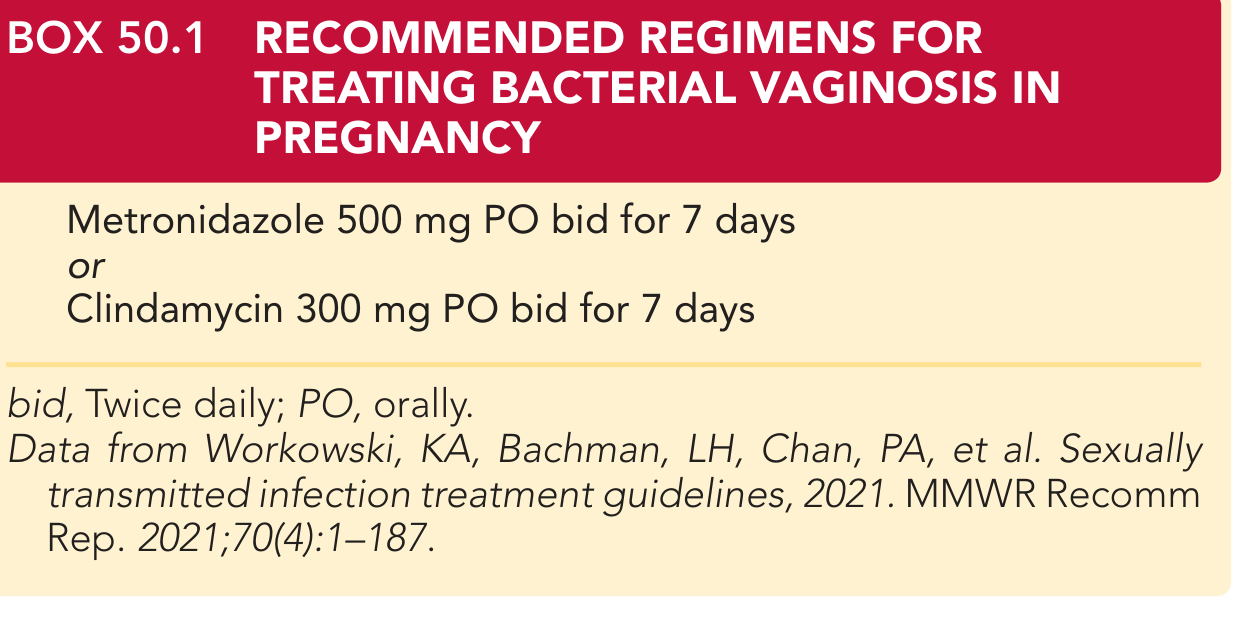
Preferred oral regimens (per CDC 2021 & Creasy & Resnik):
| Drug | Dose | Duration |
|---|---|---|
| Metronidazole | 500 mg orally twice daily | 7 days |
| Clindamycin | 300 mg orally twice daily | 7 days |
Topical alternatives (for symptom relief but NOT for preventing preterm birth):
- Metronidazole gel 0.75% — 5 g intravaginally once daily × 5 days
- Clindamycin cream 2% — 5 g intravaginally at bedtime × 7 days
Topical therapy does not prevent systemic complications of BV in pregnancy (preterm birth, chorioamnionitis, endometritis). Oral therapy is preferred when treating to reduce obstetric risk. — Creasy & Resnik's Maternal-Fetal Medicine, p. 1192
Special Considerations at 6 Weeks
-
Clindamycin is the safer first-line choice at 6 weeks given the manufacturer's contraindication of metronidazole in the first trimester. It is FDA Pregnancy Category B and has been documented as safe.
-
If metronidazole is used, the risk of teratogenicity appears low based on available human data. The CDC endorses its use in pregnancy for symptomatic BV. The decision should be individualized weighing:
- Severity of symptoms
- Risk of preterm birth
- Clinician and patient preference
-
Topical clindamycin is an option if oral treatment is not tolerated, though it provides only local benefit.
-
Single-dose metronidazole 2 g is no longer recommended — cure rates of only 60–80% vs. 90% with the 7-day regimen.
-
Avoid: tinidazole, secnidazole, and clindamycin ovules/Clindesse in pregnancy — insufficient safety data.
Does Treatment Prevent Preterm Birth?
A 2023 individual participant data meta-analysis (Klebanoff et al., Paediatr Perinat Epidemiol, PMID: 36651636) pooling 6,915 participants found:
- Clindamycin showed benefit in IPD studies (OR 0.59, 95% CI 0.42–0.82), but this was attenuated after imputation of missing data
- Metronidazole showed no significant reduction in preterm delivery
- Overall conclusion: treatment of BV during pregnancy does not reliably reduce preterm delivery in any subgroup
This is consistent with the ACOG and Cochrane position that evidence is insufficient to recommend universal screening and treatment to prevent preterm birth. Treatment remains indicated primarily for symptom relief and reducing infectious morbidity.
Summary
| Key Point | Detail |
|---|---|
| First-line at 6 weeks | Oral clindamycin 300 mg BD × 7 days (safest in first trimester) |
| Alternative | Oral metronidazole 500 mg BD × 7 days (use if benefits outweigh theoretical risk) |
| Avoid | Single-dose regimens, topical therapy alone for preterm birth prevention |
| Test of cure | Consider 1 month post-treatment (treatment failure is common) |
| Partner treatment | Male partners do NOT require treatment |
Creasy & Resnik's Maternal-Fetal Medicine; CDC STI Treatment Guidelines 2021 (MMWR 70[4]:1–187)
This is a shared conversation. Sign in to Orris to start your own chat.