
Surgical site infection ms ortho 20 marks answer
I'll start by reading the medical library skill, then research surgical site infections comprehensively for a 20-mark MS Ortho answer.
Reading File
Now let me search the library for SSI content in parallel across multiple angles:
Finding Sources
Finding Sources
Finding Sources
Excellent results. Now let me read the key sections in parallel - Mulholland's Surgery (most comprehensive SSI coverage) and Sabiston:
Reading File
Reading File
Finding Sources
Excellent! Campbell's Operative Orthopaedics has orthopaedic-specific content. Let me read those sections in parallel with Mulholland's prevention/treatment sections:
Reading File
Reading File
Reading File
Excellent content. Now let me read the treatment section from Mulholland and the risk factors table from Campbell's:
Reading File
Finding Sources
Reading File
Let me fetch the SSI classification diagram and read the risk factors table from Campbell's:
Loading Image
Reading File
I now have comprehensive content. Let me also quickly grab the risk factors table from Campbell's and the NNIS scoring system:
Reading File
Reading File
I now have comprehensive, authoritative content from Campbell's Operative Orthopaedics 2026 and Mulholland's Surgery. Let me now write the complete 20-mark MS Ortho answer.
Surgical Site Infection (SSI) - MS Orthopaedics 20 Marks
DEFINITION
A Surgical Site Infection (SSI) is an infection occurring at the operative site within 30 days of a procedure (or within 1 year if an implant is left in place) that appears related to the operative procedure.
- CDC/NHSN 2017 guidelines provide the current standard definitions.
- Reported incidence: 2-5% of all surgical procedures; in orthopaedics, deep implant-related infection rates are 0.5-2% for joint arthroplasty.
CLASSIFICATION (CDC/NHSN)
The three anatomical types are depicted below:
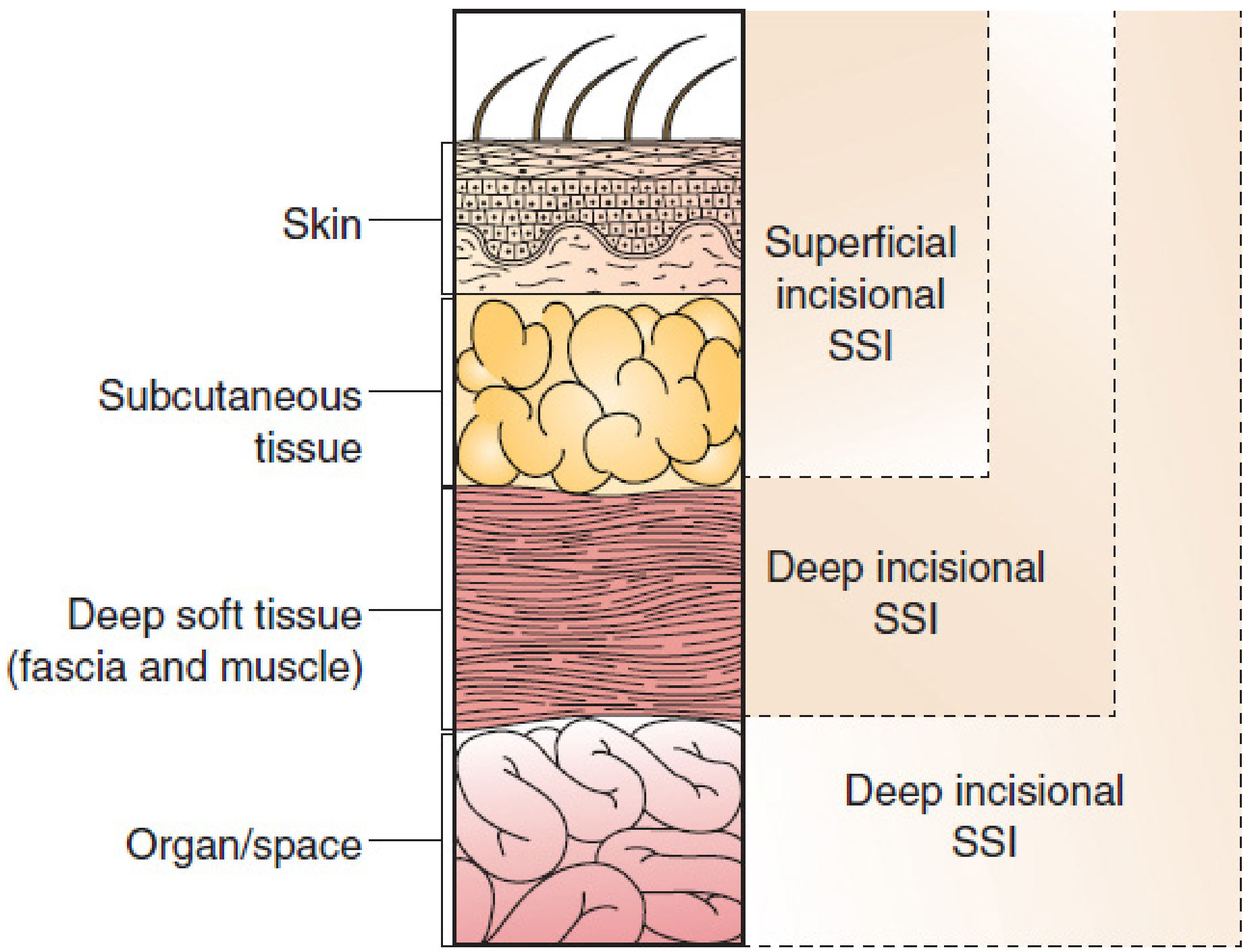
Figure: SSI definitions by CDC (Mulholland & Greenfield's Surgery, 7e, p.497)
1. Superficial Incisional SSI
- Occurs within 30 days after surgery
- Involves only skin and subcutaneous tissue
- Criteria (at least one): purulent drainage, positive culture, pain/tenderness/swelling/erythema/heat + deliberate opening by surgeon, or diagnosis by attending surgeon
2. Deep Incisional SSI
- Occurs within 30 days (no implant) or within 1 year (with implant)
- Involves deep soft tissues: fascia and muscle layers
- Criteria (at least one): purulent drainage from deep incision (not organ/space), spontaneous or deliberate dehiscence with fever >38°C or localized pain/tenderness, abscess or other evidence of infection on direct examination or reoperation, or diagnosis by surgeon
3. Organ/Space SSI
- Involves any part of the body other than the skin incision, fascia, or muscle that was opened or manipulated during surgery (e.g., joint space, bone, intra-articular abscess)
- Particularly relevant in orthopaedics: periprosthetic joint infection (PJI), osteomyelitis
WOUND CLASSIFICATION (NRC/CDC)
| Class | Type | Definition | SSI Risk |
|---|---|---|---|
| I | Clean | No inflammation; respiratory, GI, GU not entered | 1-3% |
| II | Clean-contaminated | Controlled entry into respiratory, GI, GU tracts | 3-11% |
| III | Contaminated | Open fresh traumatic wounds, gross spillage | 10-17% |
| IV | Dirty/Infected | Old traumatic wounds, established infection, perforated viscus | >27% |
ETIOLOGY AND MICROBIOLOGY
Common Causative Organisms in Orthopaedic Surgery
The most common organisms are gram-positive cocci because patient skin is the primary source of orthopaedic infection:
| Organism | Notes |
|---|---|
| Staphylococcus aureus | Most common; MRSA now comprising ~49% of SSI isolates |
| Staphylococcus epidermidis | Increasingly common; antibiotic-resistant; often forms biofilm on implants |
| Streptococcus spp. | Common in joint arthroplasty |
| Escherichia coli / Proteus | Also covered by standard prophylaxis |
| Pseudomonas aeruginosa | Gram-negative; more common in open fractures (Gustilo III) |
| Anaerobes | Relevant in contaminated/dirty wounds |
MRSA has emerged as the leading cause of postoperative infection in vascular and orthopaedic surgery, associated with substantially increased morbidity, hospital stay, and implant/graft removal rates. - Mulholland and Greenfield's Surgery, 7e, p.507
RISK FACTORS
A. Patient-Related (Non-Modifiable / Modifiable)
| Factor | Recommendation |
|---|---|
| Diabetes mellitus | Perioperative glycemic control; maintain serum glucose <180 mg/dL |
| Obesity (BMI ≥35) | Strongest independent risk; weight-adjusted antibiotic dosing |
| Smoking | Cessation at least 30 days preoperatively |
| Malnutrition | Optimize albumin/protein status before elective surgery |
| Immunosuppression | Minimize if possible; adjust antibiotic coverage |
| MRSA colonization | Preoperative nasal swab; decolonization with mupirocin + chlorhexidine baths |
| Remote infection | Treat and eradicate before elective orthopaedic procedure |
| Anemia | Preoperative optimization; blood transfusion increases SSI risk by impairing macrophage function |
| ASA score >2 | Major component of NNIS/NHSN risk index |
B. NHSN SSI Risk Index (NNIS Score)
Three independent variables - one point each:
- ASA score ≥ 3
- Wound class III or IV (contaminated or dirty)
- Operative duration > 75th percentile for that procedure
Score 0 = low risk; Score 2-3 = high risk. Laparoscopic approach reduces score by 1.
C. Procedure-Related Factors
- Wound classification
- Perioperative antibiotics (timing, selection, duration)
- Intraoperative hypothermia
- Blood loss and transfusion
- Surgical duration (risk increases 37% per additional 60 minutes; 25% per 20 minutes)
- Skin preparation method
- Hair removal technique (clipping - not shaving)
- Operating room traffic and door openings
- Surgeon technique - dead space, tissue handling
PATHOGENESIS
- Inoculation of pathogens at time of surgery (primary) or hematogenous spread to implant (secondary, can occur years later)
- Biofilm formation on orthopaedic implants: bacteria adhere to metal/polymer surfaces, secrete extracellular polysaccharide matrix, rendering them resistant to antibiotics and host defenses
- Contamination sources: patient's own skin flora (primary), airborne particles (5,000-55,000 shed/min per person in OR), surgical team, equipment
- Airborne bacteria are predominantly gram-positive and originate almost exclusively from humans in the OR - Campbell's Operative Orthopaedics, 15e, p.963
DIAGNOSIS
Clinical Features
- Early infection (within weeks): wound erythema, warmth, swelling, discharge, dehiscence, fever
- Late/chronic infection (months-years with implants): persistent or new-onset pain, sinus tract formation, implant loosening, failure of fracture fixation
Investigations
Laboratory:
- WBC count - often elevated but non-specific
- ESR - sensitive but non-specific
- CRP - more reliable; typically returns to normal by 3 weeks post-op; persistently elevated = suspect infection
- D-dimer - noninferior to CRP in diagnosis of PJI (2023 data)
- Procalcitonin, IL-6 - emerging markers
Microbiological:
- Gram stain and culture - mandatory before empiric treatment; critical in era of multidrug-resistant pathogens
- Deep wound swabs, tissue biopsy, joint aspirate
- Synovial fluid analysis: WBC >3000 cells/µL, PMN >80% suggestive of PJI
Imaging:
- Plain X-ray: periosteal reaction, bone resorption at bone-cement interface, osteolysis, cyst formation (usually late)
- CT scan: soft tissue involvement, sinus tracts, abscess
- MRI: best for soft tissue and marrow involvement
- Nuclear medicine:
- Technetium-99m bone scan: sensitive but non-specific
- Indium-111-labeled WBC scan combined with technetium scan: differentiates infection from aseptic loosening; sensitivity 64-77%, specificity 78-86%
PREVENTION
I. Preoperative Measures
- Screen and treat remote infection before elective orthopaedic surgery
- MRSA decolonization: nasal swab PCR; mupirocin ointment + chlorhexidine baths if positive
- Glycemic control: HbA1c optimization before elective procedures
- Smoking cessation: at least 30 days preoperatively
- Nutritional optimization: correct hypoalbuminemia
- Skin antisepsis: chlorhexidine-alcohol preparation is superior to povidone-iodine
- Hair removal: clip (do not shave) - shaving creates skin micro-abrasions
II. Perioperative/Intraoperative Measures
Prophylactic Antibiotics (Campbell's Concepts):
- Begin 30-60 minutes before skin incision (60-120 min for vancomycin/fluoroquinolones)
- First-generation cephalosporin (Cefazolin) is drug of choice: weight-adjusted - 1g (<60 kg), 2g (60-120 kg), 3g (>120 kg)
- Redose every 4 hours intraoperatively or when blood loss exceeds 1500 mL
- Stop within 24 hours post-operatively (not extended even with drains/catheters in situ)
- If penicillin allergy (anaphylaxis): vancomycin (15 mg/kg over ≥1 hr to prevent Red Man Syndrome) or clindamycin
- Cephalosporins are preferred over semisynthetic penicillins as they are more effective against S. epidermidis
- For hip/knee arthroplasty: cefazolin or cefuroxime; vancomycin if β-lactam allergy
Operative Technique:
- Strict aseptic technique; minimize OR personnel and door openings
- Gentle tissue handling; obliterate dead space
- Minimize operative time (<2.5 hours when possible)
- Control blood loss; use tranexamic acid
- Irrigation: 3L for Gustilo I, 6L for Gustilo II, 9L for Gustilo III open fractures
- 0.3% Povidone-iodine irrigation - 2.3-fold reduction in SSI, recommended by CDC and WHO (avoid if articular cartilage present)
- Do NOT add antibiotics to irrigation solution routinely (no added benefit)
- Topical vancomycin powder: reduces SSI in spine surgery; mixed evidence vs IV vancomycin
OR Environment:
- Hand washing: 2-minute hand scrub equally effective as traditional 5-minute scrub; alcohol-based hand rubs with chlorhexidine are superior to povidone-iodine scrubs
- Laminar flow: NOT routinely recommended; horizontal laminar flow may paradoxically increase infection rates
- Ultraviolet light: effective but not recommended due to risk to personnel; useful for terminal room cleaning
- Double-glove technique; change gloves when perforation noted
Physiological:
- Maintain normothermia (hypothermia impairs neutrophil function and wound healing)
- Supplemental oxygen intraoperatively
- Perioperative glucose <180 mg/dL
III. Postoperative Measures
- Incisional negative pressure wound therapy (iNPWT): superior to silver-impregnated dressings in high-risk patients (e.g., total joint arthroplasty)
- Subcuticular sutures with skin adhesive preferred; avoid non-absorbable sutures
- Avoid excessive electrocautery
- Wound monitoring, early detection
TREATMENT
SSI Treatment - Four-Step Strategy (Mulholland & Greenfield's Surgery, 7e)
- Early empiric antimicrobial therapy - directed against likely pathogens (gram-positive coverage as default; gram-negative cover for open fractures, immunocompromised)
- Decision on wound opening - open if fluctuance, purulent drainage, or wound dehiscence present; debride necrotic tissue
- Pathogen identification - Gram stain + culture from wound ALWAYS before or at time of opening (mandatory in era of MDR organisms)
- De-escalation of antimicrobial therapy once culture and sensitivity results are available
Management by SSI Type
Superficial SSI:
- Wound opening, irrigation, debridement
- Dressing changes
- Oral/IV antibiotics guided by culture
Deep Incisional SSI (without implant):
- Surgical debridement, washout
- Open wound management with delayed primary closure or secondary healing
- IV antibiotics
Deep Infection with Implant (Periprosthetic Joint Infection):
| Timing | Management |
|---|---|
| Early acute (<3 weeks, well-fixed implant) | Irrigation, debridement, polyethylene exchange (DAIR - Debridement, Antibiotics, Implant Retention) |
| Late chronic | Two-stage revision arthroplasty (gold standard): Stage 1 - implant removal + antibiotic spacer; Stage 2 - reimplantation after 6-12 weeks of IV antibiotics |
| Acute hematogenous (previously well-functioning, now acutely infected) | DAIR if <3-4 weeks duration and well-fixed prosthesis |
Open Fracture Infection:
- Debridement, repeated if needed
- External fixation if internal fixation compromised
- Antibiotic-impregnated beads/spacers (local delivery)
- Bone grafting after infection eradication
MRSA Bundle (when MRSA SSI diagnosed):
- MRSA nasal screening (PCR) on admission/transfer/discharge
- Contact isolation of positive patients
- Standardized hand hygiene
- Cultural transformation - staff and leadership engagement
- Targeted decolonization therapy
CURRENT CHALLENGES IN SSI
- Rising MRSA prevalence: increased from 22.5% (1986-2003) to 49.2% of all SSI isolates by 2007
- Increasingly elderly, obese, and immunocompromised patients undergoing orthopaedic surgery
- More prosthetic device implantations - biofilm-forming organisms
- Antibiotic resistance: coagulase-negative staphylococci (S. epidermidis) increasingly resistant; need for antibiogram-guided prophylaxis
- Cost burden: PJI is one of the most expensive complications in orthopaedic surgery
SUMMARY TABLE: Key Points for Exam
| Aspect | Key Fact |
|---|---|
| Definition | Infection at operative site within 30 days (1 year with implant) |
| Classification | Superficial / Deep incisional / Organ-space |
| Most common organism | S. aureus (MRSA now ~49% of isolates) |
| Drug of choice prophylaxis | Cefazolin (weight-adjusted); Vancomycin if penicillin allergy |
| Antibiotic timing | 30-60 min before incision; stop within 24 hrs |
| NNIS Risk Index | ASA ≥3 + Wound class III/IV + Op duration >75th percentile |
| Irrigation SSI reduction | 0.3% povidone-iodine (2.3x reduction; avoid if articular surface) |
| Gold standard for chronic PJI | Two-stage revision arthroplasty |
| DAIR criteria | Well-fixed implant, acute infection <3 weeks |
| Best blood marker | CRP (returns to normal reliably post-op) |
Sources:
- Campbell's Operative Orthopaedics, 15th Ed 2026 (Chapter 22 - SSI Prevention)
- Mulholland & Greenfield's Surgery: Scientific Principles and Practice, 7e (Chapter 8 - SSI)
- Sabiston Textbook of Surgery, The Biological Basis of Modern Surgical Practice
- CDC/NHSN Guidelines 2017; WHO Global Guidelines for Prevention of SSI, 2017; SCIP/SIP Performance Measures
This is a shared conversation. Sign in to Orris to start your own chat.