Now I have all the textbook content and images needed. Let me generate the visual flowchart and compile the full response.
Third Week of Embryonic Development
The third week (days 15–21) is the most eventful period of early embryogenesis. It coincides with the week after the first missed menstrual period (~5 weeks after LMP). The defining event is gastrulation — the transformation of the bilaminar disc into the trilaminar germ disc.
Textbook Timeline & Events
Day 14–15 | Starting Point: Bilaminar Disc
The embryo arrives at week 3 as a bilaminar embryonic disc consisting of:
- Epiblast — upper layer (columnar cells)
- Hypoblast — lower layer (cuboidal cells)
Day 15–16 | Gastrulation Begins: Primitive Streak
Primitive streak appears at the caudal end of the epiblast dorsal surface — initially a vague thickening, but by day 15–16 it is a clearly defined narrow groove with bulging lateral ridges.
- The cranial end of the streak forms the primitive node (Hensen's node), which surrounds the primitive pit
- Key molecular drivers: FGF8 (synthesized by streak cells) downregulates E-cadherin, releasing cells from epiblast adhesion
- BRACHYURY (T-box gene) controls cell migration and mesoderm specification
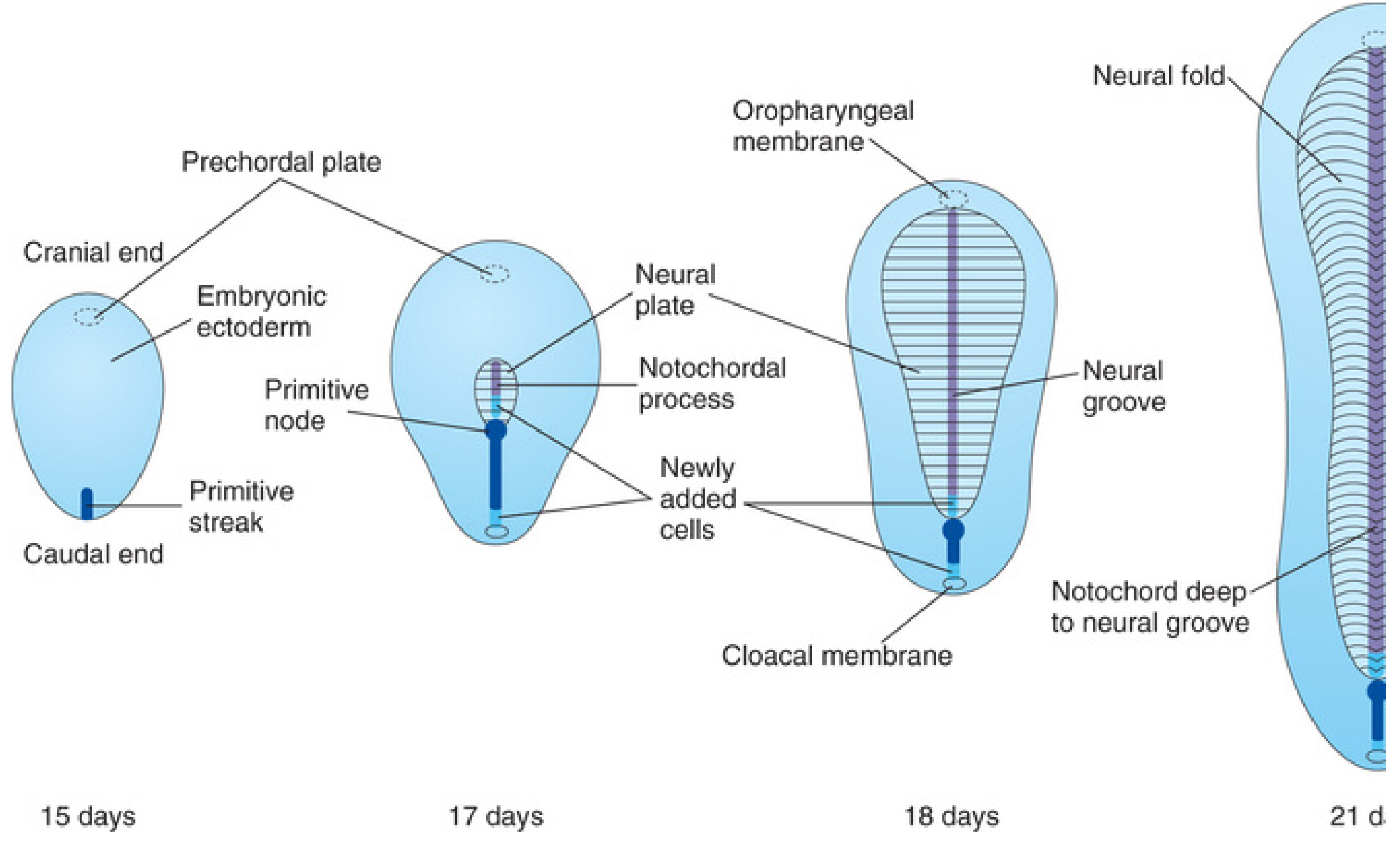
Day-by-day development of the embryonic disc showing appearance of primitive streak, notochordal process, neural plate, neural groove, and notochord — The Developing Human
Day 16 | Three Germ Layers Established (Trilaminar Disc)
Epiblast cells migrate toward the primitive streak, invaginate (become flask-shaped), and slip beneath:
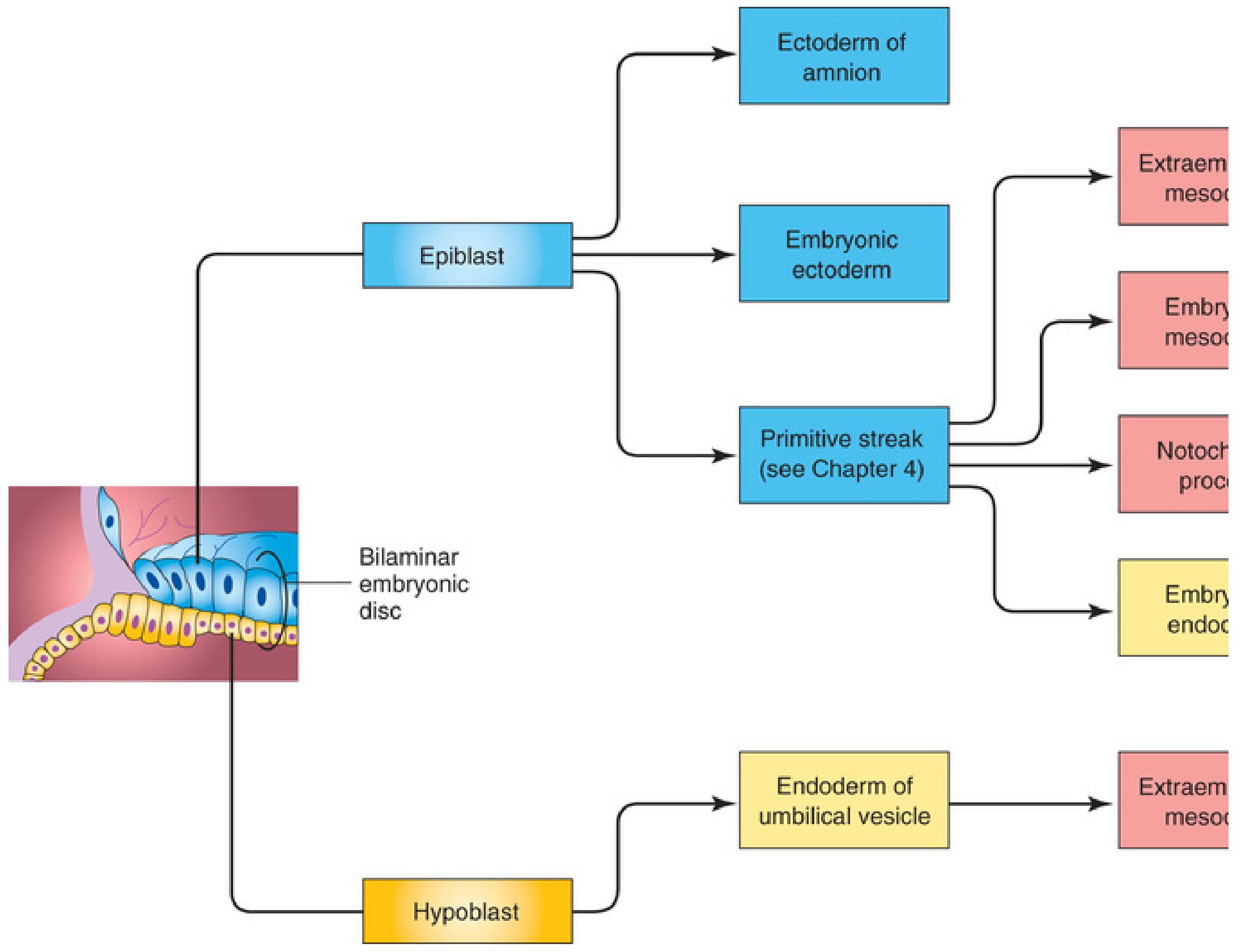
Derivation of all three germ layers from the epiblast through gastrulation — The Developing Human, FIG. 4.2
| Migration Fate | Germ Layer | Key Derivatives |
|---|
| Cells displace hypoblast | Endoderm | GI epithelium, respiratory tract, liver, pancreas |
| Cells between epiblast & endoderm | Mesoderm | Muscle, bone, cardiovascular, kidney, gonads |
| Cells remaining in epiblast | Ectoderm | Skin epidermis, entire nervous system, eyes, ears |
"The epiblast, through the process of gastrulation, is the source of all three germ layers." — Langman's Medical Embryology
Day 16–17 | Notochord Formation
- Prenotochordal cells from the primitive node migrate cranially in the midline toward the prechordal plate
- These cells intercalate into the hypoblast → form the notochordal plate (temporary bilaminar midline)
- As endoderm replaces hypoblast, notochordal plate detaches → forms the definitive notochord (solid cord)
Functions of the notochord:
- Defines the longitudinal axis of the embryo
- Signaling center — induces formation of the axial skeleton (vertebral column)
- Induces overlying ectoderm to form the neural plate (primary neurulation)
Boundaries established:
- Oropharyngeal membrane (cranial) — tightly adherent ecto- and endoderm; future oral opening; no mesoderm here
- Cloacal membrane (caudal) — future anal/urogenital opening
Day 17–18 | Neural Induction & Allantois
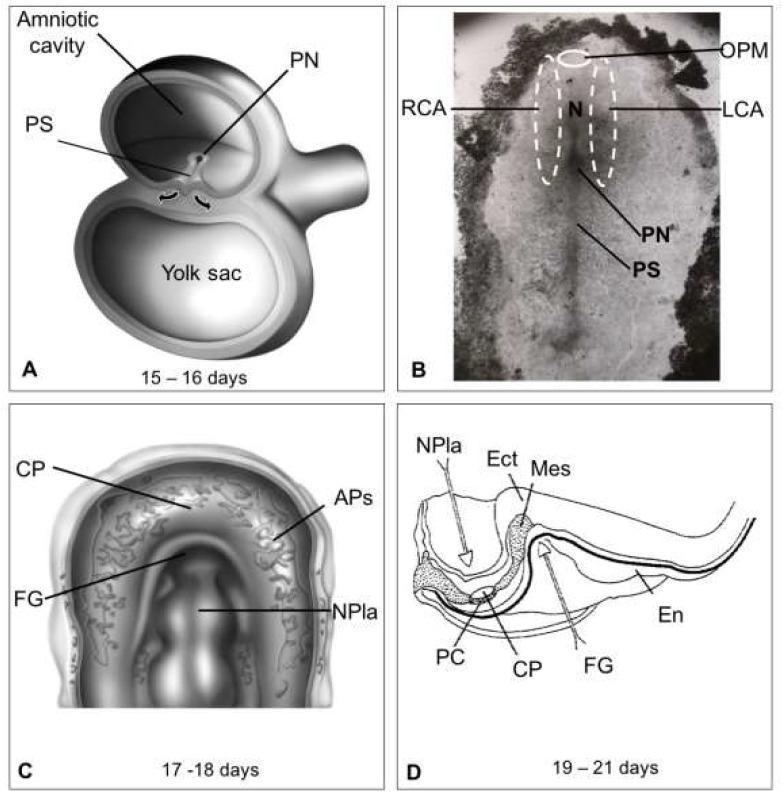
Embryonic disc at 15–21 days: PS = primitive streak, PN = primitive node, N = notochord, OPM = oropharyngeal membrane, cardiogenic areas (RCA/LCA), and neural plate (NPla) — Days 15–21
- The notochord induces overlying embryonic ectoderm → thickens into the neural plate
- Allantois appears as a small diverticulum from the caudal wall of the yolk sac into the connecting stalk
- Involved in early blood formation and development of the urinary bladder
Day 18–21 | Neurulation (Neural Tube Formation)
- Neural plate folds longitudinally → neural groove forms in the midline
- Lateral edges elevate → neural folds rise and converge
- Neural folds fuse (starting at cervical level, proceeding cranially & caudally) → neural tube
- Neural crest cells undergo epithelial-to-mesenchymal transition and migrate away bilaterally
Neural tube defects result from failure of fusion (e.g., spina bifida = caudal failure; anencephaly = cranial failure)
Day 20–21 | Mesoderm Differentiation & Somitogenesis
The intraembryonic mesoderm differentiates into three zones on each side of the notochord:
| Zone | Name | Derivatives |
|---|
| Adjacent to notochord | Paraxial mesoderm | Somites → dermis (dermatome), skeletal muscle (myotome), vertebrae & ribs (sclerotome) |
| Intermediate | Intermediate mesoderm | Kidneys, ureters, gonads, adrenal cortex |
| Lateral | Lateral plate mesoderm | Splits into somatic (body wall) + splanchnic (visceral) layers; intraembryonic coelom forms between them |
First pair of somites appears around day 20. ~3 pairs form per day thereafter. Somite count is used to date embryos.
Throughout Week 3 | Trophoblast (Chorionic Villi) Development
| Stage | Structure | Timing |
|---|
| Primary villus | Cytotrophoblast core + syncytial covering | Start of week 3 |
| Secondary villus | Mesoderm invades core | Mid-week 3 |
| Tertiary villus | Mesoderm differentiates into blood vessels (villous capillary system) | End of week 3 |
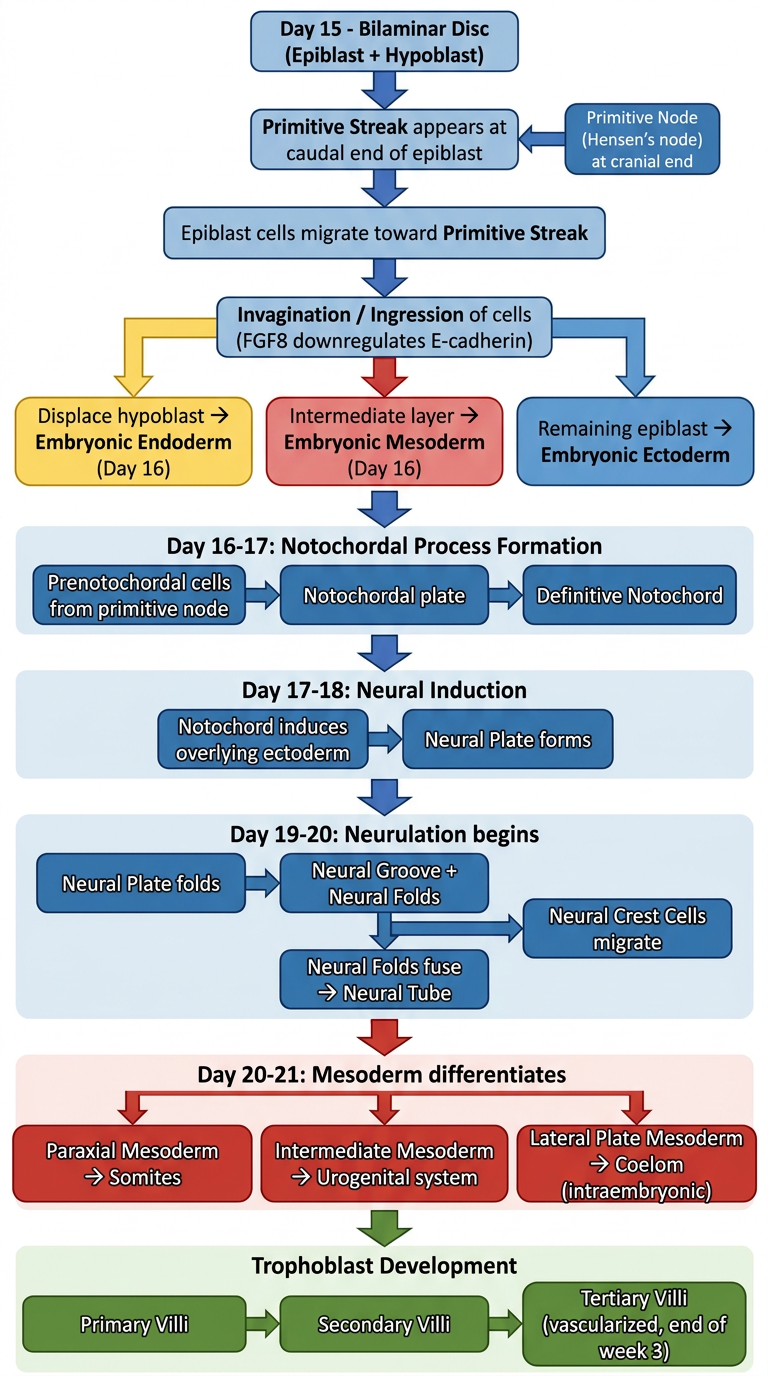
Summary Flowchart (Text)
BILAMINAR DISC (Day 14)
       │
       ▼
PRIMITIVE STREAK forms at caudal epiblast (Day 15)
  └─ Primitive node (cranial) + Primitive pit
       │  (FGF8, BRACHYURY, NODAL, BMP4)
       ▼
EPIBLAST CELLS INVAGINATE through streak (Day 15–16)
  ├──→ Displace hypoblast ────────→ ENDODERM
  ├──→ Middle layer ───────────────→ MESODERM
  └──→ Remaining epiblast ─────────→ ECTODERM
                            ↓
                  TRILAMINAR DISC (Day 16)
       │
       ▼
NOTOCHORD FORMATION (Day 16–17)
  Primitive node cells → Notochordal process → Notochordal plate → Definitive Notochord
       │
       ▼
NEURAL INDUCTION (Day 17–18)
  Notochord induces ectoderm → Neural Plate
       │
       ▼
NEURULATION (Day 18–21)
  Neural plate → Neural groove → Neural folds → NEURAL TUBE
                                              └── Neural Crest cells migrate
       │
       ▼
MESODERM DIFFERENTIATION (Day 20–21)
  ├── Paraxial → SOMITES (sclerotome, myotome, dermatome)
  ├── Intermediate → Urogenital primordia
  └── Lateral plate → Intraembryonic COELOM
       │
       ▼
TROPHOBLAST: Primary → Secondary → TERTIARY VILLI (vascularized)
Clinical Correlates
| Event | Clinical Significance |
|---|
| Primitive streak persists | Sacrococcygeal teratoma (remnant of primitive streak) |
| Failed gastrulation | Sirenomelia (caudal regression), structural malformations |
| Neural tube closure defect | Anencephaly (cranial), Spina bifida (caudal) |
| Disrupted laterality (5-HT signaling) | Situs inversus, dextrocardia, heart defects |
| SSRIs in pregnancy (disrupts serotonin) | Increased risk of cardiac malformations |
| Absent oropharyngeal membrane breakdown | Failure of oral cavity formation |
Sources:
- The Developing Human: Clinically Oriented Embryology (Moore & Persaud), Ch. 4 — Third Week
- Langman's Medical Embryology (Sadler), Ch. 5 — Third Week: Trilaminar Germ Disc