
Filigree
"Filigree" refers to delicate, intricate ornamental work. It appears in several contexts:
Jewelry & Metalwork
The most common use: fine, twisted threads of gold, silver, or copper wire soldered together to form lacy, openwork patterns. It's one of the oldest jewelry-making techniques, practiced for thousands of years across cultures — from ancient Egypt and Greece to Byzantine, Indian, and Renaissance European craftwork.
Architecture & Design
Delicate lattice or tracery patterns in stonework, woodwork, or plasterwork — often seen in Gothic cathedrals, Moorish buildings (like the Alhambra), and ornate Victorian interiors.
Paper (Quilling)
Rolling and shaping strips of paper into intricate designs is sometimes called paper filigree or quilling.
Figurative Use
The word is used metaphorically to describe anything intricate, delicate, or finely detailed — "a filigree of light through the leaves," for example.
Are you asking about a specific type of filigree — a technique, a historical tradition, a particular object, or something else?
Filigree burns
Reading File
Searching for information on filigree burns (lightning injuries) now.
search_medical_text
filigree burns lightning Lichtenberg figures skin
search_medical_image
filigree burns Lichtenberg figures lightning injury skin

Hugging Face pmc clinical VQA raw
Page 0
GradeResponse
GradeResponse
Filigree Burns (Lichtenberg Figures)
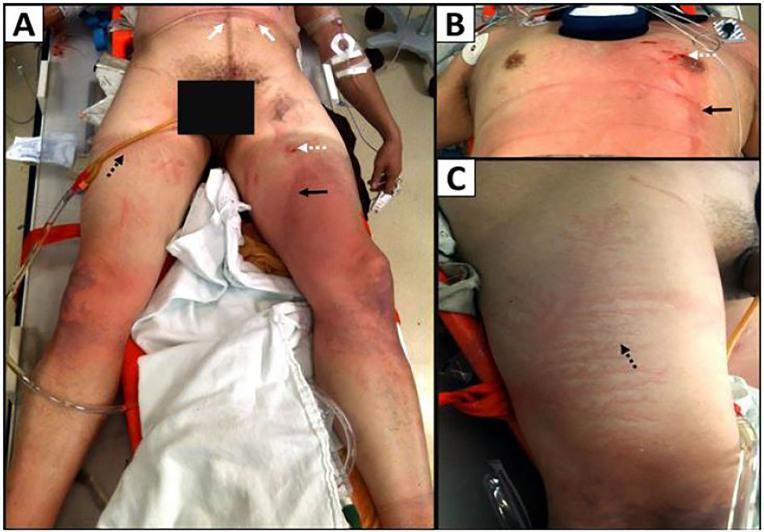
"Filigree burns" is the informal name for Lichtenberg figures — the branching, fern-like or ferning erythematous skin patterns that appear after a lightning strike. They are one of the most visually striking and pathognomonic signs of lightning injury (keraunopathology).
What They Are
Despite the name, filigree burns are not true burns. They are a transient inflammatory/vascular response — the electrical current causes flash heating and vascular disruption in the superficial skin, producing the characteristic arborescent (tree-like) reddening. They typically:
- Appear within 1–2 hours of a lightning strike
- Fade and disappear within 24–48 hours
- Leave no permanent scarring
- Are painless relative to thermal burns
Appearance
The pattern mimics the branching of a fern or a fractal tree, following the path of electrical discharge across the skin surface. They can appear anywhere on the body but are commonly seen on the trunk, back, shoulders, and limbs.
Clinical Significance
| Feature | Detail |
|---|---|
| Diagnostic value | Pathognomonic for lightning strike — confirms the diagnosis |
| True burn? | No — transient vascular/inflammatory response |
| Duration | Fades within 24–48 hours |
| Permanent scarring | Rare to none |
| Associated injuries | Cardiac arrest, respiratory arrest, neurological injury, blast trauma, tympanic membrane rupture, eye damage |
Other Lightning Burn Types (for Comparison)
Lightning strikes produce several distinct injury patterns beyond filigree burns:
- Flash burns — superficial, linear; caused by the arc of current over skin
- Punctate burns — multiple small, deep burns from current entering/exiting
- Thermal/contact burns — from heated metal objects (belt buckles, jewelry, coins) on skin
- Blast injury — from the shock wave (can cause concussion, eardrum rupture, blunt trauma)
Key Clinical Priority
The filigree pattern is diagnostically useful, but the immediate priorities in a lightning strike victim are:
- Cardiac monitoring — ventricular fibrillation and asystole are leading causes of death
- Airway and breathing — respiratory arrest can outlast cardiac arrest ("reverse triage")
- Neurological assessment — keraunoparalysis, amnesia, and long-term cognitive effects
- Ophthalmologic and audiologic evaluation — cataracts and hearing loss are delayed complications
The skin findings confirm the mechanism, but the life-threatening injuries are systemic.
This is a shared conversation. Sign in to Orris to start your own chat.