
Order of clamping in abdominal hysterectomy
Reading File
In abdominal hysterectomy, the classic order of clamping proceeds from the upper supporting structures downward to the uterine vessels and then the lower supports. Let me consult the textbooks for the precise sequence.
Searching sources...
Finding Sources
Finding Sources
Reading File
Reading File
Reading File
Reading File
I now have detailed information from both Berek & Novak's Gynecology and Sabiston's Surgery. Let me fetch the key surgical diagram images for a complete answer.
Loading Image
Reading File
I now have comprehensive information from both major textbooks. Here is the detailed answer:
Order of Clamping in Total Abdominal Hysterectomy (TAH)
The sequence proceeds from the upper uterine supports downward, systematically devascularizing the uterus before its removal. The exact order differs slightly depending on whether the ovaries are conserved or removed.
Step-by-Step Clamping Order
1. Broad Ligament Clamp (Elevation Clamp)
The uterus is first elevated by placing broad ligament clamps at each cornu, crossing the round ligament. This provides traction and controls back bleeding from the uterine cornu throughout the procedure.
2. Round Ligament
The uterus is deviated to one side, stretching the contralateral round ligament. A curved Heaney or Ballantine clamp is placed on the proximal portion; the round ligament is transected distally. The anterior leaf of the broad ligament is then incised toward the vesicouterine fold, and the posterior leaf is opened to enter the retroperitoneum for ureter identification.
3a. Utero-ovarian Vessels (if ovaries preserved)
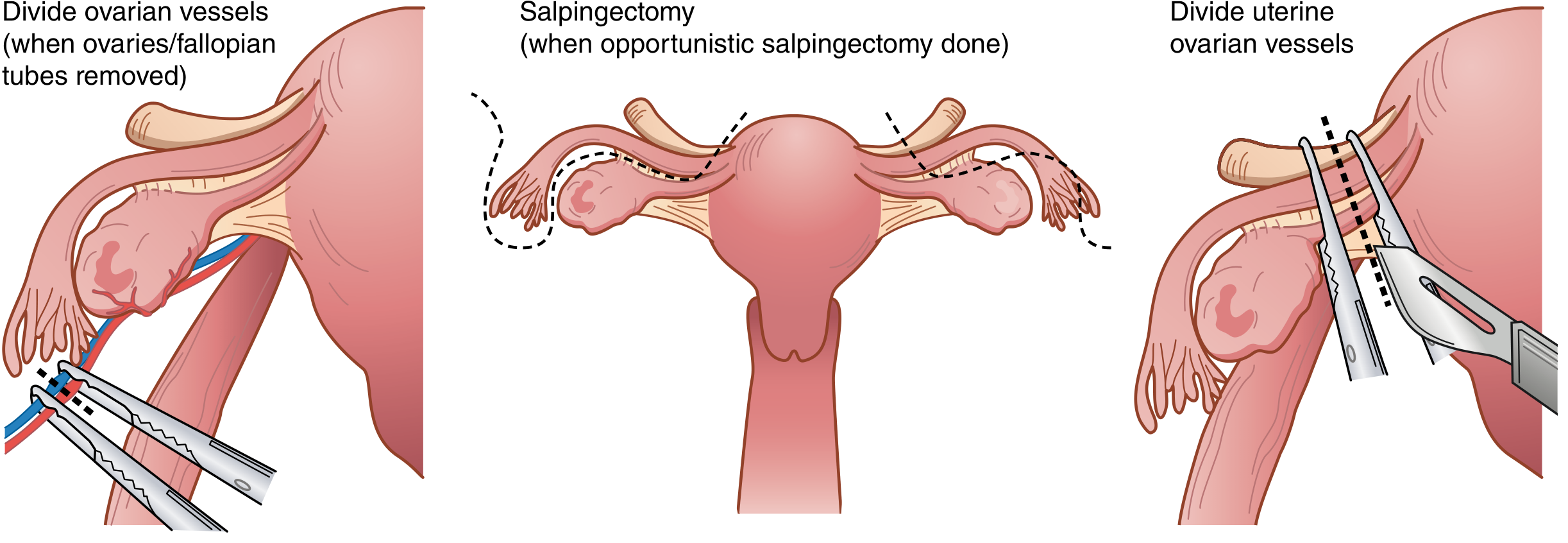
With the ureter visualized directly, the utero-ovarian ligament and proximal fallopian tube at the uterine cornua are doubly clamped (curved Heaney or Ballantine clamp), cut, and doubly ligated with a free-tie and suture ligature. The medial clamp at the cornu controls back bleeding.
3b. Infundibulopelvic (IP) Ligament / Ovarian Vessels (if ovaries removed)
The peritoneum is opened widely to expose and safely distance the ureter. A curved Heaney or Zeppelin clamp is placed lateral to the ovary across the IP ligament; it is cut between clamps and doubly ligated. The remaining posterior broad ligament leaves are incised inferiorly to skeletonize the uterine vessels.
4. Uterine Vessels (Uterine Artery and Vein)
This is the most critical step. The bladder is dissected off the cervix and retracted inferiorly. A curved Heaney or Zeppelin clamp is placed across the uterine vessels at the level of the internal cervical os, perpendicular to the uterus and flush against it (to displace the ureter laterally). The pedicle is cut and suture ligated. This is performed bilaterally.
5. Cardinal Ligaments (Mackenrodt's Ligament)
After the bladder is further dissected completely below the cervix, straight Heaney or Zeppelin clamps are placed serially on the cardinal ligaments bilaterally in a stepwise fashion, working downward. Each pedicle is cut and suture ligated.
6. Uterosacral Ligaments
Incorporated with or just after the cardinal ligaments. Curved Heaney clamps are placed bilaterally incorporating the uterosacral ligament and upper vagina just below the cervix.
7. Vaginal Angles / Colpotomy Clamps
Curved clamps are placed across the vagina just below the cervix on both sides, meeting in the midline. The uterus and cervix are cut free with curved scissors just above the clamps.
Summary Table
| Order | Structure Clamped | Notes |
|---|---|---|
| 1 | Broad ligament (elevation) | Elevates uterus, controls cornu bleeding |
| 2 | Round ligament | Bilateral; opens broad ligament leaves |
| 3a | Utero-ovarian vessels | If ovaries conserved |
| 3b | Infundibulopelvic ligament | If ovaries removed; ureter must be visualized |
| 4 | Uterine vessels | At internal os level; most important hemostatic step |
| 5 | Cardinal ligaments | Serial stepwise clamping downward |
| 6 | Uterosacral ligaments | Often combined with cardinal ligament pedicles |
| 7 | Vaginal angles / colpotomy | Final release of specimen |
Key Surgical Principle
The ureter is at risk at three points: at the pelvic brim (crosses common iliac vessels), in the midpelvis (where the uterine artery crosses above it - "water under the bridge"), and near the cervix at the internal os. Direct retroperitoneal visualization of the ureter before clamping the IP ligament and uterine vessels is mandatory to prevent injury.
Sources:
- Berek & Novak's Gynecology (9781496380357), Chapter 27 - Abdominal Hysterectomy, pp. 1420-1427
- Sabiston Textbook of Surgery (9780443124341), Chapter 120 - Total Abdominal Hysterectomy, pp. 2799-2800
This is a shared conversation. Sign in to Orris to start your own chat.