
Glycolysis mbbs 1st year final exam answer to score full marks
Reading File
Now let me search the medical library for comprehensive glycolysis content.
Finding Sources
Finding Sources
Excellent - found great sources. Let me now read the most relevant sections from Lippincott (standard MBBS biochemistry text) and Basic Medical Biochemistry simultaneously.
Reading File
Reading File
Good. Let me read the detailed steps and regulation sections from both books.
Reading File
Reading File
Now let me get the detailed 10 steps and regulation sections.
Reading File
Reading File
Excellent. Let me read the key concepts/summary and regulation details.
Reading File
Reading File
I now have comprehensive content from authoritative MBBS biochemistry textbooks (Lippincott Illustrated Reviews and Basic Medical Biochemistry). Let me now compile a thorough, exam-ready answer.
Loading Image
I now have all the content needed to write a comprehensive, exam-ready answer. Here is the full answer:
GLYCOLYSIS - Complete MBBS 1st Year Exam Answer
Sources: Lippincott Illustrated Reviews Biochemistry 8th ed; Basic Medical Biochemistry (Clinical Approach) 6th ed
Definition
Glycolysis (from Greek: glykys = sweet, lysis = splitting) is the metabolic pathway by which one molecule of glucose (6-carbon) is oxidized to two molecules of pyruvate (3-carbon), generating ATP and NADH. It occurs in the cytosol of all cells and is the primary pathway for glucose catabolism.
Overview and Significance
- Glycolysis is at the hub of carbohydrate metabolism - virtually all dietary sugars (fructose, galactose, etc.) are funnelled into it
- Provides energy with or without oxygen (aerobic and anaerobic)
- Serves both catabolic (energy production) and anabolic (precursors for biosynthesis) functions
- Consists of 10 sequential enzymatic reactions, all occurring in the cytosol
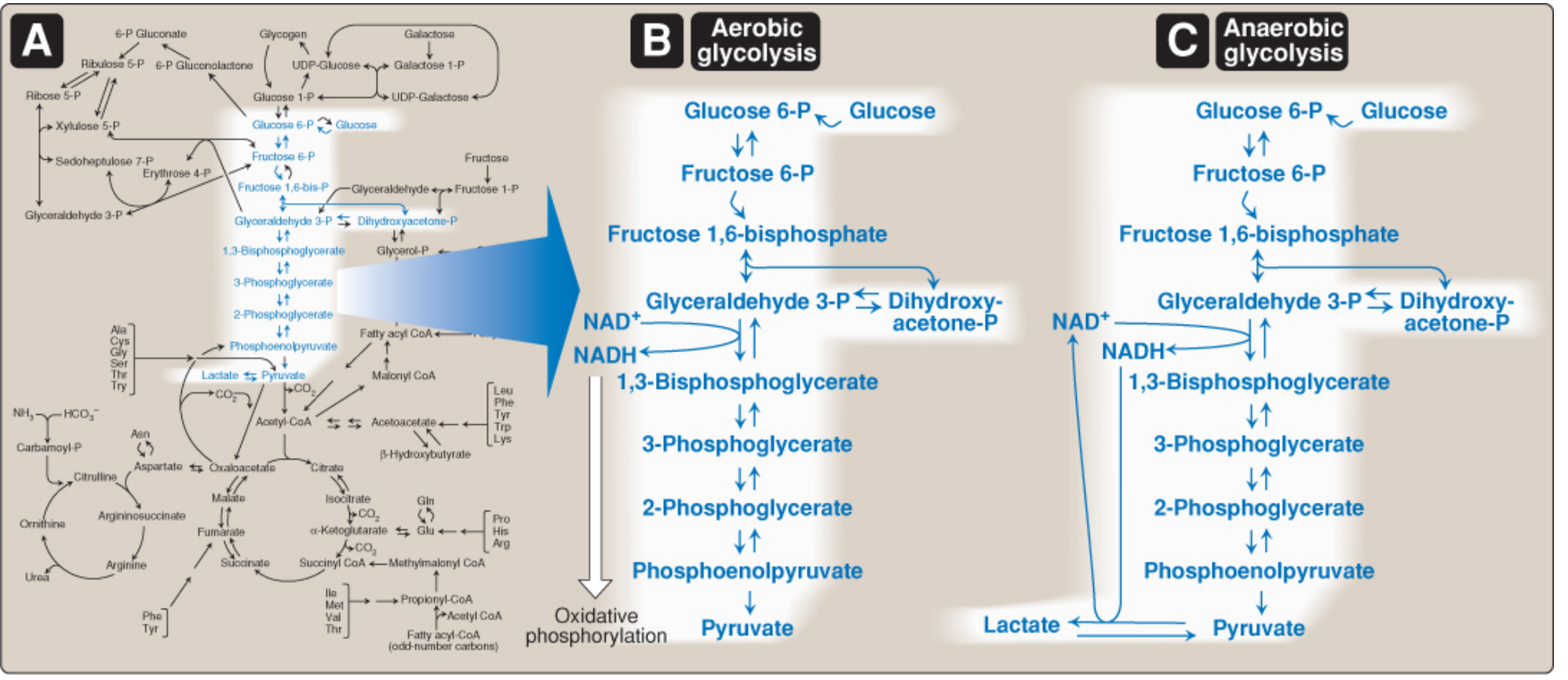
Two Phases of Glycolysis
| Phase | Reactions | ATP Balance |
|---|---|---|
| Energy Investment Phase (Preparatory) | Steps 1-5 | -2 ATP consumed |
| Energy Generation Phase (Pay-off) | Steps 6-10 | +4 ATP produced |
| NET GAIN | +2 ATP + 2 NADH |
The 10 Steps of Glycolysis (Memorize each substrate, enzyme, product, coenzyme)
PHASE 1: Energy Investment (Steps 1-5)
Step 1: Glucose → Glucose 6-phosphate (G6P)
- Enzyme: Hexokinase (most tissues) / Glucokinase (liver, pancreatic β-cells)
- Coenzyme: ATP → ADP (Mg²⁺ required)
- Key points:
- Irreversible reaction (high negative ΔG)
- Traps glucose inside the cell (phosphorylated glucose cannot cross membrane)
- Hexokinase (HK I-III): low Km (~0.1 mM), high affinity, inhibited by G6P (product inhibition)
- Glucokinase (HK IV): high Km (~10 mM), low affinity, NOT inhibited by G6P, acts as a glucose sensor
Step 2: Glucose 6-phosphate → Fructose 6-phosphate (F6P)
- Enzyme: Phosphoglucose isomerase (Phosphohexose isomerase)
- Type: Isomerization (aldose → ketose)
- Reversible reaction
Step 3: Fructose 6-phosphate → Fructose 1,6-bisphosphate (F1,6-BP)
- Enzyme: Phosphofructokinase-1 (PFK-1) ← MOST IMPORTANT REGULATORY STEP
- Coenzyme: ATP → ADP (Mg²⁺ required)
- Irreversible; rate-limiting step of glycolysis
- Regulation:
- Activated by: AMP, ADP, fructose 2,6-bisphosphate (F2,6-BP - most potent), inorganic phosphate (Pi)
- Inhibited by: ATP (high energy charge), citrate, H⁺ (acidosis)
Step 4: Fructose 1,6-bisphosphate → Dihydroxyacetone phosphate (DHAP) + Glyceraldehyde 3-phosphate (G3P)
- Enzyme: Aldolase
- Type: Aldol cleavage (splitting the 6C sugar into two 3C fragments)
- Reversible reaction
- Only G3P enters the next step directly; DHAP is converted to G3P by Step 5
Step 5: Dihydroxyacetone phosphate ⇌ Glyceraldehyde 3-phosphate
- Enzyme: Triose phosphate isomerase
- Reversible reaction
- After this step, 1 molecule of glucose yields 2 molecules of G3P, so all subsequent reactions occur twice per glucose
PHASE 2: Energy Generation (Steps 6-10)
(Each step occurs TWICE per glucose)
Step 6: Glyceraldehyde 3-phosphate → 1,3-Bisphosphoglycerate (1,3-BPG)
- Enzyme: Glyceraldehyde 3-phosphate dehydrogenase (G3PD)
- Coenzyme: NAD⁺ → NADH + H⁺ (oxidation); inorganic phosphate (Pi) used
- Substrate-level phosphorylation precursor
- Key: This is the only oxidation step in glycolysis
- Net yield: 2 NADH (×2 per glucose)
- Inhibited by arsenate (competes with Pi - important toxicology MCQ)
Step 7: 1,3-Bisphosphoglycerate → 3-Phosphoglycerate
- Enzyme: Phosphoglycerate kinase
- Coenzyme: ADP → ATP (Substrate-level phosphorylation - first ATP generation)
- Net yield: 2 ATP (×2 per glucose)
- Note: 2,3-Bisphosphoglycerate (2,3-BPG) is formed as a side reaction from 1,3-BPG in RBCs by bisphosphoglycerate mutase - important for regulating O₂ affinity of hemoglobin
Step 8: 3-Phosphoglycerate → 2-Phosphoglycerate
- Enzyme: Phosphoglycerate mutase
- Type: Transfer of phosphate from C3 to C2
- Reversible
Step 9: 2-Phosphoglycerate → Phosphoenolpyruvate (PEP)
- Enzyme: Enolase
- Type: Dehydration (removes H₂O)
- Creates a high-energy enol phosphate bond
- Inhibited by fluoride (used in NaF tubes for blood glucose collection - important clinical point)
Step 10: Phosphoenolpyruvate → Pyruvate
- Enzyme: Pyruvate kinase (PK)
- Coenzyme: ADP → ATP (Substrate-level phosphorylation - second ATP generation)
- Net yield: 2 ATP (×2 per glucose)
- Irreversible reaction
- Regulation:
- Activated by: Fructose 1,6-bisphosphate (feedforward/allosteric), AMP
- Inhibited by: ATP, alanine, glucagon (via cAMP-mediated phosphorylation in liver)
- Pyruvate kinase deficiency → hemolytic anemia (important clinical MCQ)
Summary Table of All 10 Steps
| Step | Substrate | Enzyme | Product | Notes |
|---|---|---|---|---|
| 1 | Glucose | Hexokinase/Glucokinase | G6P | Irreversible, -1 ATP |
| 2 | G6P | Phosphoglucose isomerase | F6P | Reversible |
| 3 | F6P | PFK-1 | F1,6-BP | Irreversible, rate-limiting, -1 ATP |
| 4 | F1,6-BP | Aldolase | DHAP + G3P | Cleavage |
| 5 | DHAP | Triose phosphate isomerase | G3P | Reversible |
| 6 | G3P | G3P dehydrogenase | 1,3-BPG | +2 NADH |
| 7 | 1,3-BPG | Phosphoglycerate kinase | 3-PG | +2 ATP |
| 8 | 3-PG | Phosphoglycerate mutase | 2-PG | Reversible |
| 9 | 2-PG | Enolase | PEP | -H₂O |
| 10 | PEP | Pyruvate kinase | Pyruvate | Irreversible, +2 ATP |
Net Energy Yield
| Condition | ATP | NADH |
|---|---|---|
| Aerobic | 2 ATP (net) + 2 NADH → ~7 ATP total (NADH enters ETC) | 2 NADH |
| Anaerobic | 2 ATP (net) | 0 (NADH reoxidized to NAD⁺ by LDH) |
Gross ATP produced: 4 ATP
ATP consumed: 2 ATP (Steps 1 and 3)
Net ATP = 2 ATP per glucose
Three Irreversible (Regulatory) Enzymes
These are critical for exam answers - always mention them together:
| Enzyme | Step | Why Irreversible |
|---|---|---|
| Hexokinase/Glucokinase | 1 | High -ΔG, commits glucose to metabolism |
| Phosphofructokinase-1 (PFK-1) | 3 | Rate-limiting step - most important regulator |
| Pyruvate kinase | 10 | High -ΔG |
Mnemonic: Happy People Play → Hexokinase, PFK-1, Pyruvate kinase
Regulation of Glycolysis (Very Important)
1. Phosphofructokinase-1 (PFK-1) - Key Regulator
| Activators | Inhibitors |
|---|---|
| AMP, ADP (low energy) | ATP (high energy) |
| Fructose 2,6-bisphosphate (most potent) | Citrate |
| Inorganic phosphate | H⁺ (acidosis) |
| Fructose 1,6-bisphosphate | - |
- Fructose 2,6-bisphosphate (F2,6-BP): formed by PFK-2, stimulated by insulin, inhibited by glucagon. This is the most potent allosteric activator of PFK-1.
2. Hexokinase vs Glucokinase
| Property | Hexokinase (I-III) | Glucokinase (IV) |
|---|---|---|
| Km for glucose | Low (~0.1 mM) - high affinity | High (~10 mM) - low affinity |
| Inhibition by G6P | Yes (product inhibition) | No |
| Location | Most tissues | Liver, pancreatic β-cells |
| Function | Basal glucose metabolism | Glucose sensor; activated after high carb meal |
3. Pyruvate Kinase
- Feedforward activation by F1,6-BP (product of PFK-1 activates downstream enzyme)
- Inhibited by glucagon (phosphorylation in liver), ATP, alanine
4. Hormonal Regulation
- Insulin: increases glycolysis (↑ PFK-1, glucokinase, PK expression; ↑ F2,6-BP)
- Glucagon: decreases glycolysis (↓ F2,6-BP; inhibits pyruvate kinase by phosphorylation)
Aerobic vs Anaerobic Glycolysis
| Feature | Aerobic Glycolysis | Anaerobic Glycolysis |
|---|---|---|
| O₂ required? | Yes | No |
| End product | Pyruvate → Acetyl-CoA | Lactate |
| Net ATP | 2 ATP + 2 NADH (→ TCA + ETC) | 2 ATP only |
| NADH fate | Enters mitochondria (ETC) | Oxidized by LDH → NAD⁺ regenerated |
| Tissues | Most tissues | RBCs, cornea, lens, rapidly exercising muscle |
| Key enzyme for anaerobic | - | Lactate dehydrogenase (LDH) |
Why is NAD⁺ regeneration critical in anaerobic glycolysis?
Step 6 (G3P dehydrogenase) requires NAD⁺. Without it, glycolysis stops. LDH converts pyruvate → lactate, simultaneously oxidizing NADH → NAD⁺, allowing glycolysis to continue.
Fate of Pyruvate (Very Frequently Asked)
- Aerobic conditions (mitochondria present): Pyruvate → Acetyl-CoA (by Pyruvate Dehydrogenase Complex, requires thiamine/B1, riboflavin/B2, niacin/B3, pantothenic acid/B5, lipoic acid)
- Anaerobic/hypoxia: Pyruvate → Lactate (by Lactate dehydrogenase) - regenerates NAD⁺
- Gluconeogenesis: Pyruvate → Oxaloacetate (by Pyruvate carboxylase, needs biotin/B7)
- Transamination: Pyruvate → Alanine (by Alanine aminotransferase, ALT)
- Lipogenesis: Pyruvate → Acetyl-CoA → Fatty acids (in liver, adipose)
Clinically Important Points (Scoring Bonus Marks)
| Condition | Connection to Glycolysis |
|---|---|
| Pyruvate kinase deficiency | Most common glycolytic enzyme defect; causes hemolytic anemia in RBCs |
| Fluoride inhibits enolase | Used in NaF blood collection tubes to prevent glycolysis (preserves glucose) |
| Arsenic/arsenate poisoning | Uncouples substrate-level phosphorylation at Step 7 (replaces Pi, forming 1-arseno-3-PG which spontaneously hydrolyzes - no ATP generated) |
| Thiamine (B1) deficiency | Does NOT affect glycolysis but blocks pyruvate → Acetyl-CoA (PDH complex needs TPP) - leads to pyruvate accumulation, lactic acidosis |
| 2,3-BPG in RBCs | Side product at Step 7; reduces hemoglobin-O₂ affinity (right shifts ODC); increased in high altitude, anemia |
| Warburg effect | Cancer cells preferentially use aerobic glycolysis (glycolysis even in presence of O₂) - basis of PET scan |
| Fasting/Diabetes | Glycolysis inhibited by high glucagon; glucokinase and PFK-1 expression reduced |
Subcellular Location
All 10 enzymes of glycolysis are located in the cytosol (cytoplasm). This allows glycolysis to occur even in cells lacking mitochondria (RBCs).
Key Mnemonics
10 steps of glycolysis (substrates):
Glucose → G6P → F6P → F1,6-BP → DHAP/G3P → 1,3-BPG → 3-PG → 2-PG → PEP → Pyruvate
Mnemonic: "Good Guys Fight For Daring Triumphs; Three Pathways Produce"
Three regulatory enzymes: HK, PFK-1, PK → "Happy People Play"
Activated by AMP, inhibited by ATP: PFK-1 and Pyruvate kinase - think "low energy = speed up glycolysis"
Energetics Summary (For Calculation Questions)
Per molecule of glucose:
- ATP consumed: 2 (Steps 1 and 3)
- ATP produced: 4 (Steps 7 and 10, ×2 each)
- Net ATP: +2
- NADH produced: 2 (Step 6, ×2)
- Pyruvate produced: 2
- If aerobic: 2 NADH × ~2.5 ATP each = +5 ATP additional → ~7 ATP total from glycolysis
Sources: Lippincott Illustrated Reviews: Biochemistry, 8th ed, pp. 293-322 | Basic Medical Biochemistry: A Clinical Approach, 6th ed, pp. 791-812
This is a shared conversation. Sign in to Orris to start your own chat.