
Hep c
Asking for Preferences
What would you like to know about Hepatitis C?
Reading File
Finding Sources
Searching PubMed
"hepatitis C virus" AND pathophysiology
Reading File
Reading File
Now let me get the core HCV overview and pathophysiology section from the microbiology textbook:
Reading File
Finding Sources
Finding Sources
Finding Sources
Reading File
Reading File
Reading File
Finding Sources
Reading File
Finding Sources
Reading File
Reading File
Loading Image
Reading File
I now have comprehensive data from multiple authoritative textbooks. Here is a thorough overview of Hepatitis C — its virology, pathogenesis, epidemiology, and clinical course.
Hepatitis C Virus (HCV) — Overview & Pathophysiology
1. The Virus
HCV is a small (~55 nm), enveloped, positive-sense single-stranded RNA virus, the sole member of the genus Hepacivirus within the Flaviviridae family (which also includes dengue, Zika, West Nile, and yellow fever viruses).
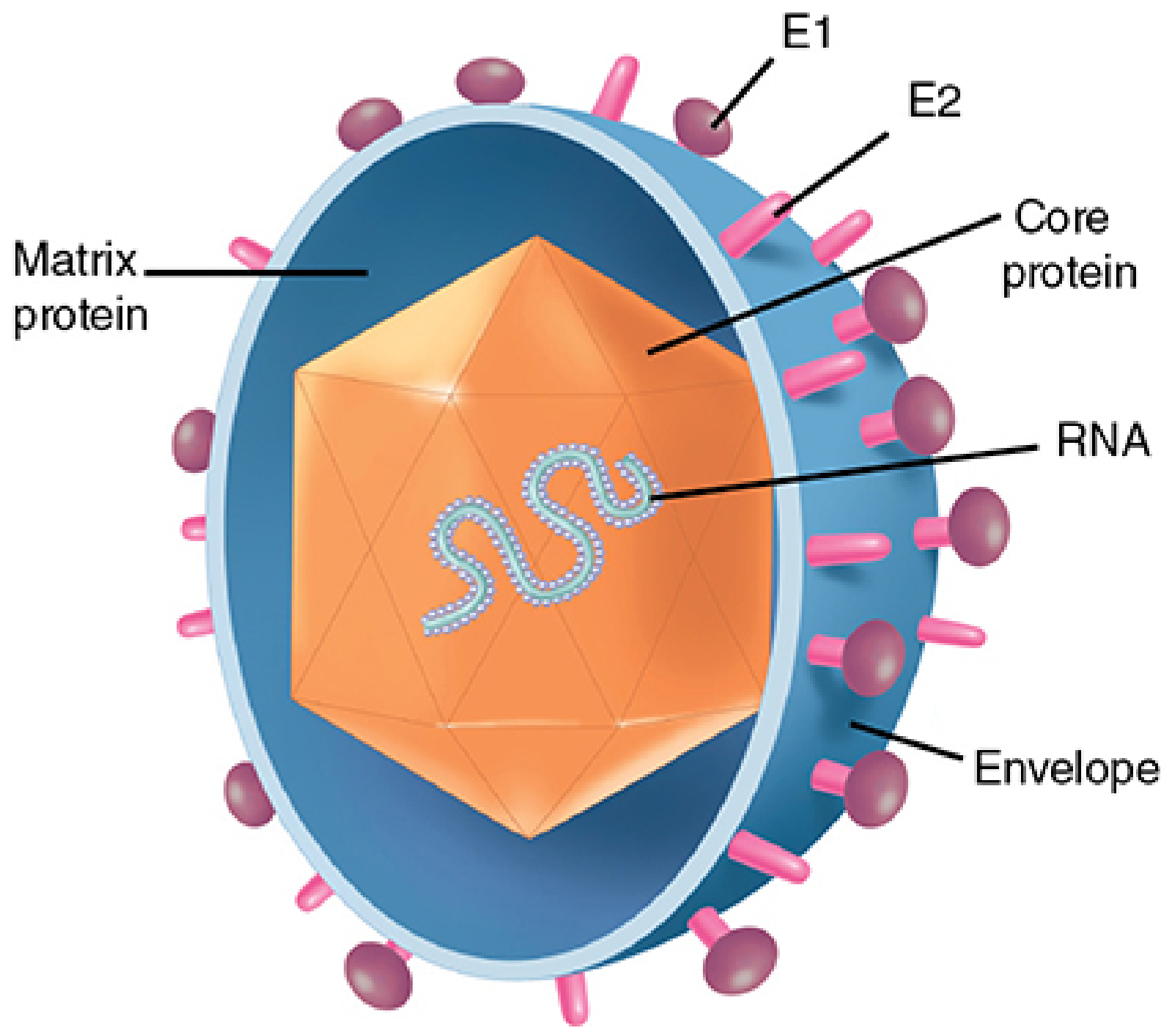
Genome (~9.6 kb) encodes a single large polyprotein that is cleaved by both host and viral proteases into 10 proteins:
| Category | Proteins | Function |
|---|---|---|
| Structural | Core, E1, E2 | Capsid, envelope glycoproteins (cell entry via CD81, SR-B1, claudin-1, occludin) |
| Ion channel | p7 | Membrane ion channel |
| Non-structural | NS2, NS3/4A, NS4B, NS5A, NS5B | Polyprotein cleavage, RNA helicase/protease, replication complex, RNA-dependent RNA polymerase (RdRp) |
The NS5B RNA-dependent RNA polymerase lacks proofreading ability, generating enormous genetic diversity — including quasispecies (viral variants within a single host) and distinct genotypes (≥6) globally. This diversity is the primary obstacle to vaccine development and underlies immune evasion.
2. Genotypes
| Genotype | Geographic predominance | Notes |
|---|---|---|
| 1 (1a, 1b) | North America, Western Europe, Japan | Most common globally; worst response to IFN-based therapy |
| 2 | Worldwide | Best response to IFN therapy |
| 3 | South Asia | Highest rate of spontaneous clearance |
| 4 | Central Africa, Middle East | Highest frequency of chronicity after acute infection |
| 5 | Southern Africa | |
| 6 | East/Southeast Asia |
— Sherris & Ryan's Medical Microbiology, 8th Ed.; Jawetz, Melnick & Adelberg's Medical Microbiology, 28th Ed.
3. Epidemiology & Transmission
- ~1% of the world population has been infected; >70 million chronic carriers worldwide (>3 million in the US)
- Sub-Saharan Africa, South America, and Asia have the highest prevalence (up to 10% in some populations)
- Egypt has ~20% HCV prevalence, linked to mass parenteral treatment campaigns for schistosomiasis (1950s–1980s) using reused needles
Transmission routes (decreasing prevalence):
- Injecting drug use (~80%)
- Clotting factor recipients (pre-1987 era)
- Blood transfusion recipients (pre-screening era)
- Chronic hemodialysis (~10%)
- High-risk sexual practices
- Healthcare workers (~1%)
- Mother-to-child vertical transmission (3–10%); higher with HIV coinfection or high viral load
- No risk with breastfeeding
Incubation period: average 6–7 weeks; seroconversion ~8–9 weeks post-exposure; ~90% anti-HCV positive by 5 months.
— Jawetz, Melnick & Adelberg's Medical Microbiology, 28th Ed.
4. Cell Entry & Replication
- HCV circulates in blood associated with lipoproteins forming lipoviroparticles (LVPs)
- LVPs bind heparan sulfate proteoglycans on hepatocyte surfaces
- Productive entry requires sequential interaction of E2 glycoprotein with SCARB1 → CD81 → claudin-1 → occludin
- Internalization via clathrin-mediated, EGFR-dependent endocytosis
- pH-dependent membrane fusion at the endosome releases the genome into the cytoplasm
- The positive-sense RNA is translated via an IRES (internal ribosome entry site) directly into the polyprotein
- Replication occurs via a negative-sense RNA intermediate template, catalyzed by NS5B RdRp
- New virions are assembled and secreted
— Yamada's Textbook of Gastroenterology, 7th Ed.; Sherris & Ryan's Medical Microbiology, 8th Ed.
5. Pathogenesis of Liver Injury
HCV is not directly cytopathic — liver injury is principally immune-mediated.
Innate immune evasion
- Host pattern recognition receptors detect HCV RNA motifs → trigger IFN and cytokine production
- HCV NS3/4A protease cleaves key innate immune signaling adaptors (MAVS/IPS-1, TRIF), blocking type-I IFN responses
- HCV core, NS4B, and NS5B suppress the NF-κB pathway, reducing antiapoptotic proteins and increasing susceptibility to TNF-α–mediated cell death
Adaptive immune response
- HLA class I-restricted intrahepatic cytotoxic T lymphocytes (CTLs/CD8+ T cells) target core, envelope, and NS protein antigens
- CTLs eliminate infected hepatocytes via apoptosis and IFN-γ–mediated inhibition of viral replication
- CD4+ T cells secrete proinflammatory cytokines contributing to hepatocyte death
- The immune response is characteristically slow and weak, owing to HCV's evolved immune evasion repertoire
TH1/TH2 imbalance in chronic disease
- TH1 cytokines (IL-2, TNF-α) → aggressive hepatic disease
- TH2 cytokines (IL-10) → milder presentation
- Chronic overexpression of TNF-α triggers a "cytokine storm," causing ongoing liver damage
- TNF-α and IL-6 drive insulin resistance in hepatocytes → promotes fibrosis and hepatocarcinogenesis
Genetic host factors
- IL28B CC haplotype (codes for interferon-λ3) → associated with spontaneous HCV clearance; non-CC alleles impair clearance
- A frameshift variant creating IFN-λ4 (ΔG polymorphism) is linked to persistent infection
- MHC class II DR5 allele → lower incidence of cirrhosis
- NK cells: in spontaneous clearance, NK cells show enhanced IFN-γ and activating receptor expression; in persistent infection, NK cytotoxicity is dysfunctional
Viral quasispecies and immune escape
- The lack of NS5B proofreading generates hypervariable regions (HVR1, HVR2) in the E2 envelope glycoprotein
- Continuous mutation allows newly generated HCV variants to escape preexisting humoral and cellular immune responses → a key mechanism driving chronicity
— Harrison's Principles of Internal Medicine, 22nd Ed.; Sherris & Ryan's Medical Microbiology, 8th Ed.; Jawetz, Melnick & Adelberg's, 28th Ed.
6. Clinical Course
| Phase | Features |
|---|---|
| Acute | 80% asymptomatic or mild; 20–30% jaundice; 10–20% nonspecific symptoms (anorexia, malaise, abdominal pain) |
| Chronicity rate | 70–80% of exposed individuals develop chronic infection |
| Chronic | Slowly progressive, often asymptomatic for decades |
| End-stage | Cirrhosis, liver failure, hepatocellular carcinoma (HCC) |
Chronic HCV is a leading cause of cirrhosis and HCC globally. US mortality from HCV exceeds that of HIV.
7. Extrahepatic Manifestations
Immune complex deposition drives extrahepatic disease:
- Mixed cryoglobulinemia (vasculitis)
- Glomerulonephritis
- Arthritis
- Lichen planus, porphyria cutanea tarda (skin)
- Lymphoma (B-cell)
Recent Evidence
A 2024 systematic review (PMID: 38385567) found that HCV eradication by direct-acting antivirals (DAAs) significantly reduces liver steatosis and carotid atherosclerosis, underscoring that HCV's metabolic and vascular effects extend well beyond the liver.
Sources: Harrison's Principles of Internal Medicine 22nd Ed. | Sherris & Ryan's Medical Microbiology 8th Ed. | Jawetz, Melnick & Adelberg's Medical Microbiology 28th Ed. | Yamada's Textbook of Gastroenterology 7th Ed.
This is a shared conversation. Sign in to Orris to start your own chat.