
Latest guidelines in detail
I need a bit more context to give you the most relevant guidelines. Let me ask quickly:
Asking for Preferences
Which medical topic or condition are you looking for the latest guidelines on?
The user skipped the clarification. Without knowing the specific topic, I can't provide meaningful "latest guidelines in detail." I should ask again more directly.
Could you clarify which condition or clinical area you're asking about? For example:
- Hypertension (JNC / ESC/ESH)
- Diabetes (ADA Standards of Care)
- Sepsis (Surviving Sepsis Campaign)
- Heart failure (ACC/AHA or ESC)
- Stroke (AHA/ASA)
- Dyslipidemia / cholesterol
- Asthma / COPD
- Atrial fibrillation
- Something else entirely
Just name the topic and I'll pull the latest guidelines in detail for you.
Latest guidelines in detail about ACLS , BLS , PLS all protocols and treatment given in these conditions
Reading File
Now launching parallel searches across the medical library, PubMed, and web simultaneously.
Finding Sources
Finding Sources
Finding Sources
Searching PubMed
ACLS BLS resuscitation guidelines
Searching the Web
AHA 2024 2025 ACLS BLS PALS guidelines updates latest protocols
Good. I have an ACLS section in Tintinalli's and the 2025 AHA guidelines are confirmed. Let me now read the textbook content and extract the web guidelines in parallel.
Reading File
Finding Sources
Reading Web Page
https://cpr.heart.org/-/media/CPR-Files/2025-documents-for-c…
Searching PubMed
cardiac arrest resuscitation 2025 guidelines
Excellent. Now let me get more detailed content from the textbook and also fetch the ACLS algorithm image and more web data.
Reading File
Finding Sources
Searching the Web
2025 AHA ACLS algorithm VF VT asystole PEA treatment medications dosages
Loading Image
Now let me get more textbook content on ACLS secondary survey, pharmacology, post-ROSC care, and BLS/PALS specifics.
Reading File
Finding Sources
Reading Web Page
https://emergencymedicinecases.com/cardiac-arrest-update-par…
Let me get more ACLS drug/pharmacology content and the BLS + PALS specific sections.
Reading File
Finding Sources
Finding Sources
Searching the Web
2025 AHA BLS guidelines updates opioid naloxone chain of survival pediatric PALS changes
Excellent. I now have comprehensive data from textbooks, the 2025 AHA guidelines, and PubMed. Let me now compile the full, detailed response.Here is the comprehensive, detailed guide to the 2025 AHA Guidelines for BLS, ACLS, and PALS - the most current resuscitation science as of October 22, 2025.
2025 AHA Guidelines: BLS, ACLS & PALS - Complete Reference
Sources: 2025 AHA Guidelines for CPR & ECC (Circulation 2025;152:suppl 2), Tintinalli's Emergency Medicine, Rosen's Emergency Medicine, European Resuscitation Council (ERC) Guidelines 2025, and PubMed practice guidelines [PMID: 41122884, 41122885, 41122893, 41117573]
PART 1 - KEY 2025 SYSTEM-LEVEL CHANGES (All Protocols)
Single Chain of Survival (NEW 2025)
The 2025 guidelines reverted to one universal Chain of Survival applicable to all cardiac arrests - adult, pediatric, in-hospital, and out-of-hospital:
- Recognition and activation of emergency response
- High-quality CPR (early)
- Rapid defibrillation
- Advanced resuscitation by EMS and healthcare providers
- Post-cardiac arrest care
- Recovery (new link added)
Choking (Foreign Body Airway Obstruction - FBAO) - MAJOR UPDATE
Previously, Heimlich maneuver alone was taught. 2025 now recommends 5+5:
- Adults/Children: 5 back blows (heel of hand between shoulder blades), then 5 abdominal thrusts - alternating until expelled or unresponsive
- Infants: 5 back blows + 5 chest thrusts (NOT abdominal thrusts) - alternating
- Pregnant patients / obese: Use 5 chest thrusts instead of abdominal thrusts
PART 2 - BASIC LIFE SUPPORT (BLS) 2025
BLS for Adults - Healthcare Provider Protocol
Step 1: Scene Safety & Recognition
- Ensure scene safety
- Check responsiveness: tap shoulders, shout "Are you OK?"
- If unresponsive + no breathing or only gasping: activate emergency response system, get AED
Step 2: Pulse Check (max 10 seconds)
- Carotid pulse (adults/children), brachial pulse (infants)
- If no pulse or unsure: START CPR immediately
Step 3: High-Quality CPR
| Parameter | Adult | Child (1yr - puberty) | Infant (<1 yr) |
|---|---|---|---|
| Rate | 100-120/min | 100-120/min | 100-120/min |
| Depth | At least 2 in (5 cm), max 2.4 in (6 cm) | At least 2 in (5 cm) | At least 1.5 in (4 cm) |
| Hand position | 2 hands, lower half of sternum | 1-2 hands, lower half sternum | 2 fingers OR 2 thumb-encircling technique (2-rescuer) |
| Compression:ventilation ratio | 30:2 (1-2 rescuers, no advanced airway) | 30:2 (1 rescuer), 15:2 (2 rescuers) | 30:2 (1 rescuer), 15:2 (2 rescuers) |
| Recoil | Full chest recoil between compressions | Full recoil | Full recoil |
Step 4: Ventilation
- 1 breath every 5-6 seconds when pulse present (adult)
- Visible chest rise without excessive volume
- Avoid hyperventilation (no >10 breaths/min during CPR with advanced airway)
- 100% FiO2 during active CPR
Step 5: Defibrillation with AED
- Attach AED as soon as available
- Minimize pauses - compression fraction must be >60% (aim >80%)
- Resume CPR immediately after shock, 2-minute cycles
- Continue until ALS providers arrive or patient recovers
New 2025 BLS Algorithm Features
- Naloxone now in BLS Algorithm: The healthcare professional BLS algorithm was updated to illustrate the role of opioid antagonists (naloxone) for suspected opioid overdose during respiratory AND cardiac arrest
- Simplified lay-rescuer visual: Emphasizes early EMS activation + AED + chest compressions
- New FBAO algorithm: Back blows first, then abdominal thrusts
- CPR training recommended for children aged 12 and older
Opioid Overdose - New 2025 BLS Guidance
Signs: Slow/absent breathing, choking sounds, drowsiness, pinpoint pupils, cyanosis
New 2025 Recommendations:
- Lay/trained rescuers: Opioid antagonist (naloxone) administration is reasonable for adults/children in cardiac arrest with suspected opioid overdose - provided it does NOT delay standard CPR
- Administer naloxone in addition to standard resuscitation, not instead of
- At discharge: All patients treated for opioid overdose should receive naloxone and instruction on its use
- Naloxone restores airway reflexes and reverses respiratory depression
PART 3 - ADVANCED CARDIAC LIFE SUPPORT (ACLS) 2025
ACLS Framework: Primary + Secondary Survey
Primary Survey (Basic ABCD)
| Component | Action |
|---|---|
| A - Airway | Open airway, check responsiveness |
| B - Breathing | Look, listen, feel; BVM with O2 |
| C - Circulation | Check pulse; start CPR; attach monitor |
| D - Defibrillation | Attach defibrillator, shock if VF/pVT |
Secondary Survey (Advanced ABCD)
| Component | Action |
|---|---|
| A - Advanced Airway | ETT or supraglottic airway; confirm with waveform capnography |
| B - Breathing | Confirm placement; mechanical ventilation; 1 breath/6 sec (10/min) |
| C - Circulation | IV/IO access; rhythm-specific drugs; continuous ECG; consider ECMO |
| D - Differential Diagnosis | Identify and treat reversible causes (H's and T's) |
The Universal ACLS Algorithm (2025)
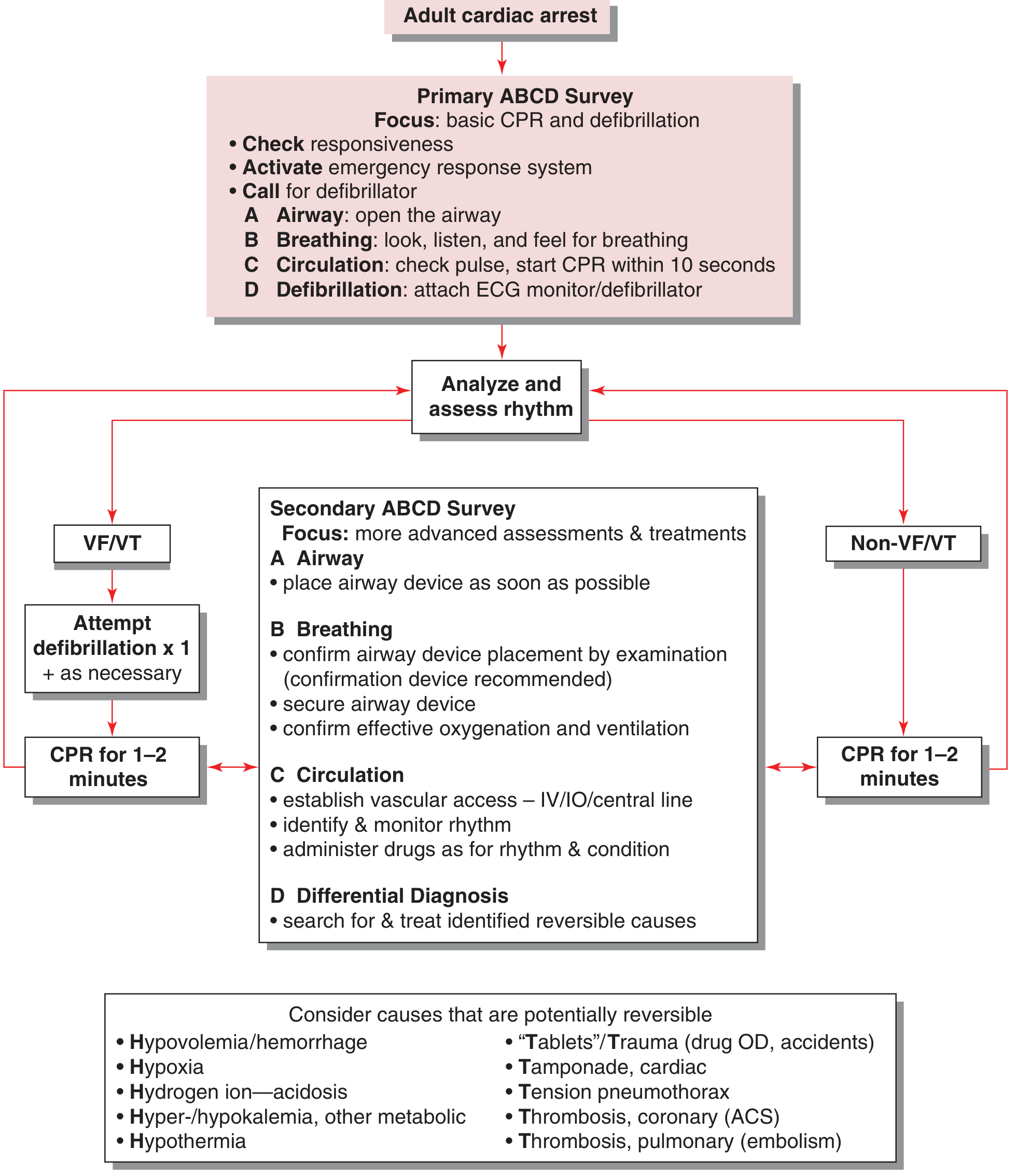
Step-by-step 2025 Adult Cardiac Arrest Algorithm:
- Start CPR + BVM + O2 + attach monitor/defibrillator
- Rhythm shockable?
If YES (VF/pVT) - Shockable Pathway:
- CPR 2 min → IV/IO access
- Shock (defibrillate)
- CPR 2 min → Epinephrine every 3-5 min
- Shock → CPR 2 min → Amiodarone or Lidocaine (after 3rd shock)
- Treat reversible causes
- Check rhythm every 2 minutes
If NO (Asystole/PEA) - Non-Shockable Pathway:
- CPR 2 min → IV/IO access
- Epinephrine ASAP (every 3-5 min)
- Consider advanced airway + capnography
- Treat reversible causes
- Check rhythm every 2 minutes
Drug Therapy - 2025 ACLS Dosages
Vasopressors
| Drug | Dose | Indication | Notes |
|---|---|---|---|
| Epinephrine | 1 mg IV/IO every 3-5 min | All cardiac arrest rhythms | First-line vasopressor; best if given early (<20 min from arrest onset) |
| Vasopressin | REMOVED from algorithm | - | 2025 confirmed removal; no benefit over epinephrine |
Key 2025 Update on Epinephrine: Multiple studies show epinephrine effectiveness converges with placebo at approximately 20 minutes of pulselessness. After 20 minutes: decreased cerebral blood flow, worse neurological outcome, and increased cardiac ischemia. Administer as early as possible.
Antiarrhythmics (for shock-refractory VF/pVT)
| Drug | Dose | Notes |
|---|---|---|
| Amiodarone | 1st dose: 300 mg IV/IO bolus; 2nd dose: 150 mg | First-choice; give IV preferred over IO (IO may blunt efficacy) |
| Lidocaine | 1st dose: 1-1.5 mg/kg IV/IO; 2nd dose: 0.5-0.75 mg/kg | Acceptable alternative; available in pre-filled syringes |
Give first antiarrhythmic dose after the 3rd shock (evidence suggests earliest possible administration beneficial).
Defibrillation Energy
| Device | Energy |
|---|---|
| Biphasic | Manufacturer recommendation (120-200 J initial); if unknown, use maximum available |
| Monophasic | 360 J |
| Subsequent shocks | Equivalent or escalating energy |
Other Medications by Indication
| Drug | Dose | Indication |
|---|---|---|
| Atropine | 1 mg IV (increased from 0.5 mg) every 3-5 min, max 3 mg | Bradycardia (stable; first-line) |
| Dopamine | 5-20 mcg/kg/min infusion (start 5 mcg/kg/min) | Bradycardia unresponsive to atropine |
| Magnesium sulfate | 1-2 g IV push | Torsades de Pointes (polymorphic VT) |
| Adenosine | 6 mg IV rapid push; repeat 12 mg x2 | Stable SVT |
| Sodium bicarbonate | 1 mEq/kg | Hyperkalemia-induced arrest, TCA overdose, severe acidosis |
| Calcium chloride | 500-1000 mg IV | Hyperkalemia, hypocalcemia, CCB toxicity |
| Naloxone | 0.4-2 mg IV/IM/IN | Opioid overdose (now in BLS AND ACLS algorithms) |
Reversible Causes: The H's and T's
| H's | T's |
|---|---|
| Hypovolemia | Tension pneumothorax |
| Hypoxia | Tamponade (cardiac) |
| Hydrogen ion (acidosis) | Toxins/Tablets (drug overdose) |
| Hypo/Hyperkalemia | Thrombosis, pulmonary (PE) |
| Hypothermia | Thrombosis, coronary (ACS) |
NEW 2025 ACLS Updates
1. Defibrillation - Vector Change & Double Sequential Defibrillation
- Vector Change Defibrillation (NEW 2025): Changing pad placement for adults with persisting VF/pVT after 3+ consecutive shocks - usefulness has NOT been established (insufficient evidence)
- Double Sequential Defibrillation (Updated 2025): Usefulness for adults with refractory VF/pVT also not established - reflect ongoing uncertainty
2. Airway - Updated 2025
- Head and neck trauma: If airway cannot be opened with jaw thrust + airway adjunct, trained rescuers should use head tilt-chin lift (patent airway = priority over spinal precautions)
- Any advanced airway (ETT or supraglottic) is acceptable - outcomes similar
- ET intubation within first 15 minutes of shockable arrest may reduce survival due to compression interruptions - avoid early ETT if it compromises CPR
3. Ventilation - Updated 2025
- Give enough tidal volume to produce visible chest rise
- Avoid hypoventilation (too few breaths or too little volume)
- Continuous waveform capnography: ETCO2 <10 mmHg after 20 min = poor prognosis; ETCO2 >20 mmHg = suggests ROSC; quality compressions should achieve ETCO2 ≥12-15 mmHg
4. Bradycardia Algorithm - New
- A new algorithm for bradycardia in adults with a pulse was added
- Sequence: Atropine → Dopamine/Epinephrine infusion → Transcutaneous pacing (TCP) → Transvenous pacing
5. Tachycardia - Updated
- Unstable wide-complex tachycardia: Synchronized cardioversion is recommended (strong recommendation)
6. Termination of Resuscitation (TOR) - Updated
- In tiered EMS systems (ALS + BLS), the universal TOR rule is now reasonable:
- Arrest NOT witnessed by EMS
- No shock delivered
- No ROSC
- Must rule out hypothermia, toxins, asphyxial causes
Vascular Access Priority (2025)
- IV (peripheral) first - large bore, proximal peripheral vein
- IO - if IV not quickly obtainable (same drug doses as IV)
- Central line - useful for CVP monitoring, but slower for fluid delivery
- Endotracheal route: NO LONGER RECOMMENDED (unreliable absorption)
- Flush each IV drug dose with ≥20 mL normal saline; continue CPR 30-60 seconds after drug delivery before defibrillation
Capnography - Monitoring Standard
- Waveform capnography = most reliable confirmation of ETT placement
- Use continuously throughout resuscitation
- Monitors CPR quality and signals ROSC
- Sudden rise in ETCO2 during CPR = likely ROSC
PART 4 - POST-CARDIAC ARREST CARE (Post-ROSC) 2025
Immediate Post-ROSC Targets
| Parameter | Target |
|---|---|
| SpO2 | 90-98% (avoid hyperoxia) |
| PaO2 | 60-105 mmHg |
| PaCO2 | 35-40 mmHg (avoid hyperventilation) |
| MAP | ≥65 mmHg |
| Temperature | Avoid fever; targeted temperature management |
| Blood glucose | Avoid hypoglycemia AND hyperglycemia |
Temperature Management (Updated 2025)
- Avoid fever is mandatory for all comatose post-arrest patients
- Active cooling considered for specific patients (evidence still evolving from TTM trials)
- Target: normothermia or mild hypothermia per clinical scenario
Coronary Angiography
- STEMI post-ROSC: Immediate PCI indicated regardless of neurological status
- Non-STEMI post-ROSC: Selective PCI based on clinical scenario
Neurological Monitoring
- EEG monitoring for seizures (treat if found)
- CT head for neurological prognostication
- Multimodal prognostication - no single test should determine outcome
Survivorship Care (NEW Recovery Link 2025)
Assessment domains at follow-up:
- Physical function and rehabilitation needs
- Cognitive function and educational support
- Emotional/psychological health
- Family/caregiver support needs
PART 5 - PEDIATRIC LIFE SUPPORT (PALS + PBLS) 2025
Published jointly by AHA and American Academy of Pediatrics (AAP), October 22, 2025, in Circulation and Pediatrics. [PMID: 41122885]
Key Principle: Pediatric Arrest Etiology
Most pediatric arrests are RESPIRATORY or SHOCK-related first, NOT primary cardiac. This fundamentally shapes the approach - early recognition and support of breathing and circulation is the priority.
Pediatric BLS (PBLS) 2025
For Children (1 year to puberty):
- Activate EMS, start CPR, get AED
- Compression depth: at least 2 inches (1/3 AP chest diameter)
- Rate: 100-120/min
- Ratio: 30:2 (1 rescuer), 15:2 (2 healthcare rescuers)
- 2-finger technique OR 2 thumb-encircling (preferred with 2 rescuers for infants)
For Infants (<1 year):
- 2-finger chest compressions OR 2 thumb-encircling technique
- Depth: at least 1.5 inches (4 cm) / 1/3 AP chest diameter
- Ratio: 30:2 (single rescuer), 15:2 (two healthcare rescuers)
Pediatric Cardiac Arrest Algorithm (2025)
Start CPR - BVM + O2 + monitor
Shockable (VF/pVT)?
- YES: Defibrillate → CPR 2 min → IV/IO → Defibrillate → CPR 2 min → Amiodarone or Lidocaine → Treat reversible causes
- NO (Asystole/PEA): CPR 2 min → IV/IO → Epinephrine ASAP → Consider advanced airway → Treat reversible causes
Pediatric Drug Dosing (Weight-Based)
| Drug | Dose | Notes |
|---|---|---|
| Epinephrine | 0.01 mg/kg IV/IO (0.1 mL/kg of 0.1 mg/mL) every 3-5 min | Max single dose 1 mg |
| Amiodarone | 5 mg/kg IV/IO bolus (max 300 mg); repeat x2 | For shock-refractory VF/pVT |
| Lidocaine | 1 mg/kg IV/IO | Alternative antiarrhythmic |
| Adenosine | 0.1 mg/kg (max 6 mg) rapid IV push; repeat 0.2 mg/kg (max 12 mg) | SVT |
| Atropine | 0.02 mg/kg IV/IO (min 0.1 mg, max 0.5 mg/dose) | Bradycardia |
| Magnesium sulfate | 25-50 mg/kg IV/IO (max 2 g) | Torsades, hypomagnesemia |
Defibrillation in Pediatrics
| Dose | Notes |
|---|---|
| Initial: 2 J/kg | First shock |
| Second: 4 J/kg | If first unsuccessful |
| Subsequent: 4-10 J/kg | Max 10 J/kg or adult dose |
2025 PALS-Specific Updates
Airway and Ventilation
- Ventilation and advanced airway strategies updated with new evidence
- BVM remains first-line; LMA and ETT acceptable
Shock Management (PALS)
| Shock Type | Treatment |
|---|---|
| Hypovolemic | Normal saline 10-20 mL/kg IV/IO bolus (reassess frequently) |
| Distributive (septic) | 20 mL/kg NS bolus; vasopressors early (norepinephrine or dopamine) |
| Cardiogenic | Avoid aggressive fluid; consider dobutamine, milrinone |
| Obstructive (tension PTX) | Needle decompression; treat cause |
Arrhythmia Management
- Bradycardia with poor perfusion: CPR if HR <60 with poor perfusion → Epinephrine → Atropine → Pacing
- SVT (stable): Vagal maneuvers → Adenosine → Synchronized cardioversion
- SVT (unstable): Synchronized cardioversion (0.5-1 J/kg; increase to 2 J/kg)
Extracorporeal CPR (ECPR) - 2025
- ECPR (ECMO during CPR) has growing evidence in pediatric in-hospital cardiac arrest
- Consider in centers with ECPR capability for refractory arrest with potentially reversible cause
Myocarditis/Cardiomyopathy - 2025
- Updated guidance for resuscitation in these conditions
- High risk of refractory arrest; ECPR should be considered early
Post-Cardiac Arrest Care in Children (Updated 2025)
| Target | Value |
|---|---|
| Temperature | Avoid fever; TTM at 36-37.5°C for comatose (evidence from THAPCA trial) |
| Oxygenation | SpO2 94-99% (avoid hyperoxia) |
| Blood pressure | ≥5th percentile for age |
| Glucose | Normoglycemia |
| Seizures | EEG monitoring; treat aggressively |
Neurological Prognostication (Post-Arrest Pediatric)
- Multimodal: EEG, MRI, clinical exam, biomarkers
- No single variable should determine prognosis
- Family presence during CPR: Updated guidance - should be offered when possible; associated with improved family psychological outcomes
PART 6 - SPECIAL CIRCUMSTANCES (2025 Updates)
Cardiac Arrest in Pregnancy
- "Resuscitative delivery" replaces "perimortem cesarean delivery" (terminology change 2025)
- Preparation begins at recognition of arrest; goal: delivery by 5 minutes
- Left lateral uterine displacement during CPR
- Dedicated Cardiac Arrest in Pregnancy Algorithm now published
Hypothermic Cardiac Arrest
- Continue CPR; warm patient
- Withhold epinephrine until core temp >30°C (European guideline)
- Up to 3 defibrillation attempts before rewarming to >30°C
- "No one is dead until warm and dead"
Hyperkalemia-Induced Arrest
- Calcium chloride/gluconate
- Sodium bicarbonate
- Insulin + Dextrose
- Dialysis if available
- Standard ACLS otherwise
Massive Transfusion in Trauma Arrest
- Balanced 1:1:1 ratio (RBCs:plasma:platelets) - reduces mortality
SUMMARY TABLE: Key 2025 Changes at a Glance
| Topic | Old (2020) | New (2025) |
|---|---|---|
| Chain of Survival | Separate adult/pediatric chains | Single universal chain |
| Choking | Abdominal thrusts (Heimlich) alone | 5 back blows + 5 abdominal thrusts |
| Naloxone | ACLS only | Now in BLS algorithm too |
| Vasopressin | Optional in algorithm | Removed entirely |
| Atropine first dose | 0.5 mg | 1 mg |
| Head/neck trauma airway | Jaw thrust only | Head tilt-chin lift if jaw thrust fails |
| Double sequential defibrillation | Being studied | Usefulness not established |
| Vector change defibrillation | Not mentioned | New recommendation (evidence insufficient) |
| TOR rule (tiered EMS) | BLS rule | Universal TOR rule now applies |
| Post-arrest care | TTM at 33°C vs 36°C | Avoid fever; normothermia emphasized |
| PALS epinephrine timing | Standard | "ASAP" explicitly emphasized for non-shockable |
| Family presence during CPR | Limited guidance | Should be offered when possible |
| Survivorship | 5-link chain | Recovery added as 6th link |
References:
- Wigginton JG et al. Part 9: Adult Advanced Life Support. Circulation 2025;152(suppl 2):S538-S577. PMID: 41122884
- Del Rios M et al. Part 1: Executive Summary. Circulation 2025;152(suppl 2). PMID: 41122893
- Part 8: Pediatric Advanced Life Support. Circulation/Pediatrics 2025. PMID: 41122885
- Greif R et al. European Resuscitation Council Guidelines 2025. Resuscitation 2025. PMID: 41117573
- Tintinalli's Emergency Medicine, 9th Ed., Ch. 24
- 2025 AHA Highlights PDFThe above covers the complete 2025 AHA BLS, ACLS, and PALS guidelines in detail. Here's a quick orientation:
What's covered above:
- BLS: CPR technique by age group, compression parameters, AED use, new FBAO 5+5 protocol, naloxone now in BLS
- ACLS: Full Primary + Secondary survey, shockable vs non-shockable algorithms, all drug doses and timings, defibrillation energy, airway updates, capnography use, new bradycardia algorithm
- Post-ROSC care: O2/CO2/hemodynamic targets, temperature management, PCI, neurological monitoring
- PALS: Pediatric-specific algorithms, weight-based drug doses, pediatric defibrillation doses, shock management by type, ECPR, post-arrest care in children
- Special situations: Pregnancy, hypothermia, hyperkalemia, trauma
Biggest 2025 changes to remember:
- One universal Chain of Survival (adult + pediatric merged)
- 5 back blows + 5 abdominal thrusts for choking (not Heimlich alone)
- Naloxone added to BLS for opioid overdose
- Vasopressin removed from ACLS algorithm
- Atropine first dose now 1 mg (was 0.5 mg)
- Recovery added as the 6th link in the chain
This is a shared conversation. Sign in to Orris to start your own chat.