
Matheiu flap
The Mathieu flap is a classic reconstructive technique used in hypospadias repair. It is a proximally based flip-flap that uses the perimeatal skin to create a neourethra, forming the ventral surface of the glans.
Searching sources...
Reading File
Finding Sources
Finding Sources
Reading File
Finding Sources
Reading File
Reading File
Now let me fetch the key images and read more about outcomes/complications:
Loading Image
Reading File
Reading File
Let me also fetch the SLAM technique image and get the original Mathieu flip-flap figure:
Loading Image
Finding Sources
I now have comprehensive textbook content. Here is a detailed answer:
Mathieu Flap (Flip-Flap Technique) for Hypospadias Repair
Overview
The Mathieu flap, also called the flip-flap technique, is a single-stage surgical procedure for repairing distal hypospadias. It was originally described by Mustarde (1965) and popularized by Devine and Horton (1973). The key concept is using a proximally based parameatal skin flap - tissue just proximal to the hypospadiac meatus - which is flipped (rotated 180°) distally onto the deficient urethral plate to create a neourethra.
Indications
- Distal hypospadias (coronal, subcoronal, distal penile)
- Situations where there is adequate perimeatal skin for flap harvest
- Alternative when TIP (Tubularized Incised Plate) repair is not preferred or when the urethral plate is narrow
It is routinely used alongside other distal techniques: TIP (Snodgrass), Thiersch-Duplay, MAGPI, and GAP repairs.
Operative Steps (Fig. 45.19 above)
-
(A, B) Marking and incision: Parallel incisions are made lateral to the urethral plate and extended proximally for a distance equal to the urethral defect, such that the raised flap can reach into the distal glans.
-
(C) Circumscribing incision: A parameatal-based rectangular flap of ventral penile skin is outlined, with its base proximal to the meatus, providing the blood supply.
-
(D) Flip: The flap is rotated 180° ("flipped") distally and laid onto the deficient urethral plate. A running suture line is placed parallel to either side of the plate to close the neourethra over a catheter.
-
Glansplasty: The glans wings are approximated over the repair to complete the procedure.
Key principle: The flap length must equal the distance from the meatus to the desired neomeatal position at the glans tip. If the base is not sufficiently wide, the blood supply may be compromised.
Surgical Images
Fig. 45.19 - Classic Mathieu Flip-Flap:
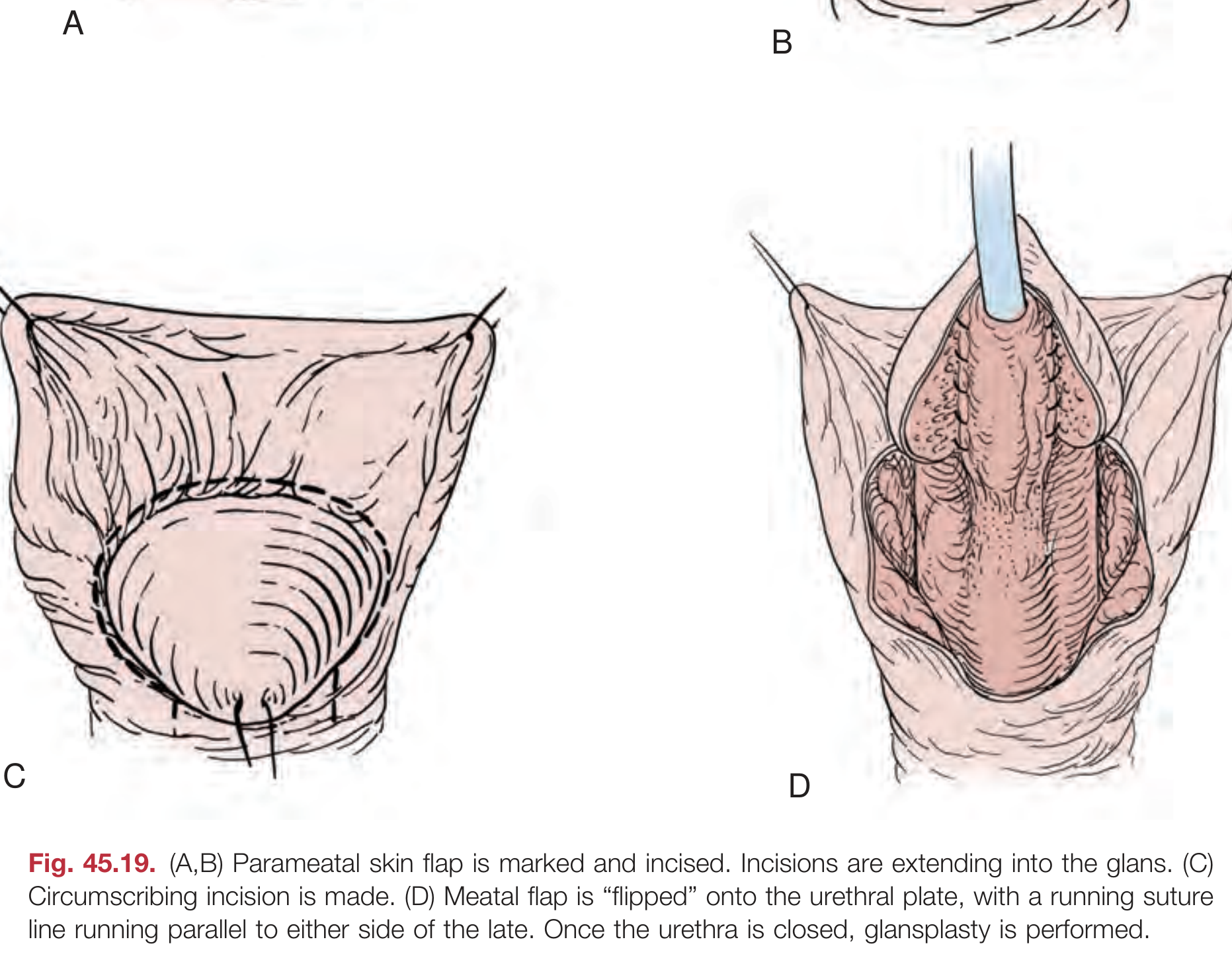
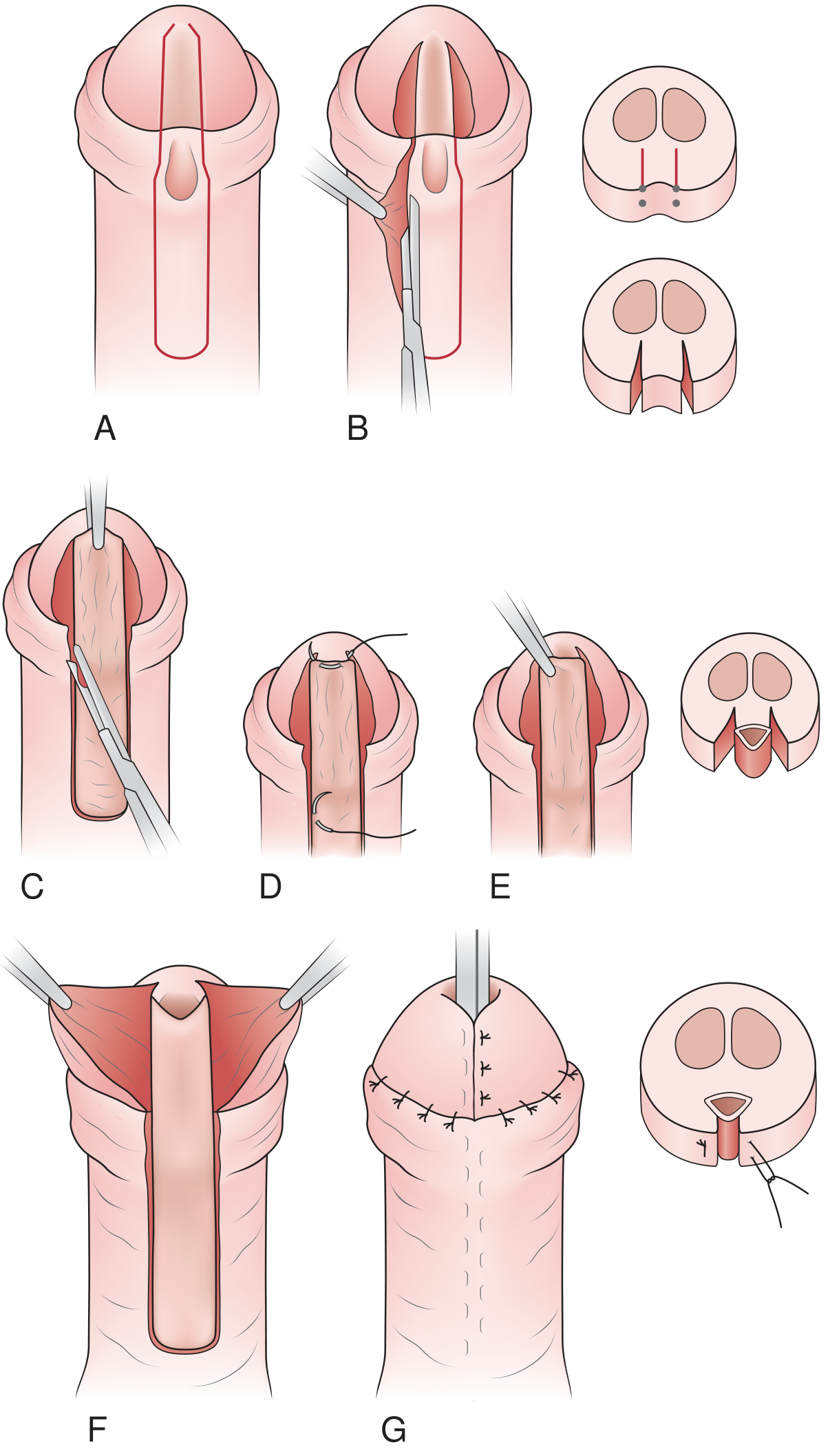
Fig. 45.20 - SLAM (Slit-Like Adjusted Mathieu) modification:
Advantages
- Single-stage repair
- Uses local, well-vascularized perimeatal skin
- No need to incise the urethral plate (preserves plate integrity)
- Proven, time-tested technique with long track record
Complications and Concerns
| Complication | Notes |
|---|---|
| Fish-mouth / rounded meatus | The most cited cosmetic drawback - the meatus can appear wide and rounded rather than a natural vertical slit |
| Urethrocutaneous fistula | Risk increases if the flap base is narrow and blood supply is compromised |
| Meatal stenosis | Less common with Mathieu than with TIP |
| Flap necrosis | If pedicle base too narrow |
A large meta-analysis by Wilkinson et al. (2012) comparing 1872 TIP repairs vs. 1496 Mathieu repairs found:
- Overall complication rate was similar: 6.9% (TIP) vs. 6.7% (Mathieu)
- Urethrocutaneous fistulas occurred equally in both
- Meatal stenosis was significantly more common after TIP than Mathieu
SLAM Modification (Slit-Like Adjusted Mathieu)
To address the fish-mouth meatal appearance, Hadidi (2012) described the SLAM procedure:
- A U-shaped incision is marked on the ventral penile shaft
- Within the glans, incisions are made parallel to the true urethral plate to develop proper glans wings
- A V/U-shaped excision of the flap tip is performed to create a slit-like meatus
- Glansplasty is then completed
- Outcomes include improved cosmetic appearance of the meatus
Comparison with Other Distal Hypospadias Repairs
| Technique | Urethral Plate | Tissue Used | Meatus Appearance |
|---|---|---|---|
| Mathieu (flip-flap) | Preserved (augmented) | Perimeatal ventral skin | Can be fish-mouth; SLAM improves this |
| TIP (Snodgrass) | Incised midline | Urethral plate tubularized | Slit-like - cosmetically superior |
| Thiersch-Duplay (TD) | Preserved (tubularized) | Urethral plate | Slit-like |
| MAGPI | Preserved | Meatal advancement | Limited to glanular/coronal |
| Onlay Island Flap (OIF) | Augmented | Inner preputial skin | Rounded; risk of diverticulum |
Key Points
- The Mathieu flip-flap is best suited for distal hypospadias with adequate perimeatal tissue
- The main limitation is the potential fish-mouth meatus appearance, addressed by the SLAM modification
- Complication rates are comparable to TIP, but meatal stenosis is less frequent
- Many surgical centers have shifted preference toward TIP/TD for better cosmesis, but Mathieu remains a valid and effective option, particularly when the urethral plate is narrow or TIP is not suitable
- Campbell-Walsh-Wein Urology, pp. 1186-1187; Hinman's Atlas of Urologic Surgery, p. 939
This is a shared conversation. Sign in to Orris to start your own chat.