
Group 1 hormone
Reading File
Group 1 hormones are lipid-soluble hormones (steroid hormones and thyroid hormones) that act intracellularly via nuclear receptors. They cross the plasma membrane directly and bind to receptors inside the cell to regulate gene transcription.
Searching sources...
Finding Sources
Finding Sources
Finding Sources
Finding Sources
Reading File
Reading File
Reading File
Finding Sources
Reading File
Reading File
Reading File
Reading File
Now let me fetch the key diagrams to include in the answer.
Loading Image
Loading Image
Here is a complete, textbook-grounded overview of Group 1 Hormones.
Group 1 Hormones (Lipid-Soluble / Intracellular Receptor Hormones)
Group 1 hormones are lipophilic (lipid-soluble) hormones that cross the plasma membrane by passive diffusion and act on intracellular receptors - either cytoplasmic or nuclear. They do NOT need a second messenger system because the activated hormone-receptor complex itself acts directly on DNA.
Members of Group 1
| Subgroup | Examples |
|---|---|
| Glucocorticoids | Cortisol |
| Mineralocorticoids | Aldosterone |
| Androgens | Testosterone, DHEA |
| Estrogens | Estradiol (17β-estradiol) |
| Progestogens | Progesterone |
| Thyroid hormones | T3 (triiodothyronine), T4 (thyroxine) |
| Vitamin D | 1,25-dihydroxycholecalciferol (calcitriol) |
| Retinoids | Retinoic acid (active form of Vitamin A) |
These hormones form the steroid hormone/thyroid hormone superfamily of receptors. All have structurally similar intracellular receptors with three binding domains: a C-terminal hormone-binding domain, a central DNA-binding domain (zinc finger), and an N-terminal gene regulatory domain.
- Basic Medical Biochemistry, Lippincott, 6e
Chemical Structure
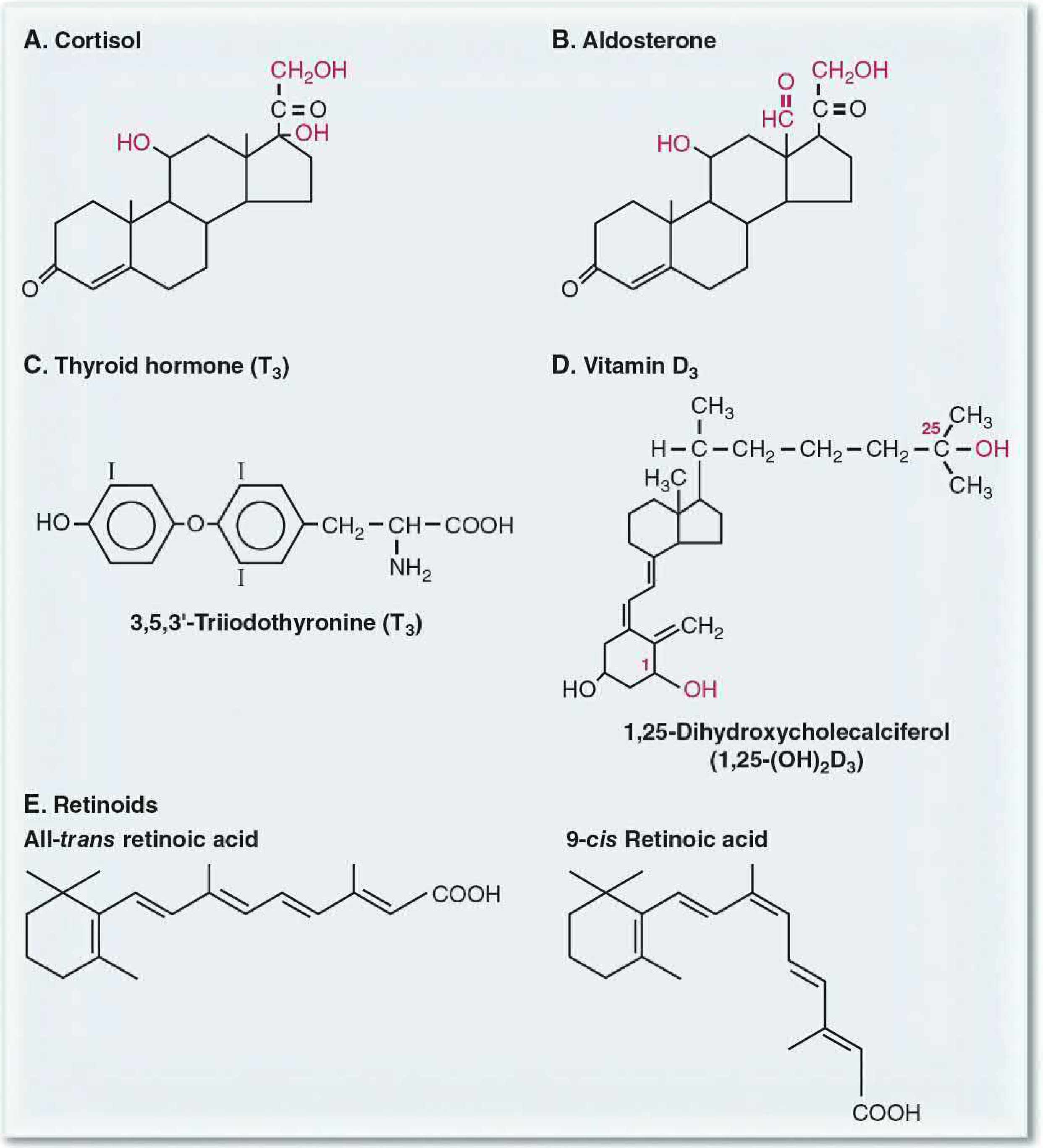
- Steroids are cholesterol-derived (4-ring cyclopentanophenanthrene nucleus)
- Thyroid hormones are iodinated tyrosine derivatives - though amino-acid based, their extensive iodination and lipophilic ether-linked structure makes them lipid-soluble
- Vitamin D and retinoids are fat-soluble vitamins acting via the same nuclear receptor superfamily
Transport in Blood
Because they are water-insoluble, Group 1 hormones travel in blood bound to carrier proteins:
| Hormone | Carrier Protein |
|---|---|
| Cortisol | Corticosteroid-binding globulin (CBG/transcortin) |
| Testosterone / Estradiol | Sex hormone-binding globulin (SHBG) |
| Thyroid hormones | Thyroid hormone-binding globulin (TBG), albumin |
| Vitamin D | Vitamin D-binding protein |
Only the small free (unbound) fraction is biologically active and can diffuse into cells.
Mechanism of Action
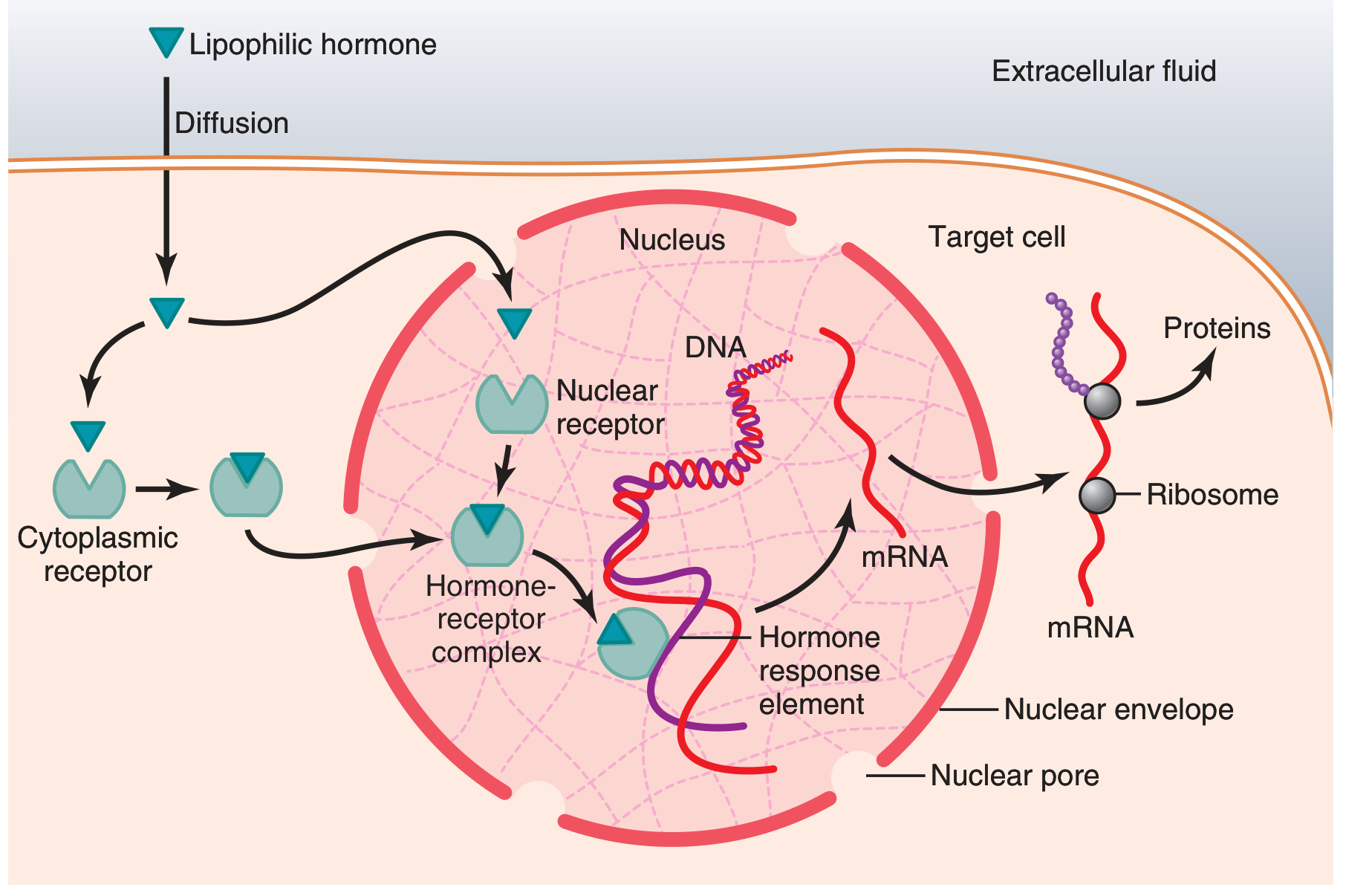
Step-by-step:
- Diffusion - Lipid-soluble hormone crosses the plasma membrane freely by passive diffusion
- Receptor binding - Binds to intracellular receptor:
- Cytoplasmic receptors (e.g., glucocorticoid receptor) - bound to heat-shock proteins in the resting state. Hormone binding causes conformational change, dissociation from heat-shock proteins, and exposure of a nuclear localization signal (NLS)
- Nuclear receptors (e.g., thyroid hormone receptor, estrogen receptor) - already reside in the nucleus, some constitutively bound to DNA
- Translocation - Hormone-receptor complex moves to the nucleus (if cytoplasmic) and dimerizes
- DNA binding - The complex binds to specific DNA sequences called Hormone Response Elements (HRE) (e.g., glucocorticoid response element = GRE)
- Gene regulation - Recruits coactivator or co-repressor proteins, altering RNA polymerase activity → changes transcription rate → new mRNA → new proteins
- Response - Biological effects appear after hours to days (time needed for protein synthesis)
No second messenger is involved - this is called nuclear-initiated steroid signaling (genomic action).
- Guyton & Hall Medical Physiology; Histology: A Text and Atlas, Pawlina; Basic Medical Biochemistry, Lippincott
Key Characteristics - Summary
| Feature | Group 1 Hormones |
|---|---|
| Solubility | Lipid-soluble (hydrophobic) |
| Receptor location | Intracellular (cytoplasm or nucleus) |
| Second messenger | None (direct genomic action) |
| Onset of action | Slow (hours to days) |
| Duration of action | Long-lasting |
| Effect | Altered gene transcription → new protein synthesis |
| Blood transport | Bound to carrier proteins |
Genomic vs. Non-Genomic Actions
While the classic (genomic) pathway is the hallmark, some steroid hormones can also signal via membrane-initiated steroid signaling - steroid receptors on the plasma membrane (in caveolae) activate G-protein cascades, producing rapid effects within seconds to minutes (e.g., rapid calcium flux). This explains why some steroid effects (like rapid vasodilation by estrogens) occur too quickly to be explained by gene transcription alone.
- Histology: A Text and Atlas, Pawlina
Contrast with Group 2 Hormones: Peptide hormones and catecholamines (epinephrine) are hydrophilic - they cannot cross the membrane and instead bind to cell-surface receptors, using second messengers (cAMP, IP3/DAG, calcium) to produce rapid but short-lived effects.
This is a shared conversation. Sign in to Orris to start your own chat.