
Draw a scheme of gamma loop and give functional characteristics of alpha- and gamma motoneurons.
A detailed anatomical and functional scheme of the gamma loop (fusimotor loop), showing: 1) Spinal cord cross-section (anterior horn) with alpha motor neuron (large, labeled) and gamma motor neuron (small, labeled); 2) Descending supraspinal input from brain (motor cortex/brainstem) activating both alpha and gamma motor neurons simultaneously (alpha-gamma coactivation); 3) Alpha motor neuron axon (large diameter, ~14 micrometers, A-alpha fiber) going to extrafusal muscle fibers (skeletal muscle bulk); 4) Gamma motor neuron axon (small diameter, ~5 micrometers, A-gamma fiber) going to intrafusal fibers (polar/contractile ends of muscle spindle); 5) Muscle spindle in the center with intrafusal fibers (nuclear bag and nuclear chain), showing the equatorial (sensory) region wrapped by Ia afferent (annulospiral ending) and type II afferent (flower-spray ending); 6) Ia afferent (thick myelinated, ~17 micrometers) going back monosynaptically to the alpha motor neuron in the spinal cord (the reflex arc closure = the gamma loop); 7) Arrows showing the direction of signal flow: supraspinal → gamma motor neuron → intrafusal fiber contraction → Ia afferent activation → alpha motor neuron → extrafusal fiber contraction; 8) Labels: gamma loop, alpha-gamma coactivation, muscle spindle sensitivity control, fusimotor system, stretch reflex arc. Clean educational diagram with colored arrows and clear labels.
The Gamma Loop - Scheme and Functional Characteristics
Scheme of the Gamma Loop
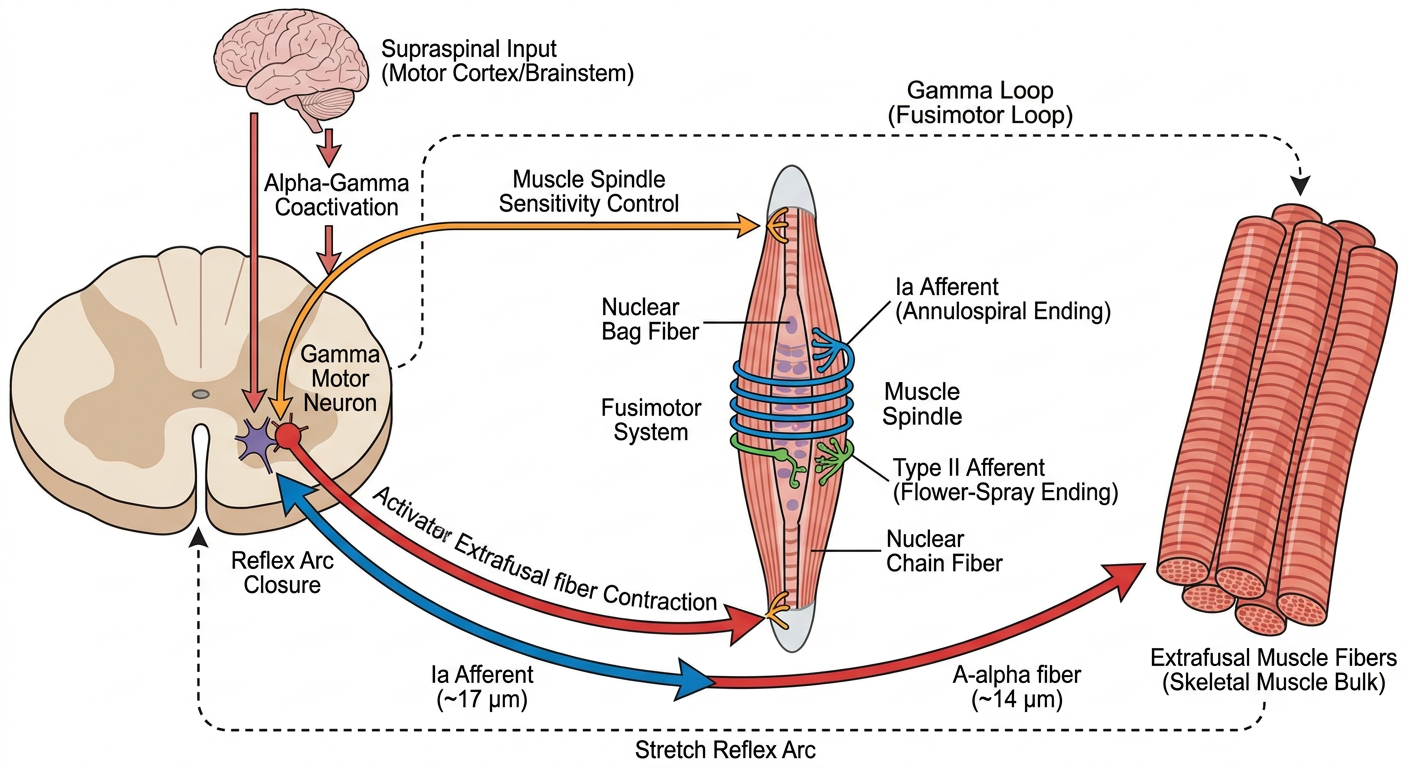

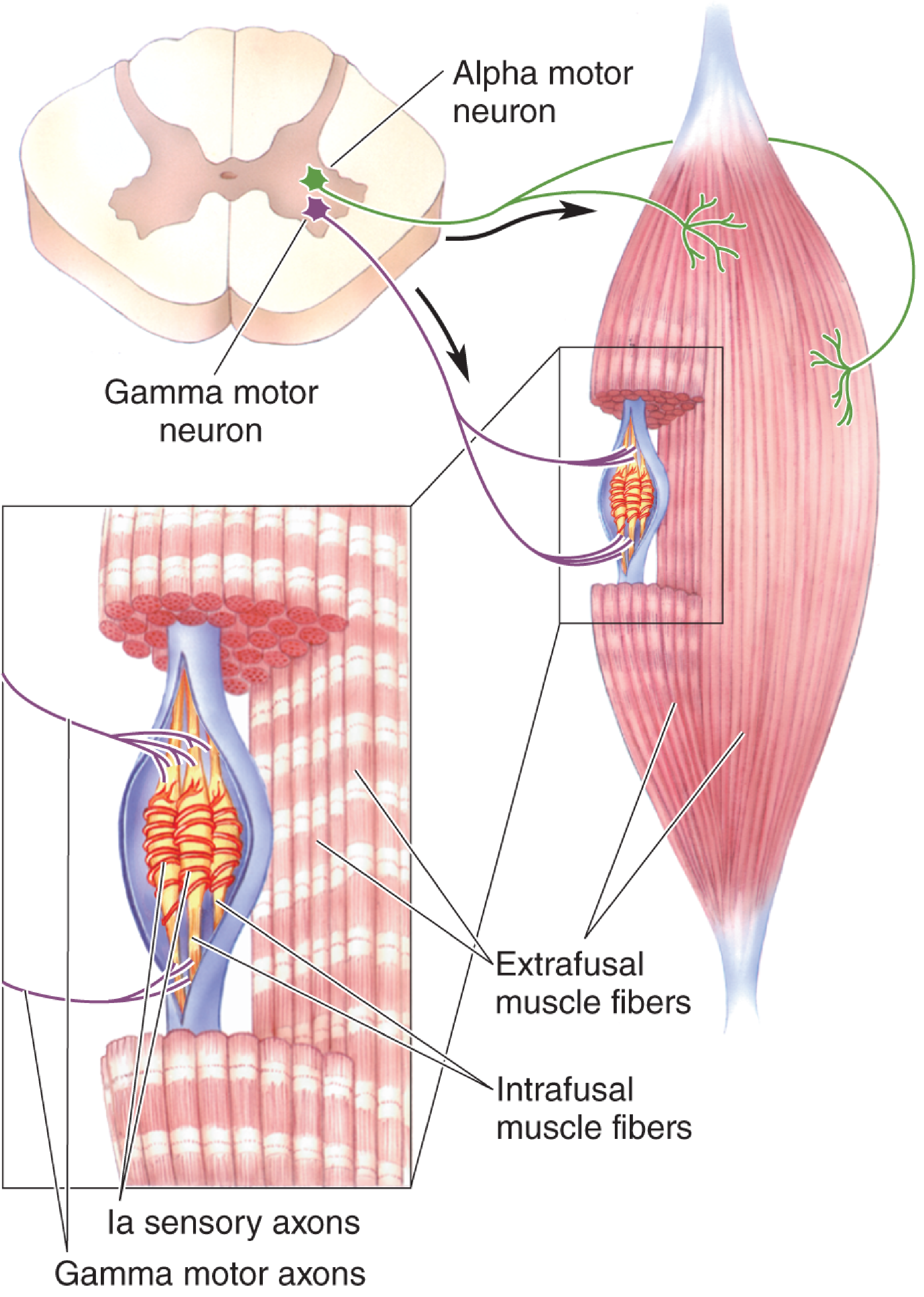
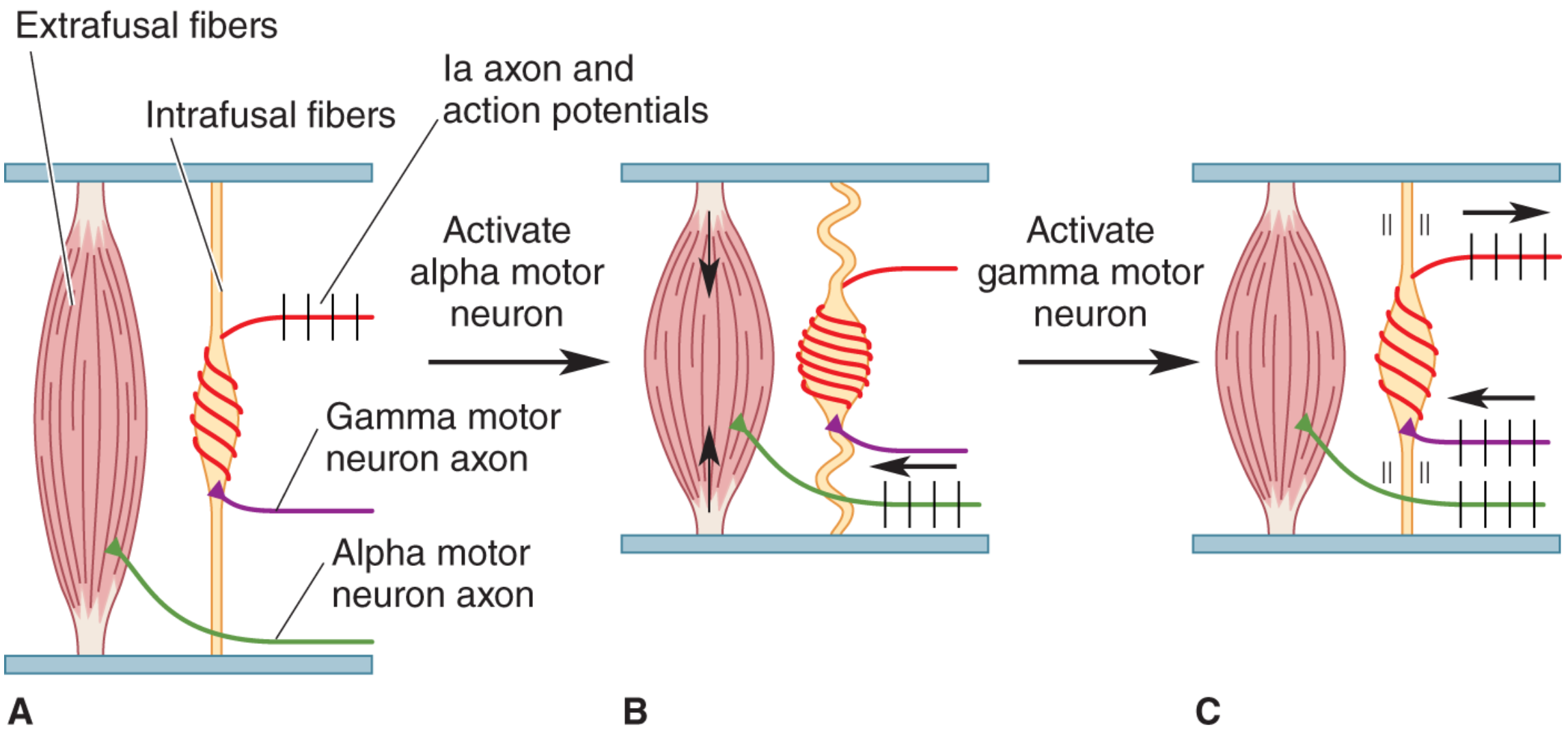
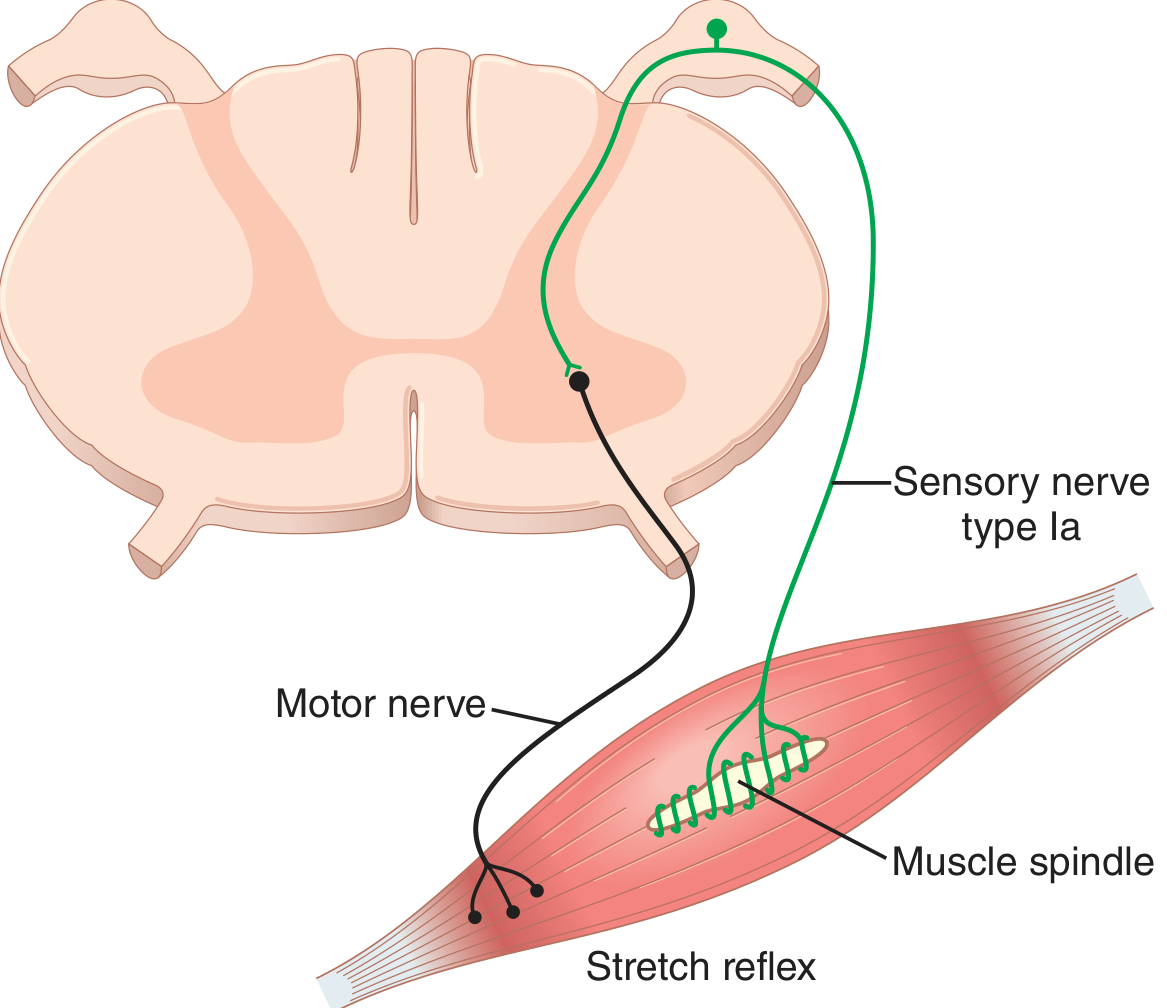
How the Gamma Loop Works (Circuit Summary)
Supraspinal input (motor cortex / brainstem)
         ↓              ↓
  α motor neuron    γ motor neuron
         ↓              ↓
  Extrafusal     Intrafusal fibers
  fiber contraction  (poles contract)
                       ↓
              Ia afferent activation
              (equatorial region stretched)
                       ↓
              Monosynaptic synapse on α motor neuron
                       ↓
              Extrafusal fiber contraction maintained/amplified
Alpha (α) Motoneurons - Functional Characteristics
| Property | Detail |
|---|---|
| Cell body location | Anterior horn of spinal cord (large multipolar neurons) |
| Target | Extrafusal skeletal muscle fibers |
| Axon diameter | ~14 μm (large myelinated, A-alpha / Aα) |
| Conduction velocity | 70-120 m/s |
| Function | Produce all voluntary and reflex muscle force; the "final common pathway" of motor output |
| Subtypes | Alpha-fast (FF, FR), Alpha-slow (S) - matching fast-twitch/slow-twitch fiber types |
| Motor unit | Each α motoneuron innervates a group of extrafusal fibers = one motor unit |
| Effect of activation | Muscle contraction (force generation) |
| Effect of Ia stretch input | Monosynaptically excited - the basis of the stretch reflex |
| Inhibition | Ia inhibitory interneurons inhibit antagonist α motoneurons (reciprocal innervation); Renshaw cells provide recurrent collateral inhibition |
Gamma (γ) Motoneurons - Functional Characteristics
| Property | Detail |
|---|---|
| Cell body location | Anterior horn of spinal cord (smaller neurons, intermingled with α cells) |
| Target | Intrafusal muscle fibers (polar/contractile ends of muscle spindle) |
| Axon diameter | ~5 μm (smaller myelinated, A-gamma / Aγ) |
| Proportion | ~31% of all motor nerve fibers to a muscle (Guyton & Hall) |
| Function | Regulate sensitivity of the muscle spindle by adjusting tension on intrafusal fibers |
| Subtypes | γ-dynamic (γd): excites nuclear bag fibers → enhances dynamic (velocity) response of spindle; γ-static (γs): excites nuclear chain fibers → enhances static (length) response of spindle |
| Effect of activation alone | Intrafusal fiber contraction → stretches equatorial region → increases Ia afferent discharge rate |
| Cannot generate significant force | Intrafusal fibers contribute negligibly to total muscle tension |
| Key functional role | Alpha-gamma coactivation: when the CNS sends a motor command, γ motoneurons fire simultaneously with α motoneurons. This keeps intrafusal fibers taut as the muscle shortens, preventing spindle unloading and maintaining continuous sensory feedback |
Alpha-Gamma Coactivation: The Core Principle
- Spindle sensitivity is maintained at all muscle lengths
- Continuous length information is relayed to the CNS during movement
- Stretch reflex damping operates throughout the range of motion
- Motor cortex (via corticospinal projections)
- Bulboreticular facilitatory area of the brainstem (especially for antigravity muscles)
- Cerebellum and basal ganglia (modulating spindle sensitivity for task-specific demands)