
Teach me ecg like a beginner
Reading File
Now let me search the library for ECG fundamentals content and images in parallel.
Finding Sources
Finding Sources
Searching Images
ECG waveform PQRST complex labeled diagram beginner
Finding Sources
Reading File
Loading Image
Loading Image
Finding Sources
Finding Sources
Searching Images
12 lead ECG placement chest limb leads diagram
Reading File
Reading File
Loading Image
Reading File
Reading File
Searching Images
normal sinus rhythm ECG strip heart rate calculation
Loading Image
Loading Image
Finding Sources
Reading File
I now have everything needed for a comprehensive beginner's ECG guide. Let me compose it.
ECG for Beginners — A Complete Guide
1. What Is an ECG?
An electrocardiogram (ECG) is a recording of the electrical activity of the heart. When the heart beats, electrical currents spread from the heart outward through surrounding tissues, all the way to the surface of the body. Electrodes placed on the skin detect these tiny potentials and plot them over time — that's your ECG tracing.
Think of it as a "movie" of the heart's electricity, frame by frame.
"If electrodes are placed on the skin on opposite sides of the heart, electrical potentials generated by the current can be recorded; the recording is known as an electrocardiogram." — Guyton and Hall Textbook of Medical Physiology
2. The Heart's Electrical System — Why the ECG Looks the Way It Does
Before reading any ECG, you need to understand why the electrical signal travels the way it does. This is the key.
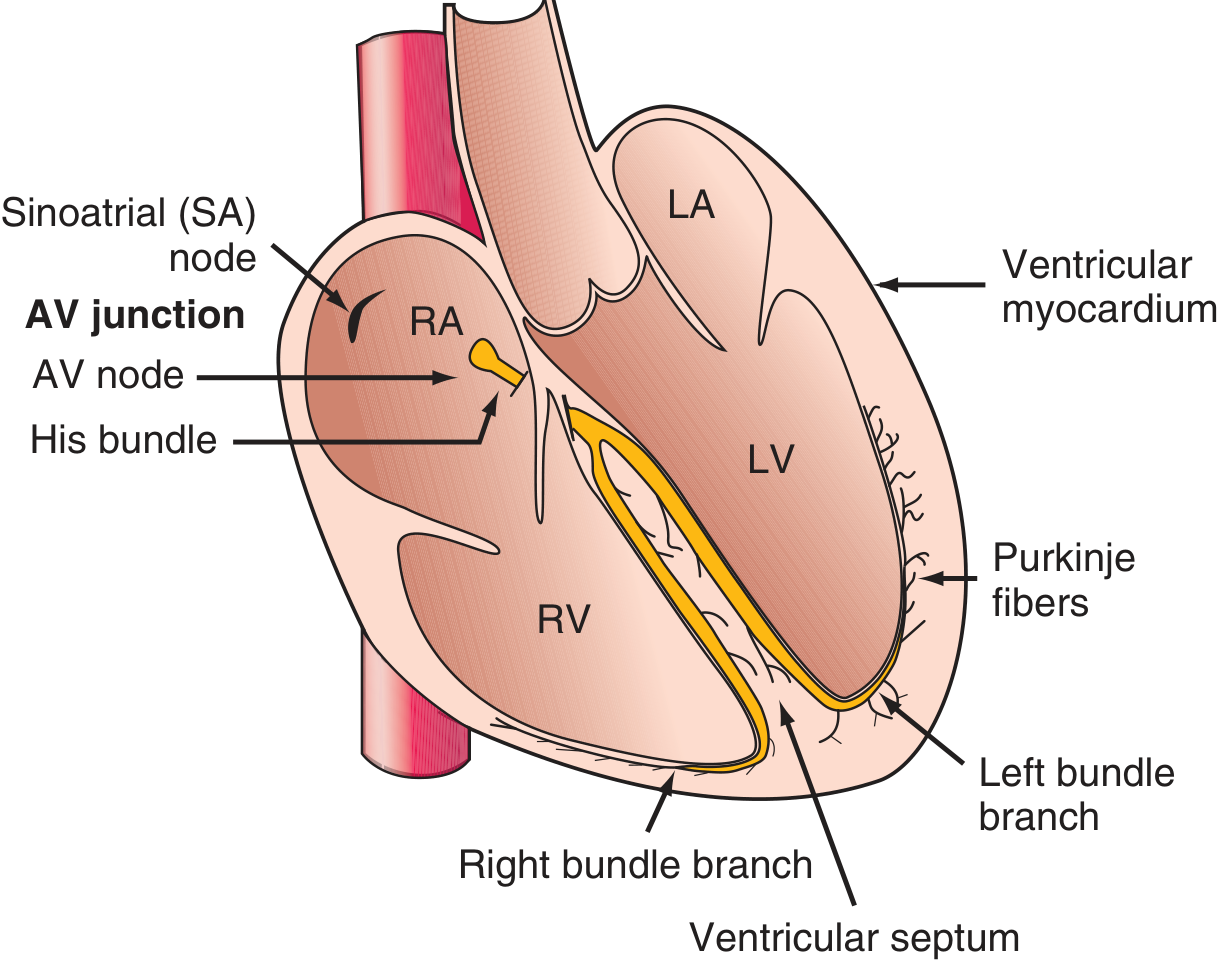
The electrical impulse follows a fixed, one-way highway:
| Step | Structure | What Happens |
|---|---|---|
| 1 | SA node (sinoatrial node) | The natural pacemaker — fires spontaneously, located where the superior vena cava meets the right atrium |
| 2 | Atria | The impulse spreads across both atria → atria contract |
| 3 | AV node (atrioventricular node) | The impulse pauses here briefly — this delay lets the atria finish pumping before the ventricles fire |
| 4 | Bundle of His → Left & Right bundle branches | The impulse races down the septum |
| 5 | Purkinje fibers | Rapid spread to ALL ventricular muscle → ventricles contract |
This pathway is what produces the characteristic waves on the ECG.
— Harrison's Principles of Internal Medicine, 22nd Ed.; Gray's Anatomy for Students
3. The ECG Waveform — Reading the Waves
This is the core of ECG interpretation. Every heartbeat produces this pattern:
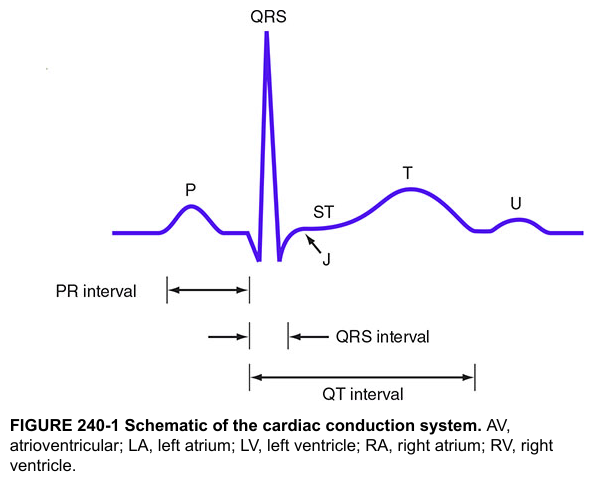
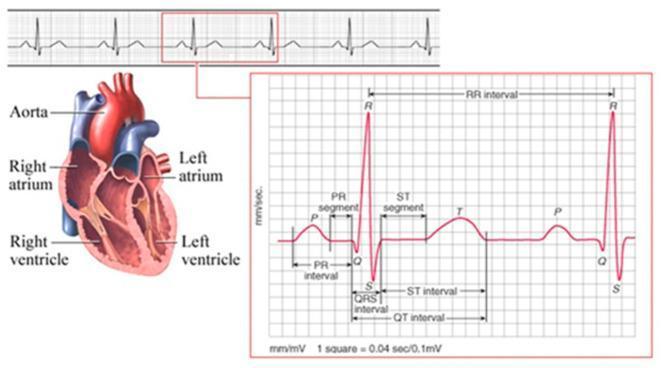
The Waves, Explained Simply
| Wave / Segment | What It Represents | Normal Appearance |
|---|---|---|
| P wave | Atrial depolarization (atria contracting) | Small, rounded bump |
| PR interval | Time for impulse to travel from atria → ventricles (through AV node) | 0.12–0.20 sec (3–5 small boxes) |
| QRS complex | Ventricular depolarization (ventricles contracting) | Tall, sharp spike — the biggest deflection |
| ST segment | Ventricles fully depolarized, resting before repolarization | Should be flat (isoelectric) |
| T wave | Ventricular repolarization (ventricles resetting) | Broad, rounded bump |
| QT interval | Total time for ventricular depolarization + repolarization | 0.35–0.45 sec (varies with heart rate) |
| U wave | Late ventricular repolarization (often invisible) | Tiny bump after T wave, if present |
Memory trick:
P = Pumping atria → QRS = Quick ventricular squeeze → T = Time to reset
The QRS complex has 3 components:
- Q wave = first downward deflection
- R wave = the big upward spike
- S wave = downward deflection after R
"The P wave is caused by electrical potentials generated when the atria depolarize... The QRS complex is caused by potentials generated when the ventricles depolarize... The T wave is caused by potentials generated as the ventricles recover from depolarization." — Guyton and Hall Textbook of Medical Physiology
4. The ECG Paper — Reading the Grid
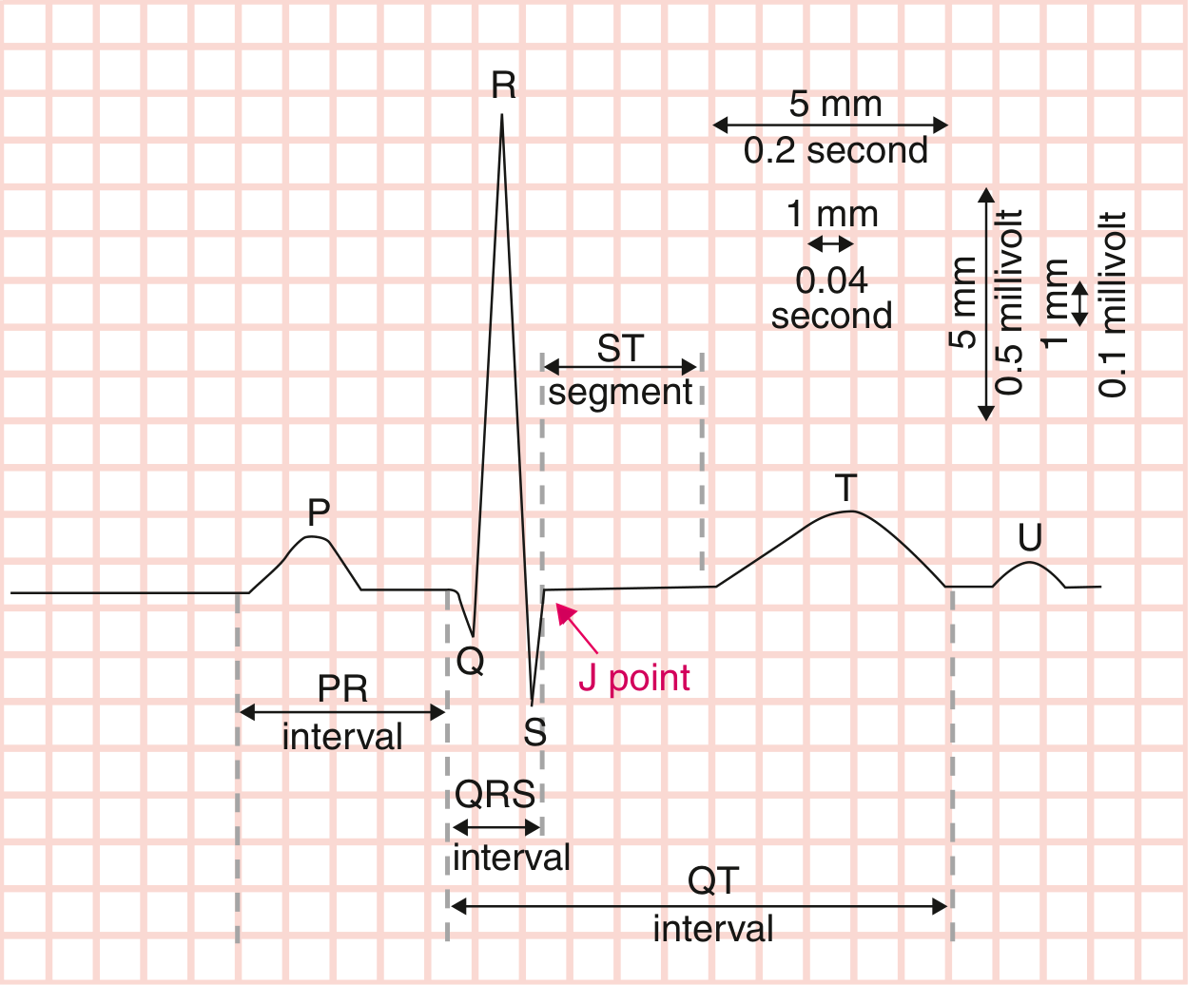
ECG paper has a grid that lets you measure time and voltage precisely:
Horizontal axis = TIME
  Small box (1 mm)  = 0.04 seconds (40 ms)
  Big box (5 mm)    = 0.20 seconds (200 ms)

Vertical axis = VOLTAGE (amplitude)
  1 mm (1 small box) = 0.1 mV
  10 mm (2 big boxes) = 1 mV (standard calibration)
Calculating Heart Rate:
Count the number of large boxes between two consecutive R waves (the RR interval), then:
Heart rate = 300 ÷ number of large boxes
| Large boxes between R waves | Heart rate |
|---|---|
| 1 box | 300 bpm |
| 2 boxes | 150 bpm |
| 3 boxes | 100 bpm |
| 4 boxes | 75 bpm ← normal |
| 5 boxes | 60 bpm ← normal |
| 6 boxes | 50 bpm |
"The RR interval, which is the measurement from R wave to R wave, allows calculation of the heart rate." — Goldman-Cecil Medicine
5. The 12 Leads — What Are They?
A standard ECG uses 10 electrodes to produce 12 different "views" of the heart's electrical activity — just like photographing the same object from 12 different angles.
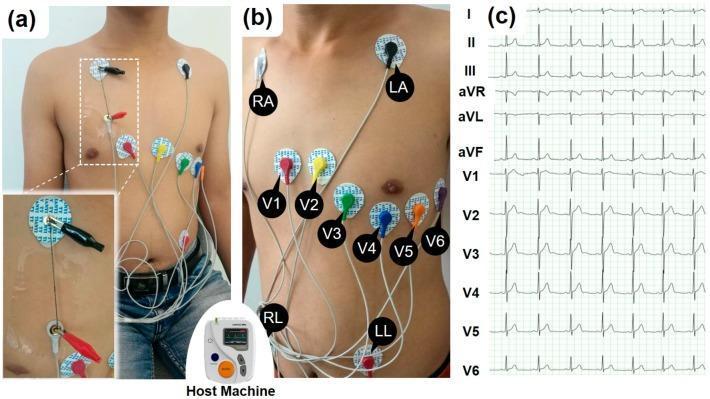
The 12 Leads — Three Groups:
Group 1 — Limb leads (4 electrodes on arms and legs):
| Lead | View of the Heart |
|---|---|
| I | Left side (lateral) |
| II | Inferior (bottom) — most commonly used for rhythm strips |
| III | Inferior |
| aVR | Right side (often inverted — "right ventricle from above") |
| aVL | Left (high lateral) |
| aVF | Inferior (foot) |
Group 2 — Precordial (chest) leads (6 electrodes across the chest):
| Lead | Position | View |
|---|---|---|
| V1 | 4th intercostal space, right sternal border | Septal |
| V2 | 4th intercostal space, left sternal border | Septal |
| V3 | Between V2 and V4 | Anterior |
| V4 | 5th intercostal space, midclavicular line | Anterior |
| V5 | Anterior axillary line | Lateral |
| V6 | Mid-axillary line | Lateral |
"Lead V5 is most commonly chosen for monitoring patients at risk for myocardial ischemia, since it has been shown to be the most sensitive single lead for detecting ischemia." — Miller's Anesthesia
6. What Does a Normal ECG Look Like?
Here is what a normal sinus rhythm looks like on a Lead II rhythm strip:

Checklist for Normal Sinus Rhythm:
- ✅ P wave before every QRS
- ✅ QRS after every P wave
- ✅ Regular RR intervals (evenly spaced)
- ✅ Heart rate 60–100 bpm
- ✅ PR interval 0.12–0.20 sec
- ✅ QRS duration < 0.12 sec (narrow)
- ✅ ST segment flat (not elevated or depressed)
- ✅ T waves upright (in most leads)
7. A Systematic Approach — How to Read Any ECG
Always use the same order — never skip steps:
1. Rate — Count the RR intervals → 300 ÷ large boxes
2. Rhythm — Regular or irregular? Is there a P before every QRS?
3. Axis — Is the electrical axis normal? (advanced — skip for now)
4. Intervals — PR, QRS, QT within normal range?
5. Morphology — Look at each wave: P wave shape, QRS shape, ST segment, T wave
8. Key Normal Values — Quick Reference
| Parameter | Normal Range |
|---|---|
| Heart rate | 60–100 bpm |
| PR interval | 0.12–0.20 sec (3–5 small boxes) |
| QRS duration | < 0.12 sec (< 3 small boxes) |
| QT interval | < 0.44 sec (corrected, QTc) |
| P wave duration | < 0.12 sec |
| P wave amplitude | < 2.5 mm |
9. The Big Picture — What Each Wave Tells You Clinically
| If you see this... | Think about... |
|---|---|
| No P waves | Atrial fibrillation |
| Prolonged PR | Heart block (AV node conduction delay) |
| Wide QRS (> 0.12s) | Bundle branch block or ventricular beat |
| ST elevation | Acute MI (STEMI) — emergency! |
| ST depression | Ischemia or strain |
| Tall, peaked T waves | Hyperkalemia |
| Long QT | Drug toxicity, electrolyte problems, arrhythmia risk |
Summary
- The heart fires from SA node → AV node → His bundle → bundle branches → Purkinje fibers
- Each beat produces P–QRS–T on the ECG
- P = atria depolarize | QRS = ventricles depolarize | T = ventricles repolarize
- The ECG paper measures time (horizontal) and voltage (vertical)
- Heart rate = 300 ÷ large boxes between R waves
- A 12-lead ECG gives 12 angles of view using 10 electrodes
- Normal sinus rhythm = P before every QRS, rate 60–100, regular rhythm
Sources: Guyton and Hall Textbook of Medical Physiology; Harrison's Principles of Internal Medicine 22nd Ed.; Goldman-Cecil Medicine; Gray's Anatomy for Students; Miller's Anesthesia 10th Ed.
.
Is there something you'd like me to clarify, continue, or help you with?
Are you done is that all about ECG I AM WAITING
Not even close! That was just the foundation. Let me continue with the next levels.
Searching Images
atrial fibrillation ECG rhythm strip irregular no P waves
Searching Images
heart block first degree second degree third degree ECG
Finding Sources
Finding Sources
Searching Images
STEMI ST elevation myocardial infarction ECG 12 lead localization
Searching Images
left bundle branch block right bundle branch block ECG wide QRS
Finding Sources
Finding Sources
Loading Image
Loading Image
Loading Image
Loading Image
You've run out of free credits. Sign up for a free account to continue using Orris.
This is a shared conversation. Sign in to Orris to start your own chat.