
Pneumonia
Reading File
The query is broad - "Pneumonia" could mean many things. Let me clarify before diving in.
Asking for Preferences
What aspect of pneumonia are you looking for? · What level of detail do you need?
Searching sources...
Finding Sources
Searching PubMed
"pneumonia" AND "classification"
Reading File
Reading File
Finding Sources
Reading File
Reading File
I have enough content. Let me also fetch that chest X-ray image from the textbook.
Loading Image
Here is a concise overview of pneumonia - its definition, types, and pathophysiology.
Pneumonia - Overview, Types & Pathophysiology
Definition
Pneumonia is an infection of the lung parenchyma that leads to consolidation of normally air-filled alveoli. It occurs across all age groups and can be caused by bacteria, viruses, mycobacteria, mycoplasma, and fungi. - Textbook of Family Medicine 9e, p. 321
Classification by Acquisition Setting
This is the most clinically practical way to categorize pneumonia:
| Type | Setting | Common Pathogens |
|---|---|---|
| Community-Acquired (CAP) | Home / outpatient | S. pneumoniae, Mycoplasma, Chlamydia, Legionella, influenza |
| Hospital-Acquired (HAP) | >48h after admission | Gram-negatives (Pseudomonas, Serratia), S. aureus (MRSA) |
| Ventilator-Associated (VAP) | On mechanical ventilation | Same as HAP, often MDR organisms |
| Aspiration pneumonia | Altered consciousness, dysphagia | Oral anaerobes (Peptostreptococcus, Bacteroides) |
| Immunocompromised host | HIV, transplant, chemotherapy | Pneumocystis jirovecii (PCP), Cryptococcus, Aspergillus, atypical mycobacteria |
- Textbook of Family Medicine 9e, p. 321-322
Classification by Morphology / Radiology
| Pattern | Description | Typical Cause |
|---|---|---|
| Lobar pneumonia | Entire lobe consolidated; lower lobe predominance | S. pneumoniae (classic) |
| Bronchopneumonia | Patchy consolidation around bronchioles; multifocal | S. aureus, gram-negatives; seen in elderly/children |
| Interstitial pneumonia | Diffuse interstitial pattern; "atypical" | Mycoplasma, viruses, Chlamydia |
Pathophysiology
1. Entry of Pathogens
The lung is usually sterile below the carina. Pathogens gain access via:
- Microaspiration of oropharyngeal secretions (most common route)
- Inhalation of aerosolized droplets
- Hematogenous spread (bacteremia)
2. Alveolar Inflammatory Response (Classic Lobar Pneumonia - 4 Stages)
| Stage | Timing | What Happens |
|---|---|---|
| Congestion | Day 1-2 | Vascular engorgement; serous fluid floods alveoli; bacteria multiply rapidly in nutrient-rich edema |
| Red hepatization | Day 2-4 | RBCs + neutrophils fill alveoli; lung feels liver-like; consolidation on X-ray |
| Grey hepatization | Day 4-8 | RBCs lyse; fibrin + macrophages dominate; continued consolidation |
| Resolution | Day 8+ | Enzymatic digestion of exudate; macrophage clearance; lung returns to normal |
Specifically for pneumococcal pneumonia: after aspiration, bacteria multiply in alveolar edema fluid. RBCs leak from congested capillaries, neutrophils follow, then alveolar macrophages. Resolution is triggered by the development of specific anti-capsular antibodies, which facilitate phagocytosis and killing. - Medical Microbiology 9e, p. 304
3. Impaired Gas Exchange
Alveolar consolidation creates a ventilation-perfusion (V/Q) mismatch - blood still perfuses non-ventilating, fluid-filled alveoli, causing hypoxemia.
Typical vs. Atypical Pneumonia - Clinical Pattern Comparison
| Feature | Typical | Atypical |
|---|---|---|
| Onset | Abrupt | Gradual, insidious |
| Fever | High (39-41°C), rigor | Low-grade |
| Cough | Productive, purulent/blood-tinged | Dry, non-productive |
| Exam | Consolidation signs (dullness, egophony, decreased breath sounds) | Near-normal exam |
| WBC | Elevated (>15,000), neutrophilia | Mildly elevated or normal |
| X-ray | Lobar consolidation | Diffuse interstitial infiltrates |
| Cause | S. pneumoniae, H. influenzae, Klebsiella | Mycoplasma, Chlamydophila, viruses, Legionella |
- Textbook of Family Medicine 9e, p. 321
Chest X-Ray: Lobar Pneumonia (Left Lower Lobe - S. pneumoniae)
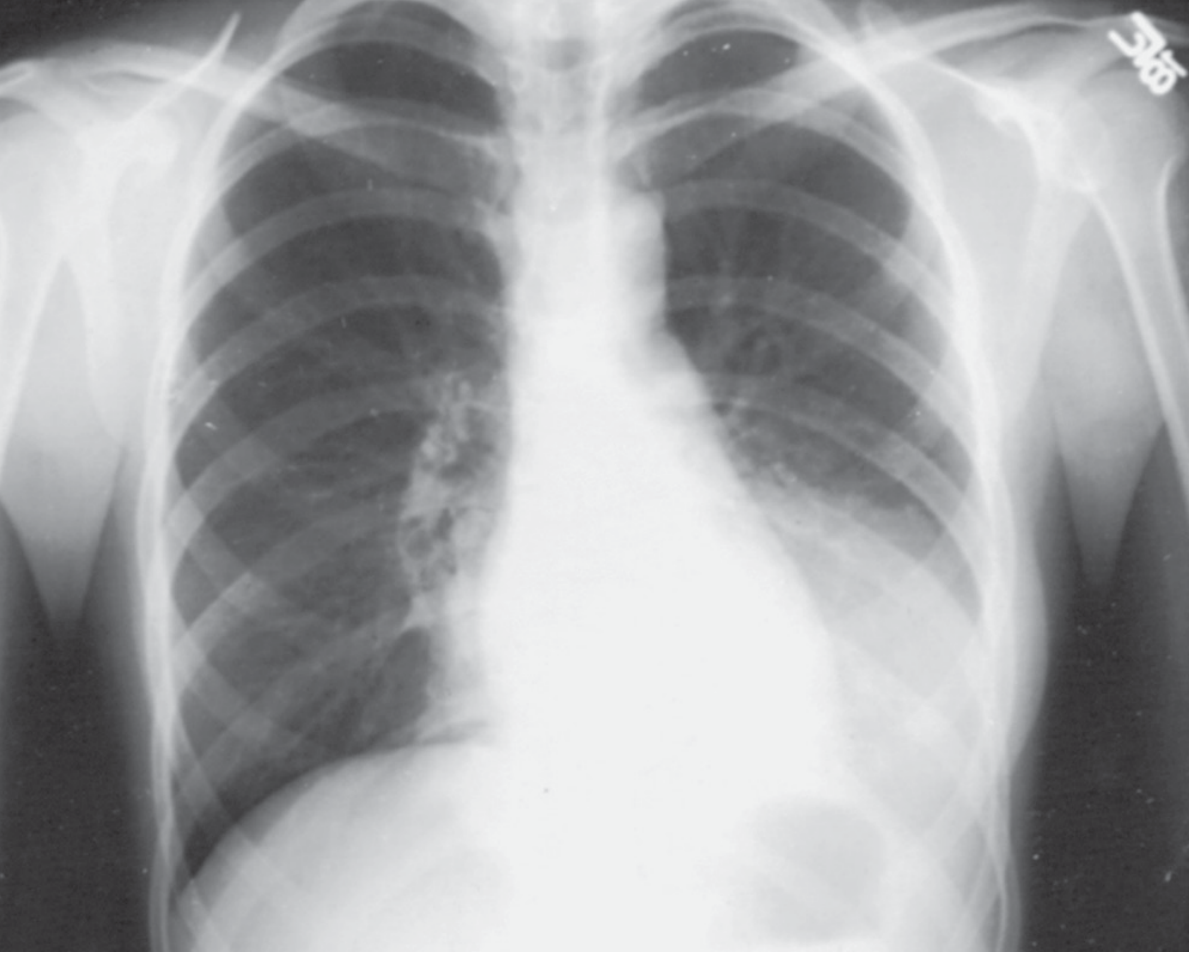
Dense left lower lobe consolidation in pneumococcal pneumonia. Note the homogeneous white-out of the lower left lung field with a visible left pleural effusion. - Medical Microbiology 9e, Fig. 19.8
Key Risk Factors
- Age extremes (infants, elderly)
- Chronic lung disease (COPD, bronchiectasis)
- Immunosuppression (HIV, steroids, chemotherapy)
- Diabetes, renal/hepatic failure
- Alcoholism (predisposes to Klebsiella and anaerobic aspiration)
- Splenic dysfunction/splenectomy (impaired clearance of encapsulated organisms)
Epidemiology
- Over 1 million hospitalizations per year in the US; in-hospital mortality ~3.3%
- Pneumonia/influenza combined represent a major economic burden (~$35 billion/year in the US)
- Children: earliest clue is often tachypnea disproportionate to fever
Sources: Textbook of Family Medicine 9e | Medical Microbiology 9e | Murray & Nadel's Respiratory Medicine | Rosen's Emergency Medicine
This is a shared conversation. Sign in to Orris to start your own chat.