
Lipolysis equation
Lipolysis is the breakdown of triglycerides (stored fats) into glycerol and free fatty acids. The overall equation is:
Triglyceride + 3 H₂O → Glycerol + 3 Fatty Acids
Or more precisely:
C₅₅H₁₀₄O₆ + 3 H₂O → C₃H₈O₃ + 3 C₁₇H₃₅COOH
(a generic tripalmitin example)
Searching sources...
Reading File
Finding Sources
Finding Sources
Finding Sources
Reading File
Reading File
Reading File
Finding Sources
Loading Image
Here is a complete breakdown of the lipolysis equation and its biochemistry, drawn from Harper's Illustrated Biochemistry and Mulholland & Greenfield's Surgery:
Lipolysis - The Overall Equation
Triglyceride (Triacylglycerol) + 3 H₂O → Glycerol + 3 Free Fatty Acids (FFA)
This is a sequential hydrolysis - it does NOT happen in a single step. Three separate lipase reactions cleave one fatty acid at a time:
Step-by-Step Reactions
| Step | Enzyme | Reaction | Products |
|---|---|---|---|
| 1 | Hormone-sensitive lipase (HSL) - rate-limiting | Triacylglycerol (TG) → Diacylglycerol (DG) + FFA | DG + FFA |
| 2 | Diacylglycerol lipase | Diacylglycerol (DG) → Monoacylglycerol (MG) + FFA | MG + FFA |
| 3 | 2-Monoacylglycerol lipase (2-MAGL) | Monoacylglycerol (MG) → Glycerol + FFA | Glycerol + FFA |
Net result: 1 TG → 1 Glycerol + 3 FFA
What Happens to the Products?
- Glycerol - enters glycolysis as dihydroxyacetone phosphate (DHAP); also used as a substrate for gluconeogenesis in the liver
- Free Fatty Acids (FFA) - transported in blood bound to albumin; taken up by heart, skeletal muscle, and liver; undergo beta-oxidation in the mitochondria to generate acetyl-CoA → ATP
Hormonal Control of Lipolysis
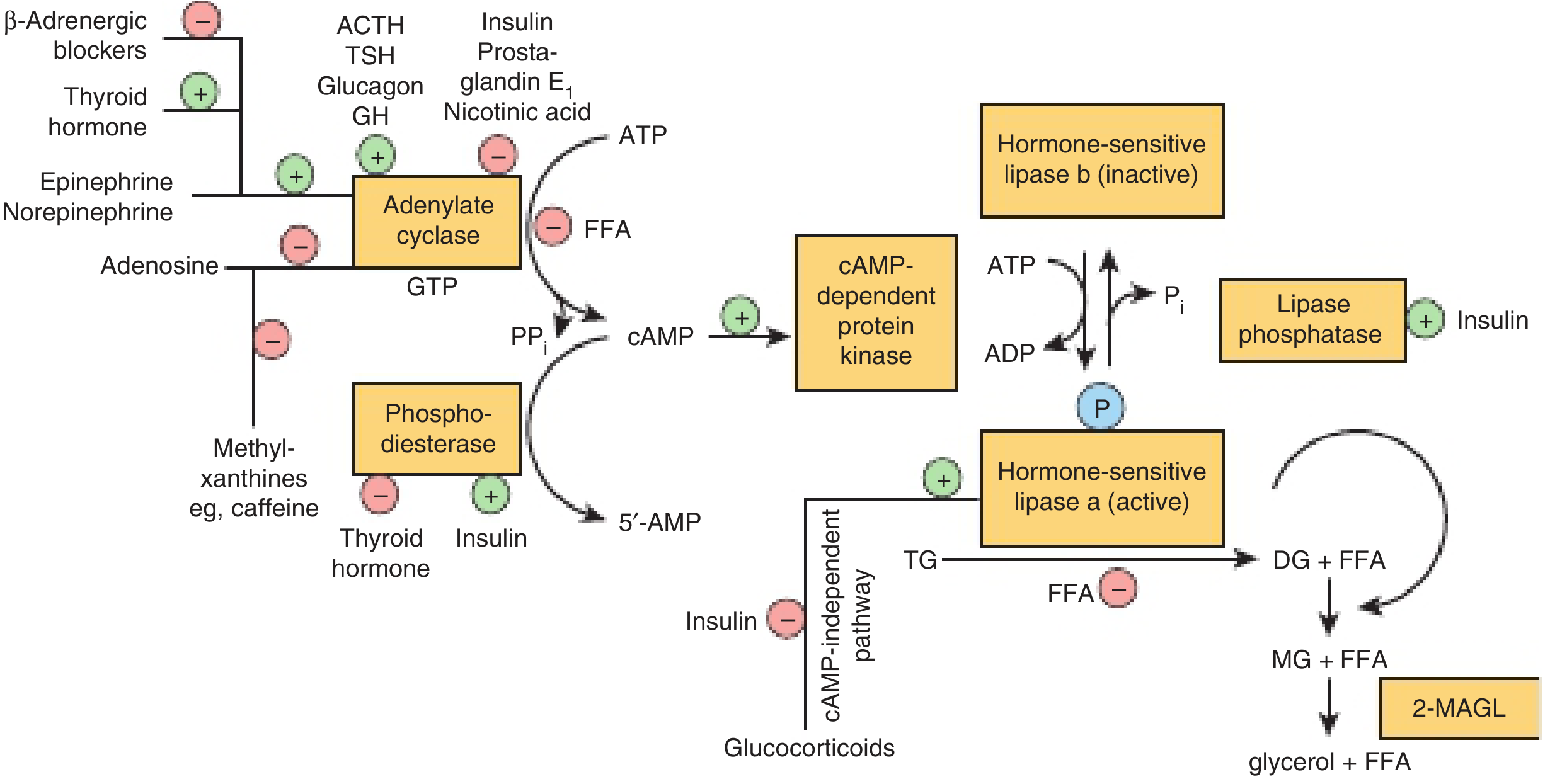
The diagram below (from Harper's Illustrated Biochemistry) shows the full regulatory cascade:
Lipolysis is stimulated by:
- Catecholamines (epinephrine, norepinephrine) - via β-adrenergic receptors → adenylate cyclase → ↑ cAMP → cAMP-dependent protein kinase → phosphorylates and activates HSL
- Glucagon, ACTH, TSH, GH - similar cAMP-mediated pathway
- Glucocorticoids - via cAMP-independent pathway (new lipase protein synthesis)
Lipolysis is inhibited by:
- Insulin - inhibits adenylate cyclase, activates phosphodiesterase (degrades cAMP), activates lipase phosphatase (inactivates HSL)
- Nicotinic acid, Prostaglandin E₁ - inhibit adenylate cyclase via Gᵢ protein
- Adenosine - inhibits adenylate cyclase
- High concentrations of FFA (negative feedback)
Key Points
- HSL is the rate-limiting enzyme of lipolysis (not the first enzyme in fat synthesis)
- Adipose tissue is extremely sensitive to insulin - even small rises in insulin powerfully suppress lipolysis
- Excess lipolysis (as in starvation or uncontrolled diabetes) floods the liver with acetyl-CoA, leading to ketone body production
- Methylxanthines (caffeine, theophylline) enhance lipolysis by blocking phosphodiesterase (preventing cAMP degradation)
Sources: - Harper's Illustrated Biochemistry, 32nd Ed., p. 268 | Mulholland & Greenfield's Surgery, 7e, p. 83
Exampl
Could you clarify what you mean by "Exampl"? It looks like your message may have been cut off.
Asking for Preferences
What would you like an example of?
Lipolysis example
Here is a concrete worked example of lipolysis using a real triglyceride molecule.
Worked Example: Lipolysis of Tripalmitin
Tripalmitin (glyceryl tripalmitate) is a common saturated triglyceride made of glycerol + 3 palmitic acid (C16:0) chains.
Molecular Formula
- Tripalmitin: C₅₁H₉₈O₆
- Palmitic acid: C₁₅H₃₁COOH (CH₃-(CH₂)₁₄-COOH)
The Reaction
C₅₁H₉₈O₆ + 3 H₂O → C₃H₈O₃ + 3 C₁₆H₃₂O₂
Tripalmitin + Water → Glycerol + 3 Palmitic acid
Step-by-Step Hydrolysis
Step 1 (HSL - rate-limiting):
Tripalmitin → Dipalmitin + Palmitic acid (1 FFA released)

Step 2 (Diacylglycerol lipase):
Dipalmitin → Monopalmitin + Palmitic acid (2nd FFA released)

Step 3 (2-Monoacylglycerol lipase):
Monopalmitin → Glycerol + Palmitic acid (3rd FFA released)
What Happens Next - Energy Accounting
Each palmitic acid (C16) undergoes beta-oxidation:
| Product | Quantity | ATP yield |
|---|---|---|
| Acetyl-CoA | 8 per palmitate | 8 × 10 = 80 ATP |
| NADH | 7 per palmitate | 7 × 2.5 = 17.5 ATP |
| FADH₂ | 7 per palmitate | 7 × 1.5 = 10.5 ATP |
| Activation cost | -1 per palmitate | -2 ATP |
| Net per palmitate | ~106 ATP |
3 palmitates × 106 = ~318 ATP from fatty acids alone, plus a small yield from glycerol entering glycolysis.
Clinical Example: Diabetic Ketoacidosis (DKA)
A type 1 diabetic with no insulin experiences uncontrolled lipolysis:
- No insulin → HSL is not inhibited → massive TG breakdown in adipose
- Flood of FFA enters the liver
- Liver overwhelmed → excess acetyl-CoA cannot enter TCA cycle
- Acetyl-CoA diverted → ketone bodies (acetoacetate, β-hydroxybutyrate, acetone)
- Result: metabolic acidosis, fruity breath, Kussmaul breathing
This is exactly why insulin is the treatment - it re-inhibits HSL and stops the lipolytic cascade.
Another Example: Fasting/Exercise
During a 12-hour fast or aerobic exercise:
- Blood glucose drops → insulin falls, glucagon rises
- Glucagon → ↑ cAMP → activates HSL in adipocytes
- FFAs released → skeletal muscle and heart switch to fat as primary fuel
- Glycerol released → liver uses it for gluconeogenesis to maintain blood glucose
This is the normal, controlled version of lipolysis - the body's way of mobilizing stored energy.
This is a shared conversation. Sign in to Orris to start your own chat.