
Pathogenesis of gynecomastia 2nd mbbs pathology robbins
Reading File
Finding Sources
Finding Sources
Reading File
Reading File
Searching Content
"Fig. 23.10" in /textbooks/9780443264528
Searching Images
gynecomastia histology male breast ductal epithelial hyperplasia
query_images_db
Gynecomastia — Pathogenesis (Robbins, Cotran & Kumar, Pathologic Basis of Disease)
Definition: Gynecomastia is enlargement of the male breast — the only benign lesion of any real frequency seen in the male breast. It presents as a button-like, firm subareolar enlargement, unilateral or bilateral.
Core Mechanism
Robbins states plainly: gynecomastia results from an imbalance between estrogens (which stimulate breast tissue) and androgens (which normally counteract that stimulation). Whenever the estrogen:androgen ratio rises — whether from absolute estrogen excess or relative androgen deficiency — ductal epithelium proliferates and stroma expands.
Settings in which this hormonal imbalance occurs
- Puberty — transient physiologic gynecomastia from a temporary surge in estrogen relative to androgen during pubertal hormonal maturation.
- Old age (senescence) — as testicular androgen (testosterone) production declines with age, there is a relative increase in circulating estrogen, tipping the ratio toward estrogenic stimulation even without a true rise in estrogen.
- Any adult state of hyperestrinism, the most important cause being cirrhosis of the liver — the liver is the organ responsible for metabolizing/clearing estrogen, so hepatic failure leads to reduced estrogen breakdown and systemic estrogen excess.
- Drugs — alcohol, marijuana, heroin, antiretroviral therapy, and anabolic steroids have all been linked to gynecomastia (via various endocrine/hepatic effects on the estrogen-androgen balance).
- Rare causes — Klinefelter syndrome (47,XXY karyotype, due to primary testicular failure with low androgen and relatively elevated estrogen/gonadotropins), and functioning testicular neoplasms such as Leydig cell tumors or Sertoli cell tumors, which secrete estrogen directly.
Morphology (the structural correlate of this pathogenesis)
- Microscopically there is an increase in dense collagenous connective tissue (stromal fibrosis) together with epithelial hyperplasia of the duct lining.
- Lobule formation is almost never seen — this distinguishes gynecomastia from normal female breast development, because true lobular differentiation requires the combined progesterone/prolactin milieu of the female breast, which is absent in men; the male breast only shows ductal and stromal response to the altered estrogen/androgen ratio.
(Source: Robbins, Cotran & Kumar Pathologic Basis of Disease, "Gynecomastia" section, Ch. 23 – Breast)
Quick clinical correlation (useful for exam answers)
Standard classification of the underlying imbalance (as also detailed in surgical texts like Schwartz's Principles of Surgery) groups causes into:
- Estrogen excess states (cirrhosis, testicular/adrenal tumors, obesity/aromatization)
- Androgen deficiency states (Klinefelter syndrome, hypogonadism, aging)
- Drug-induced (spironolactone, cimetidine, ketoconazole, digoxin, anabolic steroids, alcohol)
- Idiopathic
This is consistent with, and an elaboration of, the Robbins mechanism of estrogen/androgen imbalance.
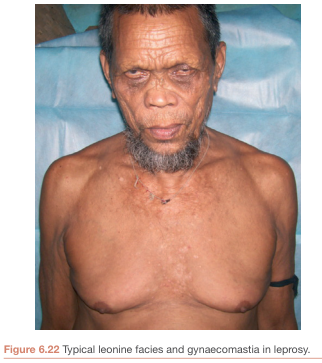
Below is a clinical photograph showing marked gynecomastia (here in the context of leprosy-associated endocrine changes), illustrating the typical bilateral subareolar breast enlargement described above:
Recent-evidence check: I ran a supplementary search for recent systematic reviews/meta-analyses on gynecomastia pathogenesis and found no results contradicting or materially updating this classic pathophysiology — the estrogen/androgen imbalance model remains the accepted mechanism in current literature.
In flow chart form
Pathogenesis of Gynecomastia — Flow Chart (Robbins)
                        ↑ ESTROGEN : ANDROGEN RATIO
                      (relative or absolute estrogen excess)
                                    │
        ┌───────────────┬──────────┼──────────┬──────────────────┐
        │               │          │          │                  │
        ▼               ▼          ▼          ▼                  ▼
   PUBERTY          SENESCENCE  CIRRHOSIS   DRUGS            RARE CAUSES
   (transient        (old age)  OF LIVER   Alcohol,          • Klinefelter
   ↑estrogen                    │          marijuana,          syndrome
   relative to                  │          heroin,             (47,XXY)
   androgen during              │          antiretroviral      → ↓androgen,
   hormonal                     │          therapy,            ↑relative
   maturation)                  │          anabolic             estrogen
                                 │          steroids           • Testicular
                                 │                               tumors
                                 │                               (Leydig cell /
                                 │                               Sertoli cell)
                                 │                               → direct
                                 │                                 estrogen
                                 │                                 secretion
                                 ▼
                    ↓ Testicular androgen
                    production with age
                    → RELATIVE ↑ estrogen
                                 │
                                 ▼
                    ↓ Hepatic metabolism
                    of estrogen
                    → ABSOLUTE ↑ estrogen
                                 │
        └───────────────┴──────────┴──────────┴──────────────────┘
                                    │
                                    ▼
                  ESTROGEN STIMULATES BREAST TISSUE
              (androgen normally counteracts this effect —
                     balance is now disrupted)
                                    │
                                    ▼
                 ┌──────────────────────────────────┐
                 │      MORPHOLOGIC RESPONSE          │
                 │  • ↑ Dense collagenous connective   │
                 │    tissue (stromal fibrosis)        │
                 │  • Epithelial (ductal) hyperplasia  │
                 │  • Lobule formation almost NEVER    │
                 │    seen (no progesterone/prolactin  │
                 │    milieu as in female breast)      │
                 └──────────────────────────────────┘
                                    │
                                    ▼
                CLINICAL: Button-like, firm, subareolar
                    breast enlargement (uni- or bilateral)
                        = GYNECOMASTIA
Key takeaway line for exams: Gynecomastia = disturbed estrogen (stimulatory) : androgen (inhibitory) ratio → ductal epithelial hyperplasia + stromal fibrosis, without lobule formation.
(Source: Robbins, Cotran & Kumar Pathologic Basis of Disease, Ch. 23 – Breast, "Gynecomastia")
This is a shared conversation. Sign in to Orris to start your own chat.