
Pulse pressure definition & clinical significance
Pulse pressure is the difference between systolic and diastolic blood pressure (e.g., 120/80 mmHg gives a pulse pressure of 40 mmHg). Normal range is roughly 40-60 mmHg. A wide pulse pressure (>60 mmHg) suggests increased stroke volume or decreased arterial compliance, seen in aortic regurgitation, atherosclerosis, or hyperthyroidism. A narrow pulse pressure (<25 mmHg) suggests low stroke volume or increased peripheral resistance, as in cardiac tamponade, severe heart failure, or hypovolemic shock.
Searching sources...
Reading File
Finding Sources
Finding Sources
Searching PubMed
"pulse pressure" AND cardiovascular risk
Now let me read the key sections from several authoritative textbooks in parallel:
Reading File
Reading File
Reading File
I now have excellent content from multiple authoritative sources. Let me also fetch the Guyton figure that shows abnormal pulse contours:
Loading Image
Reading File
I now have rich material from multiple authoritative sources. Here is the complete answer:
Pulse Pressure: Definition & Clinical Significance
Definition
Pulse pressure (PP) = Systolic BP - Diastolic BP
Example: BP 120/80 mmHg → PP = 40 mmHg (normal range: ~40-60 mmHg)
It is also incorporated into mean arterial pressure:
MAP = Diastolic pressure + (Pulse pressure / 3)
- Roberts and Hedges' Clinical Procedures in Emergency Medicine, p. 43
- Morgan & Mikhail's Clinical Anesthesiology, 7e
Physiological Determinants
According to Guyton and Hall, pulse pressure is governed by two principal factors:
Pulse pressure ≈ Stroke volume / Arterial compliance
- Stroke volume - the greater the SV, the more blood enters the arterial tree per beat, the larger the swing between systolic and diastolic pressure.
- Arterial compliance (distensibility) - stiffer arteries produce a higher pressure rise for the same volume of blood ejected.
Any condition altering either factor will change pulse pressure. - Guyton and Hall Textbook of Medical Physiology
Abnormal Pulse Pressure
Wide Pulse Pressure (PP ≥ 60 mmHg)
Occurs when stroke volume is high or arterial compliance is low:
| Condition | Mechanism |
|---|---|
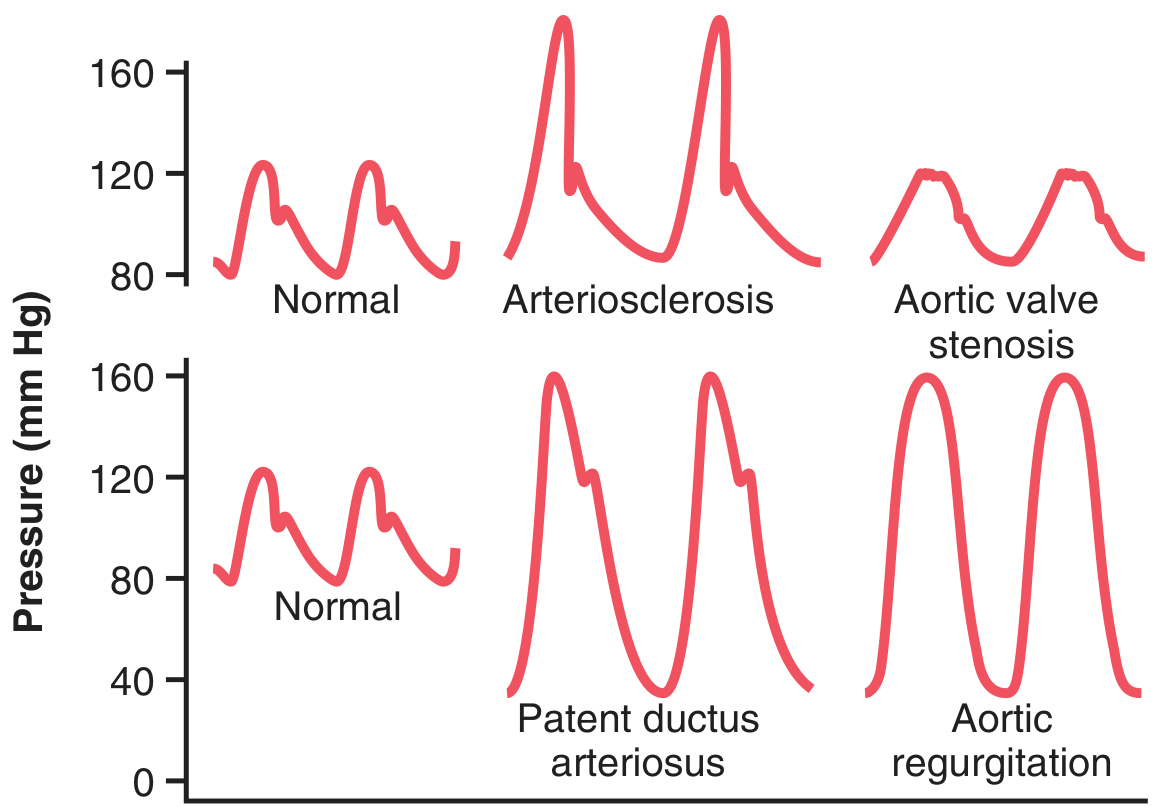
| Aortic regurgitation | Blood regurgitates back into LV during diastole → DBP falls to near zero, massive SV increase |
| Patent ductus arteriosus | Blood shunts back into pulmonary circulation → DBP falls markedly |
| Arteriosclerosis / aging | Stiff arteries → same SV produces exaggerated pressure swing |
| Anemia | High cardiac output, vasodilation |
| Hyperthyroidism | Hyperdynamic state, increased SV |
| AV fistula | Runoff during diastole lowers DBP |
| Increased intracranial pressure (Cushing reflex) | Reflex hypertension with wide PP |
| Exercise | Increased SV, vasodilation in skeletal muscle |
Narrow Pulse Pressure (PP ≤ 20-25 mmHg)
Occurs when stroke volume is low or systemic vascular resistance is very high:
| Condition | Mechanism |
|---|---|
| Cardiac tamponade | External compression limits cardiac filling → SV drops sharply |
| Aortic stenosis | Restricted outflow → reduced SV; pulsus parvus et tardus |
| Severe heart failure | Reduced SV, compensatory vasoconstriction |
| Hypovolemic shock | Reduced preload → reduced SV |
| Early septic shock | Increased peripheral vascular resistance (before vasodilation predominates) |
| Cold/vasoconstrictive septic shock | Decreased peripheral pulses, narrow PP |
- Roberts and Hedges' Clinical Procedures in Emergency Medicine
- The Harriet Lane Handbook, 23rd ed.
- Miller's Anesthesia, 10e
The aortic pressure pulse contours for key conditions:
Pulse Pressure as an Early Hemodynamic Warning Sign
An important bedside application: reduction in pulse pressure is an early indicator of reduced central blood volume even when traditional vital signs (SBP, SpO2) remain stable. Traditional parameters often fail to predict mortality or signal the need for life-saving intervention until cardiovascular collapse has already occurred. - Roberts and Hedges' Clinical Procedures in Emergency Medicine
Pulse-Pressure Variation (PPV) - ICU Application
In mechanically ventilated patients, the variation in pulse pressure across the respiratory cycle is used to assess fluid responsiveness:
PPV = (PPmax - PPmin) / PPmean × 100
-
PPV > 13% is highly predictive of fluid responsiveness in mechanically ventilated patients (i.e., the patient is preload-dependent and will respond to a fluid bolus).
-
Basis: mechanical ventilation cyclically alters RV preload; the resulting stroke volume variation manifests as PP variation.
-
Roberts and Hedges' Clinical Procedures in Emergency Medicine
-
Tintinalli's Emergency Medicine
Pulse Pressure as a Cardiovascular Risk Marker
From the Framingham Heart Study (adults 50-79 years): risk for coronary heart disease increased with lower DBP at any SBP ≥120 mmHg, making pulse pressure an important risk component in older adults. Wide pulse pressure in this age group largely reflects arterial stiffness - a marker of vascular aging.
From the REGARDS study: pulse pressure was independently associated with incident coronary heart disease even after adjustment for SBP.
Key age-related trend: SBP rises continuously with age; DBP plateaus around age 50 then falls - so PP naturally widens with aging, reflecting reduced arterial compliance.
Risk factors for wide PP: older age, female sex, diabetes, hypertension. - Fuster and Hurst's The Heart, 15th ed.; Goldman-Cecil Medicine
Recent Evidence (2024-2025)
- A 2025 meta-analysis in JACC (PMID 39745404) analyzing 4 heart failure trials found that higher pulse pressure was associated with worse outcomes in heart failure patients, reinforcing its role as a prognostic marker beyond simple SBP.
- A 2024 meta-analysis in Hypertension Research (PMID 39039284) identified outcome-driven thresholds for pulse pressure amplification (the normal increase of PP from central aorta to peripheral arteries), relevant to cardiovascular risk stratification.
Summary Table
| Parameter | Normal | Wide (≥60 mmHg) | Narrow (≤20-25 mmHg) |
|---|---|---|---|
| Value | 40-60 mmHg | >60 mmHg | <25 mmHg |
| SV/Compliance | Balanced | High SV or low compliance | Low SV or high SVR |
| Key causes | - | AR, PDA, arteriosclerosis, anemia, hyperthyroidism | Tamponade, AS, HF, hypovolemia |
| Risk implication | - | Arterial stiffness, CV risk in elderly | Impending shock, low output state |
This is a shared conversation. Sign in to Orris to start your own chat.