
How to treat hypoxic brain injury
I'll start by reading the medical library skill, then search for information on hypoxic brain injury treatment in parallel.
Reading File
Now I'll run parallel searches across the textbook library and PubMed simultaneously.
Finding Sources
Finding Sources
Searching PubMed
"hypoxic-ischemic brain injury" AND treatment
Excellent results. Now I'll read the key textbook sections in parallel - Harrison's (most current, 2025), Rosen's EM, and Plum & Posner's (the authoritative coma text).
Reading File
Reading File
Reading File
Good content from Harrison's and Plum & Posner. Now I'll read the treatment section from Harrison's more fully, and also read the Plum & Posner continuation for complications/management details.
Reading File
Reading File
Excellent - I now have comprehensive, detailed content from both Harrison's and Plum & Posner. Let me also fetch the MRI image shown in Harrison's for visual context, and read the final part of Harrison's treatment section.
Reading File
Loading Image
I now have a comprehensive picture. Let me compile the full, well-structured answer.
Treatment of Hypoxic-Ischemic Brain Injury (HIBI)
Hypoxic-ischemic brain injury results from failure of oxygen delivery to the brain - either from hypotension/circulatory arrest (hypoxia-ischemia) or from respiratory failure/asphyxia alone. Causes include cardiac arrest, shock, asphyxiation, carbon monoxide poisoning, and cyanide poisoning. Consciousness is lost within seconds of circulatory arrest; if circulation is not restored within 3-5 minutes, permanent neurological damage often results.
The DWI MRI below shows diffuse cortical injury following cardiac arrest - bright signal throughout the cortex, caudate, globus pallidus, and thalamus bilaterally, which is the hallmark imaging finding:
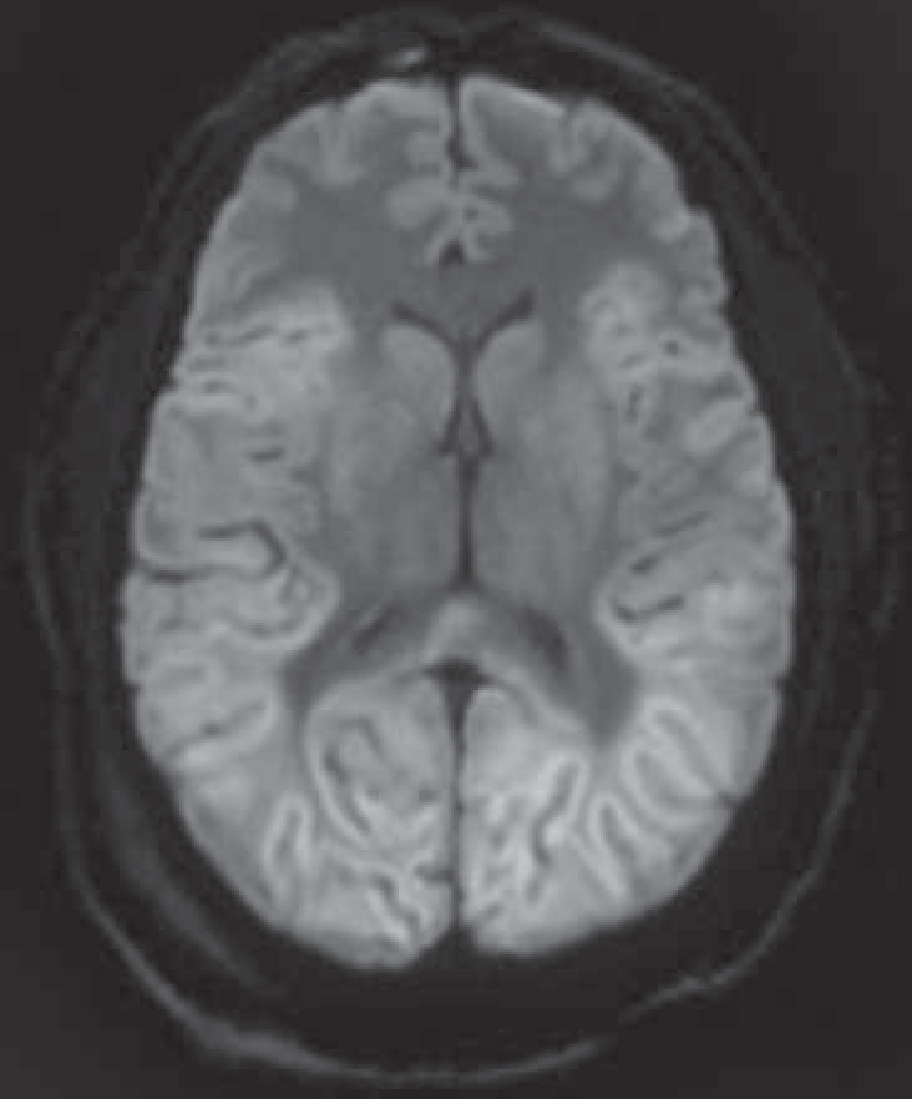
1. Immediate Resuscitation (Restore Cardiorespiratory Function)
The first priority is eliminating the ongoing cause of hypoxia:
-
Airway: Secure the airway immediately; intubate if necessary
-
Oxygenation/ventilation: Ensure adequate oxygenation. Target SpO2 94-98% - avoid hyperoxia, as elevated cumulative oxygen tension is associated with worse functional outcomes
-
Restore cerebral perfusion: CPR, IV fluids, vasopressors (norepinephrine is commonly used), or cardiac pacing as needed
-
Target MAP >60 mmHg (systolic >90 mmHg). Higher perfusion targets may benefit patients with elevated ICP or intracranial stenosis, but benefit is not firmly established by trials
-
12-lead ECG immediately after ROSC; emergent cardiac catheterization if ST-elevation MI is identified
-
Head CT (noncontrast) to exclude hemorrhagic stroke or subarachnoid hemorrhage presenting as cardiac arrest
-
Harrison's Principles of Internal Medicine 22E (2025), p. 2390
-
Plum and Posner's Diagnosis and Treatment of Stupor and Coma, p. 612
2. Targeted Temperature Management (TTM) - Neuroprotection
This is the primary neuroprotective strategy after return of spontaneous circulation (ROSC) in comatose survivors.
Current guideline recommendation: Maintain a constant temperature between 32-37.5°C in patients who have no meaningful response to verbal commands after ROSC. Fever must be actively avoided in all cases.
Evidence summary:
- Early trials showed mild hypothermia (33°C for 12-24 h) improved functional outcome after out-of-hospital cardiac arrest with shockable rhythms
- Subsequent larger trials (TTM trial) showed 33°C vs. 36°C yielded similar outcomes - suggesting the benefit may derive primarily from fever prevention rather than the degree of cooling
- A more recent trial found early fever treatment (target <37.8°C) resulted in similar outcomes to hypothermia to 33°C
- Current practice: target either 33°C or 36°C per institutional protocol, with strict fever avoidance
Methods to achieve temperature control:
- Surface cooling: cold baths, ice packs, adhesive pads, helmets
- IV infusion of chilled fluids
- Endovascular temperature control devices (balloons with circulating cold fluid)
- Modern devices use real-time temperature feedback loops
Shivering management (critical to maintaining target temperature):
- Counter-warming of hands/feet
- Acetaminophen 650 mg q4h PO
- Buspirone 30 mg q8h PO
- Sedation: propofol infusions (preferred) or benzodiazepines
- Analgesia: fentanyl or other opiate infusions
- Dexmedetomidine: potent anti-shivering agent
- Magnesium sulfate (target serum Mg 3-4 mEq/L)
- Meperidine 25 mg IV q6h (use cautiously - lowers seizure threshold)
- Neuromuscular blockade (vecuronium) as a last resort
Contraindications: Absolute - refractory bleeding at a non-compressible site, severe recurrent symptomatic bradycardia. Relative - severe baseline neurologic impairment, multiorgan failure, sepsis/meningitis, trauma, pregnancy.
- Plum and Posner's Diagnosis and Treatment of Stupor and Coma, pp. 613-615
3. Seizure Management
-
Seizures occur in 10-30% of comatose post-arrest patients, most with status epilepticus (SE)
-
Most common during rewarming; may be convulsive or nonconvulsive
-
Continuous EEG monitoring is essential - nonconvulsive seizures will be missed clinically
-
Treatment: levetiracetam, valproic acid, and benzodiazepines (e.g., clonazepam) are preferred in cardiac arrest patients
-
Myoclonic status epilepticus within 24 h post-arrest is a poor prognostic sign, even when controlled
-
Do not give prophylactic anticonvulsants routinely
-
Complete suppression of all rhythmic/periodic EEG activity for 48 h (in a clinical trial) did not improve outcomes vs. standard care - this strategy is not recommended
-
Post-hypoxic myoclonus: clonazepam 1.5-10 mg/day PO or valproate 300-1200 mg/day in divided doses
-
Harrison's Principles of Internal Medicine 22E (2025), p. 2391
-
Plum and Posner's Diagnosis and Treatment of Stupor and Coma, p. 614
4. Intracranial Pressure (ICP) Management
-
Cerebral edema/swelling occurs in up to one-third of patients after cardiac arrest
-
Managed using standard ICP protocols (head of bed elevation, osmotic therapy, etc.)
-
Important caveat: brain swelling after cardiac arrest is a poor prognostic sign - it indicates extensive cortical neuronal loss, so decompressive craniectomy is generally not indicated
-
Monitor carefully during rewarming for possible herniation
-
Plum and Posner's Diagnosis and Treatment of Stupor and Coma, p. 615
5. Systemic/Medical Management
| Parameter | Target / Action |
|---|---|
| Glucose | Normoglycemia: 140-180 mg/dL (insulin infusion) |
| Electrolytes | Monitor and replace K, Mg, phosphate (cold diuresis shifts these) |
| IV fluids | Avoid hypotonic fluids |
| Ventilation | Low tidal volume (6 mL/kg IBW) for ARDS (lung-protective) |
| Infection | Screen aggressively for pneumonia, UTI; prophylactic antibiotics NOT recommended |
| DVT prophylaxis | Pneumatic compression + subcutaneous heparin or enoxaparin |
- Plum and Posner's Diagnosis and Treatment of Stupor and Coma, p. 615
6. Special Cases
Carbon monoxide / cyanide poisoning:
- Carbon monoxide intoxication: hyperbaric oxygen is the treatment of choice for severe cases
- Both CO and cyanide can cause delayed encephalopathy - a parkinsonian syndrome (akinesia + rigidity without tremor) can develop weeks later, with progressive basal ganglia damage on CT/MRI
Neonatal hypoxic-ischemic encephalopathy (HIE):
- Therapeutic hypothermia (whole-body or selective head cooling) is the established standard of care
- Multiple large RCTs support its use; xenon and argon as adjuncts are being investigated in preclinical and early clinical studies (PMID 39453983)
7. Prognostication
Prognostication guides goals-of-care decisions and should use a multimodal approach:
| Finding | Implication |
|---|---|
| Intact pupillary, corneal, oculocephalic reflexes | Better prognosis |
| Absent pupillary reflex + absent/extensor motor response at 5-7 days | Poor prognosis (excluding sedation/hypothermia confounders) |
| Bilateral absence of SSEP N20 (after several days) | Poor prognosis |
| Burst-suppression or nonreactive EEG | Poor prognosis |
| NSE >60 µg/L in first 1-3 days | Worse outcome |
| CT/MRI: diffuse cortical DWI restriction | Extensive injury |
Critical caveat: Hypothermia and sedation delay the reliable timing of clinical prognosticators. The false-positive rate for incorrect poor-prognosis prediction can be as high as 21% in hypothermia-treated patients at 3 days. Allow sufficient observation time (some patients awaken after a week or longer).
- Harrison's Principles of Internal Medicine 22E (2025), pp. 2389-2391
Summary Algorithm
HIBI suspected/confirmed
       |
       v
Restore airway + oxygenation (SpO2 94-98%) + circulation
       |
       v
ROSC achieved?
       |
       Yes
       v
12-lead ECG → STEMI → emergent cath
Head CT → exclude hemorrhage/SAH
       |
       v
Comatose (no response to verbal commands)?
       |
       Yes → TTM: target 32-37.5°C (commonly 33°C or 36°C)
              → Treat/prevent fever STRICTLY
              → Continuous EEG monitoring
              → Seizure management (levetiracetam, VPA, clonazepam)
              → Normoglycemia, electrolyte management
              → Lung-protective ventilation
              |
              v
       Multi-modal prognostication (earliest reliable: 5-7 days post-arrest,
       longer if hypothermia used)
Sources: Harrison's Principles of Internal Medicine 22E (2025), pp. 2389-2391 | Plum and Posner's Diagnosis and Treatment of Stupor and Coma, pp. 612-616
This is a shared conversation. Sign in to Orris to start your own chat.