
Pellagra
I'll read the medical library skill first, then research Pellagra comprehensively.
Reading File
Now I'll run parallel searches across the medical library for pellagra.
Finding Sources
Finding Sources
Searching PubMed
pellagra niacin deficiency
Excellent results. Now I'll read the key sections from multiple textbooks in parallel for comprehensive coverage.
Reading File
Reading File
Reading File
Reading File
Reading File
Now let me get the rest of Andrews' clinical features + treatment section and fetch the clinical image.
Reading File
Reading File
Loading Image
I now have comprehensive information from multiple authoritative textbooks. Let me compile the full answer.
Pellagra
Pellagra is a systemic nutritional deficiency disease caused by inadequate niacin (vitamin B3) or its amino acid precursor tryptophan. Untreated, it is fatal.
Biochemical Basis
Niacin (nicotinic acid/nicotinamide) is required for synthesis of NAD+ and NADP+, coenzymes central to oxidation-reduction reactions throughout the body. Tryptophan can be converted to niacin at a ratio of 60 mg tryptophan → 1 mg niacin, a process that requires pyridoxine (B6) as a cofactor. Deficiency of riboflavin or B6 - even with adequate niacin/tryptophan intake - can thus precipitate pellagra.
- Harper's Illustrated Biochemistry, 32nd Ed.
Etiology & Risk Factors
Pellagra can develop within 60 days of dietary niacin deficiency and arises through several mechanisms:
Dietary/Primary:
- Diets based almost entirely on corn, millet, or sorghum (these cereals contain niacin in bound, non-bioavailable form)
- Alcoholism (most common cause in developed countries)
- Malnutrition / anorexia nervosa
- Restrictive elimination diets (e.g., in atopic dermatitis patients avoiding "food allergens")
Disease-related:
- Carcinoid syndrome - tumor diverts up to 60% of tryptophan to serotonin (5-HT) synthesis, starving the niacin pathway
- Hartnup disease - autosomal recessive defect in neutral amino acid transporter causing intestinal malabsorption and renal wasting of tryptophan
- GI disorders: Crohn disease, celiac disease, gastroenterostomy, prolonged diarrhea
- Prolonged IV supplementation without niacin replacement
Drug-induced:
| Drug | Mechanism |
|---|---|
| Isoniazid (INH) | Inhibits pyridoxal phosphate (blocks tryptophan → niacin conversion) |
| Azathioprine / 6-mercaptopurine | Interferes with niacin biosynthesis |
| 5-Fluorouracil | Interferes with niacin biosynthesis |
| Ethionamide, pyrazinamide, protionamide | Interfere with niacin biosynthesis |
| Hydantoins, phenobarbital, carbamazepine | Rare, dose-dependent |
- Andrews' Diseases of the Skin, Clinical Dermatology
Epidemiology note: Twice as many women as men are affected in outbreaks, attributed to inhibition of tryptophan metabolism by estrogen metabolites.
Classic Triad: "The 3 Ds"
Dermatitis - Diarrhea - Dementia (a 4th D, Death, marks the untreated endpoint)
Clinical Features
1. Dermatitis (most recognizable feature)
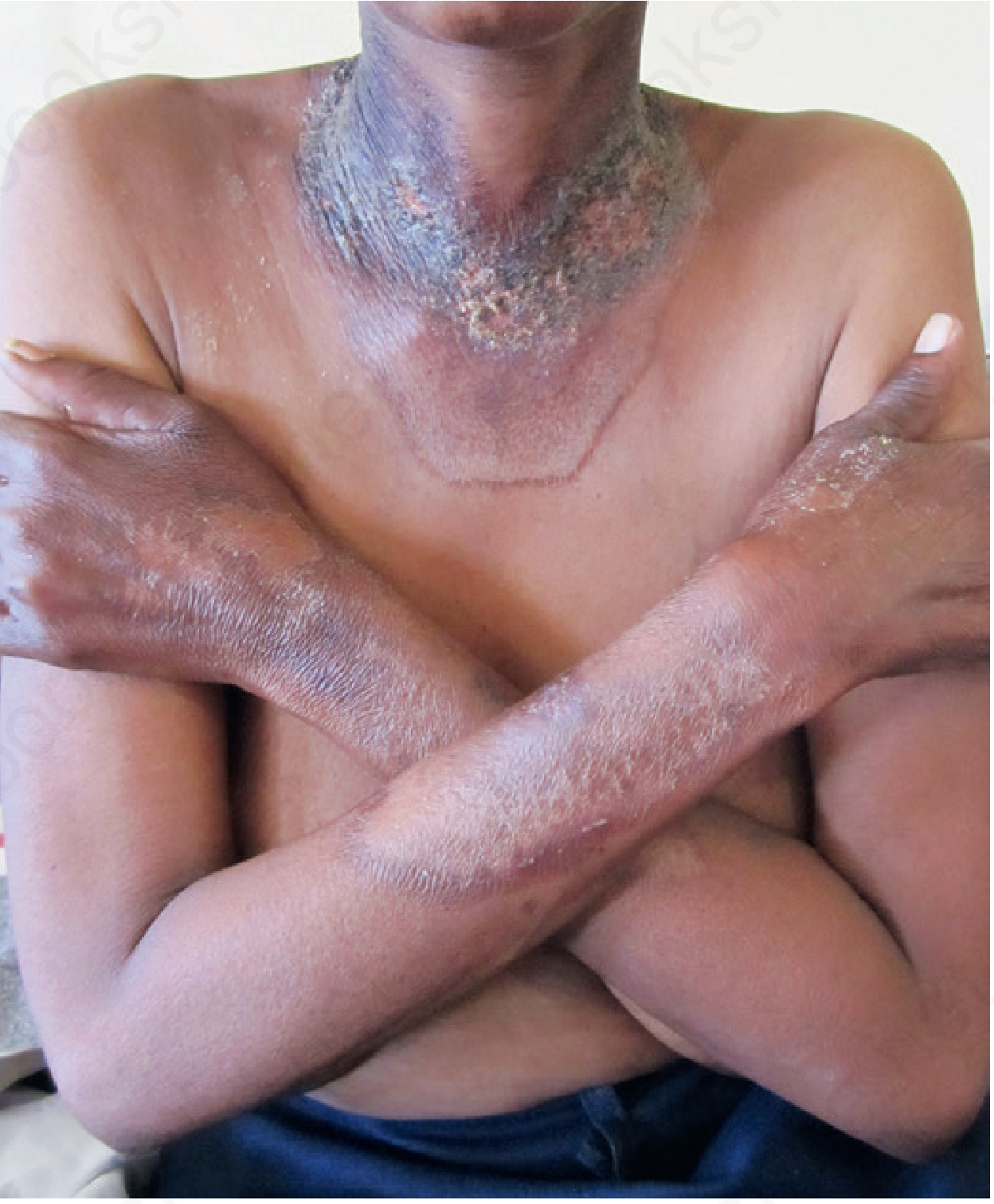
Pellagra showing the classic hyperpigmented, scaly dermatitis over the neck (Casal's necklace) and extensor forearms. - Andrews' Diseases of the Skin / Fitzpatrick's Dermatology
- Distribution: Symmetrical, photosensitive - face, neck, upper chest, extensor arms, dorsum of hands and feet
- Casal's necklace: Characteristic hyperpigmented collar-like eruption around the neck
- Evolution:
- Early: erythema + edema after sun exposure, burning/itching (4× slower recovery than normal sunburn)
- Intermediate: vesicles/bullae ("wet pellagra") in severe cases
- Chronic: thickening, scaling, hyperpigmentation; copper/mahogany hue; ultimately parchment-like, paper-thin skin
- Nose: Dull erythema of the bridge with fine yellow scales ("sulfur flakes") over follicular orifices; resembles seborrheic dermatitis
- Histopathology: Pallor and vacuolar changes of keratinocytes in upper stratum malpighii just below the granular layer; cleft formation correlates with blister formation; depletion of epidermal Langerhans cells
2. Gastrointestinal
- Stomatitis, glossitis (bright red, raw-looking tongue), angular cheilitis
- Nausea, vomiting, abdominal pain
- Diarrhea (may be severe, contributing to fluid/electrolyte loss)
- Anorexia, weight loss
3. Neuropsychiatric (Dementia)
Early/neurasthenic phase:
- Insomnia, fatigue, irritability, depression, anxiety
Intermediate:
- Mental dullness, apathy, impaired memory, mild confusional states
- Muscle weakness, paresthesias, headaches, dizziness
- Delusions of parasitosis (reported)
- Hallucinations, psychosis
Late:
- Frank dementia, seizures, coma
- Progressive neurologic degeneration
Spinal cord: Symmetrical degeneration of posterior columns (especially Goll's fasciculus) and, to a lesser extent, corticospinal tracts - resembles subacute combined degeneration (SCD). Signs referable to both posterior and lateral columns.
Peripheral nerves: Changes similar to nutritional neuropathy/beriberi; may not respond to niacin alone but can respond to thiamine replacement.
Pathology (CNS): Swollen, rounded neurons with eccentric nuclei and loss of Nissl bodies (chromatolysis) predominantly in Betz cells, basal ganglia, cranial motor nuclei, cerebellar dentate nuclei, and anterior horn cells.
- Adams and Victor's Principles of Neurology, 12th Ed.
Important Nuance: Neurologic Manifestations
A critical point from Adams & Victor: only the cutaneous, GI, and neurasthenic manifestations are reliably reversed by niacin replacement. The neurologic deficits (peripheral neuropathy, spinal cord degeneration) are largely recalcitrant to niacin and likely reflect co-existing pyridoxine deficiency. This is especially relevant in isoniazid-induced pellagra where both niacin and pyridoxine must be replaced.
Diagnosis
- Primarily clinical - the triad of photosensitive dermatitis + GI symptoms + neuropsychiatric features in a patient with relevant risk factors
- Therapeutic trial: skin lesions begin resolving within 24 hours of niacin supplementation, which confirms the diagnosis
- Urine N-methylnicotinamide (NMN) levels can be measured but rarely needed
- Rule out drug causes, carcinoid, and Hartnup disease when dietary deficiency is not obvious
Treatment
| Setting | Regimen |
|---|---|
| Standard (oral) | Nicotinamide 100 mg 3× daily for several weeks |
| Alternative oral (Harrison's) | 100-200 mg nicotinic acid or nicotinamide TID for up to 4 weeks |
| Severe/malabsorption (IV) | Niacin 100 mg IV/day for 5-7 days, then switch to oral |
| High-dose (Adams & Victor) | 500 mg/day niacin for ~3 weeks |
| INH-induced | Replace both niacin AND pyridoxine |
- Supportive: correct fluid/electrolyte losses from diarrhea; address underlying cause (alcoholism, offending drug, carcinoid); high-protein diet (animal proteins, eggs, milk, vegetables)
- Harrison's Principles of Internal Medicine 22E (2025)
- Adams and Victor's Principles of Neurology, 12th Ed.
Niacin Toxicity (relevant when treating dyslipidemia at pharmacologic doses)
- Flushing (prostaglandin-mediated, via G protein-coupled receptor): starts in the face, can be reduced by aspirin pre-treatment; tachyphylaxis develops
- Hepatotoxicity: most serious with sustained-release niacin; cases of fulminant hepatic failure at 3-9 g/day
- Other: nausea, glucose intolerance, hyperuricemia, macular edema, rhabdomyolysis (especially combined with statins)
- The safe upper limit for non-therapeutic daily niacin is 35 mg; liver damage occurs above 500 mg/day of either nicotinic acid or nicotinamide
Summary Table
| Feature | Detail |
|---|---|
| Deficiency | Niacin (B3) / tryptophan |
| Key pathways | NAD+/NADP+ synthesis |
| Classic mnemonic | 3 Ds: Dermatitis, Diarrhea, Dementia |
| Hallmark skin sign | Casal's necklace; photosensitive, symmetric eruption |
| Most common cause (developed world) | Alcoholism |
| Most common cause (developing world) | Corn/maize-based diet |
| Key drug causes | Isoniazid, azathioprine, 5-FU |
| Disease causes | Carcinoid, Hartnup disease, Crohn disease |
| Treatment | Nicotinamide 100 mg TID; response within 24 h |
| Fatal if untreated | Yes |
Recent evidence note: A 2026 systematic review (PMID 41876960) reviewing pellagra in contemporary clinical practice (2000-2023) is now available and may contain updated epidemiological data or case series - the core management principles above align with this recent literature.
This is a shared conversation. Sign in to Orris to start your own chat.