


IMG-20260602-WA0028.jpg
IMG-20260602-WA0027.jpg
What is further investigation and management options
I'll read the medical library skill first, then research this case in parallel.
Reading File
Now I'll search the medical library and PubMed in parallel for right colon cancer investigation and management.
Finding Sources
Finding Sources
Searching PubMed
"colon cancer" AND "right hemicolectomy" AND staging
Reading File
Finding Sources
Finding Sources
Reading File
Reading File
Reading File
Finding Sources
Reading File
Loading Image
I now have comprehensive information to provide a detailed answer. Here is the full structured response:
CT Abdomen & Pelvis - Further Investigation & Management
Patient: Rahul Khare, Male, 67 years
Summary of CT Findings
The CT report describes a locally advanced right-sided colorectal malignancy most likely involving the ascending colon/cecum with terminal ileal involvement, characterized by:
- Mass-like irregular wall thickening + polypoidal soft tissue lesion, ~7.7 cm length, ~5 cm combined wall thickness
- Full-thickness involvement (T3/T4 stage - extension beyond serosa into adjacent mesocolon)
- Fat stranding, nodularity, increased vascularity in mesocolon - suggesting loco-regional venous spread
- Subcentimeter heterogeneous enhancing mesenteric lymph nodes along right ileocolic vessels
- Moderate-severe luminal narrowing but no obstruction
- No liver metastases, no ascites, no distant spread seen on CT
FURTHER INVESTIGATIONS
1. Histological Confirmation (Most Urgent)
Colonoscopy + Biopsy - as recommended in the CT opinion
- Confirms malignancy histologically
- Assesses tumor grade (well/moderate/poorly differentiated)
- Determines microsatellite instability (MSI) / mismatch repair (MMR) status - critical for prognosis and predicts benefit from immunotherapy
- Identifies KRAS, NRAS, BRAF mutations - determines eligibility for targeted therapy (anti-EGFR agents like cetuximab only for RAS wild-type)
- Rules out synchronous lesions (~5% of patients have synchronous cancer, ~10-20% have synchronous polyps)
- Consider tattooing to aid intraoperative localization
2. Laboratory Tests
| Test | Purpose |
|---|---|
| Full blood count | Baseline; assess anemia (common in right-sided tumors) |
| Metabolic panel / LFTs | Hepatic reserve, baseline |
| Serum CEA (carcinoembryonic antigen) | Baseline level for postoperative surveillance comparison; >20 ng/mL suggests advanced/metastatic disease |
| Coagulation studies | Pre-operative workup |
| Renal function | Pre-op & chemotherapy dosing |
| Serum albumin / pre-albumin | Nutritional status assessment (affects surgical risk) |
"A preoperative carcinoembryonic antigen (CEA) level should be measured. It is important to obtain a baseline CEA level to compare with postoperative levels on surveillance and to alert to the increased probability of advanced disease." - Current Surgical Therapy 14e
3. Staging Workup (NCCN-Recommended)
- CT Chest - to complete thoracic staging and exclude pulmonary metastases (not included in this report)
- This CT abdomen/pelvis is already done and shows no liver mets or ascites
PET-CT is not routinely recommended for initial staging per NCCN 2021 guidelines. However, it may be used selectively if:
- CT findings are inconclusive
- CEA is markedly elevated (>20 ng/mL)
- There is suspicion of peritoneal disease not well-characterised on CT
4. Molecular/Genetic Testing (on biopsy specimen)
| Test | Significance |
|---|---|
| MSI/dMMR status | If high MSI (MSI-H): may benefit from immunotherapy (pembrolizumab); low risk of distant metastases in stage II |
| KRAS/NRAS mutation | If mutated: anti-EGFR therapy (cetuximab, panitumumab) NOT effective |
| BRAF V600E mutation | Poor prognosis; specific targeted therapy available |
MANAGEMENT OPTIONS
Stage Assessment
Based on CT findings, this tumor is at minimum cT3-T4b N1 Mx (given serosal extension and mesenteric spread with regional nodal involvement). This is likely Stage III disease, pending histology and chest CT.
Definitive Surgical Management
Right Hemicolectomy is the standard-of-care surgery for cecal/ascending colon cancer:
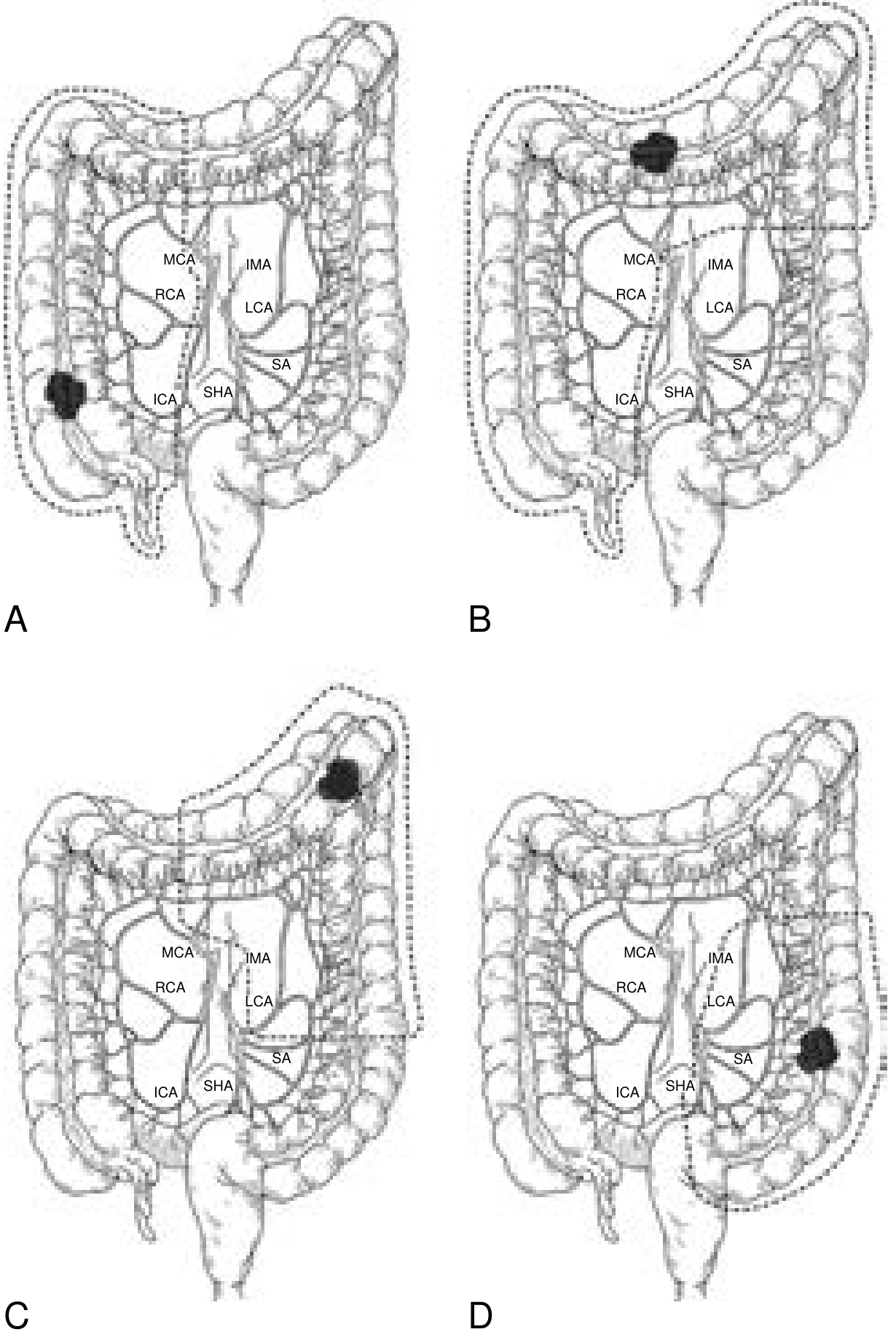
Procedure involves:
- High ligation of the ileocolic and right colic vascular pedicles
- Resection of terminal ileum, cecum, ascending colon, and hepatic flexure
- Construction of ileotransverse anastomosis
- Minimum 12 lymph nodes must be harvested for accurate nodal staging
- 5-7 cm proximal and distal margins
Surgical approach:
- Laparoscopic (minimally invasive) - preferred when expertise available; equivalent oncologic outcomes, shorter hospital stay, faster recovery
- Robotic - alternative minimally invasive approach with better visualization and lower conversion rates
- Open colectomy - preferred for large/locally advanced tumors requiring multivisceral resection (which may apply here given mesocolon extension)
Complete Mesocolic Excision (CME) with central vascular ligation has emerged as the standard per the 2025 EAES rapid guideline [PMID: 40355740], analogous to TME in rectal cancer, to maximise lymph node harvest and oncologic clearance.
Pre-operative Preparation
- Bowel preparation: Mechanical (polyethylene glycol) + oral antibiotics (neomycin + metronidazole)
- Nutritional optimization if malnourished
- Enhanced Recovery After Surgery (ERAS) protocol
- Prophylactic IV antibiotics before skin incision
- DVT prophylaxis (LMWH + sequential compression device)
- Medical optimization of comorbidities (note: mild BPH, fatty liver)
Adjuvant Chemotherapy (Post-surgery)
For Stage III disease (lymph node positive), adjuvant chemotherapy is standard of care:
| Regimen | Details |
|---|---|
| FOLFOX (preferred) | Oxaliplatin + 5-fluorouracil + leucovorin; 6 months (or 3 months for low-risk T1-3 N1) |
| CAPOX | Capecitabine + oxaliplatin; similar efficacy, oral option |
| Capecitabine alone | If patient cannot tolerate oxaliplatin |
"In stage III colon cancer, adjuvant chemotherapy has been the standard of care since 1990, with several large randomized clinical trials showing benefits in both OS and disease-free survival." - Current Surgical Therapy 14e
High-risk Stage III (T4 N1-2 or any T with N2): 6 months of FOLFOX is recommended (3 months shown inferior in this group).
If MSI-H/dMMR: Consider immunotherapy (pembrolizumab), especially if metastatic disease confirmed.
Gallstones (Incidental Finding)
The CT also shows large gallstones (15.5 x 12.5 mm) in the gallbladder neck with no current cholecystitis or CBD dilatation. Consideration for simultaneous cholecystectomy at the time of colectomy is reasonable, discussed with the surgical team.
Post-operative Surveillance (if resected)
- CEA every 3-6 months for 2 years, then every 6 months to 5 years
- CT chest/abdomen/pelvis every 6-12 months for 5 years
- Colonoscopy 1 year after resection; if no polyps, repeat in 3 years
Multidisciplinary Team (MDT) Approach
This case should be discussed at a colorectal cancer MDT including:
- Colorectal/general surgeon
- Medical oncologist
- Radiologist
- Pathologist (once biopsy available)
- Gastroenterologist (for colonoscopy)
Key references:
- Current Surgical Therapy 14e - Surgical Management of Colon Cancer, pp. 294-297
- NCCN Clinical Practice Guidelines - Colon Cancer v2.2021
- EAES Rapid Guideline: CME for right-sided colon cancer (2025) [PMID: 40355740]
This is a shared conversation. Sign in to Orris to start your own chat.