
Kidney anatomy
Reading File
Finding Sources
Searching Images
kidney anatomy cross section diagram
Reading File
Reading File
Loading Image
Reading File
Searching Images
nephron structure glomerulus tubule diagram
Loading Image
Reading File
Here is a comprehensive overview of kidney anatomy, drawn from Brenner and Rector's The Kidney and Medical Physiology.
Kidney Anatomy
Position & Gross Features
The kidneys are paired, bean-shaped, retroperitoneal organs extending from vertebrae T12 to L3. The right kidney sits slightly more caudal than the left (displaced by the liver).
| Parameter | Males | Females |
|---|---|---|
| Weight | 125–170 g | 115–155 g |
| Length (MRI) | ~12.4 cm | ~11.6 cm |
| Volume | ~202 mL | ~154 mL |
| Thickness | 2.5–3.0 cm | 2.5–3.0 cm |
Each kidney is enclosed in a tough fibrous capsule. On the medial (concave) surface lies the hilum — the gateway for:
- Renal artery (in)
- Renal vein (out)
- Ureter (out)
- Lymphatics
- Nerve plexus
The hilum opens into the renal sinus, a fat-filled space containing the renal pelvis, major and minor calyces, and vessels.
Internal Structure
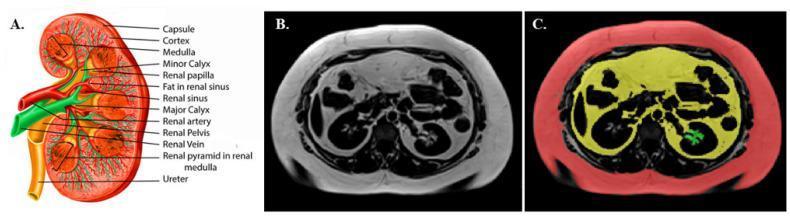
A bisected kidney reveals two layers:
- Cortex — outer granular region (~1 cm thick); contains glomeruli, convoluted tubules, and cortical columns (columns of Bertin)
- Medulla — inner striated region; composed of 8–18 renal pyramids
Each renal pyramid has:
- Its base at the corticomedullary junction
- Its apex (papilla) pointing toward the renal pelvis
- An area cribrosa at the papilla tip — perforations where collecting ducts (ducts of Bellini) empty urine into minor calyces
One pyramid + its surrounding cortex = one renal lobe
Minor calyces → Major calyces → Renal pelvis → Ureter (28–34 cm long) → Bladder
Vascular Supply
The kidneys receive ~20% of cardiac output, despite being <0.5% of body weight.
Arterial pathway:
Renal artery → Anterior + Posterior branches → Segmental (lobar) arteries → Interlobar arteries → Arcuate arteries (at corticomedullary junction) → Interlobular arteries → Afferent arterioles → Glomerular capillaries → Efferent arterioles → Peritubular capillaries / Vasa recta
There is no collateral circulation between segmental arteries — occlusion causes infarction of the supplied segment.
The Nephron — Functional Unit
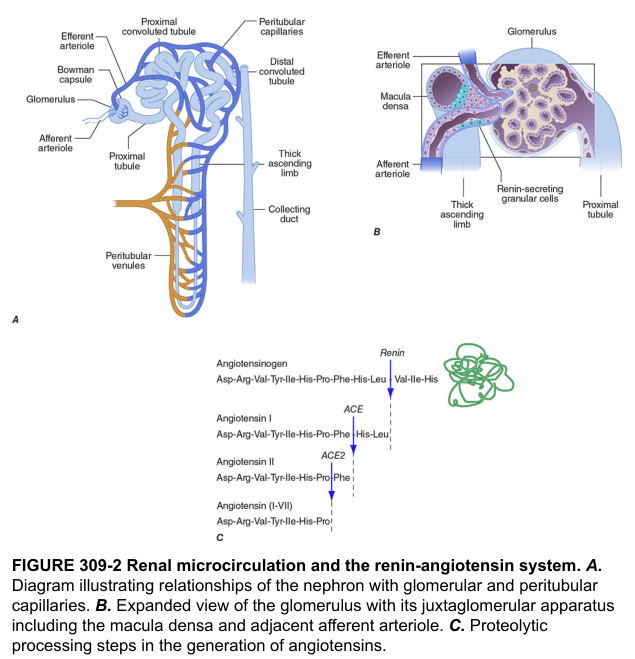
Each kidney contains ~900,000–1 million nephrons (range: 200,000–2.5 million). Each nephron consists of:
- Renal corpuscle = Glomerulus + Bowman's capsule
- Proximal convoluted tubule (PCT)
- Loop of Henle (thin descending, thin ascending, thick ascending limb)
- Distal convoluted tubule (DCT)
- Connecting segment → Collecting duct
Two nephron types:
- Superficial (cortical) nephrons — short loops of Henle; efferent arterioles feed peritubular capillaries
- Juxtamedullary nephrons — long loops extending deep into medulla; efferent arterioles form vasa recta (critical for concentrating urine)
Glomerulus
The glomerulus is a tuft of fenestrated capillaries forming the filtration barrier, composed of three layers:
- Fenestrated capillary endothelium (pores 70–100 nm)
- Glomerular basement membrane (GBM)
- Podocyte foot processes with filtration slit diaphragms
Four cellular components of the glomerulus:
- Endothelial cells
- Mesangial cells (structural support + contraction)
- Parietal epithelial cells (line Bowman's capsule)
- Visceral epithelial cells / Podocytes
Juxtaglomerular Apparatus (JGA)
Located at the vascular pole of the glomerulus, the JGA comprises:
- Macula densa — specialized cells of the thick ascending limb that sense tubular NaCl
- Granular (juxtaglomerular) cells in the afferent arteriole wall — secrete renin
- Extraglomerular mesangial cells (lacis cells)
The JGA is the cellular hub of the renin-angiotensin-aldosterone system (RAAS).
Summary Table
| Structure | Location | Key Function |
|---|---|---|
| Cortex | Outer kidney | Filtration, reabsorption |
| Medulla/Pyramids | Inner kidney | Concentration gradient |
| Glomerulus | Cortex | Plasma ultrafiltration |
| Proximal tubule | Cortex | Bulk reabsorption (~65%) |
| Loop of Henle | Medulla | Countercurrent multiplication |
| Distal tubule | Cortex | Fine-tuning Na/K/acid-base |
| Collecting duct | Cortex → Medulla | Water reabsorption (ADH) |
| JGA | Vascular pole | Renin secretion, autoregulation |
| Renal pelvis/Calyces | Sinus | Urine collection/transport |
Sources: Brenner and Rector's The Kidney, 2-Vol Set; Medical Physiology (Boron & Boulpaep); Harrison's Principles of Internal Medicine, 21e
This is a shared conversation. Sign in to Orris to start your own chat.