
Inflammation in brain
Reading File
Brain inflammation (neuroinflammation) involves activation of microglia and astrocytes, release of cytokines, and breakdown of the blood-brain barrier. It underlies conditions like encephalitis, multiple sclerosis, Alzheimer's disease, and traumatic brain injury.
Searching sources...
Finding Sources
Finding Sources
Searching PubMed
neuroinflammation brain mechanisms
Reading File
Reading File
Finding Sources
Reading File
Finding Sources
Finding Sources
Finding Sources
Reading File
Reading File
Loading Image
Loading Image
Here is a thorough overview of Neuroinflammation (Brain Inflammation) drawn from multiple authoritative medical textbooks.
Neuroinflammation: Inflammation in the Brain
1. What Is Neuroinflammation?
Neuroinflammation is the inflammatory response that occurs within the CNS. Unlike peripheral inflammation, the brain has unique cellular mediators (microglia, astrocytes) and is partly shielded by the blood-brain barrier (BBB). However, when that barrier breaks down or CNS cells are activated, a full inflammatory cascade can unfold.
2. Key Cellular Players
Microglia - The Brain's Resident Immune Cell
Microglia make up about 10% of all glial cells in the CNS. They are derived from myeloid progenitors in the yolk sac - not from the bone marrow as once thought - and colonize the brain early in embryonic development.
In the healthy brain:
- Continuously survey the extracellular environment
- Make direct contact with neurons and synapses
- Prune (engulf) pre- and postsynaptic structures during development to sculpt neural circuits
During injury/disease:
- Undergo rapid morphological change - their processes become highly motile
- Recruit lymphocytes, neutrophils, and monocytes into the CNS
- Phagocytose debris, dying cells, and toxic proteins
- Release proinflammatory cytokines (IL-1β, IL-6, TNF-α) and neurotoxic proteins
- Can induce "neurotoxic reactive astrocytes"
- Contribute to synapse loss in Alzheimer disease and other neurodegenerative conditions
Eric Kandel - Principles of Neural Science, 6th Ed.
Astrocytes - Reactive Astrogliosis
Following brain injury, astrocytes undergo reactive astrocytosis - changes in gene expression, morphology, and signaling. There are at least two subtypes:
- Neuroprotective type: promotes repair and recovery
- Neurotoxic type: actively kills neurons after acute CNS injury; prominent in Alzheimer disease and other neurodegenerative diseases
Astrocytes also:
- Form end-feet around capillaries, contributing to the BBB
- Protect neurons from oxidative stress via glutathione peroxidase
- Secrete synaptogenic factors and neurotrophic factors
Principles of Neural Science, 6th Ed.
3. Triggers of Neuroinflammation
Neuroinflammation can be initiated by:
| Trigger Category | Examples |
|---|---|
| Infection (PAMPs) | Bacterial LPS, viral RNA/DNA |
| Sterile tissue injury (DAMPs) | HMGB1, S100β proteins, released by damaged cells |
| Systemic inflammation | Surgery, sepsis, obesity, chronic mental illness |
| Psychological/lifestyle | Chronic stress, early life adversity, sleep disruption, microbiome dysregulation |
| Neurodegeneration | Amyloid-β plaques, tau tangles |
PAMPs and DAMPs bind to Toll-like receptors (TLRs) on microglia and other innate immune cells. This activates NF-kB signaling and triggers production of IL-1β, IL-6, and TNF-α, detectable in the CSF after brain insults.
Miller's Anesthesia, 10th Ed.
4. The Blood-Brain Barrier in Inflammation
The BBB is normally formed by:
- Tight junctions between cerebral endothelial cells
- Astrocyte end-feet
- Pericytes
When inflammation occurs:
- Bacterial cell wall components and toxins increase vascular permeability
- Leukocytes are recruited
- The BBB breaks down, allowing passive flux of cytokines into the CNS
- Cerebral edema develops (hallmark of acute CNS inflammation)
- Contrast-enhancing lesions on MRI indicate BBB disruption (seen in meningitis, encephalitis, tumors, MS plaques)
Bacterial meningitis specifically begins with BBB breakdown, followed by organism entry into the subarachnoid space. Because CSF has low complement and antibody levels, bacteria can multiply rapidly. The resulting inflammatory response (not just the bacteria) is responsible for most neuronal damage.
Tintinalli's Emergency Medicine; Neuroanatomy through Clinical Cases, 3rd Ed.
5. Downstream Effects of Neuroinflammation
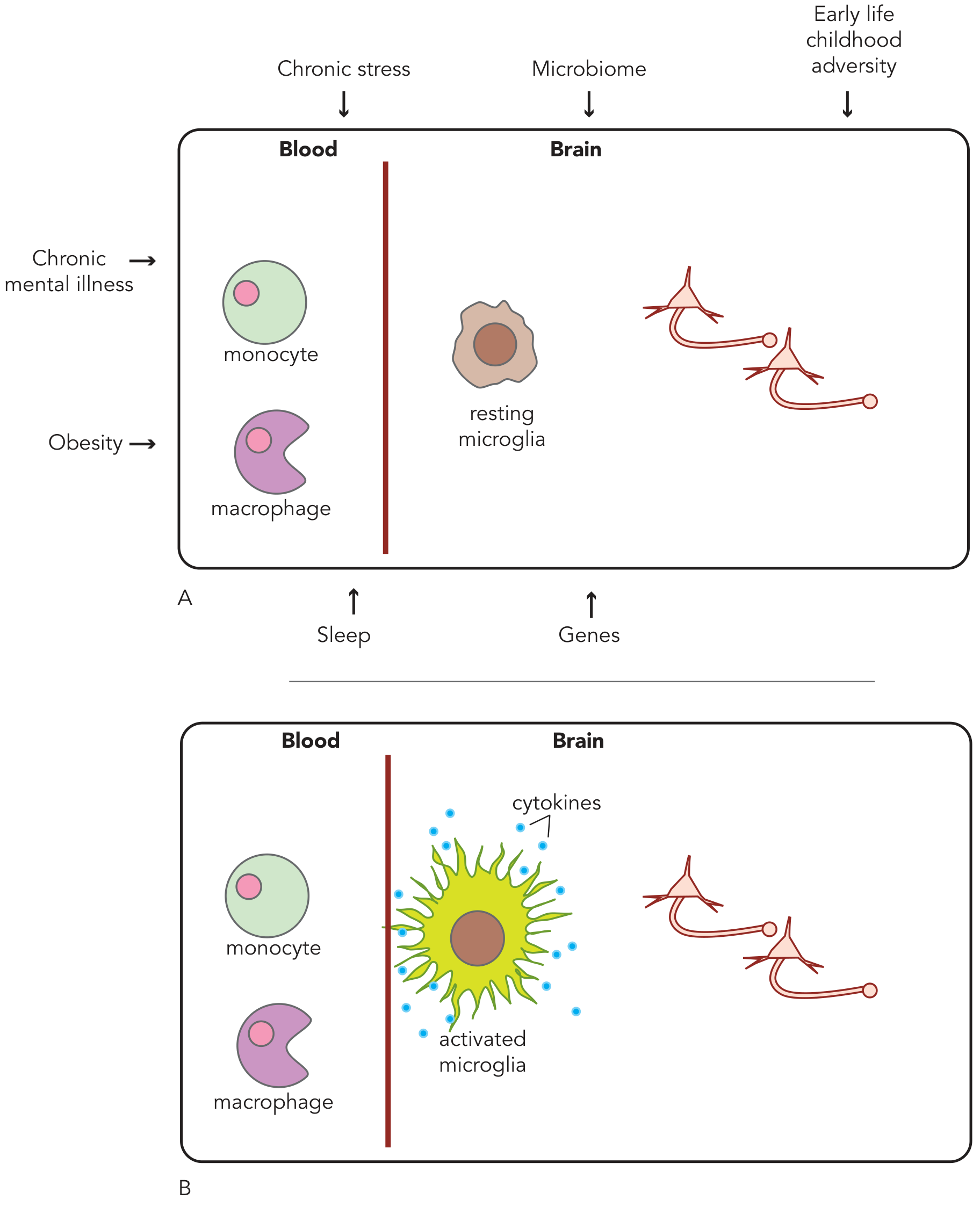
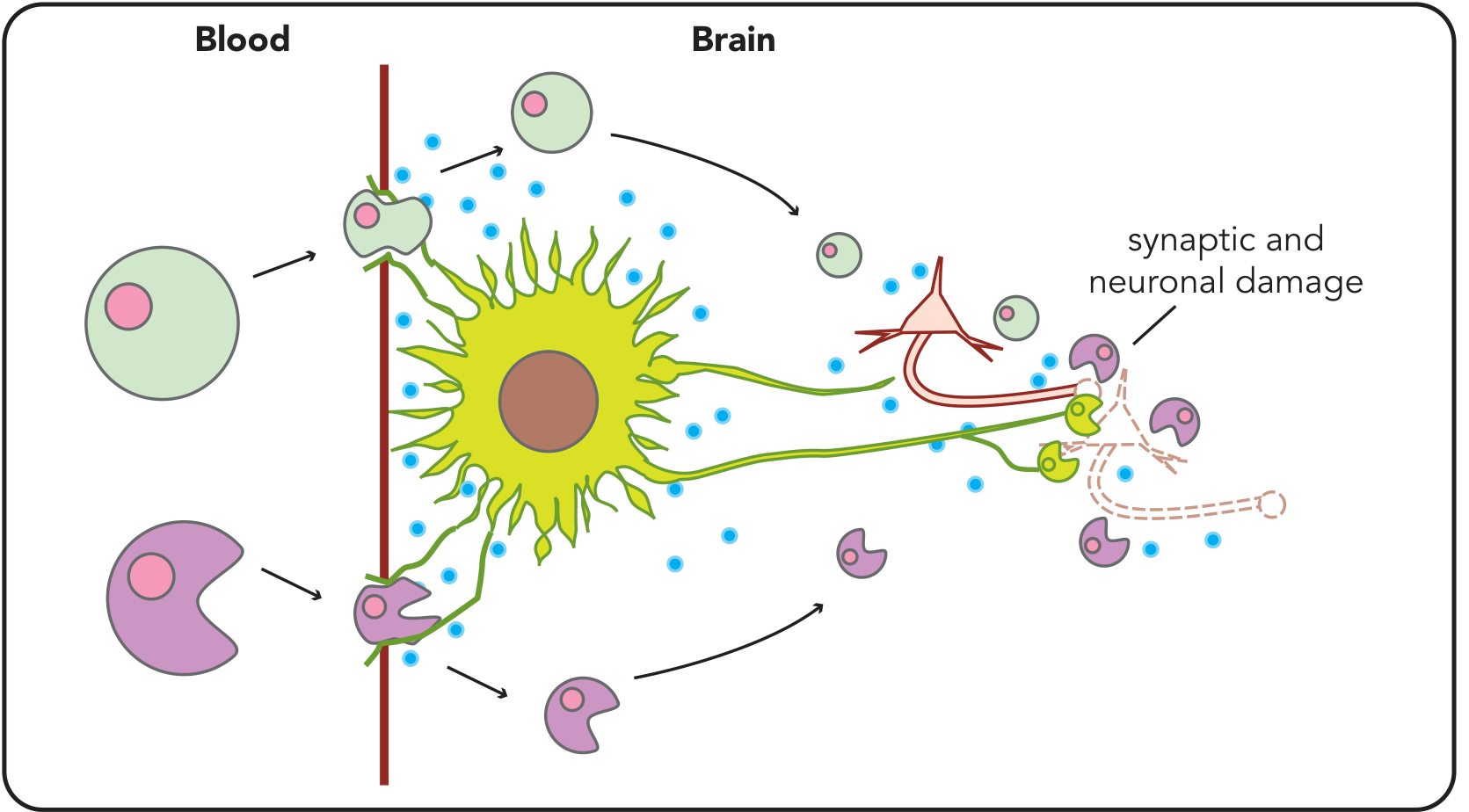
Once the inflammatory cascade begins:
- Proinflammatory cytokines (IL-1β, IL-6, TNF-α) are released by activated microglia
- Monocytes and macrophages are recruited across the BBB
- Infiltrating immune cells cause:
- Oxidative stress and mitochondrial dysfunction
- HPA-axis dysregulation
- Reduced neurotrophic factor availability (e.g., BDNF)
- Epigenetic changes
- Synaptic loss and neuronal death
- Additional metalloproteinases and reactive oxygen species amplify tissue damage
- CNS perfusion is impaired
Stahl's Essential Psychopharmacology; Miller's Anesthesia, 10th Ed.; Fishman's Pulmonary Diseases
6. Diseases Linked to Neuroinflammation
| Condition | Mechanism |
|---|---|
| Bacterial/Viral Meningitis | PAMPs trigger BBB breakdown; leukocyte recruitment; cytokine-mediated CNS damage |
| Encephalitis | Direct viral invasion + immune-mediated neurotoxicity |
| Multiple Sclerosis (MS) | Autoimmune demyelination; T-cell and complement activation |
| Alzheimer Disease | Amyloid-β activates microglia; neurotoxic reactive astrocytes; synapse loss |
| Traumatic Brain Injury (TBI) | DAMPs activate glial cells; cytokine storm; neutrophil recruitment; microglia become the dominant resident immune responders |
| Depression | Chronic neuroinflammation linked to hippocampal atrophy, HPA hyperactivation, cognitive decline |
| Post-operative Cognitive Dysfunction | Surgery-induced DAMPs raise CSF cytokines; monocyte influx into CNS |
| Myasthenia gravis / Guillain-Barré | Complement-mediated neuroinflammation |
Henry's Clinical Diagnosis; Mulholland & Greenfield's Surgery, 7th Ed.; Stahl's Psychopharmacology
7. Resolution of Neuroinflammation
The brain also produces pro-resolution lipid mediators:
- Resolvins, protectins, and maresins (detected in human CSF)
- Impaired resolution is thought to contribute to post-operative cognitive dysfunction
- Exogenous treatment with maresin-1 has been shown to reduce postoperative memory deficits in animal models
Failure to resolve inflammation is a key driver of chronic neurodegeneration.
Miller's Anesthesia, 10th Ed.
Summary Table
| Feature | Detail |
|---|---|
| Primary resident immune cell | Microglia (10% of CNS glia) |
| Key cytokines | IL-1β, IL-6, TNF-α |
| Pattern recognition | Toll-like receptors, NF-kB signaling |
| BBB role | Disruption allows immune cell/cytokine entry |
| Astrocyte response | Reactive astrogliosis (can be neuroprotective or neurotoxic) |
| Chronic consequences | Synaptic loss, hippocampal atrophy, neurodegeneration |
| Resolution mediators | Resolvins, protectins, maresins |
Sources:
- Eric Kandel - Principles of Neural Science, 6th Ed.
- Stahl's Essential Psychopharmacology - Neuroscientific Basis
- Miller's Anesthesia, 10th Ed.
- Tintinalli's Emergency Medicine
- Mulholland & Greenfield's Surgery, 7th Ed.
- Henry's Clinical Diagnosis and Management by Laboratory Methods
This is a shared conversation. Sign in to Orris to start your own chat.