
from Guyton and Hall textbook of medical physiology, 4th South Asia edition write a 5 mark short note on Factors Affecting Stroke Volume
Reading File
Finding Sources
Finding Sources
Finding Sources
Finding Sources
Finding Sources
Finding Sources
Finding Sources
Finding Sources
Reading File
Reading File
Finding Sources
Finding Sources
Reading File
Reading File
Loading Image
I now have all the content needed. Here is the complete 5-mark short note directly from Guyton and Hall Textbook of Medical Physiology:
Factors Affecting Stroke Volume
(Guyton and Hall Textbook of Medical Physiology, 4th South Asia Edition)
Stroke volume (SV) is the volume of blood ejected by each ventricle per beat. Normally, each ventricle ejects about 70 mL per beat from an end-diastolic volume (EDV) of ~110-120 mL, leaving an end-systolic volume (ESV) of ~40-50 mL. The ejection fraction (SV/EDV) is approximately 60%.
Stroke Volume = End-Diastolic Volume - End-Systolic Volume
Three principal factors regulate stroke volume:
1. Preload (End-Diastolic Volume) - Frank-Starling Mechanism
Preload refers to the degree of ventricular filling before contraction, reflected by the EDV.
The Frank-Starling mechanism (named after Otto Frank and Ernest Starling) states: "The more the heart muscle is stretched during cardiac filling, the greater the force of contraction, and the greater the quantity of blood pumped into the aorta."
- When extra blood returns to the heart, the cardiac muscle fibers are stretched to a greater length
- Stretching brings the actin and myosin filaments to a more nearly optimal degree of overlap, generating greater force
- This causes the ventricle to automatically pump the extra blood back into the arteries
- Within physiological limits, the heart pumps all the blood that returns to it via the veins
Ventricular Function Curves graphically depict this relationship - as atrial pressure (a measure of preload) rises, stroke work output and stroke volume rise correspondingly:
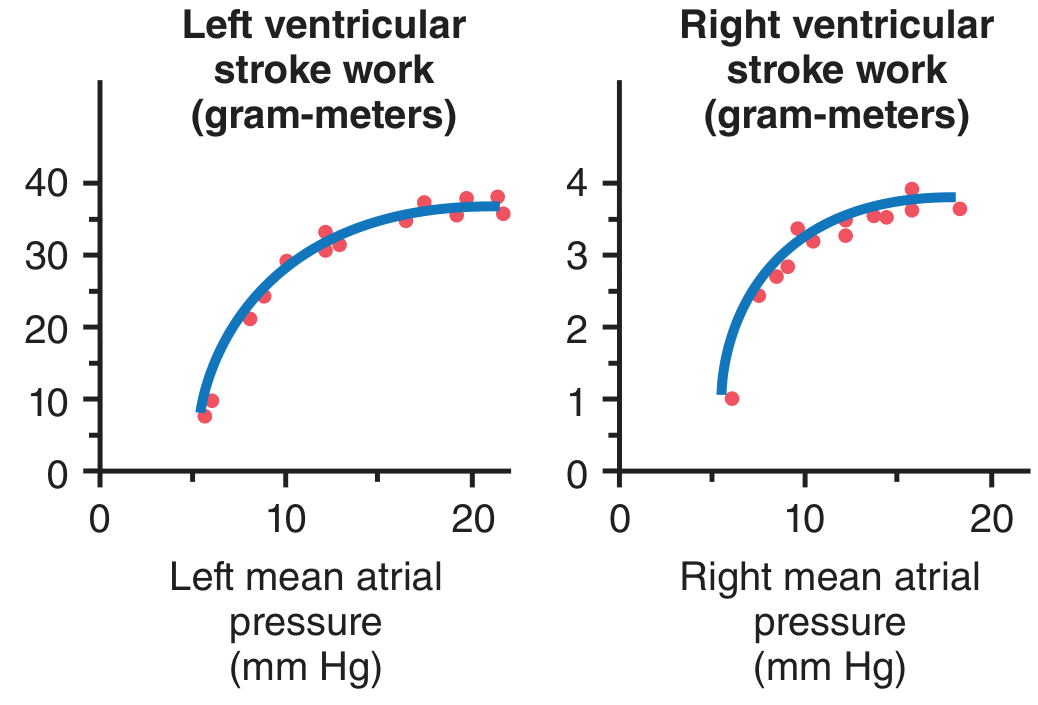
Factors that increase preload (and thus SV): increased venous return, increased blood volume, increased atrial contraction.
2. Afterload (Aortic/Pulmonary Artery Pressure)
Afterload is the resistance the ventricle must overcome to eject blood - essentially the arterial pressure opposing outflow.
- During systole, the ventricle must generate enough pressure to open the semilunar valves (left ventricle must exceed ~80 mm Hg aortic pressure; right ventricle must exceed ~8 mm Hg pulmonary artery pressure)
- An increase in afterload (e.g., hypertension, aortic stenosis) increases the ESV because less blood can be ejected - this reduces stroke volume
- In aortic stenosis, the stroke volume through the aortic valve is reduced because of the increased resistance to outflow
- Conversely, reduced afterload (e.g., vasodilation) allows more complete emptying and increases stroke volume
3. Myocardial Contractility (Inotropy)
Contractility is the intrinsic ability of the heart muscle to generate force independent of preload and afterload.
- Strong sympathetic stimulation can double the force of heart contraction (positive inotropy), increasing the volume of blood pumped and the ejection pressure
- Sympathetic stimulation increases maximum cardiac output 2-fold to 3-fold above normal
- Increased contractility shifts the ventricular function curve upward and to the left - more stroke work is generated at any given preload
- Positive inotropes (catecholamines, digoxin, Ca²+) increase SV; negative inotropes (beta-blockers, heart failure, hypoxia) decrease SV
When the heart contracts strongly, the ESV may decrease to as little as 10-20 mL. Combined with an increased EDV of up to 150-180 mL in a healthy heart under sympathetic drive, stroke volume can increase to more than double its resting value.
Summary Table
| Factor | Effect on SV | Mechanism |
|---|---|---|
| Increased preload (EDV) | Increases SV | Frank-Starling: greater fiber stretch → greater force |
| Increased afterload | Decreases SV | Greater ESV; incomplete ejection |
| Increased contractility | Increases SV | More forceful contraction, reduced ESV |
| Sympathetic stimulation | Increases SV | Positive inotropy; doubles contractile force |
| Parasympathetic stimulation | Decreases SV | Reduced contractility |
Clinical relevance: In exercise, both EDV increases (higher venous return) and contractility increases (sympathetic activation), so during maximal exercise, stroke volume rises to ~95% of its maximum, approximately doubling the resting SV.
(Source: Guyton and Hall Textbook of Medical Physiology - Chapters 9 and 20)
This is a shared conversation. Sign in to Orris to start your own chat.