
Usg report how to read with images
Reading File
Finding Sources
Finding Sources
Searching the Web
how to read ultrasound USG report basics interpretation
Finding Sources
Reading Web Page
https://drsono.com/blogs/news/how-to-read-an-ultrasound
Loading Image
Reading File
Loading Image
Searching the Web
ultrasound image echogenicity anechoic hypoechoic hyperechoic diagram labeled
Reading File
Loading Image
Searching the Web
ultrasound report components findings impression labeled example image
Loading Image
Loading Image
Now I have everything needed to write a thorough guide. Let me compile it all.
How to Read a USG (Ultrasound) Report
USG stands for Ultrasound Sonography - the same as "echography." The report is a written summary of what the radiologist sees in the scan images. Here is a complete guide to understanding it.
1. The Physics Behind the Image (Why Things Look Black, Gray, or White)
Ultrasound sends high-frequency sound waves (1-20 MHz) into the body. When those waves bounce back (echo), the machine converts them into a grayscale image. The key concept is echogenicity - how well a tissue reflects sound:

| Appearance on Screen | Term | What It Means | Examples |
|---|---|---|---|
| Black | Anechoic | No echoes - sound passes right through | Fluid, urine, blood, bile, amniotic fluid |
| Dark gray | Hypoechoic | Few echoes returned | Soft tissue, muscles, most solid organs |
| Bright white | Hyperechoic | Many echoes reflected | Bone, calcium, fat, air, stones |
| Mix of gray shades | Isoechoic | Same echogenicity as surrounding tissue | Normal organ parenchyma |
From Textbook of Clinical Echocardiography: "The velocity of propagation in bone is much faster (~3000 m/s) than in lung tissue (~700 m/s)... Knowledge of the strengths, and more importantly the limitations, of this technique is critical for correct clinical diagnosis."
Key rule: Denser tissue = brighter (more white). Fluid = black. Bone or stone = bright white, often with a posterior acoustic shadow (dark stripe behind it).
2. Parts of a USG Report
A standard USG report has these sections:
A. Patient & Exam Header
- Patient name, age, sex, ID
- Date/time of scan
- Referring doctor
- Type of exam (e.g., "USG Abdomen", "USG Kidney", "Obstetric USG")
B. Indication
Why the scan was ordered - e.g., "right flank pain," "first trimester pregnancy check," "follow-up liver lesion."
C. Technique
The method used - B-mode (standard grayscale), Doppler (blood flow), 3D/4D, transvaginal, transrectal, etc.
D. Findings (The Most Important Section)
This is where each organ or structure is described systematically:
| Descriptor | What the Radiologist Checks |
|---|---|
| Size | Measured in cm (length × width × height) |
| Shape | Normal / enlarged / shrunken |
| Echotexture | Normal, increased echogenicity, heterogeneous |
| Contour/Margins | Smooth, irregular, lobulated |
| Lesions | Cystic (black, well-defined) vs. solid (gray/white, irregular) |
| Vascularity | Blood flow on Doppler - increased/decreased/absent |
| Posterior effects | Posterior shadowing (stone/bone), posterior enhancement (cyst) |
E. Impression / Conclusion
The radiologist's summary diagnosis based on findings - the most clinically actionable part. Example:
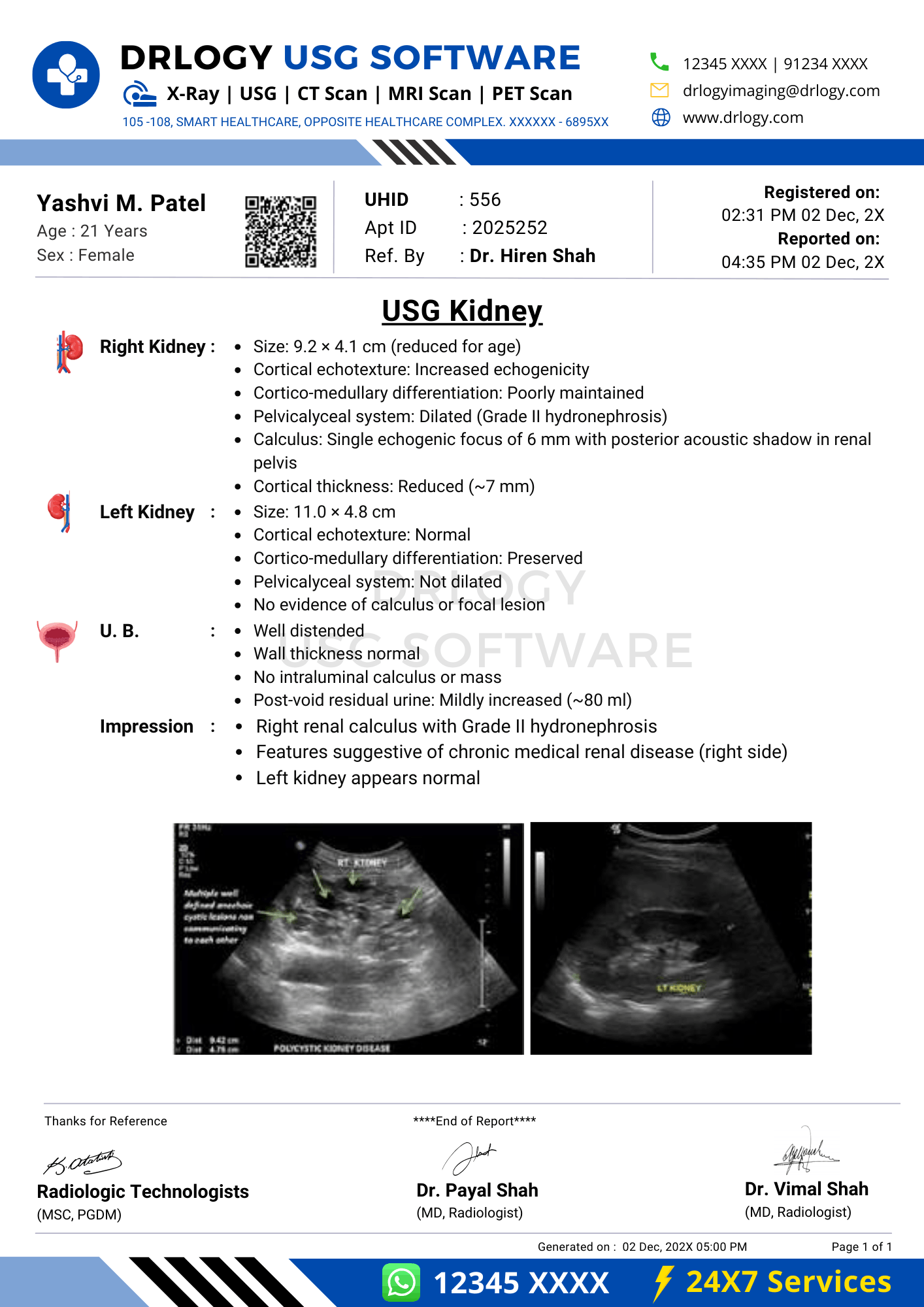
"Right renal calculus with Grade II hydronephrosis. Features suggestive of chronic medical renal disease (right side). Left kidney appears normal."
Here is a real example of a kidney USG report with its structure:
3. Common Terms You Will See
| Term | Meaning |
|---|---|
| Echogenic focus | Bright spot (often calcium or stone) |
| Posterior acoustic shadow | Dark stripe behind a stone or bone |
| Posterior acoustic enhancement | Brighter area behind a fluid-filled cyst |
| Heterogeneous | Mixed echo pattern - may suggest pathology |
| Homogeneous | Uniform echo pattern - usually normal |
| Cortico-medullary differentiation | Kidney: visible boundary between cortex and medulla (preserved = normal) |
| Pelvicalyceal system (PCS) dilated | Hydronephrosis - fluid backing up in kidney |
| Free fluid | Anechoic (black) collection in abdomen - abnormal outside of ascites context |
| No focal lesion | No cyst or mass seen - normal |
| Well-defined / ill-defined | Describes lesion margins - ill-defined can suggest malignancy |
Phrases meaning normal:
- "No evidence of..."
- "Expected size and placement"
- "Within normal limits"
- "Unremarkable"
Phrases that need follow-up:
- "Indeterminate lesion"
- "Hypoechoic nodule"
- "Suspect / suspicious for"
- "Further evaluation recommended"
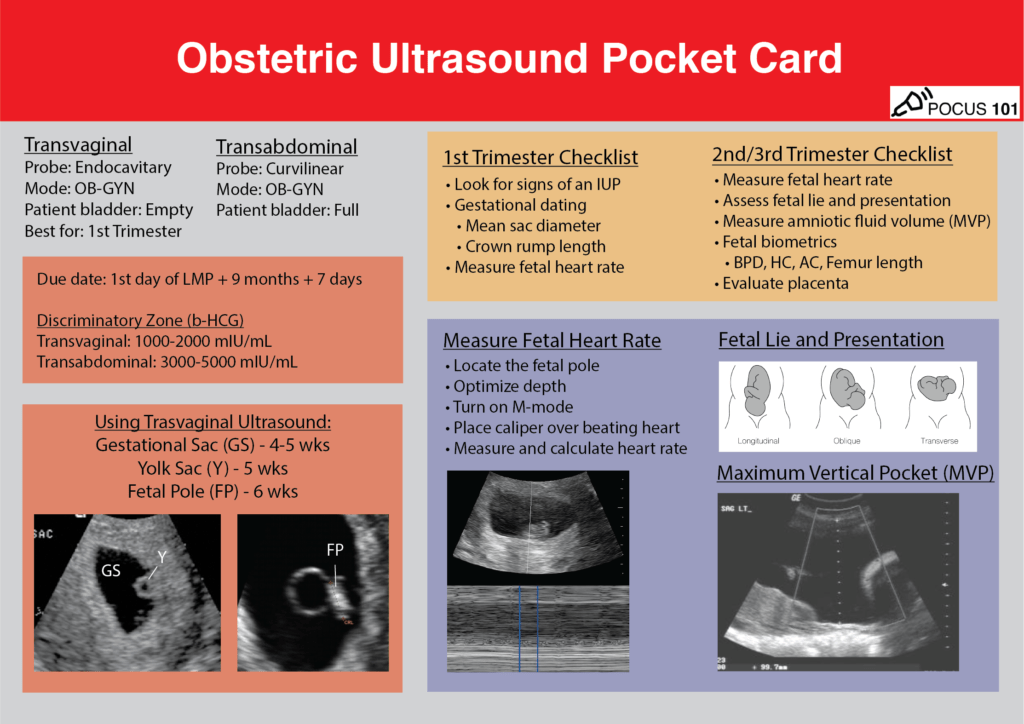
4. Reading an Obstetric (Pregnancy) USG
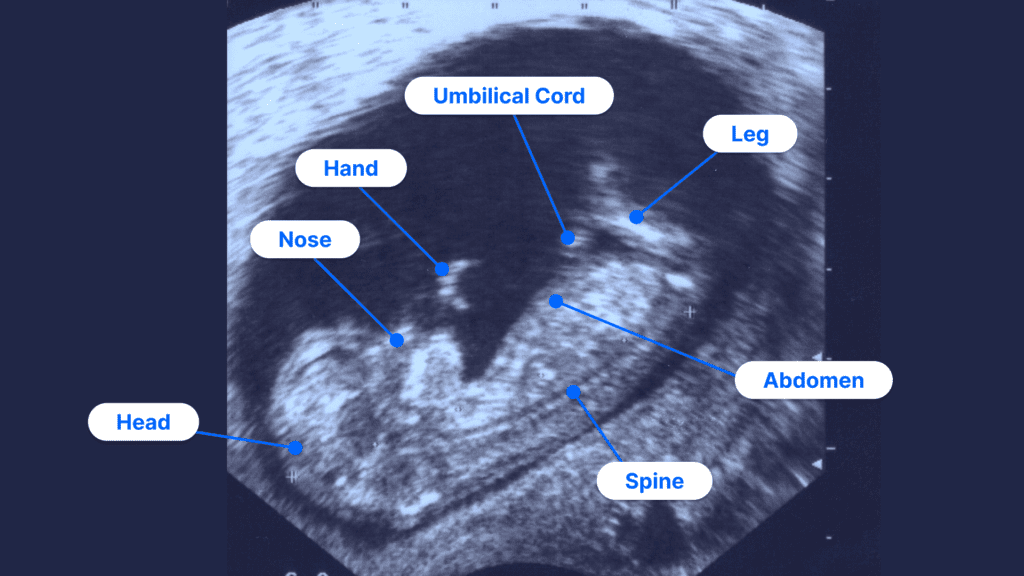
Obstetric Abbreviations Explained
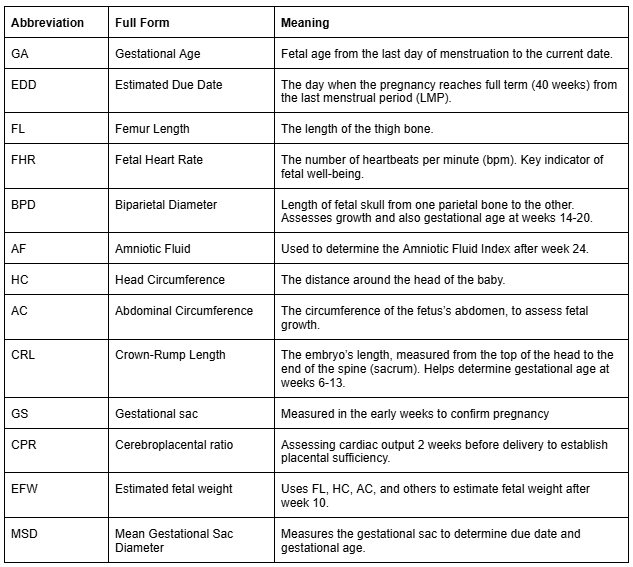
| Abbreviation | Full Form | Purpose |
|---|---|---|
| GA | Gestational Age | Fetal age from last menstrual period |
| EDD | Estimated Due Date | LMP + 9 months + 7 days |
| CRL | Crown-Rump Length | Measures gestational age at 6-13 weeks |
| BPD | Biparietal Diameter | Head width - assesses growth at 14-20 weeks |
| HC | Head Circumference | Overall head size |
| AC | Abdominal Circumference | Fetal abdominal growth |
| FL | Femur Length | Thigh bone length |
| EFW | Estimated Fetal Weight | Calculated from FL, HC, AC |
| FHR | Fetal Heart Rate | Normal: 110-160 bpm |
| AFI | Amniotic Fluid Index | Normal: 8-18 cm (after week 24) |
| GS | Gestational Sac | Confirms pregnancy in early weeks |
| MVP | Maximum Vertical Pocket | Amniotic fluid assessment |
5. Reading Doppler USG
Doppler is used to assess blood flow:
- Red on color Doppler = blood flowing toward the probe
- Blue on color Doppler = blood flowing away from the probe
- Spectral waveform = shows velocity and resistance of flow
- Resistive Index (RI) = measures downstream resistance (elevated in kidney disease, tumors)
- Peak Systolic Velocity (PSV) = useful for detecting arterial stenosis
6. Quick Organ-by-Organ Reference
| Organ | Normal Findings on Report |
|---|---|
| Liver | Normal size (~15 cm in midclavicular line), homogeneous echogenicity, no focal lesion, no duct dilatation |
| Gallbladder | Wall thickness <3 mm, no calculi, no pericholecystic fluid |
| Pancreas | Echogenic, homogeneous, duct <2 mm |
| Kidneys | Size ~10-12 cm, cortical thickness >1 cm, CMD preserved, PCS not dilated |
| Uterus | Normal size varies by age/parity, normal endometrial thickness |
| Ovaries | Size ~3×2×2 cm, no dominant follicle (outside ovulation) |
| Bladder | Well-distended, wall thickness <3 mm, no intraluminal mass, post-void residual <50 mL |
7. Tips for Reading Any USG Report
- Read the Impression first - it gives you the summary answer
- Then read Findings - understand the evidence behind the impression
- Note measurements - compare to normal ranges (above)
- Flag "indeterminate" or "recommend correlation" - these need clinical follow-up
- Don't interpret in isolation - USG findings must always be combined with symptoms, labs, and clinical history
A USG report does not replace your doctor's interpretation. The same finding (e.g., a hypoechoic nodule) can be benign or malignant depending on context.
This is a shared conversation. Sign in to Orris to start your own chat.