I now have excellent textbook diagrams and comprehensive content. I have everything I need to write a thorough, easy-to-understand explanation with memory aids. Let me compose the full response now.
🏥 Uterine Prolapse - Complete Easy Guide + Memory Aids
Sources: Bailey & Love's Surgery 28th Ed., Berek & Novak's Gynecology, Campbell-Walsh Urology
🎯 What is it? (The Simple Idea)
Think of the uterus like a hammock suspended in the pelvis. The "ropes" of this hammock are the pelvic floor muscles + ligaments (mainly cardinal and uterosacral ligaments). When these ropes weaken or snap, the uterus slides downward into or out of the vagina.
That's uterine prolapse - the uterus descending from its normal position toward or through the vaginal opening.
🏗️ What Normally Holds the Uterus Up?
Three levels of support (remember: "3 Floors of a Building"):
| Level | Structure | What it supports |
|---|
| Level 1 (top floor) | Cardinal + Uterosacral ligaments | Cervix & upper vagina |
| Level 2 (middle floor) | Pubocervical + Rectovaginal fascia | Middle vagina |
| Level 3 (ground floor) | Pelvic floor muscles (levator ani) + perineal body | Lower vagina & outlet |
Key point: Uterine prolapse mainly occurs when Level 1 support (cardinal/uterosacral ligaments) fails.
😰 Why Does It Happen? (Risk Factors)
Mnemonic: "OLD POEMS"
- O - Obese women
- L - Labour (vaginal delivery, prolonged labour, high parity)
- D - Deficiency of oestrogen (menopause)
- P - Parity (multiple pregnancies)
- O - Occupation (heavy lifting, chronic straining)
- E - Ehlers-Danlos / connective tissue disorders (Marfan syndrome)
- M - Menopause (oestrogen loss weakens tissues)
- S - Straining chronically (constipation, chronic cough)
📊 Grading / Classification (POP-Q System)
Here is how we grade the degree of prolapse:
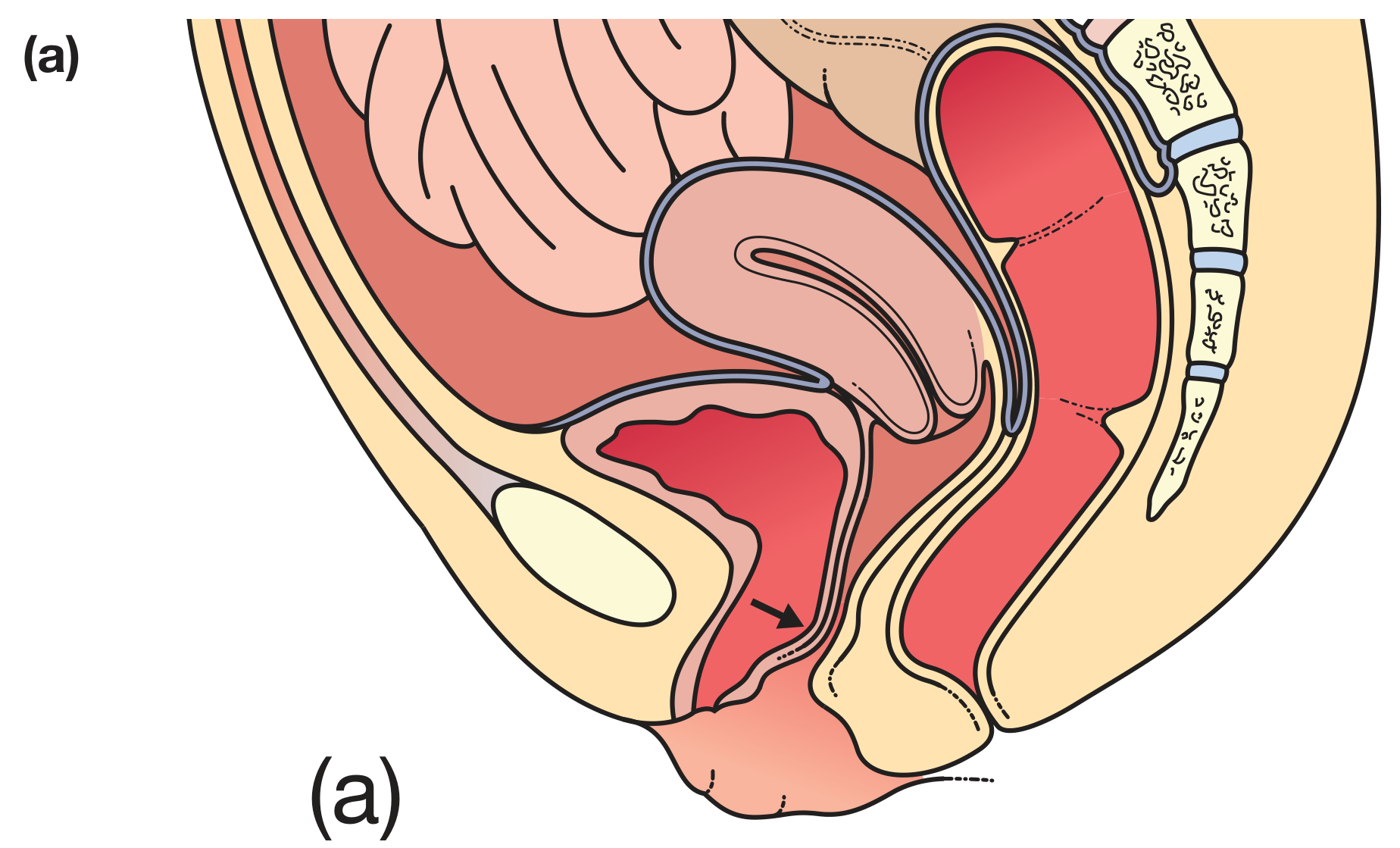
Fig A: Urethrocele/cystocele - bladder prolapsing into the vagina
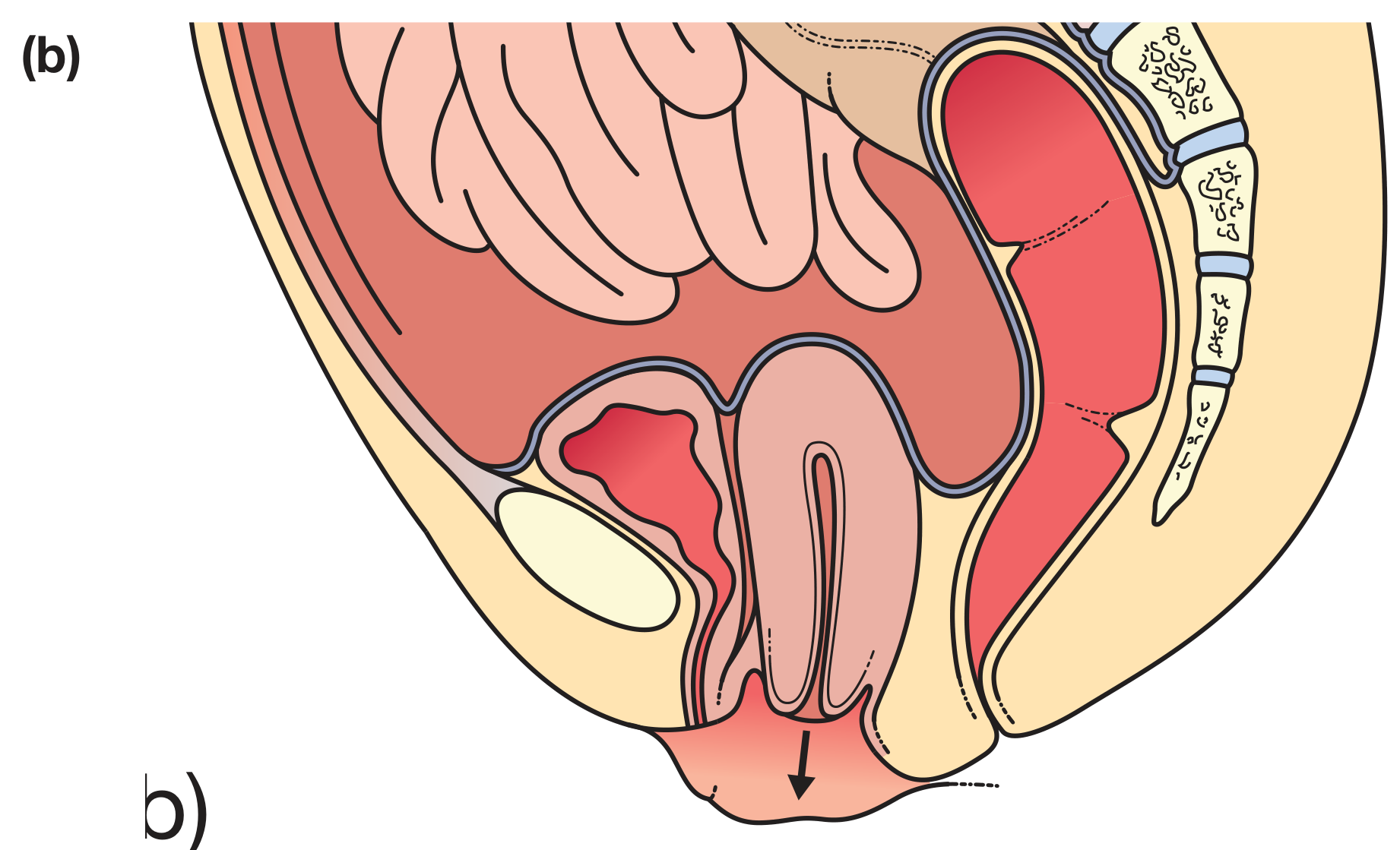
Fig B: Complete uterine prolapse - uterus descending through the vaginal opening
Mnemonic: "0 = Nothing, 4 = Maximum"
| Grade | What happens |
|---|
| 0 | No prolapse at all |
| 1 | Prolapse stays >1 cm ABOVE the hymen (barely moves) |
| 2 | Prolapse is within 1 cm ABOVE or BELOW the hymen (at the entrance) |
| 3 | Prolapse is >1 cm BELOW hymen but not fully out |
| 4 | Complete descent - maximum prolapse (called Procidentia) |
Memory trick: Imagine a lift/elevator. Grade 0 = parked at top floor. Grade 4 = elevator crashed into the basement.
🗂️ Types of Pelvic Organ Prolapse (Related to Uterine Prolapse)
The uterus rarely prolapses alone - it drags neighbouring organs with it:
| Structure prolapsing | Medical name | Memory aid |
|---|
| Uterus descends | Uterine prolapse | Uterus drops |
| Bladder bulges into front vaginal wall | Cystocele | "Cysto" = bladder |
| Bladder + urethra bulge together | Cystourethrocele | Bladder + tube |
| Rectum bulges into back vaginal wall | Rectocele | "Recto" = rectum |
| Small bowel bulges in | Enterocele | "Entero" = intestine |
| Vaginal vault falls after hysterectomy | Vault prolapse | No more uterus to hold it |
🩺 Symptoms (What the Patient Feels)
Mnemonic: "ABCDE"
- A - A lump/bulge felt or seen at the vagina ("something coming down")
- B - Bladder problems (urgency, frequency, leaking, recurrent UTIs)
- C - Constipation / difficulty defecating (especially in rectocele)
- D - Discomfort or dragging sensation in the pelvis
- E - Erosion/ulceration of vaginal mucosa (in severe/complete prolapse - bleeding, discharge)
Mild prolapses may be completely asymptomatic.
🔍 Examination
- Patient examined in lithotomy position (lying back, legs up)
- Sim's speculum used to visualize the walls
- Ask patient to strain/cough (Valsalva) - makes prolapse visible
- Check anterior wall (cystocele), posterior wall (rectocele), apex (uterine prolapse)
- Also check for stress urinary incontinence
💊 Management
1. Conservative (Non-Surgical)
| Approach | Details |
|---|
| Lifestyle | Avoid constipation, lose weight, stop heavy lifting |
| Pelvic floor exercises | At least 16 weeks of physiotherapy for Grade 1-2 |
| Topical oestrogen | For postmenopausal women - improves tissue strength |
| Ring pessary | Most commonly used device; inserted between posterior fornix and pubic bone; replaced every 3-6 months |
Pessary = a mechanical support device inserted into the vagina to hold the uterus up.
2. Surgical
Mnemonic: "HIM Can Save" (for uterine prolapse options)
| Surgery | What it does |
|---|
| Vaginal hysterectomy | Remove uterus vaginally (for completed family) |
| Manchester repair (Fothergill operation) | Amputate cervix + tighten transverse cervical ligaments - UTERUS PRESERVED |
| Sacrohysteropexy | Mesh suspends uterus to the sacral promontory (laparoscopic) |
| McCall suture | Plication (tightening) of uterosacral ligaments laparoscopically |
| Colpocleisis | Close off the vagina entirely (for elderly women no longer sexually active) |
For cystocele: Anterior colporrhaphy (anterior vaginal wall repair - NO mesh)
For rectocele: Posterior colporrhaphy
🧠 Master Memory Table
| Feature | Key Fact | Memory Trick |
|---|
| Most common risk factor | Vaginal delivery / multiparity | "Babies weaken the hammock" |
| Grade 4 special name | Procidentia | "Pro" = completely out |
| Most used pessary | Ring pessary | Ring = simple ring shape |
| Pessary change frequency | Every 3-6 months | "Every season, check the ring" |
| Non-surgical exercise duration | 16 weeks minimum | "16 = one big quarter" |
| Cardinal ligament failure | Main cause of uterine prolapse | "Cardinal = most important" |
| Uterus-preserving surgery | Manchester repair | "Manchester = keeps the uterus" |
🔄 Quick Flow Diagram
UTERINE PROLAPSE
      |
      ├─ Mild (Grade 1-2) ──► Pelvic floor physio + Oestrogen + Lifestyle
      |
      ├─ Moderate (symptomatic) ──► Ring pessary
      |
      └─ Severe / Fit for surgery ──►
              ├─ Family complete? ──► Vaginal hysterectomy
              └─ Wants uterus? ──► Manchester repair / Sacrohysteropexy
⚡ 10 High-Yield Exam Points
- Uterine prolapse = failure of cardinal + uterosacral ligaments (Level 1 support)
- Most common cause = multiparity / vaginal delivery
- Grade 4 = Procidentia (complete prolapse)
- POP-Q grades 0-4 based on position relative to hymen
- First-line conservative = pelvic floor exercises x 16 weeks
- Most common pessary = ring pessary, changed every 3-6 months
- Uterus-preserving surgery = Manchester repair (amputates cervix, plicates ligaments)
- After hysterectomy → vault can still prolapse = vault prolapse
- Cystocele repair = anterior colporrhaphy (NO mesh routinely)
- Postmenopausal women benefit from topical oestrogen to improve tissue
Your PDF contained image-based notes that couldn't be read directly as text (scanned/photographed pages). The explanation above is built from authoritative textbooks (Bailey & Love's Surgery 28th Ed. and Berek & Novak's Gynecology) to give you a complete, exam-ready guide. The mnemonics, tables, and flow diagram should make this easy to memorize!