
Anti rabies vaccine in 2 year old
Reading File
Anti-rabies vaccine in a 2-year-old follows the same schedule as adults - the dose and regimen are not reduced by age. Let me pull the detailed textbook guidance.
Searching sources...
Finding Sources
Searching the Web
anti rabies vaccine 2 year old child schedule dose WHO 2024
Finding Sources
Finding Sources
Reading File
Reading File
Reading File
Now I have comprehensive textbook content. Let me also fetch the Essen regimen diagram image.
Loading Image
Reading File
I now have all the information needed for a thorough answer. Here is the complete guide:
Anti-Rabies Vaccine in a 2-Year-Old
Key Pediatric Point - Injection Site
For a child aged 2 years or older, the vaccine is given into the deltoid muscle (same as adults). For children under 2 years, the anterolateral thigh is used instead. The gluteal region must never be used (poor immunogenicity).
- Park's Textbook of Preventive & Social Medicine, p. 324
Step 1 - Wound Classification (Category of Exposure)
Before any vaccine is given, classify the exposure:
| Category | Description | Treatment |
|---|---|---|
| I | Touching/feeding animal, licks on intact skin | Wash hands; no vaccine |
| II | Nibbling of uncovered skin, minor scratches/abrasions without bleeding | Wound care + vaccine |
| III | Single/multiple transdermal bites or scratches, licks on broken skin, mucous membrane contact, bat exposure | Wound care + RIG + vaccine |
Step 2 - Wound Care (Do This FIRST)
- Wash the wound with soap and water under running tap for at least 15 minutes - this alone can reduce rabies risk by up to 80%
- Apply a virucidal agent: povidone-iodine, alcohol (40-70%), or aqueous iodine
- Do NOT suture immediately; if required, suture at 24-48 hours with minimum stitches
- Give antibiotics and anti-tetanus prophylaxis as indicated
Step 3 - Post-Exposure Prophylaxis (PEP) Schedule
Three approved IM regimens exist. The vaccine volume is 1.0 ml or 0.5 ml depending on the type (e.g., HDCV = 1.0 ml; PCECV = 0.5 ml):
Regimen 1: Essen (5-dose, most widely used)
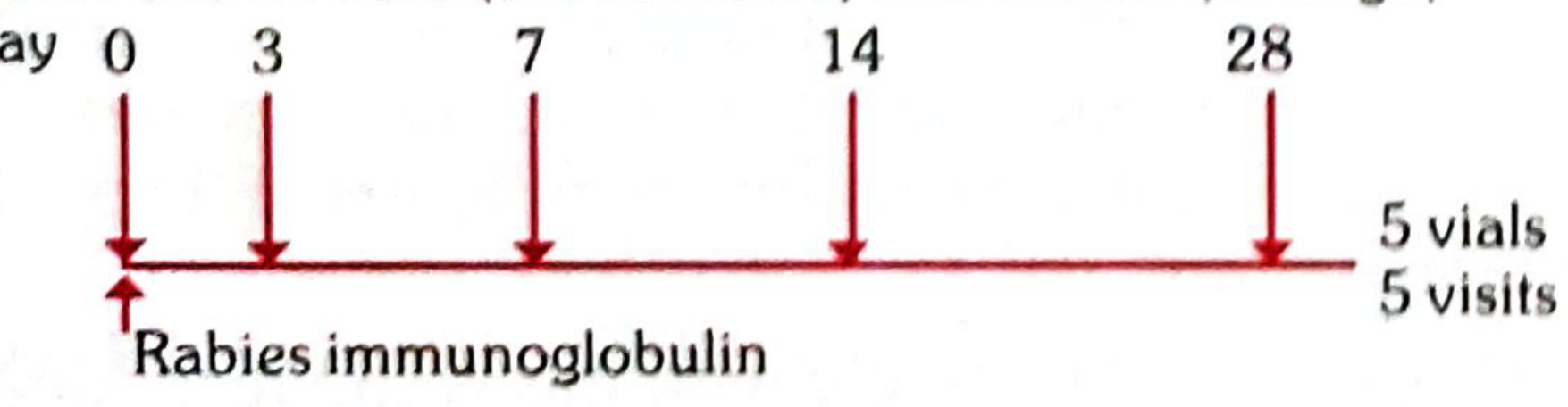
| Day | Dose |
|---|---|
| 0 | 1 IM dose + RIG (if Cat III) |
| 3 | 1 IM dose |
| 7 | 1 IM dose |
| 14 | 1 IM dose |
| 28 | 1 IM dose |
Total: 5 doses, 5 visits
Regimen 2: Zagreb / 2-1-1 (4-dose abbreviated multisite)
| Day | Dose |
|---|---|
| 0 | 2 IM doses (one in each deltoid/thigh) + RIG (if Cat III) |
| 7 | 1 IM dose |
| 21 | 1 IM dose |
Total: 4 doses, 3 visits
Regimen 3: Modified (for healthy, immunocompetent with RIG)
Doses on days 0, 3, 7, and 14 (4 doses total) - an alternative for those who received proper wound care + high-quality RIG + WHO-prequalified vaccine.
Intradermal (ID) Route (if nationally approved)
0.1 ml at 2 sites (deltoid or thigh) on days 0, 3, 7, and 28. (Day 14 dose is skipped.) Cost-saving option but not available everywhere.
Step 4 - Rabies Immunoglobulin (RIG) - Category III Only
RIG is given once only, on Day 0 alongside the first vaccine dose. It is not needed after day 7 (active immunity from vaccine is assumed to have developed).
| Type | Dose | Notes |
|---|---|---|
| Human RIG (HRIG) | 20 IU/kg body weight | Preferred; safer |
| Equine RIG (ERIG) | 40 IU/kg body weight | Less expensive; small risk of anaphylaxis (~1/45,000); no skin test needed |
How to give RIG: Infiltrate as much as possible directly into and around the wound(s). Any remainder is given IM at a site distant from the vaccine injection.
No Contraindications in Children
Rabies is invariably fatal once symptoms develop. There are no contraindications to PEP in children, including infants, immunocompromised children, or those with HIV/AIDS. Pregnancy is also not a contraindication. If the child is on chloroquine, use the IM route only (not ID, as chloroquine reduces immune response to ID rabies vaccines).
- Park's Textbook of Preventive & Social Medicine, p. 325
Pre-Exposure Prophylaxis (PrEP) - If Applicable
For children at high risk (living in rural endemic areas, animal handlers):
- IM: 1 ml or 0.5 ml on days 0, 7, and 21 or 28
- ID: 0.1 ml on days 0, 7, and 21 or 28
- Boosters only needed if antibody titres fall below 0.5 IU/ml
Summary for a 2-Year-Old
- Injection site: deltoid (anterolateral thigh only if <2 years)
- Dose: full adult dose (no dose reduction for age)
- Regimen: Essen (days 0, 3, 7, 14, 28) is most commonly used
- Add RIG (20 IU/kg HRIG or 40 IU/kg ERIG) on Day 0 for Category III exposure, infiltrated into the wound
- No contraindications; treat every bite as a medical emergency
This is a shared conversation. Sign in to Orris to start your own chat.