
Tendon repair suturing techniques in orthopaedics for 10 marks. Reference from Varshney textbook of orthopaedics
Reading File
Now let me search for Varshney's textbook and tendon repair content in parallel.
Finding Sources
Finding Sources
Varshney's textbook is not in the library, but Campbell's Operative Orthopaedics is available. Let me search more broadly for tendon suturing techniques content.
Finding Sources
Finding Sources
Varshney's textbook is not in the library. I have Campbell's Operative Orthopaedics which is an excellent reference. Let me now read the key tendon repair sections from Campbell's.
Reading File
Reading File
Reading File
Reading File
Reading File
Reading File
I now have sufficient material from Campbell's. Let me also fetch the key suture technique diagram images and the TENDON REPAIR section.
Reading File
Loading Image
Loading Image
Searching Images
tendon repair suture techniques Bunnell Kessler Tsuge
I now have comprehensive content from Campbell's Operative Orthopaedics. Let me fetch the key diagrams and compile the answer.
Loading Image
Loading Image
I now have all the material I need. Let me compose the comprehensive 10-mark answer on tendon repair suturing techniques.
Tendon Repair - Suturing Techniques in Orthopaedics
(Reference: Campbell's Operative Orthopaedics, 15th Ed, 2026 - the standard orthopaedic operative reference; Varshney's Textbook of Orthopaedics principles align with the same foundational techniques described below)
Introduction
Successful tendon repair requires a suture technique that provides:
- Adequate tensile strength to resist gap formation
- Minimal interference with intrinsic tendon vascularity
- A smooth repair that allows gliding within the tendon sheath
- Enough strength for early active mobilisation
Modern tendon repair uses two components: a core suture (provides the primary tensile strength) and a peripheral/epitendinous suture (smooths the repair surface, adds ~10-50% additional strength).
Classification of Suture Techniques
A. Core Suture Techniques
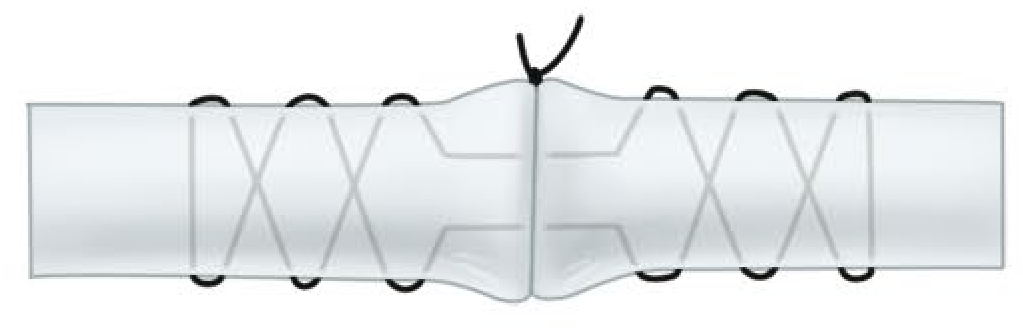
1. Bunnell Stitch (Crisscross Stitch)
- The oldest and most widely known technique
- A figure-of-eight or crisscross configuration is passed through the tendon substance
- The suture criss-crosses within the tendon, exiting at the cut end
- Disadvantage: Intratendinous crisscross pattern compromises intrinsic vascularity (ischaemia), increases stiffness, and produces significant tendon bunching
- Largely replaced by grasping techniques in modern flexor tendon repair
2. Kessler (Grasping) Stitch
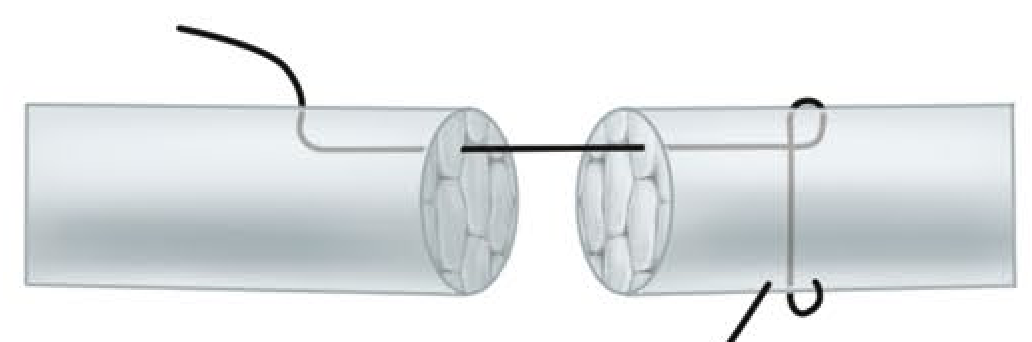
- Introduced by Kessler (1973) - the "grasping technique"
- The suture passes transversely across the tendon near the cut end, creating a purchase on the tendon fibres
- A modified Kessler (Tajima modification) uses the suture locked with each exit from the tendon; separate sutures are used for each end so they can be used as traction sutures when passing the tendon through the sheath
- Knots are tied within the tendon substance
- This is the most commonly used two-strand core suture technique
- Provides good strength with less vascular compromise than Bunnell
3. Tsuge (Looped) Stitch
- Uses a looped suture - a single suture bent back on itself, creating two parallel strands
- The loop is passed within the tendon and exits at the cut end; the needle re-enters and the process is repeated, creating a locked configuration
- The knot on the tendon surface is buried within the repair
- Provides a self-tightening mechanism; when tension is applied, the loop cinches around the tendon fibres
- Advantage: No knot at the repair site; strong grasping mechanism
4. Four-Strand Techniques (Lee Technique)
- Multiple-strand modifications of the Kessler repair
- The four-strand adaptation of Kessler is significantly stronger than the two-strand modified Kessler
- Two knots are placed within the repair site
- Provides improved tensile strength allowing early active motion protocols
- Suitable for areas with limited access within the flexor sheath
5. Savage Six-Strand Technique
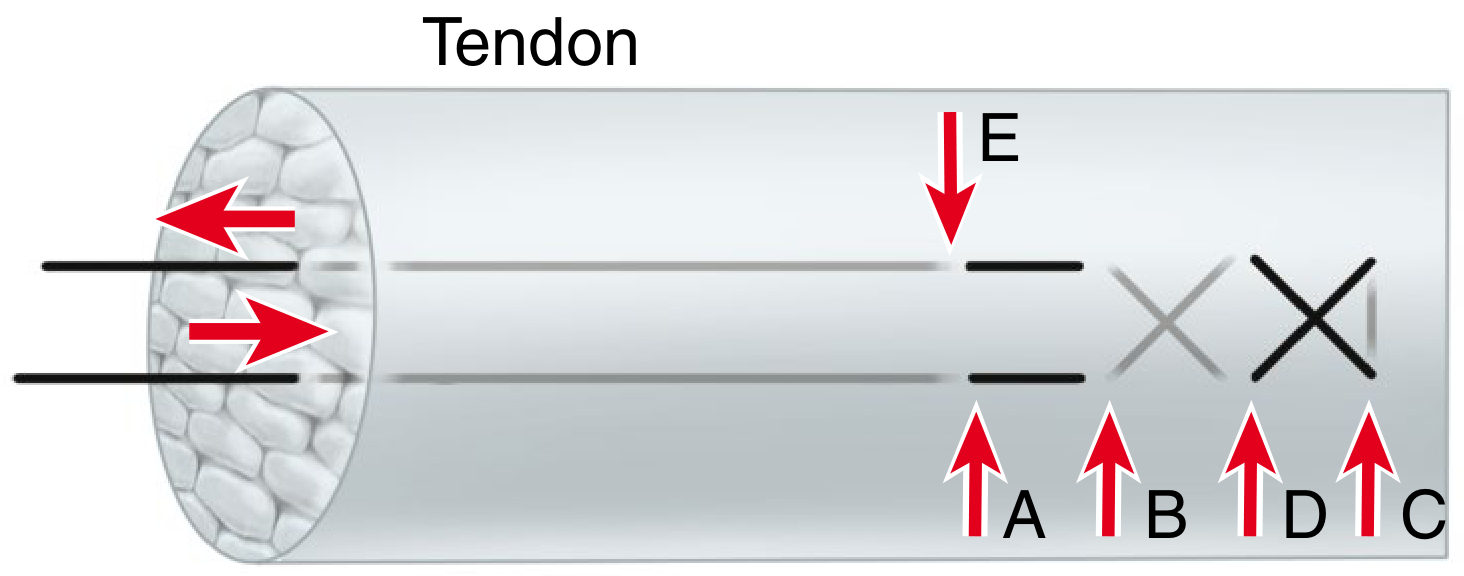
- Six individual strands cross the repair site
- The needle is passed in a rectangular configuration on each side of the tendon
- Each pass is locked where it traverses the tendon surface
- Provides the greatest tensile strength among standard techniques
- Allows safe early active mobilisation
- More technically demanding; greater bulk at repair site
6. Eight-Strand Repair (Winters and Gelberman)
Steps:
- Insert needle at the repair site extending through the posterolateral quadrant, exiting 1 cm from the cut tendon edge
- Working counterclockwise, insert needle just distal to previous exit point to anchor the tendon transversely
- Complete the first posterolateral rectangle by paralleling the first suture pass with the tendon edge
- Duplicate the same steps in the opposite tendon stump (dorsal rectangle)
- Advance the needle into the palmar half and repeat, with needle exiting opposite and palmar to initial entry site
- Place tension on the double-stranded suture for tendon apposition
- Tie a four-throw surgeon's knot at the repair site
- Complete with a 6-0 nylon epitendinous running suture
7. Mason-Allen (Chicago) Stitch
- A locking horizontal mattress-type stitch
- Provides excellent purchase on tendon fibres
- Used frequently for flexor tendon and rotator cuff repairs
- The suture locks with each pass, reducing slippage
8. Modified Kessler-Tajima (Adelaide Technique - Six-Strand)
- A six-strand flexor tendon repair combining the Tajima core suture with a horizontal mattress core suture and a running-lock peripheral epitendinous stitch
- Steps:
- Tajima core sutures placed, staying along the volar portion of the tendon
- Back wall (dorsal) running-lock peripheral epitendinous stitch
- Mattress core suture added in the palmar tendon gap
- All core sutures tied
- Running-lock peripheral epitendinous suture completed
B. Peripheral / Epitendinous Suture Techniques
The epitendinous suture is placed around the circumference of the repair site and provides:
- 10-50% additional repair strength
- Smooth repair surface for tendon gliding
- Reduction of gapping tendency
Types:
- Simple running suture - 6-0 monofilament nylon or polypropylene; quick and easy
- Running-lock (cross-stitch) epitendinous suture - provides more strength; recommended over simple running
- Interlocking horizontal mattress suture - highest stiffness; best overall peripheral suture; peripheral sutures placed 2 mm (not 1 mm) from repair site provide stronger repair
- Halsted (horizontal mattress) stitch - used for bulky extensor tendons
Key Principles of Tendon Repair (Campbell's Concepts)
| Principle | Details |
|---|---|
| Strength loss | Repair strength diminishes considerably in the first 10 days post-op |
| Core suture role | Core sutures should not be used to approximate ends - use partial epitendinous suture or tendon approximator/hypodermic needles to hold ends in apposition before placing core sutures |
| Strand count | More strands = stronger repair; multistrand (4-8) 3-0 or 4-0 core sutures + 6-0 epitendinous suture is recommended by global survey (Tang et al.) |
| Healing timeline | Tendon strength gradually increases; by 10-12 weeks, considerable active forces can be applied |
| Suture placement | Peripheral sutures 2 mm from repair are stronger than those 1 mm from repair |
Biomechanical Comparison
| Technique | Strands | Relative Strength |
|---|---|---|
| Bunnell | 2 | Moderate (with vascular risk) |
| Modified Kessler | 2 | Standard baseline |
| Modified Kessler-Tajima | 2-4 | Stronger than Kessler alone |
| Lee four-strand | 4 | Significantly stronger than modified Kessler |
| Savage | 6 | Very high |
| Adelaide/Adelaide-modified | 6 | Very high; suitable for early active motion |
| Winters-Gelberman | 8 | Highest; allows most aggressive rehabilitation |
Suture Materials Used
- Core sutures: 3-0 or 4-0 braided polyester (Ethibond, Fiberwire) or nylon
- Peripheral sutures: 5-0 or 6-0 monofilament nylon or polypropylene
- The "no touch" technique (suture passed with instruments, not fingers) reduces tendon handling and adhesion risk
Clinical Pearls for Exam
- Modified Kessler is the most widely used and tested technique in clinical practice
- Bunnell stitch is no longer recommended for primary flexor tendon repair due to intrinsic vascular compromise
- Increasing strand count increases strength but also increases bulk at repair site
- The epitendinous suture adds ~10-50% strength and significantly reduces gap formation
- Zone II ("no man's land") flexor tendon injuries require the most meticulous repair as the tendon runs through the flexor sheath - multistrand repairs + early active motion protocols are mandatory
- For extensor tendon repair, the modified Bunnell technique has been shown in cadaver studies to produce the strongest repair with no gapping (Roberts and Hedges, 2023)
- The strength of any repair is lowest at 10 days post-operatively - this corresponds to the phase of collagen lysis before new collagen deposition
- Krackow technique is used specifically for tendon-to-bone fixation (e.g., Achilles tendon reattachment, patella tendon repair) - a locking stitch passed in a criss-cross fashion around the distal end of tendon before passing through a bone tunnel
Source: Campbell's Operative Orthopaedics, 15th Edition, 2026 (Chapter 71 - Flexor and Extensor Tendon Injuries); Roberts and Hedges' Clinical Procedures in Emergency Medicine. Note: Varshney's Textbook of Orthopaedics was not available in the reference library but the techniques above are standard across all major orthopaedic texts including Varshney, which covers these same foundational methods.
This is a shared conversation. Sign in to Orris to start your own chat.