
CVS examination in medicine
Reading File
Now let me search the library for CVS examination content:
Finding Sources
Finding Sources
Harrison's has a dedicated "CARDIOVASCULAR EXAMINATION" section. Let me read it along with the Goldman-Cecil and Fuster's Heart sections:
Reading File
Reading File
Reading File
Finding Sources
Reading File
Reading File
Reading File
Loading Image
Reading File
Loading Image
Reading File
Loading Image
Finding Sources
I now have comprehensive content from Harrison's and Fuster's Heart. Let me compile a thorough, well-organized response.
Cardiovascular System (CVS) Examination
Sources: Harrison's Principles of Internal Medicine 22E (2025) and Fuster & Hurst's The Heart, 15th Edition
Overview
The CVS examination follows the classical sequence: General Inspection → Blood Pressure → Jugular Venous Pulse → Arterial Pulse → Precordial Inspection & Palpation → Auscultation. Each component provides hemodynamic information that builds a complete clinical picture.
1. General Inspection
Look for signs that point to underlying cardiac pathology:
- Dyspnea at rest - tachypnea, use of accessory muscles
- Cyanosis (central vs peripheral)
- Pallor, jaundice (in severe RHF with hepatic congestion)
- Malar flush - classic in mitral stenosis
- Peripheral edema, ascites - signs of right heart failure
- Clubbing - congenital cyanotic heart disease, infective endocarditis
- Splinter hemorrhages, Osler's nodes, Janeway lesions - infective endocarditis
- Xanthelasmata, corneal arcus - hyperlipidemia
- Specific syndromes: Marfan's (tall, arachnodactyly, lens dislocation, AR), Down's (ASD/VSD), Turner's (coarctation)
2. Blood Pressure Measurement
Accurate measurement requires careful technique:
-
Patient seated, arm at heart level, feet on floor, back supported, after 5-10 min of rest
-
Cuff bladder: 80% of arm circumference in length, 40% in width (too small = overestimate; too large = underestimate)
-
Inflate 30 mmHg above expected systolic; release at 2-3 mmHg/s
-
Systolic = first Korotkoff sound (K1); Diastolic = fifth Korotkoff sound (K5)
-
Measure both arms - a difference >15-20 mmHg suggests subclavian stenosis or aortic dissection
-
Pulsus paradoxus: inspiratory fall in systolic BP >10 mmHg - seen in pericardial tamponade, massive PE, severe obstructive lung disease. Measured as the difference between K1 heard only on expiration vs K1 heard throughout the cycle.
-
Pulsus alternans: beat-to-beat variability in pulse amplitude with regular rhythm - indicates severe LV systolic dysfunction
-
Very low/zero diastolic pressures occur in chronic severe AR or large AV fistula ("diastolic run-off")
-
Harrison's Principles of Internal Medicine 22E, p. 1905
3. Jugular Venous Pressure (JVP) and Waveform
The JVP is the single most important bedside measurement for estimating volume status.
Technical points:
- Use the internal jugular vein (preferred over external, which is valved and not directly in line with the SVC/RA)
- Patient at 30-45° elevation; vertical distance from the sternal angle (angle of Louis) to the top of the venous column
- Distance >4.5 cm above the sternal angle at 30° is abnormal
- The clavicle is an alternative reference: pulsations above it in the sitting position are clearly abnormal (distance from clavicle to RA is ≥10 cm)
- Bedside CVP is in cmH₂O; convert to mmHg (1.36 cmH₂O = 1.0 mmHg)
- An RA pressure >10 mmHg predicts pulmonary wedge pressure >22 mmHg with 88% positive predictive value in heart failure
Distinguishing JVP from carotid pulse:
| Feature | JVP | Carotid |
|---|---|---|
| Pulsations | Biphasic (in sinus rhythm) | Monophasic |
| Compressibility | Obliterated by light pressure | Not easily obliterated |
| Positional change | Changes with posture/inspiration | No change |
JVP Waveform Components
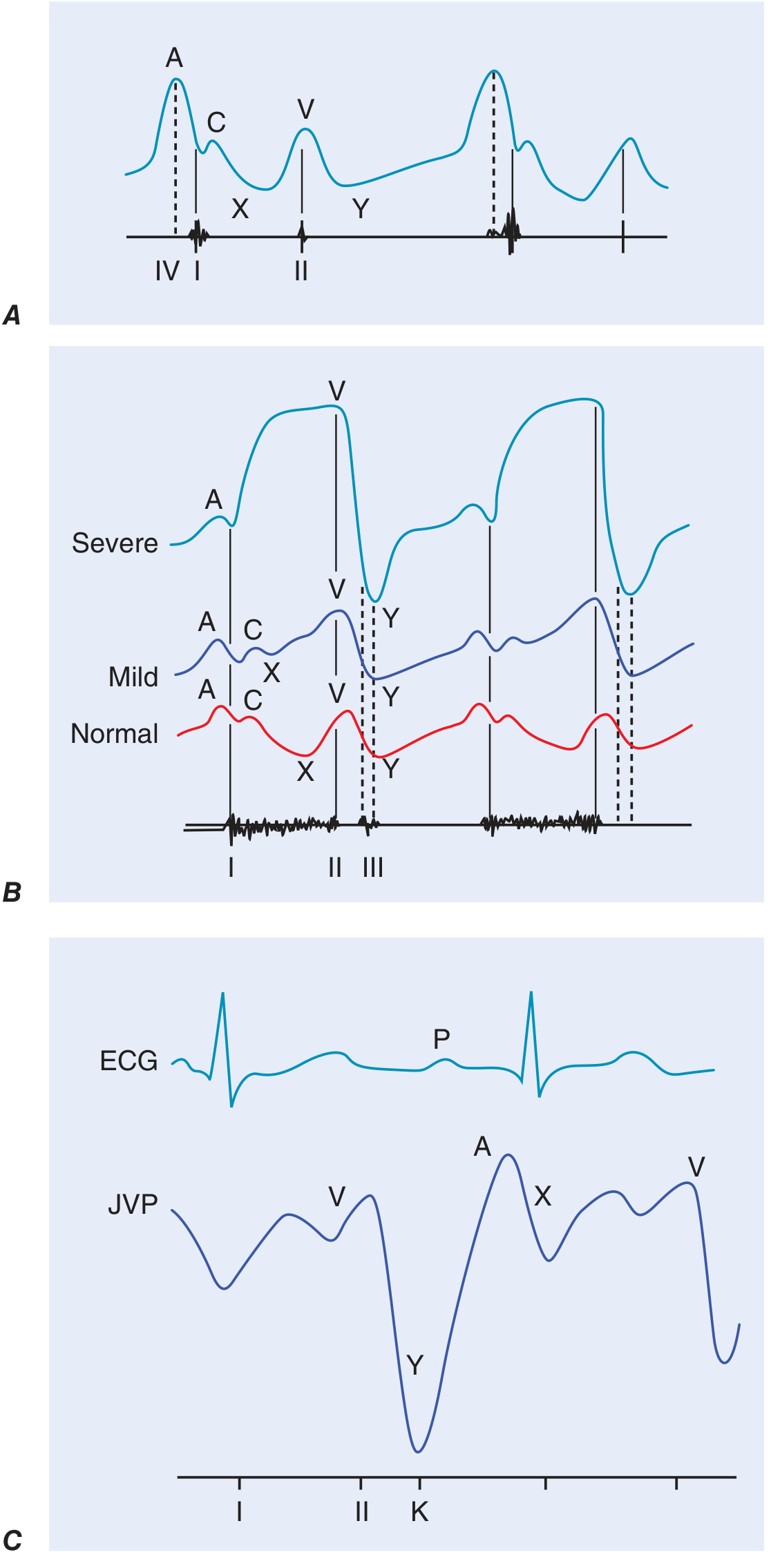
| Wave/Descent | Mechanism | Timing | Abnormalities |
|---|---|---|---|
| a wave | Right atrial presystolic contraction | After P wave, before S1 | Prominent: reduced RV compliance, tricuspid stenosis; Absent: atrial fibrillation; Cannon a waves: AV dissociation (diagnoses VT) |
| c wave | Tricuspid valve pushed into RA during early systole | Interrupts x descent | Small, often not visible |
| x descent | Fall in RA pressure after tricuspid opening | After a wave | Exaggerated: pericardial constriction/tamponade; Absent: tricuspid regurgitation |
| v wave | Atrial filling during ventricular systole | During ventricular systole | Prominent ("cv waves"): tricuspid regurgitation - waveform becomes "ventricularized" |
| y descent | RA pressure fall after tricuspid valve opens | After v wave | Rapid/deep: constrictive pericarditis (along with pericardial knock); Slow/blunted: tricuspid stenosis, tamponade |
Kussmaul's sign: paradoxical rise in JVP with inspiration - seen in constrictive pericarditis, RV failure, restrictive cardiomyopathy (normally JVP falls with inspiration).
Abdominojugular reflux (hepatojugular reflux): sustained JVP rise >3 cm with 15-30 seconds of firm right upper quadrant pressure - positive in right heart failure and elevated central venous pressure.
- Harrison's Principles of Internal Medicine 22E, p. 1904-1905
4. Arterial Pulse Examination
Technique: Palpate the carotid or brachial arteries. Assess amplitude, contour, rate, and rhythm. Also palpate all peripheral pulses (radial, femoral, popliteal, posterior tibial, dorsalis pedis).
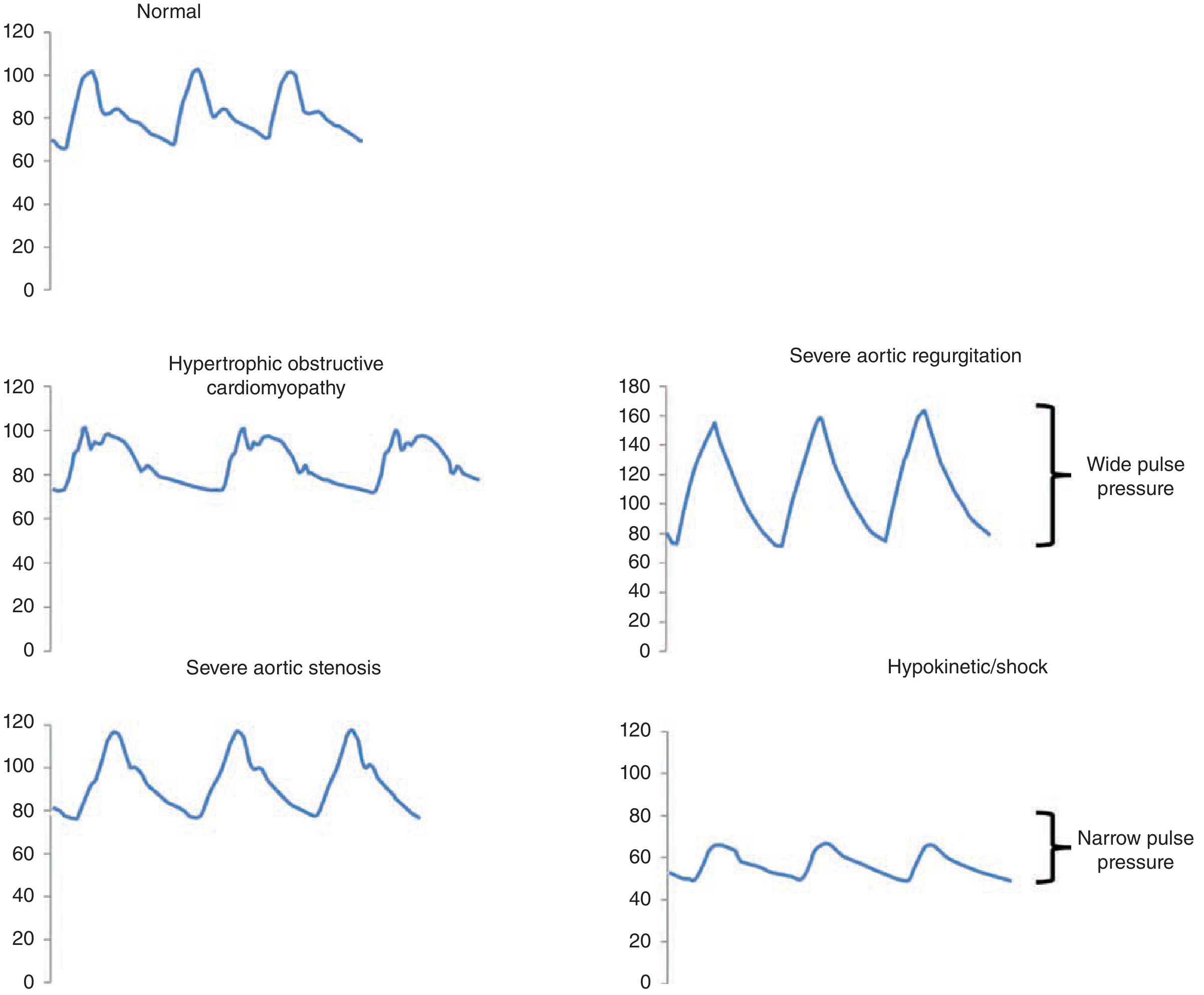
Abnormal Pulse Patterns
| Pulse Type | Description | Associated Condition |
|---|---|---|
| Parvus et tardus | Reduced amplitude (parvus) + delayed, slurred upstroke with late peak (tardus) | Severe aortic stenosis |
| Corrigan's (water-hammer) pulse | Sharp, rapid rise and rapid fall-off ("collapsing") | Chronic severe aortic regurgitation |
| Bisferiens pulse | Two systolic peaks | Severe AR, HOCM |
| Pulsus alternans | Beat-to-beat variation in amplitude (regular rhythm) | Severe LV systolic dysfunction |
| Pulsus paradoxus | >10 mmHg systolic drop with inspiration | Cardiac tamponade, massive PE, severe obstructive lung disease |
| Small, thready pulse | Narrow pulse pressure | Cardiogenic shock, severe AS, tamponade |
| Jerky pulse | Sharp rise, sudden late collapse | HOCM |
Simultaneous radial-femoral palpation: a femoral delay suggests coarctation of the aorta.
Peripheral vascular examination: auscultate for bruits (carotid, subclavian, renal, femoral). A bruit extending into diastole or a palpable thrill indicates severe obstruction. The ankle-brachial index (ABI) - lower ankle pressure divided by the higher arm pressure - quantifies peripheral arterial disease.
- Fuster & Hurst's The Heart, 15th Edition, p. 81-82
5. Inspection and Palpation of the Precordium
Inspection
- Apex beat: normally visible in the 5th intercostal space, midclavicular line in thin adults
- Visible pulsations elsewhere = abnormal
- Left anterior chest wall heave: enlarged/hyperdynamic LV or RV
- Right upper parasternal pulsation: ascending aortic aneurysm
Palpation
Patient in supine position (30°); enhanced by left lateral decubitus position.
Apex beat assessment:
- Normal: <2 cm diameter, brief outward movement
- Displaced laterally/downward: LV cavity enlargement
- Sustained/heaving: pressure overload (AS, hypertension)
- Palpable S4 (presystolic impulse): reduced LV compliance, ischemia, LVH
- Palpable S3: rapid early filling, heart failure
- Ectopic impulse: LV aneurysm (dyskinetic, separate from apex)
- Triple cadence (triple ripple): HOCM - palpable S4 + bisferiens systolic pulse
Right ventricular assessment:
- Parasternal lift/heave: RV pressure or volume overload
- Confirmed by: loud/palpable P2 (pulmonary hypertension) or CV waves in JVP (TR)
- Subxiphoid palpation can also detect RV impulse
Thrills: palpable turbulence, indicating grade ≥4 murmur. Location identifies murmur origin.
- Harrison's Principles of Internal Medicine 22E, p. 1906-1907
6. Cardiac Auscultation
Heart Sounds
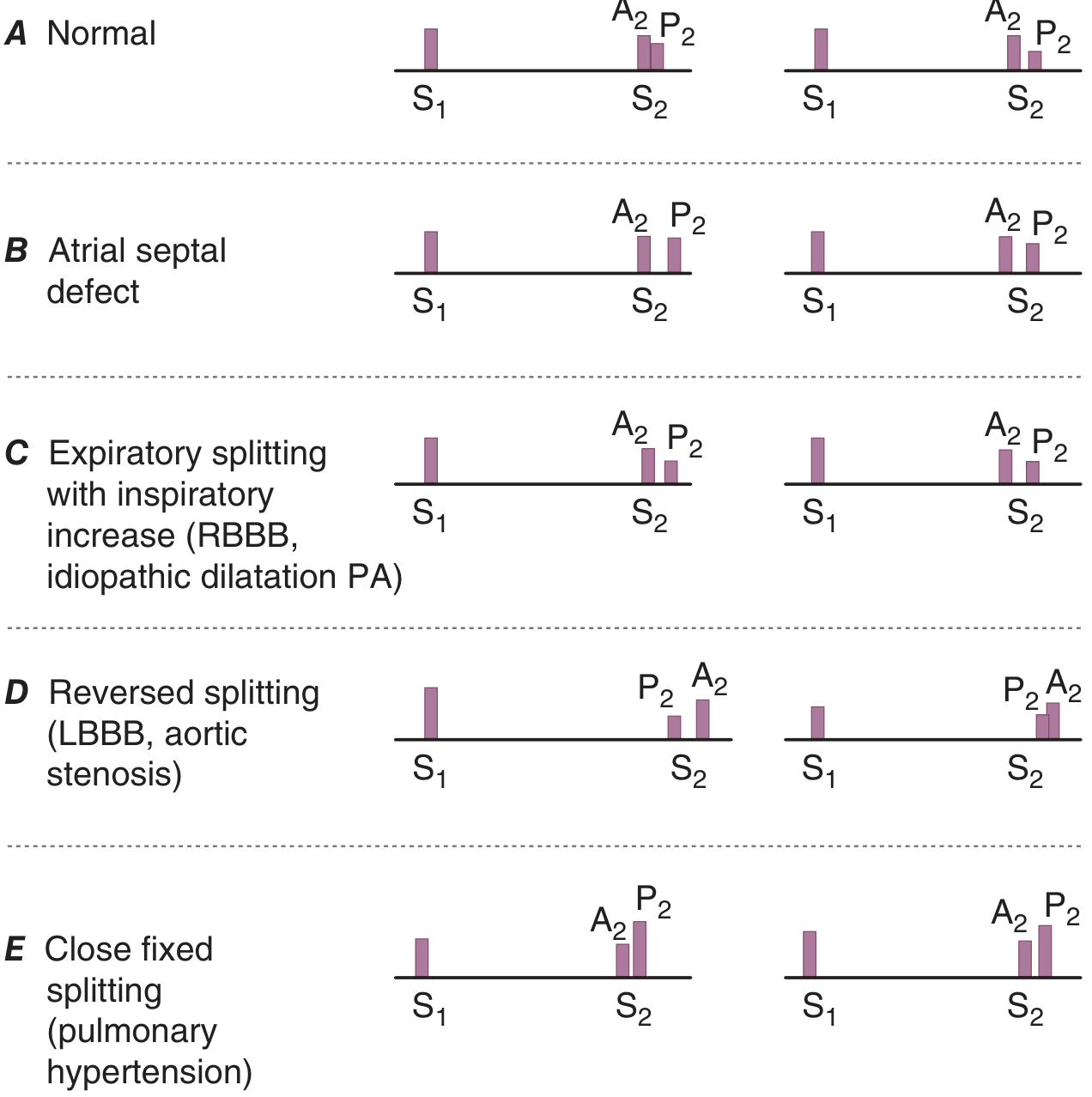
First Heart Sound (S1)
- Mitral + tricuspid valve closure
- Loud S1: early rheumatic MS, hyperkinetic states, short PR interval, tachycardia
- Soft S1: advanced calcified MS, long PR interval, beta-blockers, LV contractile dysfunction
- Intensity also reduced by: obesity, COPD, pericardial effusion, pneumothorax
Second Heart Sound (S2)
- Aortic (A2) + pulmonic (P2) valve closure
- A2 heard best at the right upper sternal border; P2 at the left upper sternal border
| S2 Splitting Pattern | Mechanism | Conditions |
|---|---|---|
| Physiologic (normal) | Widens on inspiration, narrows on expiration | Normal |
| Wide splitting | Delayed P2 or early A2 | RBBB (delayed P2), severe MR (early A2) |
| Fixed splitting | Wide, does not change with respiration | Atrial septal defect (ASD) |
| Reversed (paradoxical) splitting | P2 precedes A2; widens on expiration | LBBB, RV pacing, severe AS, HOCM, acute ischemia |
| Narrow/single S2 | A2 and P2 fused | Pulmonary arterial hypertension (loud P2), severe AS or PS |
S3 (Third Heart Sound)
- During rapid diastolic filling
- Normal: children, adolescents, young adults, athletes, pregnancy
- Abnormal in adults: heart failure (equally common in HFrEF and HFpEF), volume overload (MR, AR, VSD)
- Left-sided S3: low-pitched, best at the apex; Right-sided S3: lower left sternal border, increases with inspiration
- Predictive of cardiovascular morbidity and mortality in chronic heart failure
S4 (Fourth Heart Sound)
- During atrial systole (presystolic)
- Indicates reduced ventricular compliance requiring increased atrial contribution
- Heard in: LVH, active ischemia/infarction, hypertrophic cardiomyopathy, AS
- Not present in atrial fibrillation (no atrial contraction)
Additional Sounds
| Sound | Timing | Features | Cause |
|---|---|---|---|
| Ejection click | Early systole (sharp, high-pitched) | Correlates with carotid upstroke; pulmonic click decreases with inspiration | Bicuspid aortic/pulmonary valve, aortic/pulmonary root dilation |
| Mid-systolic click | Mid-systole | May be multiple; best at apex | Mitral valve prolapse (MVP) |
| Opening snap (OS) | Early diastole (high-pitched, after S2) | Short A2-OS interval = severe MS | Mitral stenosis (pliable leaflets) |
| Pericardial knock (PK) | Early diastole (high-pitched, slightly later than OS) | Coincides with rapid y descent in JVP | Constrictive pericarditis |
| Tumor plop | Diastole (lower-pitched) | Positional | Left atrial myxoma |
- Harrison's Principles of Internal Medicine 22E, p. 1907-1908
7. Cardiac Murmurs
Murmurs are caused by turbulent blood flow. Graded 1-6 (thrill present at grade ≥4). Characterize each murmur by: timing, location, radiation, intensity, quality (pitch/character), and response to maneuvers.
Systolic Murmurs
| Murmur | Timing | Location | Radiation | Key Features |
|---|---|---|---|---|
| Aortic stenosis (AS) | Mid-systolic (crescendo-decrescendo) | Right upper sternal border | Carotids, occasionally apex (Gallavardin) | Parvus et tardus pulse, soft A2, S4 |
| Mitral regurgitation (MR) - holosystolic | Holosystolic | Apex | Left axilla (posterior leaflet lesion radiates anteriorly/base; anterior leaflet radiates posteriorly) | Soft S1, S3, displaced apex |
| Tricuspid regurgitation (TR) | Holosystolic or early systolic | Lower left sternal border | Right | Increases with inspiration (Carvallo's sign), CV waves in JVP |
| VSD | Holosystolic | Left sternal border | Right | Harsh, loud; thrill common |
| HOCM | Mid-systolic | Lower left sternal border / apex | Decreases with squatting/handgrip; increases with Valsalva/standing | Jerky pulse, double apical impulse |
| Pulmonary stenosis (PS) | Mid-systolic | Left upper sternal border | Left shoulder | Ejection click, soft P2 |
| MVP | Late systolic (preceded by click) | Apex | — | Click moves earlier with standing/Valsalva |
Diastolic Murmurs (always pathological)
| Murmur | Timing | Location | Key Features |
|---|---|---|---|
| Aortic regurgitation (AR) | Early diastolic (decrescendo, high-pitched, blowing) | Left sternal border (lean forward, expiration) | Wide pulse pressure, Corrigan's pulse, Austin Flint murmur (functional MS at apex) |
| Mitral stenosis (MS) | Mid-diastolic (rumble, low-pitched) | Apex (left lateral decubitus) | Opening snap precedes it, loud S1, presystolic accentuation if sinus rhythm |
| Tricuspid stenosis (TS) | Mid-diastolic | Lower left sternal border | Increases with inspiration |
| PR (Graham Steell murmur) | Early diastolic | Left upper sternal border | Pulmonary hypertension, high-pitched |
Continuous Murmurs
- PDA: machinery murmur, left infraclavicular area
- AV fistula, ruptured sinus of Valsalva
8. Dynamic Auscultation - Bedside Maneuvers
| Maneuver | Effect on Preload/Afterload | Murmurs that increase | Murmurs that decrease |
|---|---|---|---|
| Valsalva (strain phase) | ↓ Preload | HOCM, MVP (click moves earlier) | AS, MR, TR, VSD |
| Standing | ↓ Preload | HOCM, MVP | AS, MR |
| Squatting | ↑ Preload + ↑ Afterload | AS, MR, AR, VSD | HOCM, MVP (click moves later) |
| Handgrip (isometric) | ↑ Afterload | MR, AR, VSD | AS, HOCM |
| Inspiration | ↑ RV filling | TR, TS, PS (right-sided murmurs) - Carvallo's sign | Left-sided murmurs |
| Amyl nitrite | ↓ Afterload, ↑ HR | AS, HOCM | MR, VSD |
9. Peripheral Signs of Specific Cardiac Conditions
| Sign | Description | Condition |
|---|---|---|
| Corrigan's (water-hammer) pulse | Bounding, rapidly collapsing | Aortic regurgitation |
| de Musset's sign | Head nodding with pulse | Severe AR |
| Quincke's sign | Visible capillary pulsation in nail bed | AR |
| Duroziez's sign | Systolic/diastolic femoral bruit with compression | AR |
| Hill's sign | Popliteal BP > brachial BP by >20 mmHg | AR |
| Malar flush | Mitral facies, bluish-red cheeks | Mitral stenosis |
| Cannon a waves | Large JVP a waves | AV dissociation (VT) |
| Kussmaul's sign | Paradoxical rise in JVP with inspiration | Constrictive pericarditis, RV failure |
Summary: Sequence of CVS Examination
- General inspection - dyspnea, cyanosis, peripheral signs, body habitus
- Hands - clubbing, splinter hemorrhages, peripheral perfusion (CRT)
- Face - malar flush, xanthelasma, corneal arcus, central cyanosis (tongue)
- Neck - JVP (height + waveform), carotid pulse (character), thyroid
- Chest - inspect, palpate (apex, thrills, heaves, RV impulse), auscultate (4 areas + axilla + back)
- Abdomen - hepatomegaly (pulsatile in TR), ascites, aortic aneurysm
- Legs - peripheral pulses, edema, ABI if PAD suspected
- BP - both arms; pulsus paradoxus if tamponade/COPD suspected
Sources:
- Harrison's Principles of Internal Medicine 22E (2025) - Chapter 246: Cardiovascular Examination, pp. 1904-1909
- Fuster & Hurst's The Heart, 15th Edition - Chapter 2: Clinical Cardiovascular Examination, pp. 56-82
This is a shared conversation. Sign in to Orris to start your own chat.