
Medical ethics
What aspect of medical ethics are you interested in? · What are you looking for?
Medical Ethics: A Comprehensive Overview
1. Historical Foundations
| Milestone | Significance |
|---|---|
| Code of Hammurabi (Babylonia, ~1750 BCE) | One of the earliest documented standards for medical practitioners |
| Sushruta's Oath (~1500 BCE) | From the Sushruta Samhita; foundational ethical standards in ancient Indian surgery |
| Charaka's Oath (~200 BCE) | From the Charaka Samhita; adopted by India's NMC in 2022 for the white coat ceremony |
| Hippocratic Oath (5th century BCE) | Attributed to Hippocrates ("Father of Medicine and Medical Ethics"); established beneficence, non-maleficence, and justice |
| Thomas Percival (1803) | Coined the terms "medical ethics" and "medical jurisprudence"; wrote the first modern code of medical ethics |
| AMA Code of Ethics (1847) | Based on Percival's work; one of the first formal institutional codes |
| Declaration of Geneva (1948, WMA) | Modern restatement of the Hippocratic Oath; amended multiple times (most recently 2017) |
| International Code of Medical Ethics (1949, WMA) | Delineated duties to the sick, to colleagues, and to society |
- The Essentials of Forensic Medicine and Toxicology, 36th edition, block 1
2. The Four Principles (Beauchamp and Childress)
1. Autonomy
- Informed consent - the process of ensuring a patient understands and freely agrees to treatment
- Confidentiality - protecting patient information
- Truth-telling - honesty in disclosing diagnoses and prognoses
"Every human being of adult years and sound mind has a right to determine what shall be done with his own body; and a surgeon who performs an operation without his patient's consent, commits an assault." - Justice Cardozo
- Scott-Brown's Otorhinolaryngology, block 4
- A persistent sense of self with personal values
- Sufficient understanding of available choices
- Ability to reflect on options and communicate a decision
- Adequate information (what would materially affect the patient's choice)
2. Beneficence
3. Non-Maleficence
- Risk-benefit analysis before procedures
- Medical futility decisions (withholding non-beneficial interventions)
4. Justice
- Distributive justice: equitable allocation of scarce resources
- Rights-based justice: respect for patient legal rights
- Procedural justice: fair processes in healthcare decisions
"The four principles of medical ethics that command wide consensus... provide an acceptable framework, although close scrutiny of many difficult dilemmas highlights limitations in these principles and apparent conflicts between them." - Emery's Elements of Medical Genetics and Genomics
3. Ethical Frameworks (Beyond Principlism)
| Framework | Core Idea |
|---|---|
| Deontology | Actions are right or wrong regardless of consequences (rule-based duty); underlies much of professional regulatory guidance |
| Consequentialism / Utilitarianism | The rightness of an action is determined by its outcomes (greatest good for the greatest number) |
| Virtue Ethics | Focuses on the character of the practitioner - what would a virtuous person do? |
| Casuistry | Case-based reasoning; objects to abstract top-down principles, focusing on specific circumstances |
| Ethics of Care | Emphasizes empathy, compassion, and relationships; originated with Carol Gilligan |
4. Informed Consent
- Disclosure - The clinician provides sufficient information (diagnosis, proposed treatment, risks, benefits, alternatives)
- Capacity - The patient has decision-making capacity (ability to understand, reason, communicate a stable choice)
- Voluntariness - The decision is made free from coercion
"The doctrine of informed consent operationalizes the duty to respect autonomy; it ensures that the patient is capable..." - Kaplan & Sadock's Comprehensive Textbook of Psychiatry, block 62
- Patients who lack capacity: Decision-making passes to a surrogate (usually next of kin or legal guardian), guided by advance directives or substituted judgment ("what would this patient have wanted?")
- Emergencies: Implied consent when a patient cannot consent and delay would cause harm
- Minors: Parental consent required; however, mature minors may give their own consent in many jurisdictions
- Refusal of treatment: A competent adult may refuse any treatment, including life-sustaining treatment - this must be respected
5. Confidentiality
- Public health duties: Notifiable/communicable diseases must be reported to health authorities
- Risk of serious harm to third parties: e.g., a patient with homicidal intent (Tarasoff principle)
- Legal requirements: Court orders, statutory duties
- Best interests: When a patient lacks capacity and disclosure serves their welfare
6. End-of-Life Ethics
Advance Directives
- Living will: Specifies which treatments to accept or refuse
- Do Not Resuscitate (DNR) orders: Instruction to withhold CPR
- Durable Power of Attorney for Healthcare: Names a surrogate decision-maker
Futility and Withholding Treatment
Euthanasia and Assisted Dying
| Term | Definition | Legality |
|---|---|---|
| Passive euthanasia | Withdrawing/withholding life-sustaining treatment | Legal in most jurisdictions with proper consent |
| Palliative sedation | Sedation to relieve intractable suffering at end of life | Ethically accepted; "doctrine of double effect" applies |
| Physician-assisted dying (PAD) | Physician provides means (prescription); patient acts | Legal in some jurisdictions (Netherlands, Canada, some US states) |
| Active euthanasia | Physician directly causes death | Illegal in most countries |
7. Research Ethics
| Document | Key Contribution |
|---|---|
| Nuremberg Code (1947) | Formulated after Nazi medical experiments; emphasized voluntary informed consent |
| Declaration of Helsinki (1964, WMA) | Governs ethical conduct of medical research; distinguishes therapeutic from non-therapeutic research; requires ethics committee review |
| Belmont Report (1979, USA) | Identified three principles: respect for persons, beneficence, justice; led to modern IRB (Institutional Review Board) system |
8. Special Ethical Domains
Confidentiality vs. Disclosure (the Tarasoff dilemma)
Genetics and Genomics Ethics
Resource Allocation (Justice)
Professionalism
9. Common Ethical Dilemmas and How to Approach Them
- Gather facts - clinical details, patient values, social context
- Identify the ethical conflict - which principles are in tension?
- Assess decision-making capacity - is the patient competent?
- Consult relevant parties - patient, family, team, ethics committee
- Consider the legal framework - advance directives, relevant statutes
- Make a reasoned judgment - document reasoning clearly
- Review and learn - debrief after difficult cases
Key Declarations and Codes at a Glance
| Document | Year | Body | Focus |
|---|---|---|---|
| Hippocratic Oath | ~5th c. BCE | Hippocrates | Beneficence, non-maleficence, confidentiality |
| Declaration of Geneva | 1948 (updated 2017) | WMA | Modern physician oath |
| International Code of Medical Ethics | 1949 | WMA | Duties to patients, colleagues, society |
| Nuremberg Code | 1947 | International | Research consent |
| Declaration of Helsinki | 1964 | WMA | Research ethics |
| Belmont Report | 1979 | USA | Research: respect, beneficence, justice |
Medical code of ethics of mbbs students with images
NMC medical code of ethics MBBS students India Declaration of Geneva Charaka oath white coat ceremony
https://medicaldialogues.in/health-news/nmc/no-charak-shapat…
A formal medical illustration showing the four pillars of medical ethics: Autonomy, Beneficence, Non-Maleficence, and Justice. Each pillar is represented as a Greek column with the principle name and a symbolic icon - a person (autonomy), heart with hands (beneficence), shield (non-maleficence), and balanced scales (justice). Clean, educational infographic style with a white background and professional blue/gold color scheme. Title at top: "The Four Principles of Medical Ethics"
A historical timeline infographic showing the evolution of medical ethics oaths from ancient times to modern day. Include: Code of Hammurabi 1750 BCE, Charaka Oath 200 BCE, Hippocratic Oath 5th century BCE, Thomas Percival 1803, AMA Code 1847, Nuremberg Code 1947, Declaration of Geneva 1948, Declaration of Helsinki 1964, Belmont Report 1979, NMC Physician Pledge 2022. Each milestone shown with a small icon on a horizontal timeline with dates. Clean academic style, blue and gold color scheme.
?
A formal medical education infographic showing the four pillars of medical ethics as four Greek columns: Autonomy (person icon), Beneficence (heart with hands), Non-Maleficence (shield with cross), and Justice (balanced scales). Each column labeled clearly. Title at top: "The Four Principles of Medical Ethics - Beauchamp & Childress". Clean professional style, blue and gold color scheme, white background.
A horizontal historical timeline infographic titled "Evolution of Medical Ethics Oaths". Milestones from left to right: Code of Hammurabi 1750 BCE, Charaka Oath 200 BCE, Hippocratic Oath 460 BCE, Thomas Percival 1803, AMA Code 1847, Nuremberg Code 1947, Declaration of Geneva 1948, Declaration of Helsinki 1964, Belmont Report 1979, NMC Physician Pledge 2022. Each point has a small icon and year label. Academic style, blue and gold palette, clean white background.
Retry
A formal medical education infographic showing the four pillars of medical ethics as four Greek columns: Autonomy (person icon), Beneficence (heart with hands), Non-Maleficence (shield with cross), and Justice (balanced scales). Each column labeled clearly. Title at top: "The Four Principles of Medical Ethics - Beauchamp and Childress". Clean professional style, blue and gold color scheme, white background.
A horizontal historical timeline infographic titled "Evolution of Medical Ethics Oaths". Milestones shown in order: Code of Hammurabi 1750 BCE, Charaka Oath 200 BCE, Hippocratic Oath 460 BCE, Thomas Percival 1803, AMA Code 1847, Nuremberg Code 1947, Declaration of Geneva 1948, Declaration of Helsinki 1964, Belmont Report 1979, NMC Physician Pledge 2022. Each point has a small icon and year label. Academic style, blue and gold palette, clean white background.
Medical infographic showing professional misconduct acts for doctors listed as numbered items in a clean warning-style box with a red border. Title: "Acts Constituting Professional Misconduct (MCI/NMC)". Items include: Adultery, Improper Advertisement, Fee Splitting, Using Touts, Breach of Confidentiality, Refusing Emergency Care, Practicing Under Influence of Alcohol or Drugs, Issuing False Certificates, Sex Determination for Feticide, Assisting Unqualified Practitioners. Professional medical education style, white background, red and dark blue text.
Medical Code of Ethics for MBBS Students
1. Historical Evolution of Medical Ethics Oaths
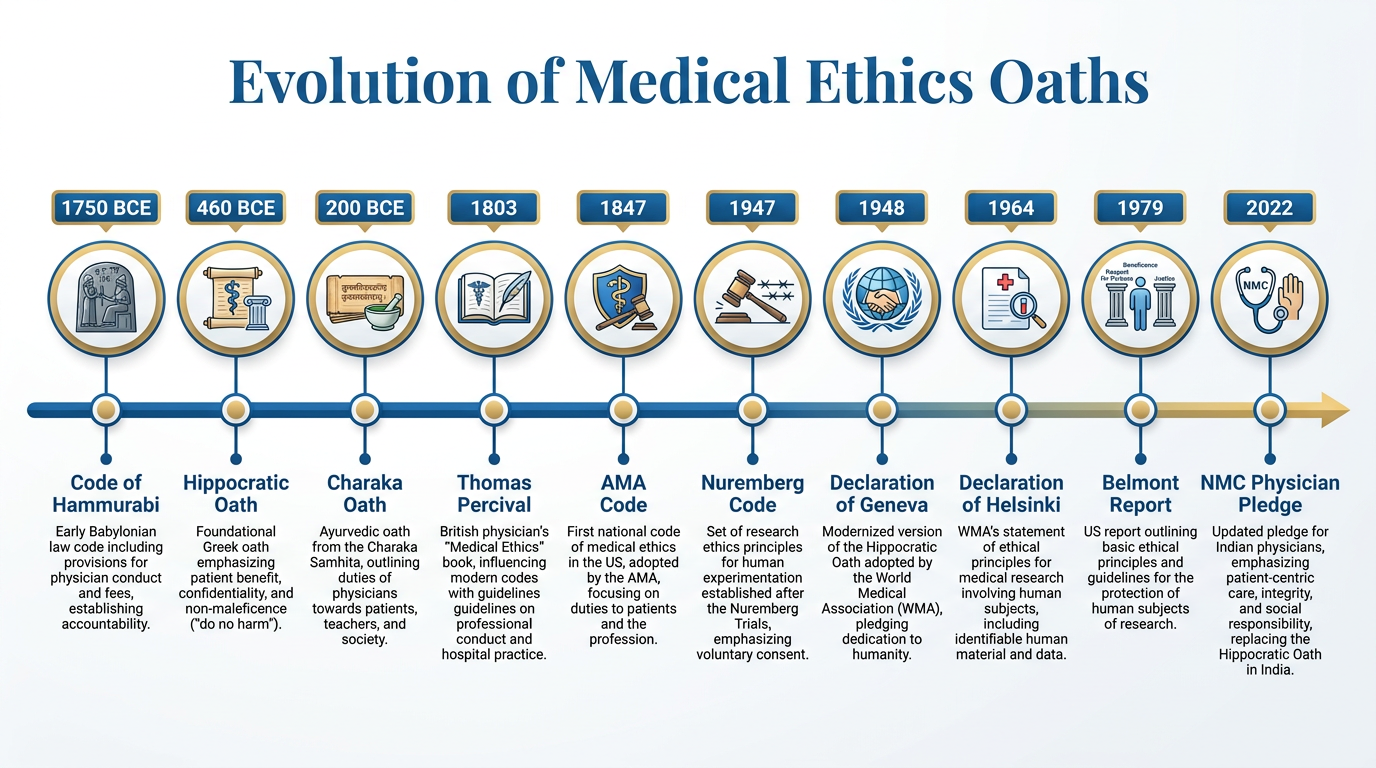
| Milestone | Year | Significance |
|---|---|---|
| Code of Hammurabi | ~1750 BCE | Earliest documented medical practitioner standards (Babylonia) |
| Sushruta's Oath | ~1500 BCE | Sushruta Samhita - Father of Indian Surgery |
| Charaka's Oath | ~200 BCE | Charaka Samhita - Father of Indian Medicine; adopted by NMC in 2022 for white coat ceremony |
| Hippocratic Oath | 5th century BCE | Foundation of Western medical ethics (beneficence, non-maleficence, confidentiality) |
| Thomas Percival | 1803 | Coined "medical ethics" and "medical jurisprudence"; wrote the first modern code |
| AMA Code of Ethics | 1847 | First institutional code; based on Percival's work |
| Nuremberg Code | 1947 | Research ethics; voluntary informed consent after Nazi experiments |
| Declaration of Geneva | 1948 (updated 2017) | Modern Hippocratic Oath; issued by the World Medical Association |
| Declaration of Helsinki | 1964 | Ethical principles for human experimentation |
| Belmont Report | 1979 | Research ethics: respect for persons, beneficence, justice |
| NMC Physician's Pledge | 2022 | Replaced Charaka Shapath and Hippocratic Oath for Indian MBBS students |
- The Essentials of Forensic Medicine and Toxicology, 36th edition
2. The Four Core Principles of Medical Ethics
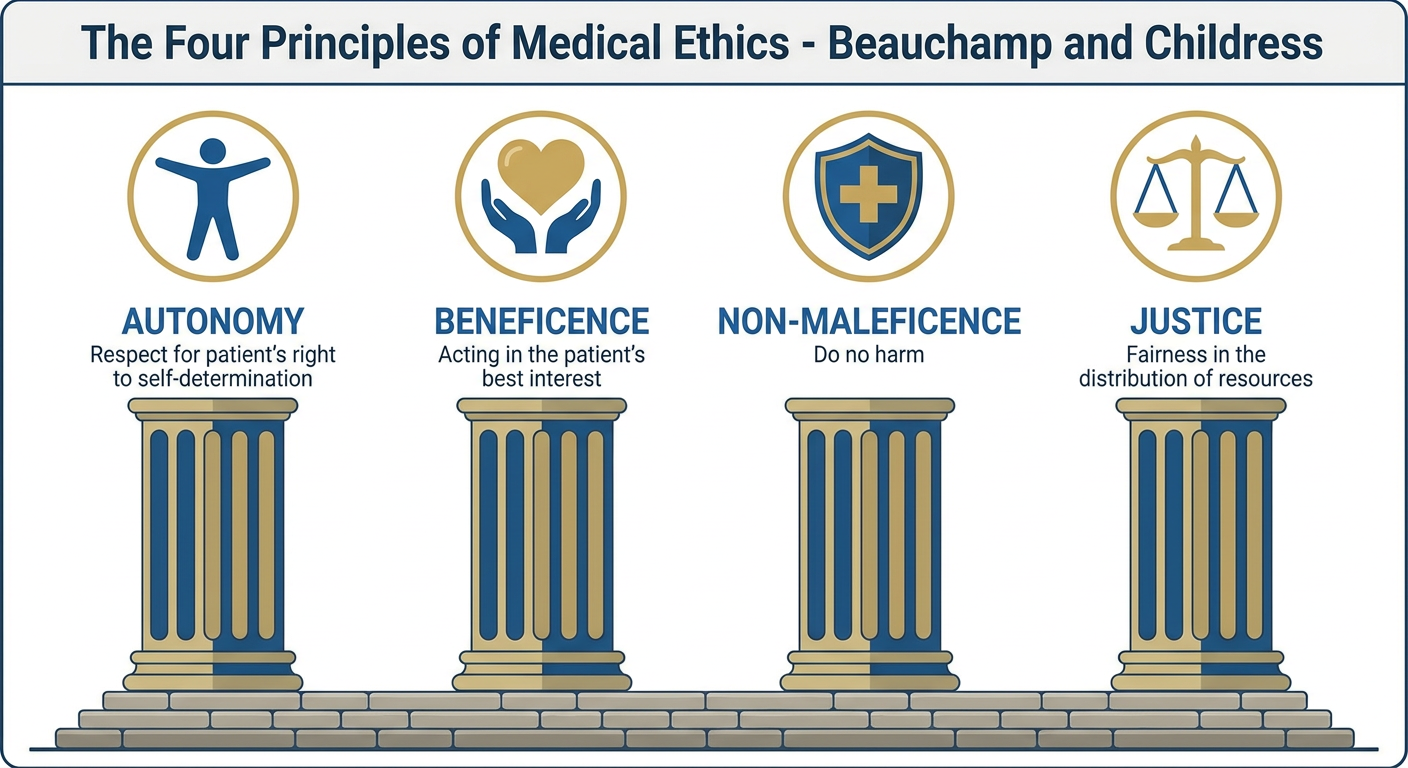
🔵 1. Autonomy
- Respect for the patient's right to make their own decisions
- Requires informed consent: disclosure + understanding + voluntary choice
- Covers confidentiality, truth-telling, and the right to refuse treatment
- Decisional capacity must be assessed - if lacking, a surrogate decides
🟢 2. Beneficence
- Act in the patient's best interest and actively do good
- Promote health, prevent disease, relieve suffering
- Underpins clinical duty of care
🔴 3. Non-Maleficence
- Primum non nocere - "first, do no harm"
- Every intervention carries risk; harm of action must be weighed against harm of inaction
- Basis for medical futility decisions and risk-benefit analysis
🟡 4. Justice
- Fairness in treatment and resource distribution
- Includes distributive justice (fair allocation of resources), patient rights, and non-discrimination
- No patient may be denied care on grounds of race, religion, gender, nationality, or social status
3. The Hippocratic Oath (Full Text)
"I will prescribe regimen for the good of my patients according to my ability and my judgment and never do harm to anyone. To please no one will I prescribe a deadly drug, nor give advice which may cause his death... In every house where I come I will enter only for the good of my patients, keeping myself far from all intentional ill-doing... All that may come to my knowledge in the exercise of my profession... I will keep secret and will never reveal. If I keep this oath faithfully, may I enjoy my life and practice my art, respected by all men and in all times."
- P.C. Dikshit Textbook of Forensic Medicine and Toxicology
4. The Declaration of Geneva (1948, Updated 2017)
"AS A MEMBER OF THE MEDICAL PROFESSION:
- I SOLEMNLY PLEDGE to dedicate my life to the service of humanity
- THE HEALTH AND WELL-BEING OF MY PATIENT will be my first consideration
- I WILL RESPECT the autonomy and dignity of my patient
- I WILL MAINTAIN the utmost respect for human life
- I WILL NOT PERMIT considerations of age, disease or disability, creed, ethnic origin, gender, nationality, political affiliation, race, sexual orientation, or social standing to intervene between my duty and my patient
- I WILL RESPECT the secrets that are confided in me, even after the patient has died
- I WILL PRACTISE my profession with conscience and dignity and in accordance with good medical practice
- I WILL FOSTER the honour and noble traditions of the medical profession
- I WILL GIVE to my teachers, colleagues, and students the respect and gratitude that is their due
- I WILL SHARE my medical knowledge for the benefit of the patient and the advancement of healthcare
- I WILL ATTEND TO my own health, well-being, and abilities in order to provide care of the highest standard
- I WILL NOT USE my medical knowledge to violate human rights and civil liberties, even under threat
- I MAKE THESE PROMISES solemnly, freely, and upon my honour."**
5. Professional Misconduct - What MBBS Students Must Avoid
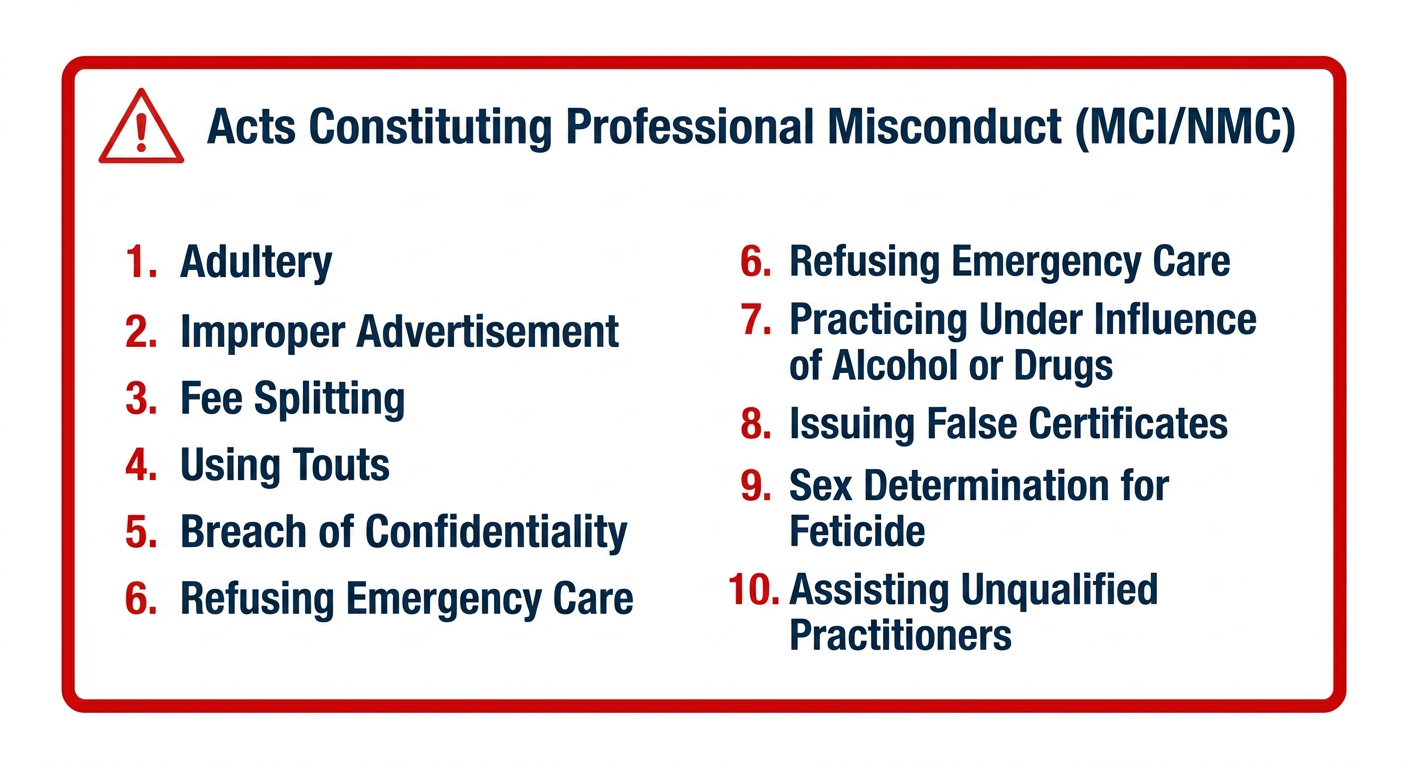
| # | Prohibited Act |
|---|---|
| 1 | Adultery - sexual relations with a patient |
| 2 | Improper advertisement - unusual signboards, self-promotion through pharmaceutical firms |
| 3 | Fee splitting / dichotomy - receiving or giving commissions from colleagues or drug manufacturers |
| 4 | Using touts and agents to fetch patients |
| 5 | Breach of confidentiality - disclosing patient secrets without consent |
| 6 | Refusal to treat on religious grounds |
| 7 | Practicing under influence of alcohol or addictive drugs |
| 8 | Issuing false certificates (for insurance, passport, sick benefits, etc.) |
| 9 | Sex determination tests with intent to destroy the female fetus |
| 10 | Assisting unqualified practitioners |
| 11 | Not reporting notifiable diseases to health authorities |
| 12 | Association with pharmaceutical firms (ownership, rebates) |
- P.C. Dikshit Textbook of Forensic Medicine and Toxicology
6. IMC Regulations 2002 - Key Salient Points (Now Under NMC)
- Doctors may choose their patients but must not refuse emergency care
- Refer only when absolutely necessary; avoid unnecessary investigations
- Once a case is accepted, the patient must not be abandoned without notice
- Fees and charges must be displayed clearly
- No endorsement of medications or equipment for financial gain
- Prescribe drugs by generic name as far as possible
- No sex determination tests for feticide
- Patients must not be subjected to trials except under ICMR guidelines
- Maintain patient records for a minimum of 3 years for inpatients
7. Key WMA Declarations Every MBBS Student Should Know
| Declaration | Year | Topic |
|---|---|---|
| Declaration of Geneva | 1948 (2017) | Modern physician oath |
| Declaration of Helsinki | 1964 | Human experimentation ethics |
| Declaration of Sydney | 1968 | Death certification and organ harvesting |
| Declaration of Oslo | 1970 | Therapeutic abortion |
| Declaration of Tokyo | 1975 | Prohibition of torture |
| Declaration of Lisbon | 1981 | Rights of patients |
| Declaration of Madrid | 1983 | Euthanasia is unethical |
| Declaration of Malta | 1991 | Management of hunger strikers |
- The Essentials of Forensic Medicine and Toxicology, 36th edition
8. Informed Consent - A Core Duty
| Component | What it means |
|---|---|
| Disclosure | Patient receives full information about diagnosis, treatment, risks, benefits, alternatives |
| Capacity | Patient can understand, reason, and communicate a stable decision |
| Voluntariness | Decision is free from coercion or undue influence |
- Emergencies - implied consent applies when delay would be harmful
- Minors - parental/guardian consent required; mature minors may consent in some jurisdictions
- Unconscious patients - surrogate/next-of-kin decides; advance directives are honored
- Refusal of treatment - a competent adult has the absolute right to refuse, even life-saving treatment
9. Quick Memory Aid for MBBS Exams
B - Beneficence       → Do Good
N - Non-maleficence   → Do No Harm
A - Autonomy          → Respect Patient's Choice
J - Justice           → Be Fair to All
"BNAJ" or remember as the "4 pillars" of bioethics - every clinical decision should be tested against all four.
Genrate same for all medical health care professionals like ahs
code of ethics allied health professionals AHS nursing pharmacy physiotherapy dentistry India WHO 2024
https://code-medical-ethics.ama-assn.org/ethics-opinions/all…
NCAHP India RAHP professional conduct ethics regulations 2026 allied health professions code duties
A colorful medical education infographic titled "Code of Ethics for ALL Healthcare Professionals". Center shows a large circular diagram with healthcare professionals arranged around it: Doctor (stethoscope), Nurse (cap), Pharmacist (mortar and pestle), Physiotherapist (exercise icon), Dentist (tooth), Radiographer (X-ray), Lab Technician (microscope), Nutritionist (food plate), Occupational Therapist (hands). All connected to a central shield with a cross symbol labeled "Universal Healthcare Ethics". Professional, vibrant educational infographic style, white background.
An educational infographic titled "Universal Ethical Duties of All Healthcare Professionals". Shows 8 duty cards in a 2x4 grid, each with an icon and short text: 1-Patient Welfare First (heart icon), 2-Informed Consent (handshake icon), 3-Confidentiality (lock icon), 4-Non-Discrimination (equal sign icon), 5-Competence and Continuing Education (graduation cap icon), 6-Honest Communication (speech bubble icon), 7-Report Errors and Unsafe Practices (warning icon), 8-Teamwork and Collaboration (people icon). Clean flat design, blue, green, and white color palette, medical education style.
Genrate same for all medical health care professionals like ahs
A colorful medical education infographic titled "Code of Ethics for ALL Healthcare Professionals". Center shows a circular diagram with a red cross shield in the middle. Around it are 9 labeled segments each with a professional icon: Doctor with stethoscope, Nurse with cap, Pharmacist with mortar and pestle, Physiotherapist with exercise band, Dentist with tooth, Radiographer with X-ray film, Lab Technician with microscope, Nutritionist with food plate, Occupational Therapist with hands. All connected to the center. Clean professional educational infographic, blue green white color palette, white background.
Medical education infographic titled "Universal Ethical Duties of All Healthcare Professionals". Eight duty cards arranged in 2 rows of 4, each with an icon and bold title plus one line of description. Card 1: heart icon - Patient Welfare First - Always prioritize patient wellbeing. Card 2: handshake icon - Informed Consent - Explain and obtain agreement. Card 3: lock icon - Confidentiality - Protect patient information. Card 4: equal sign icon - Non-Discrimination - Treat all patients equally. Card 5: graduation cap icon - Competence - Maintain and update skills. Card 6: speech bubble icon - Honest Communication - Be truthful always. Card 7: warning triangle - Report Unsafe Practices - Speak up for safety. Card 8: group of people - Teamwork - Collaborate across professions. Blue green white flat design, professional medical infographic style.
A professional medical reference infographic titled "Profession-Specific Ethics Bodies in India". Table-style layout with two columns: Profession and Regulatory Body. Rows: Doctors - NMC (National Medical Commission), Nurses - Indian Nursing Council (INC), Dentists - Dental Council of India (DCI), Pharmacists - Pharmacy Council of India (PCI), Allied Health Professionals - NCAHP, Rehabilitation Professionals - Rehabilitation Council of India (RCI). Each row has a small profession icon. Blue and white color scheme, clean official government document style, white background.